




















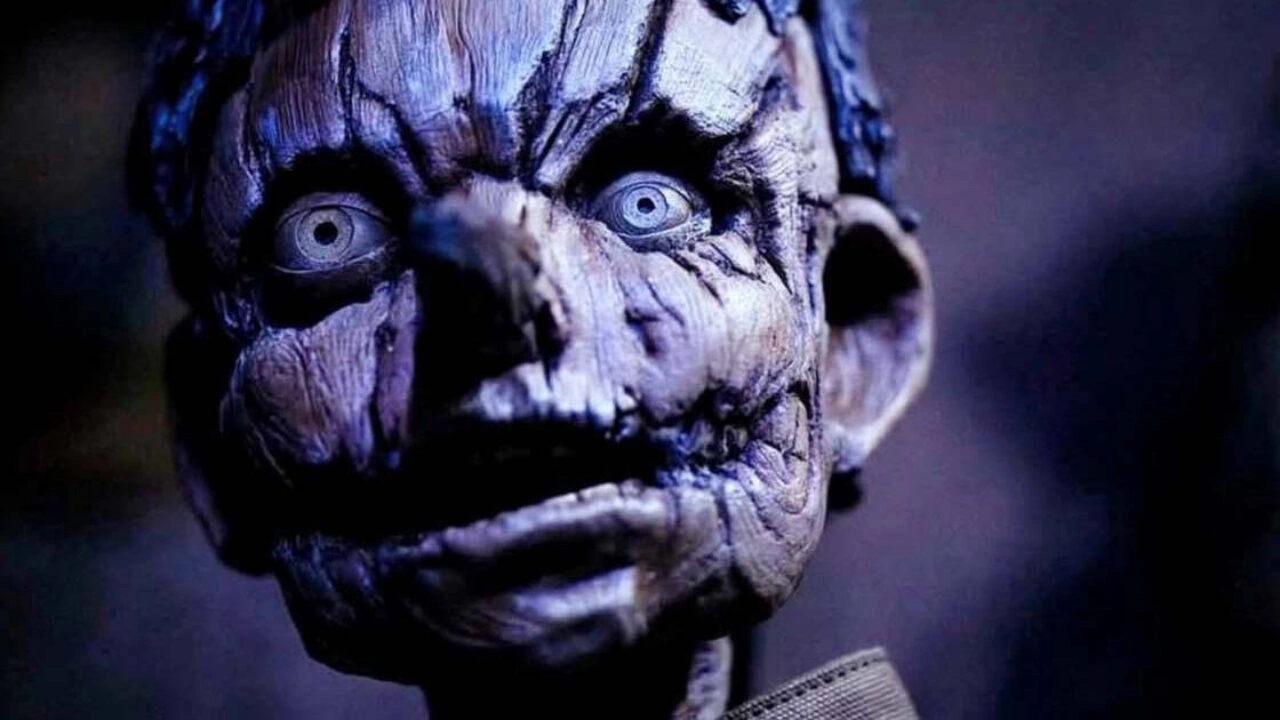

Geppetto gives his grieving grandson a friend who can never die, then seems surprised when immortality produces a few social complications. That contradiction gives Pinocchio: Unstrung a stronger dramatic foundation than the murderous-public-domain premise suggests. Director Rhys Frake-Waterfield still delivers the gore expected from the Twisted Childhood Universe, but this entry places genuine craft and sadness beneath the splinters.
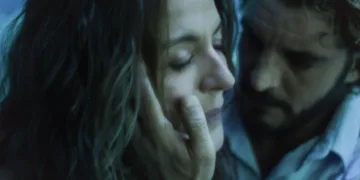
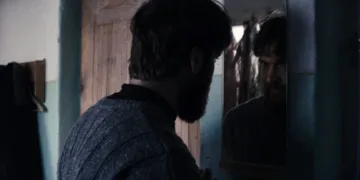
James has lost his parents in an accident and a close friend to cancer. His grandfather Geppetto, played by Richard Brake, responds by carving Pinocchio from magical wood. The solution is well intentioned and quietly terrible. James initially recoils from the puppet’s fixed grin and jerky movements, yet loneliness draws the two boys together.
Brake gives Geppetto a hard, remote manner that keeps the character from becoming a cuddly inventor. Watch the calm conviction with which he explains why James should never need to mourn this companion. The line expresses love, control, and spectacularly poor risk assessment at once.
A Lesson Learned Literally
The film’s smartest narrative change places James and Pinocchio under the same roof. One is a human child struggling with death. The other is a wooden child who cannot understand it. Their friendship turns the original tale’s moral education inside out.
James secretly takes Pinocchio to school and hides him inside his bag. After bullies torment him, James mutters that he wishes they were dead. Pinocchio treats the statement as an instruction. The scene works because the puppet is still operating from childish loyalty rather than clear malice. His violence grows from a desire to protect James, which makes his descent sadder than a standard killer-doll rampage.
Cricket, voiced by Robert Englund, exploits that confusion. Instead of guiding Pinocchio toward empathy, he encourages the boy to treat murder as proof of devotion. Englund gives each suggestion a playful, coaxing menace. His voice makes Cricket sound like the sort of imaginary friend who already knows where the bodies are buried.
Pinocchio’s fascination with James’s anatomy offers the film its clearest visual idea. He studies skin, hair, teeth, and eyes, then begins collecting those parts from his victims. The checklist gives his killings a purpose beyond body count. He does not understand that personhood cannot be assembled like furniture.
The script understands that idea, then keeps explaining it. Repeated anatomy jokes, including Pinocchio’s concern about a missing body part, drag a disturbing curiosity into juvenile comedy. Several scenes lose tension because a child swears or somebody states an emotion the puppetry has already communicated.
Wood, Wire, and Flesh
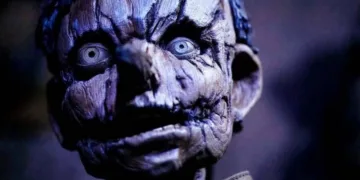
Practical effects are physical creations performed in front of the camera: puppets, prosthetics, animatronics, and fabricated wounds. They matter here because Pinocchio needs weight. His feet must strike the floor, his head must turn with mechanical resistance, and his grin must occupy the same space as James.
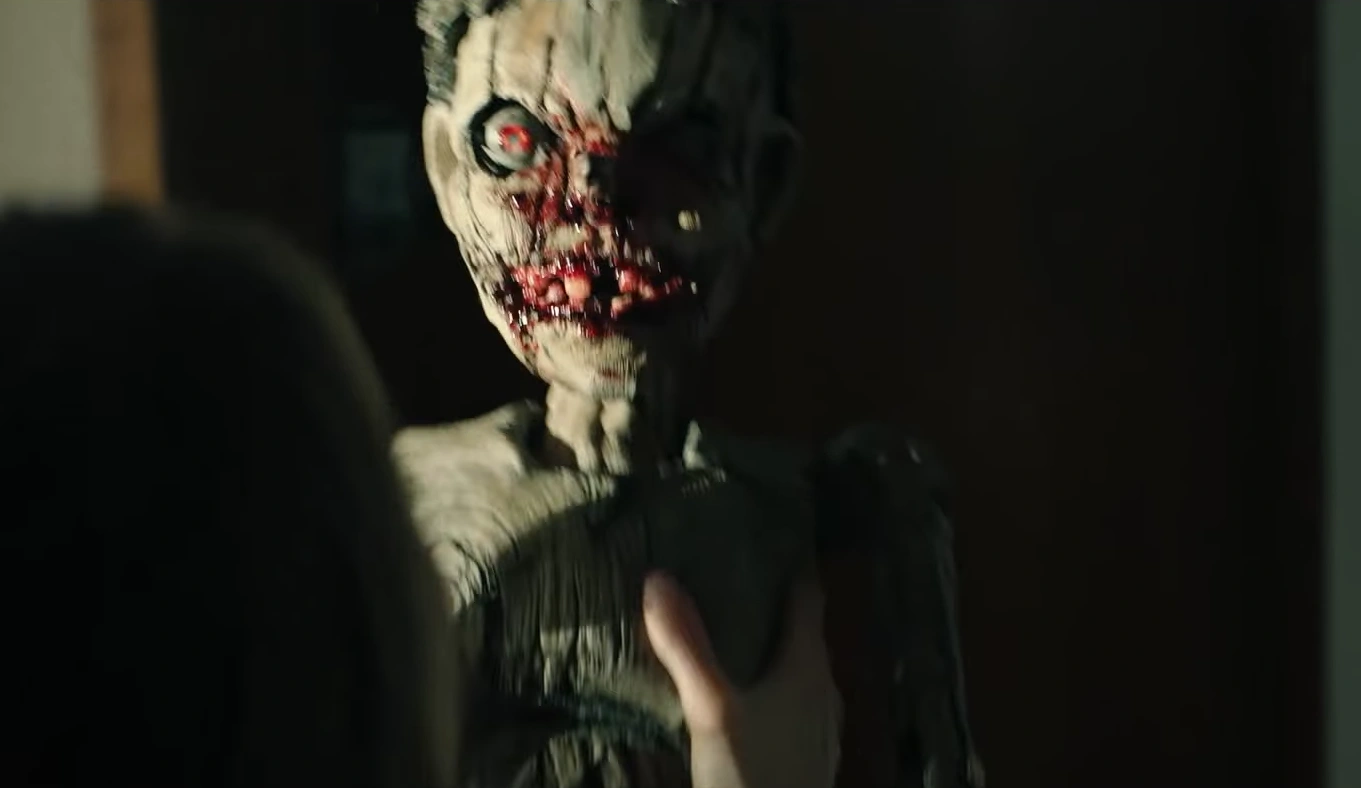
The animatronic puppet accomplishes that. During the early bonding scenes, Pinocchio’s stiff gestures make every affectionate exchange feel slightly wrong. Jude Evan Lloyd’s voice performance completes the illusion, pairing innocent curiosity with possessive intensity. As Pinocchio adds stolen human features to his wooden frame, the design becomes less artificial and far less human.
A shadow-puppet prologue introduces the corrupted fairy tale with greater visual confidence than earlier films in this franchise displayed. Later, the strongest kills use prosthetics and mechanical effects rather than digital shortcuts. Faces collapse, teeth are removed, and body parts join Pinocchio’s collection with appropriately unpleasant texture. A delayed killing involving his growing nose finally turns the character’s famous feature into a weapon.
The craftsmanship also exposes weaker material. Digital effects look thin beside the puppet and prosthetic work. Some victims arrive with so little characterization that their deaths play like demonstrations from an effects workshop. The shower sequence involving a character presented as a school student is especially misjudged. Its lingering silhouette and nudity add exploitation without sharpening fear or character.
The film has a mean streak elsewhere, including a joke aimed at an overweight child using an inhaler. Black comedy can make violence funny. Punching down merely makes the joke smaller.
Stronger Hands, Loose Strings
Cameron Bell gives James the vulnerability the story requires. His strongest moments come before the killing begins, when he studies Pinocchio with fear, curiosity, and the faint hope that this impossible creature might fill an absence. Bell’s quiet reactions keep James emotionally present once the plot accelerates.
Brake and Englund lend authority to clumsy dialogue, while Lloyd gives the puppet a consistent emotional logic. Several younger supporting actors struggle with stiff school scenes, though the writing rarely gives them much to shape.
At 82 minutes, the film moves quickly, yet its middle stretch settles into a repeated pattern: insult James, attract Pinocchio’s attention, suffer an elaborate death. The structure becomes predictable before the killings run out of invention.
The final movement introduces the Wood Mother, a corrupted Blue Fairy figure tied to transformation, rebirth, and immortality. Her arrival pushes the film away from contained slasher territory and toward stranger body horror. The concept has visual promise, particularly beside Pinocchio’s assembled anatomy, but it enters before Cricket, Geppetto, and James have completed their own dramatic work.
Pinocchio: Unstrung shows what this franchise can accomplish when physical craft leads the production. Its puppet has presence, its best gore has texture, and its grief-driven premise gives the slaughter an emotional source. The writing keeps tugging those gains back toward crude jokes, disposable victims, and cruelty mistaken for wit.
This dark independent slasher film premiered at the Brussels International Fantastic Film Festival on April 11, 2026, ahead of its wider theatrical release. The story follows a sentient wooden puppet crafted by Geppetto who embarks on a violent crusade to eliminate perceived threats and become a real boy.
Where to Watch Pinocchio: Unstrung (2026) Online







Full Credits
Title: Pinocchio: Unstrung
Distributor: ITN Distribution, Altitude Film Distribution, Viva Pictures
Release date: April 11, 2026
Rating: R
Running time: 82 minutes
Director: Rhys Frake-Waterfield
Writers: Rhys Frake-Waterfield
Producers and Executive Producers: Rhys Frake-Waterfield, Scott Chambers
Cast: Richard Brake, Robert Englund, Cameron Bell, Jessica Balmer, Jack Art Gray, Peter DeSouza-Feighoney, Jude-Evan Lloyd
Director of Photography (Cinematographer): Vince Knight
Editors: Not specified
Composer: Andrew Scott Bell
The Review
Pinocchio: Unstrung
Pinocchio: Unstrung gives the Twisted Childhood Universe its clearest technical leap through expressive puppetry, tactile gore, and a surprisingly sad bond between James and his wooden companion. The practical work often looks far richer than the budget suggests, especially as Pinocchio grafts human features onto his body. Yet clumsy dialogue, repetitive killings, cheap jokes, and several needlessly cruel choices keep breaking the tension. Rhys Frake-Waterfield has made a stronger film than his earlier franchise entries, though its craftsmanship deserves a sharper script.
PROS
- Impressive Pinocchio puppetry
- Strong practical gore effects
- Richard Brake’s committed performance
- Robert Englund’s sinister voice work
- Effective grief-driven premise
CONS
- Clumsy, juvenile dialogue
- Repetitive middle section
- Thinly written victims
- Uneven digital effects
- Mean-spirited comic choices