
















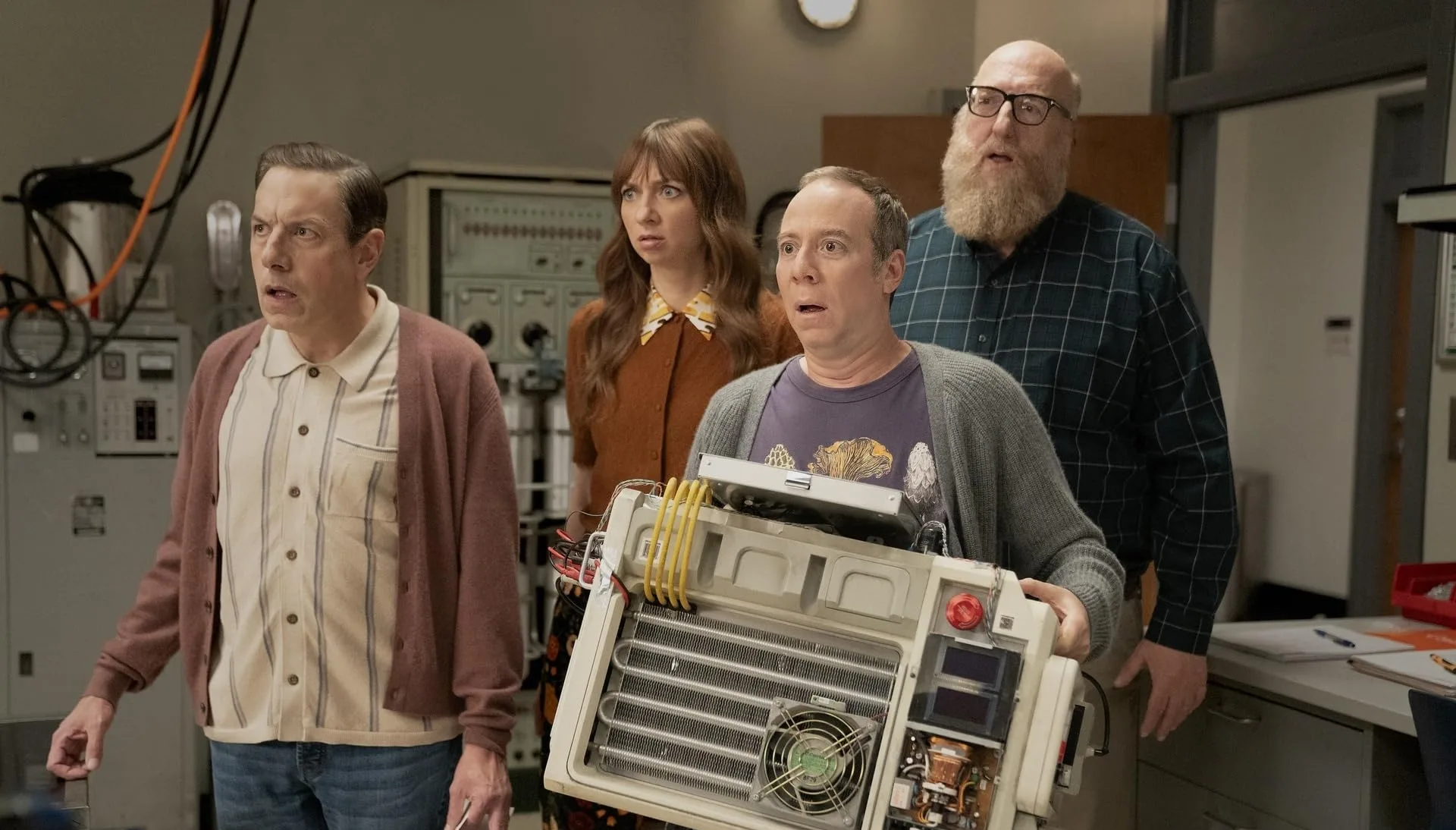

Streaming television loves to announce freedom from old formats, then rebuild the same machinery with a larger effects budget. Stuart Fails to Save the Universe offers a particularly revealing example. Chuck Lorre and Bill Prady return to The Big Bang Theory franchise with Zak Penn, abandon the studio-audience structure, and send four former supporting characters through a damaged multiverse. The sets are larger, the monsters are uglier, and the familiar pauses for laughter are gone. Several old assumptions remain remarkably intact.
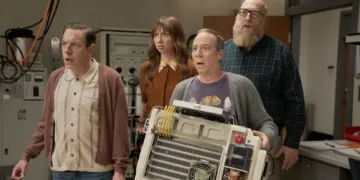
The premise is a genuine creative risk. A quantum entanglement device associated with Sheldon, Leonard, and Howard has fractured reality. Stuart Bloom, once the anxious comic-shop owner hovering at the edge of somebody else’s sitcom, must repair the damage with Denise, Bert Kibbler, and Barry Kripke. Their machine carries them between altered worlds without allowing them to select a destination.
That setup could have become a sharp examination of characters who spent years serving as punchlines for wealthier, more socially secure men. Instead, the series largely converts marginality into a branding opportunity. Stuart gets promoted from background loser to cosmic hero, yet the worldview surrounding him changes far less than the production format.
Pasadena After the Apocalypse
The premiere drops Stuart into a Pasadena reduced to burnt ruins and mutant threats. His comic shop survives, though its business model has adapted. Customers trade comics for canned food. A dimensional rift in the floor provides a convenient place to discard rubbish and corpses.
A giant moth attempts to force its way inside. Kyle and Trevor repeat the sort of geek argument that once fueled harmless studio banter, then the dispute ends with one stabbing the other over Hawkeye’s place among the Avengers.
That escalation captures the new show’s strongest instinct. Material that once depended on verbal repetition acquires a physical consequence. The joke lands because director Kyle Newacheck stages the familiar exchange inside a world where fandom has lost its protective distance. Pop-culture trivia persists after social order has collapsed. Of course it does.
Barry Kripke has become Lord Kripke, an authoritarian hoarding food, money, weapons, and women. Another version of Stuart arrives with news of the broken device, pulling the local Stuart into an explosive confrontation. Soon Kevin Sussman is throwing explosives while the Beastie Boys’ “Sabotage” plays, a deliberately absurd attempt to fit Stuart’s hunched uncertainty into action-hero choreography.
The production enjoys the discrepancy. Sussman never fully straightens Stuart’s posture or hardens his voice, so the spectacle retains the character’s discomfort. The ordinary-looking universe-jumping device performs a similar joke, placing cosmic power inside an appliance that appears ready to reheat leftovers.
The shift away from multi-camera comedy creates fresh problems. Dialogue still arrives in rhythms built for audience reaction, yet silence now follows several punchlines. The violent Hawkeye dispute works because staging and editing supply the final beat. Many verbal exchanges simply hang there, waiting for laughter from a room that no longer exists. HBO Max has liberated the franchise from the soundstage and forgotten to free its sentences.
The opening titles adapt faster. They warn viewers against pressing the skip button, changing their jokes and mock spoilers from episode to episode. Chuck Lorre’s closing vanity cards retain their brief observations after the credits. Some carry tighter comic timing than the scenes placed between them, an uncomfortable success for text viewers must pause to read.
Background Characters Demand the Spotlight
Stuart’s promotion carries an appealing corrective impulse. He spent much of The Big Bang Theory defined by financial instability, social failure, and limited access to the core group’s domestic world. Making him responsible for reality itself gives his old position a satisfying comic scale. The universe has finally noticed him, mainly because he helped break it.
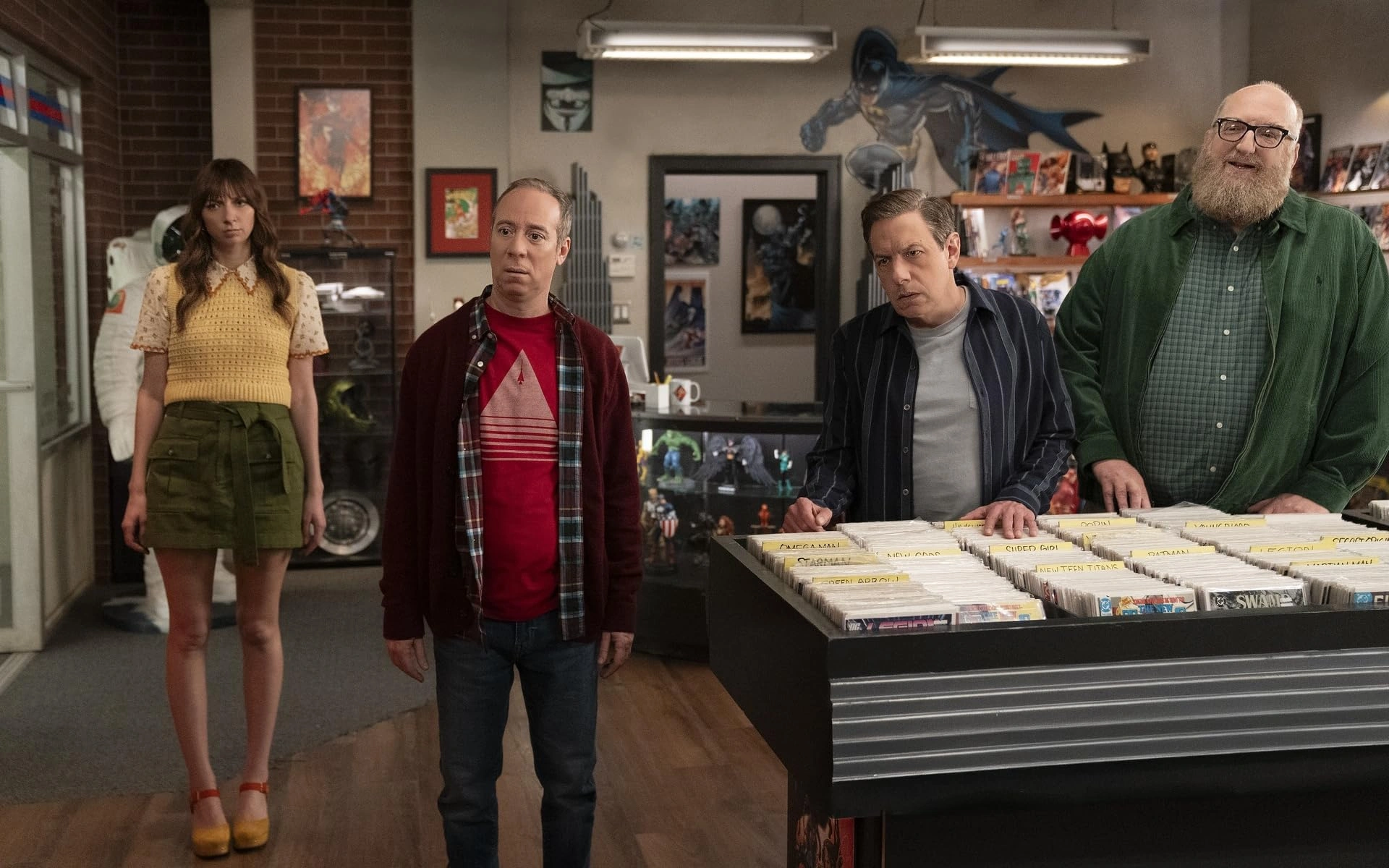
Sussman handles the change with precision. Early Stuart distrusts any plan linked to another version of himself, asking, “When did we start listening to me?” The line lands as self-deprecation and franchise commentary. A character trained to expect dismissal cannot suddenly act like a lead because the title card says so.
Across ten episodes, Sussman gradually adjusts Stuart’s decisions before changing his surface manner. He volunteers for danger, refuses an easy escape, and eventually declares that he and his friends are “not background characters anymore.” His nervous pauses remain. The confidence grows around them. This is careful performance work inside a season that often rushes the steps connecting one emotional state to the next.
Lauren Lapkus gives Denise an easy warmth that can momentarily disguise how little independent space the scripts grant her. Brian Posehn makes Bert’s literal-minded responses feel generous rather than vacant. John Ross Bowie treats Kripke’s ego as a permanent atmospheric condition. Together, they have enough distinct energy to carry a series.
What they lack is shared history as a unit. These characters existed near one another in the earlier sitcom, yet they rarely formed a meaningful group. The new series sends them into mortal danger before establishing what each person wants from the others. Their functions are immediately legible: Stuart worries, Bert misunderstands, Kripke provokes, Denise steadies the room. Their bonds remain harder to locate.
The psychiatric-hospital episode exposes this weakness. Stuart recounts the multiversal catastrophe to a therapist, and the details sound like evidence of collective delusion. The setup invites a closer reading of the group’s trust, fear, and dependence. It soon returns to the season’s regular machinery, leaving the institutional setting to function mainly as another genre costume.
Familiar guest actors appear in altered roles throughout the season. Their arrivals initially create playful disorientation. Repetition changes the effect. Each cameo begins to look like an insurance policy taken out against the possibility that viewers may lose interest in Stuart. A series built to promote background characters keeps calling senior management into the room.
Ten Worlds, One Repeated Episode
The multiverse promises structural freedom, yet the season quickly settles into a rigid loop. The device sends the quartet to a new reality. They identify its governing rule. A comic misunderstanding becomes a life-threatening conflict. They escape before the world can acquire emotional weight.
One episode gives the characters centaur bodies. Another places them in a reality where magic works. A militarized Pasadena turns civic identity into endless combat, including a commander who encourages soldiers by imagining future war re-enactors discussing their noble deaths over beer and wings. The joke is sharp because it connects heroic rhetoric to commercial leisure with one clean turn.
The production design, costumes, effects, and action staging give every destination an immediate identity. This franchise has never looked so mobile. It has rarely felt so dramatically static.
Nothing meaningful accumulates from world to world. The inhabitants are treated as temporary game pieces, even when their reality faces destruction. Stuart’s mission concerns billions of lives, yet the series frames those lives as an abstract scale attached to his self-esteem. Once the group reaches the next universe, the previous population vanishes from their concern.
The ten-episode order makes this shallowness stranger, not inevitable. Short streaming seasons are frequently sold as protection against filler. Here, the compact run leaves too little room for four separate jobs: teaching the rules of each reality, moving the central mystery forward, building an ensemble from former side characters, and restoring Stuart and Denise’s relationship.
The later episodes begin to feel repetitive because the series resets its emotional conditions each week. Stuart becomes braver in broad increments, but the worlds do not test different parts of his morality. Bert and Kripke repeat familiar functions. Denise remains tethered to Stuart’s romantic progress.
The finale finally introduces a stronger complication connected to the multiverse itself and creates a promising second-season direction. It arrives after nine episodes have used infinity as a sketch generator. Infinite realities, apparently, can still produce a very strict template.
Saving Stuart, Spending Everyone Else
The show’s bleakest limitation appears in its idea of heroism. Stuart learns to see himself as valuable. That change matters. The series shows little interest in the people he is supposedly saving, or in the ethical cost of treating alternate lives as disposable variations.
Kyle, Trevor, and Gary recur across realities as replaceable figures. Gary suffers repeated gruesome deaths, with his former relationship with Denise functioning as the presumed comic justification. The joke depends on the audience accepting romantic competition as a karmic offense. The multiverse becomes a machine for punishing a man who once dated the protagonist’s desired woman.
Female characters fare worse. Lord Kripke boasts about acquiring a harem by controlling food and threatening starving women. The writing recognizes his depravity, then uses it as comic texture. In another reality, a man encounters a culture unfamiliar with monogamy and manipulates a woman into marriage. The scenario is staged like a childish victory rather than a violation of trust.
Denise receives the season’s most sustained version of this problem. After one Denise rejects Stuart, he later speaks of having “claimed” another Denise from a different universe. The series then uses interdimensional shortcuts to accelerate them into commitment. Stuart receives affection without rebuilding trust, confronting past failures, or accepting that this Denise has a history distinct from the woman he knew.
Sussman’s sweetness and Lapkus’s relaxed chemistry create brief moments that suggest a gentler romance. The scripts keep converting those moments into evidence that Stuart has succeeded. Denise becomes the certificate awarded after his self-improvement course.
This is where the streaming reinvention reveals its institutional conservatism. The franchise can abandon the laugh track, burn down Pasadena, and transform its cast into centaurs. It still imagines male growth through possession, status, and access to women. The universe has changed. The entitlement survived intact.
This sci-fi comedy television series premiered on HBO Max on July 23, 2026. The story follows Stuart Bloom as he accidentally activates an experimental quantum device, forcing him to navigate alternate dimensions to repair the fabric of reality.
Where to Watch Stuart Fails to Save the Universe Online


Full Credits
Title: Stuart Fails to Save the Universe
Distributor: HBO Max
Release date: July 23, 2026
Rating: TV-14
Running time: 30 minutes per episode
Director: Mark Cendrowski
Writers: Chuck Lorre, Steve Molaro, Eric Kaplan
Producers and Executive Producers: Chuck Lorre, Steve Molaro, Peter Chakos, Kevin Sussman
Cast: Kevin Sussman, Lauren Lapkus, Brian Posehn, John Ross Bowie, Riki Lindhome, Kunal Nayyar, Carol Ann Susi
Director of Photography (Cinematographer): Steven V. Silver
Editors: Peter Chakos
Composer: Barenaked Ladies
The Review
Stuart Fails to Save the Universe
Stuart Fails to Save the Universe gives a neglected sitcom character the scale of a superhero and then measures his growth largely through confidence, conquest, and romantic reward. The visual reinvention is energetic, Kevin Sussman handles Stuart’s slow change with care, and several alternate realities produce sharp comic ideas. Yet the repeated episode structure drains the multiverse of consequence, while Denise and other women are treated with a cynicism the show mistakes for irreverence. Streaming freedom has expanded the production, not its emotional imagination.
PROS
- Kevin Sussman’s measured performance
- Ambitious franchise reinvention
- Playful alternate-universe designs
- Strong opening-title jokes
- Promising finale setup
CONS
- Repetitive episode structure
- Thin ensemble relationships
- Cameo dependence
- Cruel gender politics
- Rushed Stuart and Denise romance