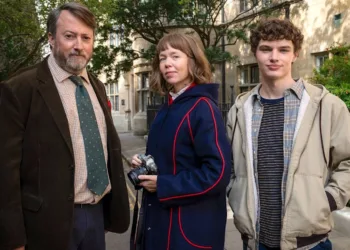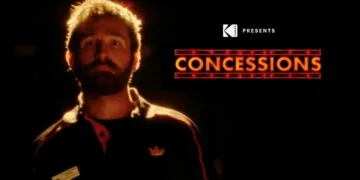

























In his feature debut, Concessions, writer-director Mas Bouzidi presents a scenario familiar to the landscape of American cinema: the end of an era. The film unfolds during the final day of operation for the Royal Alamo, a single-screen movie theater in upstate New York that has survived for 52 years. Its tone is one of bittersweet elegy, a quiet mourning for the fading ritual of communal filmgoing.
Bouzidi constructs his narrative not around a single driving plot but through a series of interlocking vignettes focused on the theater’s small staff and the last of its patrons. Each character stands at a personal crossroads, their uncertain futures mirrored in the dimming lights of the old picture house. The story is a microcosm of a larger cultural shift, examined with wistful affection.
Portraits in Limbo
The film’s emotional center is found at the concessions stand, a space that serves as both a workplace and a form of purgatory for its two main employees. Hunter, played by Rob Riordan with a well-honed bitterness, is the cynical veteran of the popcorn machine.

He is trapped in a transitional job that became a permanent fixture, and his sharp wit is a carefully constructed shield against the humiliation of serving former classmates who have achieved conventional success. His sarcastic pronouncements that theatrical viewing is passé hide a deep-seated sadness he is unwilling to confront.
Countering his cynicism is Lorenzo (Jonathan Lorenzo Price), a younger employee who seemingly has a clear path forward with a football scholarship. Yet Lorenzo’s confidence is fragile; his conversations reveal an anxiety about leaving the familiar comfort of his small town for the pressures of a larger world.
Their dynamic, built on a foundation of film trivia and shared frustrations, forms the narrative’s most compelling relationship. They talk circles around their futures, their banter a defense mechanism against the terrifying silence of what comes next.
Overseeing this quiet drama is the theater’s manager, Luke (Steven Ogg). Portrayed as a man burdened by the weight of a legacy he cannot sustain, Luke inherited the Royal Alamo from his father and now presides over its demise. His gruff exterior and perfunctory announcements over the theater’s sound system barely conceal a profound sense of failure.
He is a relic, much like the theater he manages. Observing them all is Deana (Lana Rockwell), the ticket-seller who methodically documents the final day with her camera. Her photography is an act of preservation, an attempt to capture the spirit of a place and its people before they dissipate. These characters are defined by their stasis, and the theater’s closing acts as an unwelcome catalyst, forcing them to reckon with the lives they have put on hold.
Celluloid Ghosts and Satirical Reels
Director Mas Bouzidi makes a significant aesthetic choice to shoot Concessions on 16mm film. This decision is central to the movie’s thematic purpose. The tangible grain of the film stock, with its inherent warmth and slight imperfections, mirrors the charmingly shabby state of the Royal Alamo itself.

The visuals feel less like a pristine digital recording and more like a recovered memory, reinforcing the story’s deep-seated nostalgia. This choice also serves as a statement in a cinematic landscape dominated by digital clarity, championing the texture and personality of physical media.
This sense of a bygone era is given human form with the posthumous appearance of Michael Madsen as Rex Fuel, an aging, boozy stuntman who wanders in for a final screening. Madsen’s performance is filled with a weary charisma, perfectly capturing a man from an older, more rugged Hollywood.
As he hands out his business card and recounts stories of working with movie stars, he becomes a living symbol of a craft being steadily replaced by computer-generated effects. The real-world knowledge of Madsen’s passing lends his scenes an unavoidable poignancy, transforming his character’s professional obsolescence into a layered and moving farewell.
Bouzidi balances this melancholy with a sharp, satirical wit aimed squarely at the modern film industry. The features playing at the Alamo are not real films but absurd parodies, such as the Hamilton-esque Taft! The Musical and the inexplicable sequel Schindler’s List: Refueled. These titles are more than simple jokes; they function as a cutting critique of Hollywood’s current reliance on intellectual property, sequels, and gimmicks.
At its most direct, the film employs a character known only as the “Theatre Philosopher” (Greg Roman) to break the fourth wall. He speaks to the audience in a direct address about the sanctity of the theatrical experience. It is a bold narrative device, risking didacticism to ensure the film’s core message is heard without ambiguity.
A Gentle Shrug of a Tribute
The screenplay for Concessions is strongest when it focuses on small, observational details. The rhythm of the dialogue captures the specific mix of boredom and intellectual meandering that defines many service jobs. Its authentic, witty exchanges, particularly during interactions with difficult customers, create moments of cathartic humor.

The script accurately portrays the thankless, often surreal nature of working in a public-facing role, allowing for a fantasy of customer non-service that is both funny and satisfying. The film’s structural ambitions, however, are not always as successful. While the central characters are well-drawn, the wider ensemble of patrons and peripheral figures often feels underdeveloped, existing as quirky set dressing rather than fully realized individuals. This can make the world of the Royal Alamo feel smaller than intended.
Furthermore, the film’s pacing can lag. Certain cinephile-heavy monologues, while true to the characters who deliver them, feel self-indulgent from a narrative perspective. They occasionally slow the story’s momentum at moments when it should be building. Consequently, the film’s emotional impact is more muted than monumental. Concessions does not offer a grand, passionate defense of cinema.
Instead, its final feeling is one of a poignant and gentle shrug, a heartfelt acknowledgment of what is being lost without resorting to cheap sentimentality. It successfully argues for the value of imperfect, local theaters as essential community hubs, leaving the audience with a fond, lingering sadness for the empty seats they leave behind.
“Concessions” is an American comedy-drama film that premiered at the Edinburgh International Film Festival on August 15, 2025. The film, directed and written by Mas Bouzidi, takes place on the last day of the closing Royal Alamo Cinema, following the intersecting lives of employees, patrons, and an unhinged manager. The movie was filmed on 16mm and presented on a 35mm print at its premiere. It’s a low-budget production from Terra Productions, Kebrado, and Sentenza Film Company. The film features the late Michael Madsen in one of his final roles. While a theatrical release was limited, discussions are in progress for its potential streaming distribution on platforms like Amazon Prime.
Full Credits
Director: Mas Bouzidi
Writers: Mas Bouzidi
Producers & Executive Producers: Ram Segura Khagram, Malcolm Brainerd, Sophia Winkler, Harrison Allen (executive), Michael Beckley (executive), Ari Benmosche (executive), Brian Tetsuro Ivie (executive), Gregory Daniel King (executive), Amit Sinha (executive), Jack Donovan Saperstein (consulting), Pokey Spears (co-producer)
Cast: Michael Madsen, Steven Ogg, Josh Hamilton, Lana Rockwell, Ivory Aquino, Rob Riordan, Jonathan Lorenzo Price, Volkan Eryaman, Greg Roman, Nate Odenkirk, Sarah Okada, Aaron Dalla Villa, Max Madsen, Annie Grier
Director of Photography (Cinematographer): Derrick Chen
Editors: Erin DeWitt
Composers: John Keville, Chuck Pinnell
The Review
Concessions
Concessions is a witty and heartfelt elegy for the local movie house, anchored by authentic dialogue and a poignant final performance from Michael Madsen. Its nostalgic 16mm aesthetic beautifully captures the melancholy of a closing chapter. While the film is sharp and observational, its momentum is sometimes slowed by underdeveloped supporting characters and meandering conversations. It succeeds as a gentle, bittersweet tribute rather than a powerful statement, leaving a fond, sad impression of a fading cultural institution.
PROS
- Authentic and witty dialogue that captures the slacker spirit.
- Sharp, satirical critique of the modern film industry.
- Poignant posthumous performance from Michael Madsen.
- Nostalgic and visually textured 16mm cinematography.
- Accurate and humorous depiction of customer service work.
CONS
- Many supporting characters feel thinly sketched.
- The pacing can be slow and uneven.
- Some cinephile-focused monologues feel self-indulgent.