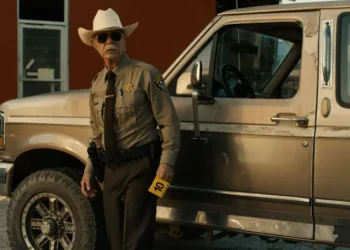


























A man walks into the space left by his daughter. The man is Irakli, and the space is a quiet home, a vague letter, and a map made from a final assignment. His daughter, Lisa, a photographer of sports, has vanished. Her last task was to capture the decaying football pitches of rural Georgia, so Irakli traces this itinerary of rust and overgrown grass.
This is not a hunt. It is a slow, methodical pilgrimage into an emptiness. He is accompanied by a voice, Levan, his daughter’s friend. Levan is invisible. This fact is stated with the same placid certainty as the rising of the sun. The film accepts this from the start.
A man can walk with a ghost, for what is a search for the missing but a conversation with a phantom? The journey unfolds without urgency, a long exhalation across a landscape that holds its secrets tightly. The mystery is a stone dropped in a deep well; we do not wait for the splash, we only watch the ripples.
Memory’s Corrupted File
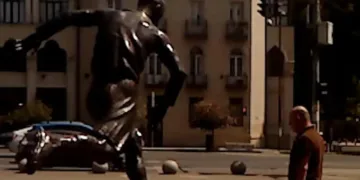
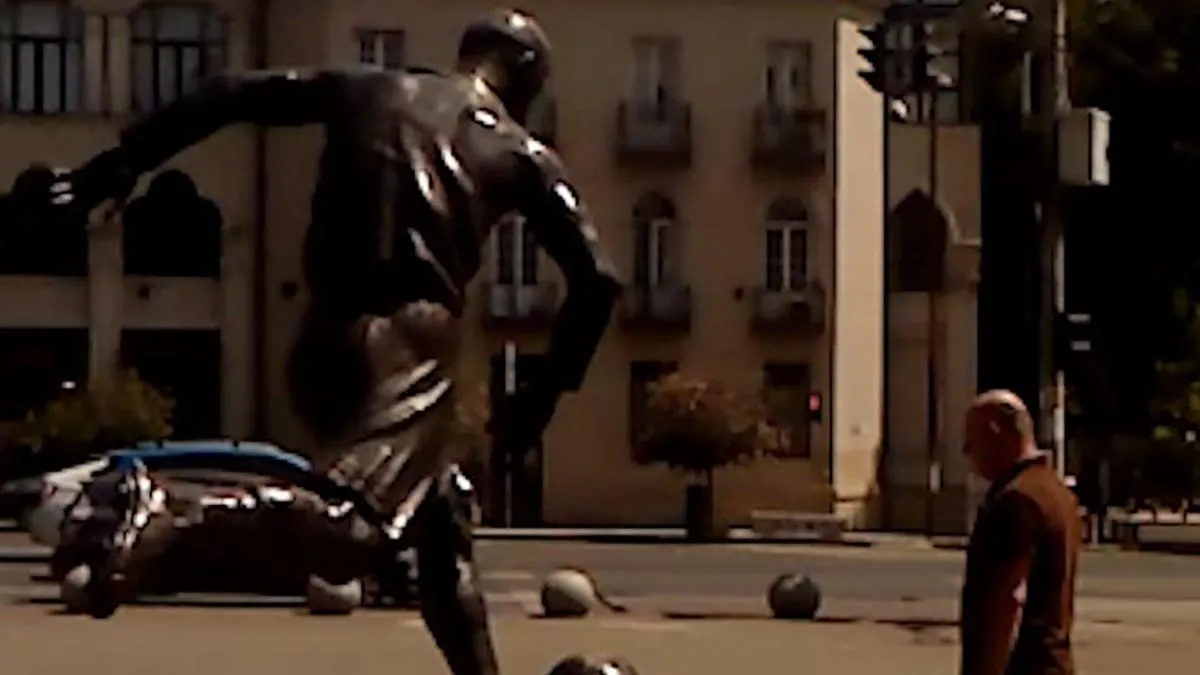
The world of Dry Leaf is a damaged artifact, viewed through the unsparing eye of a Sony Ericsson phone from a forgotten technological era. This is not a filter applied in post-production; it is the raw material of the film’s universe, a fundamental condition of its being.
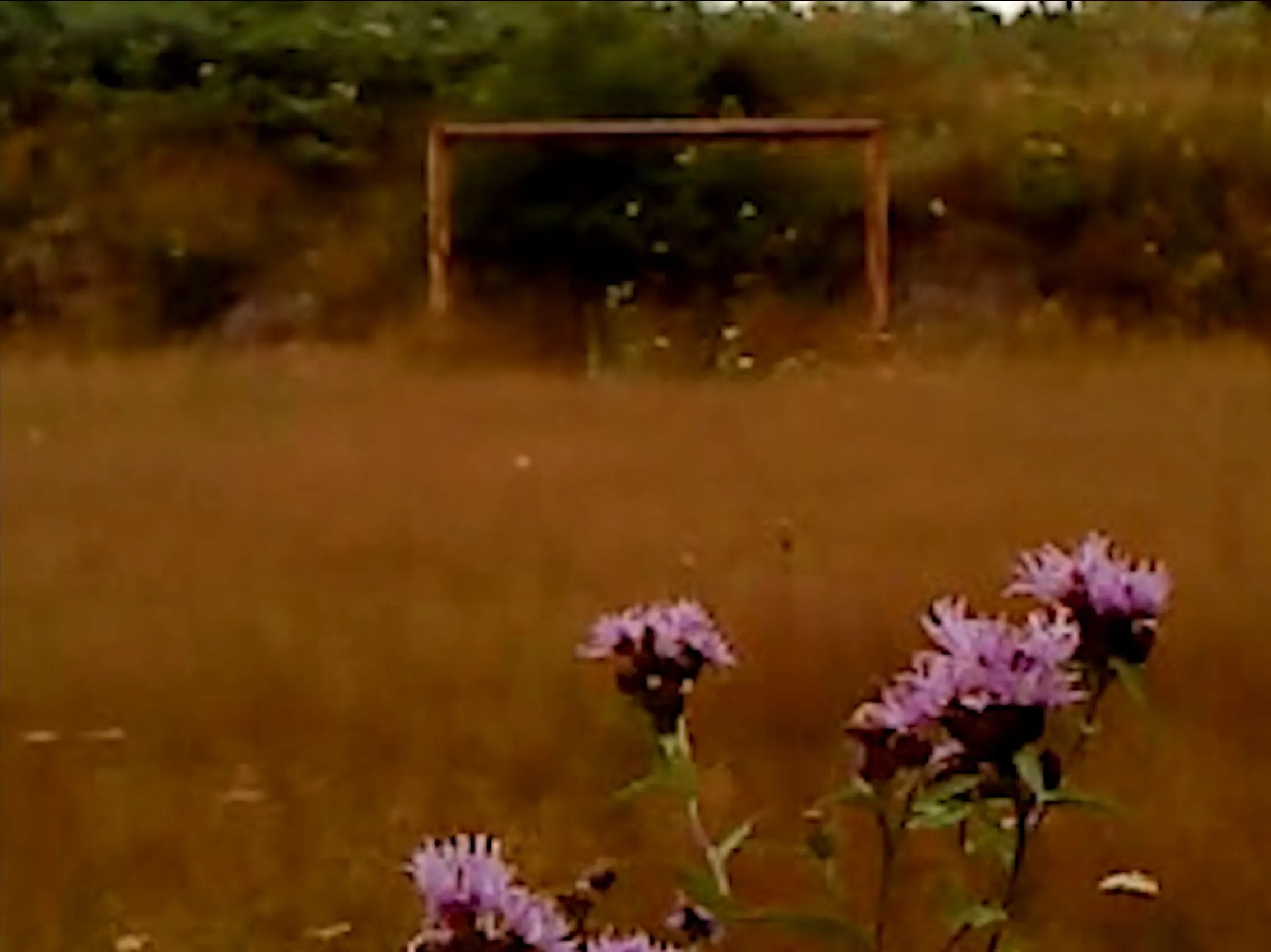
The image is a ruin. Its video files, saved with extreme and lossy compression, create chunky digital artifacts that obscure as much as they reveal. Pixels bleed into one another, forming coarse, breathing blocks of color that swarm across the frame. Landscapes captured from a distance dissolve into an impressionistic haze, where the natural lines separating grass from bush are rendered illegible.
Figures in motion shed their forms, becoming smears of pure data, like Turner’s frantic seascapes rendered in code. A simple pan across a field becomes an exercise in abstraction, a reminder that the world’s solidity is an illusion contingent on the quality of the recording. This is a statement on the nature of seeing itself.
The camera’s failing is an admission of truth: that perception is always a form of decay, a corrupted file. We are asked to find clarity in the blur, to reconstruct a world from its degraded signal. The aesthetic choice forces an active form of watching, a straining to see what lies beneath the digital noise. What emerges is something akin to a memory, not as it was, but as it is recalled—partial, distorted, with essential details lost to the simple friction of time.
The Ghosts We Listen For
Irakli moves through a world populated by the unseen. Levan is merely the first; entire villages seem to speak from just beyond the veil of visibility. We hear the voices of children leading Irakli to another field, yet the frame remains stubbornly empty. These presences are not ghosts in a supernatural sense; they are an ontological condition of this place.
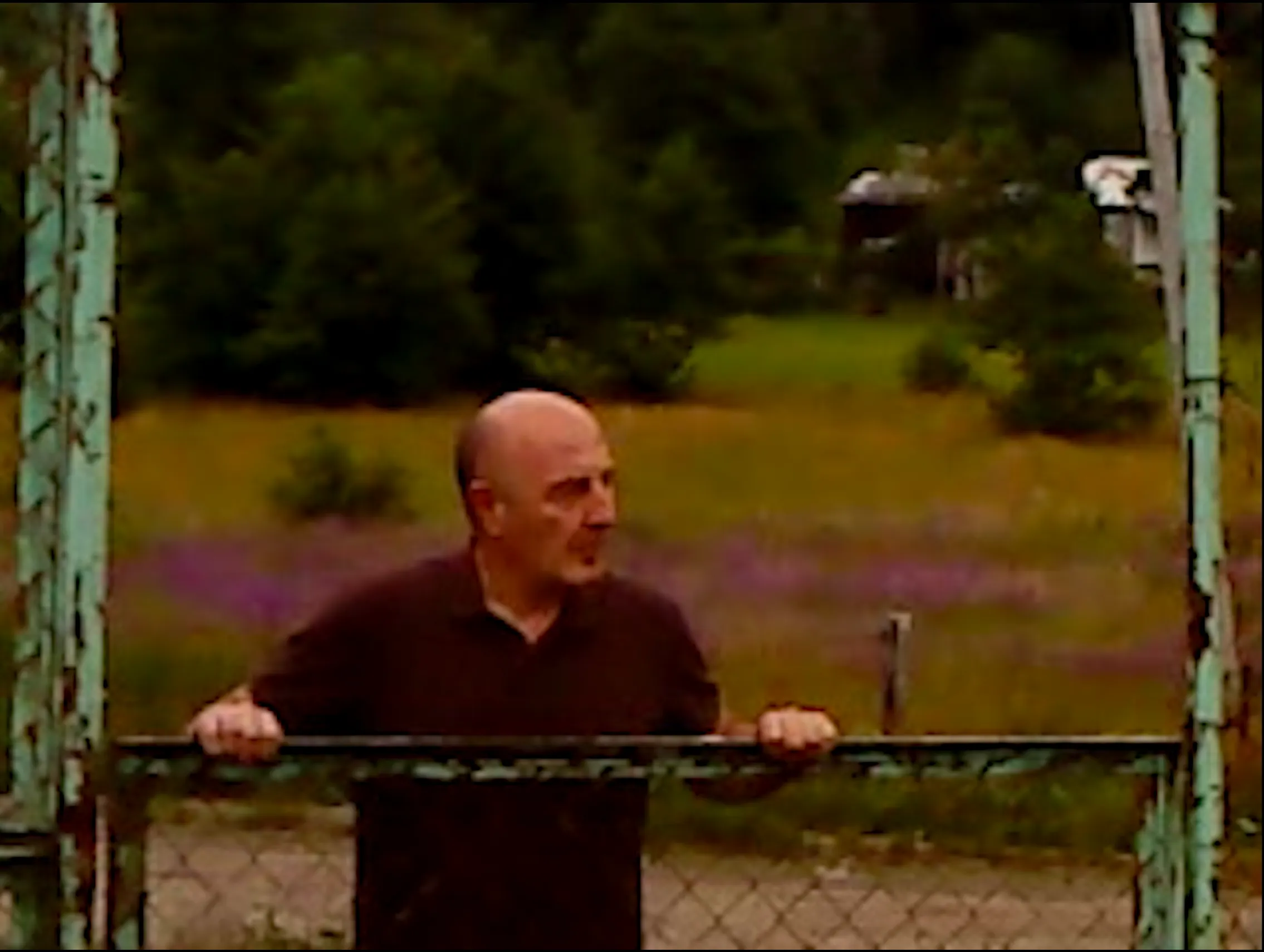
Their existence challenges the primacy of the visual, suggesting that what is most essential may be that which we cannot perceive directly. The film forces a belief in the unheard testimony, the unverified presence. This spectral population deepens the film’s meditation on absence, which finds its physical form in the settings themselves. Irakli’s path leads him to one empty football field after another, their rusting goalposts standing like skeletal totems against the sky.
These are monuments to forgotten games and failed aspirations, post-human landscapes where wandering farm animals are the only spectators. Amid this human emptiness, the non-human world asserts its dominance. The camera lingers on a donkey standing patiently, on street dogs twitching in their sleep, on a black cat whose sudden appearance feels like a tear in reality.
These creatures simply exist, unburdened by quests or meaning. Their pure, unreflective being serves as a silent rebuke to Irakli’s very human, very anxious search. His drama feels small here, a fleeting concern against the immense, indifferent backdrop of the Georgian countryside.
An Echo in the Void
Giorgi Koberidze’s score provides the emotional longitude for this journey. It is a spare and haunting thing, a series of delicate notes that measure the silence. At times it evokes the playful mischief of a silent-film caper; at others, it descends into the solemn tones of folk horror. The music offers no stable emotional ground, reflecting a world where moods shift without reason.
In a film of such profound visual ambiguity, the sound becomes an anchor, charting the currents of melancholy and quiet wonder that flow beneath the surface. The film’s three-hour length is a challenge, an insistence on existing in its own unhurried temporal space.
It asks the viewer to surrender to its rhythm, to abandon the expectation of narrative gratification and instead confront the stark reality of time’s passage. When the resolution to Lisa’s disappearance finally arrives, it is abrupt, almost dismissive, an afterthought in the film’s closing moments. This anti-catharsis is the point.
The search was a MacGuffin, a fragile human premise for a far deeper inquiry. The film denies us the comfort of a meaningful conclusion because life itself so often does. The title, a term for a swerving, unpredictable football shot, becomes a metaphor for the film’s own meandering path. It uses a dead technology to look at a fading world, suggesting that the act of looking, however imperfectly, is all we truly have.
“Dry Leaf” is a 2025 German-Georgian road movie that premiered at the 78th Locarno Film Festival on August 13, 2025. It also won a Special Mention prize at the festival. It is set to be screened at the 2025 Toronto International Film Festival on September 7, 2025. The movie is about a father who is searching for his missing daughter across Georgia. It was shot using a Sony Ericsson mobile phone. The film is distributed by Heretic. It’s currently seeking U.S. distribution.
Full Credits
Director: Alexandre Koberidze
Writers: Alexandre Koberidze
Producers & Executive Producers: Mariam Shatberashvili, Luise Hauschild, Alexandre Koberidze
Cast: David Koberidze, Otar Nijaradze, Irina Chelidze, Giorgi Bochorishvili, Vakhtang Panchulidze, Manu Tavadze
Director of Photography (Cinematographer): Alexandre Koberidze
Editors: Alexandre Koberidze
Composer: Giorgi Koberidze
The Review
Dry Leaf
Dry Leaf is less a film to be watched and more a state to be endured. It is a three-hour meditation on the decay of memory, the unreliability of sight, and the beauty found in a corrupted signal. A challenging, often maddening work of slow cinema, its power lies in its refusal to offer comfort, instead presenting a profound and unsettling look into the static of existence.
PROS
- A singular and deeply intentional visual style that challenges conventional cinematography.
- Philosophically rich exploration of absence, perception, and memory.
- A meditative pace that rewards patient and contemplative viewers.
- Haunting and effective musical score that complements the ambiguous visuals.
CONS
- The three-hour runtime and extremely slow pace will be inaccessible for many.
- Deliberately pixelated aesthetic can be visually frustrating or difficult to watch.
- The minimalist plot and abrupt resolution may feel unsatisfying to those seeking a conventional narrative.