































The bull shark is almost incidental. Jeff Wadlow’s The Devil’s Mouth has already supplied its characters with sharp rocks, unstable chambers, dwindling air, monsoon flooding, and a friendship capable of turning any emergency into an argument. Then the shark arrives, as if the film has mistaken an overcrowded premise for an underfed one.
Written by Aja Gabel and Myung Joh Wesner, the survival thriller sends five recent college graduates into a flooded Thai cave system after storms have pushed saltwater wildlife into its brackish passages. Sara (Kathryn Newton), Max (Lana Condor), James (Nico Hiraga), Adrienne (Tommi Rose), and Greg (Gavin Casalegno) join local guide Wat (Tayme Thapthimthong) for an expedition through a place ominously called the Devil’s Mouth. They choose the advanced red route after being advised to take the safer green one. The signage does everything except produce a waiver stating, “You are now entering the second act.”
The confined setting gives Wadlow a useful variation on the standard shark thriller. Open water permits movement in every direction. These caves force swimmers through narrow gaps, submerged tunnels, and chambers with limited oxygen. The characters cannot simply reach shore or climb onto a boat. The shark is trapped with them, though the screenplay never makes enough of the fact that predator and prey occupy the same prison.
Warning Signs and Future Victims
Sara is introduced as the group’s responsible member and its emotional spare part. Max and Adrienne have brought their boyfriends, leaving Sara as the unpaired fifth traveller. Her isolation becomes literal when the others sail away without noticing she is still in the water. A jellyfish attack leaves her injured before the cave trip has begun.
The sequence establishes the tension between Sara and Max with welcome efficiency. Sara has accepted a hard-earned job that will place distance between them. Max responds by pressing her to move to Los Angeles, treating Sara’s future as a scheduling inconvenience. Her apology after the jellyfish incident sounds like a statement prepared for legal review. Condor understands the character’s method: Max turns forcefulness into charm until charm stops working.
The remaining travellers receive thinner assignments. James is Max’s passive boyfriend and occasional voice of caution. Greg jokes whenever silence might require thought. Adrienne exists mostly beside him. Their dialogue identifies traits with the precision of luggage tags, then leaves the actors to carry bags packed with air.
Wat explains that recent storms have disturbed the cave ecosystem. He points out the fragile rock, confusing tunnels, and danger of cuts in the water. The group encounters a dead turtle bearing an enormous bite mark. Max later carves initials into the cave wall after hearing that the formations are delicate.
These warnings do not create suspense because the screenplay piles them so high that survival begins to look undeserved. Character mistakes can drive horror, but each mistake should expose personality or worsen an existing flaw. Here, poor decisions often serve one plain function: arranging the next victim where the shark can reach them. The death order becomes visible long before the bodies do.
The Cave Works Harder Than the Shark
Wadlow finds his strongest material whenever the environment takes control. One extended passage forces Sara, Max, and James through flooded tunnels where shrinking air pockets offer temporary relief. The shark circles below while the ceiling presses down from above. The scene builds danger from movement, breath, and limited space, giving the characters several problems they cannot solve by swimming faster.
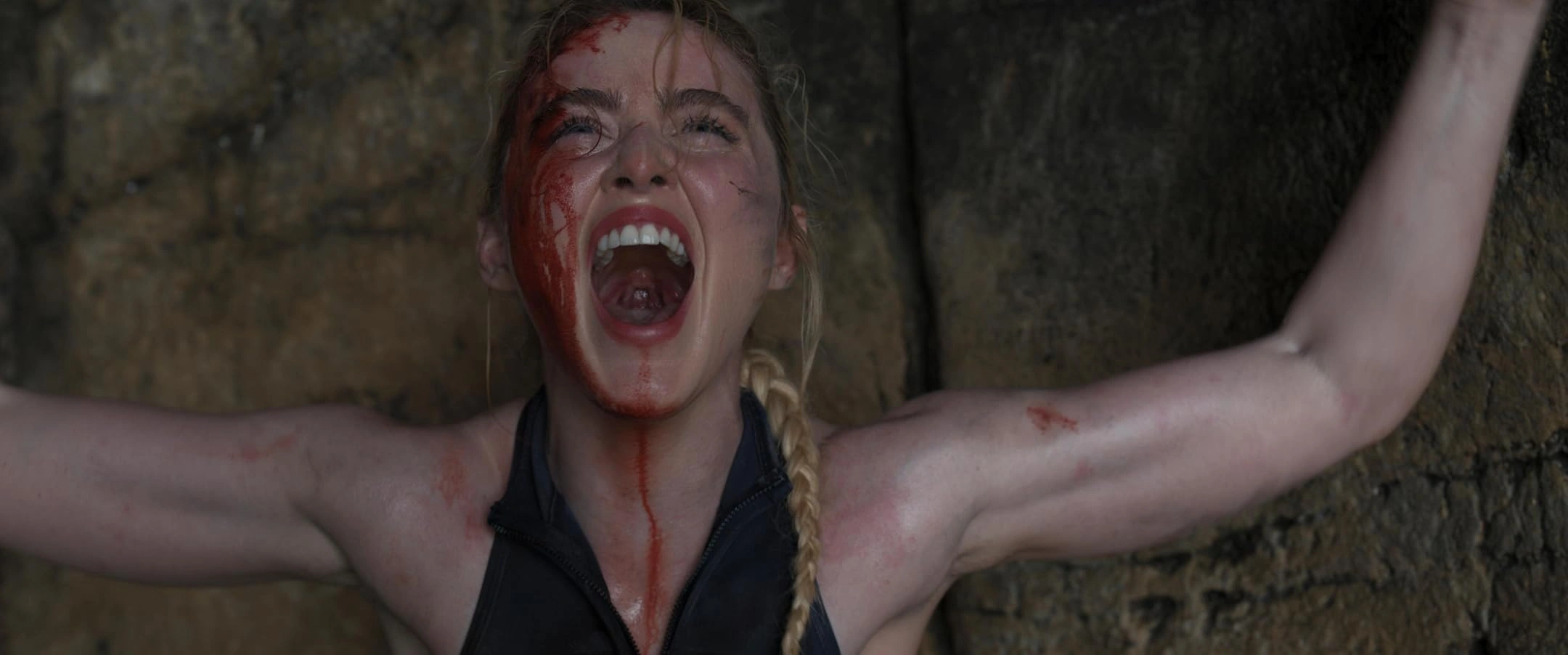
An emotionally charged drowning sequence also carries greater force than the creature attacks. It works because the danger has physical rules the audience can understand. A person needs air. A passage is too narrow. Panic wastes time. The film briefly stops manufacturing shocks and lets cause lead to consequence.
The shark is less persuasive. Its digital movement often lacks weight, especially when it grabs a victim and throws the body around the cave formations. A short point-of-view shot turns the attack into accidental slapstick. The restrained gore might have encouraged Wadlow to build dread around what cannot be seen, but the film keeps showing enough of the creature to reveal the effect and too little to give it personality.
The attacks settle into a routine: swim, argue, separate, lunge, regroup. Repetition can tighten a survival story when each cycle removes an option or changes the group’s strategy. Here, it mostly confirms the structure already predicted during the introductions. The shark appears less like an animal than a production assistant arriving on cue.
Lost in the Layout
James Kniest’s cinematography occasionally makes the cave feel hostile. Torchlight catches sharp rock edges, bodies vanish beneath muddy water, and a bioluminescent chamber provides a brief shift away from the brown-gray palette. That chamber stands out because it has an identity. Most of the cave system does not.
Spatial clarity is essential in confined horror. The audience needs to know where an exit lies, which route has collapsed, and how close the threat is to the next air pocket. The Devil’s Mouth loses those relationships once the group moves deeper underground. Chambers blur together, passages lack visual markers, and the shark’s position changes according to the needs of each attack.
A map overlay attempts to explain the route, but its adventure-film presentation belongs to a livelier movie. It supplies information after the images have failed to establish it. Darkness can hide danger. It should not hide the story’s basic geometry.
This confusion damages the pacing across the 104-minute runtime. Long stretches of cave movement produce little change in strategy, while repeated quarrels between Sara and Max restate grievances the opening has already made clear.
Newton gives Sara alertness during the physical sequences, and Condor finds flashes of fear beneath Max’s control. Their performances suggest a sharper friendship drama, one where survival exposes harder truths and forces morally costly choices. The screenplay prefers another swim through another murky passage. The cave has teeth, pressure, and limited air. The shark has a schedule.
The Devil’s Mouth is a survival thriller film released on Amazon Prime Video on July 29, 2026. The plot follows a group of friends exploring a remote underwater cave system in Thailand who must fight for survival against a bloodthirsty bull shark.
Where to Watch The Devil’s Mouth (2026) Online


Full Credits
Title: The Devil’s Mouth
Distributor: Amazon MGM Studios, Lionsgate Films
Release date: July 29, 2026
Rating: PG-13
Running time: 104 minutes
Director: Jeff Wadlow
Writers: Aja Gabel, Myung Joh Wesner
Producers and Executive Producers: Basil Iwanyk, Erica Lee, Carsten H. W. Lorenz, Will Flynn, Sam Greenberg, Jeff Wadlow
Cast: Kathryn Newton, Lana Condor, Gavin Casalegno, Nico Hiraga, Tommi Rose, Tayme Thapthimthong
Director of Photography (Cinematographer): James Kniest
Composer: Bear McCreary
The Review
The Devil’s Mouth
The Devil’s Mouth has the right pieces for an efficient survival thriller: a trapped bull shark, unstable caves, shrinking air pockets, and a friendship already close to collapse. The screenplay arranges them in the most predictable order available. A few suffocating underwater passages show what the film might have achieved, yet repetitive arguments, unclear geography, restrained attacks, and an underwhelming digital predator drain the tension. The characters keep ignoring warnings because the plot needs victims, which is less narrative momentum than scheduled feeding.
PROS
- Effective flooded-cave premise
- Strong shrinking-air-pocket sequence
- Newton and Condor bring energy
- Brief flashes of claustrophobic tension
CONS
- Predictable death order
- Thin supporting characters
- Confusing cave geography
- Repetitive pacing
- Unconvincing shark effects