




























The most revealing image in Redlight to Limelight is created twice. First, a woman from Kolkata’s Boro Goli district lives through abandonment, violence, or economic coercion. Later, she performs a version of that experience for a camera held by someone from her own community. Bipuljit Basu’s documentary occupies the unstable space between those two acts, where memory becomes fiction and fiction offers a degree of control.
Cam On is a filmmaking collective formed by sex workers and their children in Boro Goli, near Kalighat. Its members are producing Nupur: The Story of Two Sisters, a fictional drama built from recurring experiences within the district. One sister hopes to avoid sex work; the other has accepted it as inevitable. Rabin, whose Nepalese mother was sold into the trade at 12, directs the production.
Basu watches the collective learn how to stage scenes, position performers, and search for usable shots. The roughness matters. A cleaner production might have turned Cam On into an inspirational case study, polished until the material conditions disappeared. Here, missed cues and improvised decisions preserve the sense that filmmaking is being discovered in real time.
Performance as Testimony
Indian cinema has long used melodrama to give private suffering a public language. Nupur draws upon that tradition, yet its performers are reenacting situations adjacent to their own lives rather than entering a distant fictional world. The distinction changes the meaning of every scene. Acting becomes a form of testimony with a protective layer.
Meena Haldar, credited as Mina, plays the sisters’ mother. She came to Boro Goli after being beaten and expelled from her marital home while carrying her seven-month-old daughter. A taxi driver brought her to the district and introduced her to women who offered shelter. Basu does not reconstruct this history through stylized flashbacks. He lets Meena state it plainly, then observes her performing maternal fear and exhaustion for Cam On’s camera.
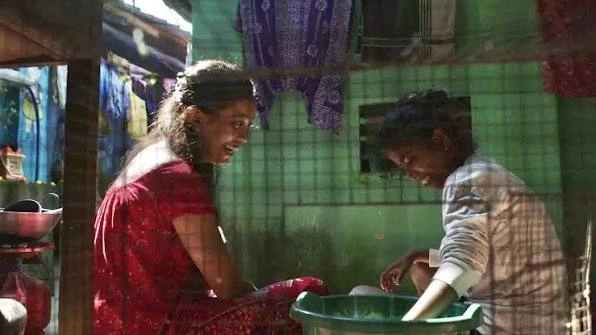
The distance between Meena and her role is narrow enough to be painful. It is also wide enough to permit play. During production, the women laugh, discuss scenes, and participate in decisions about their representation. These moments resist the familiar documentary habit of holding marginalized subjects inside solemn close-ups while an external filmmaker interprets their pain.
Bilkis, whose name is Srina Khatun, plays the older sister attempting to escape the future prepared for her. Outside the film, she decorates clay idols with tiny plastic jewels, earning little through painstaking work. A supplier’s promised increase in pay never arrives. The connection between role and performer is brutally exact: both women are searching for an economic exit that keeps moving farther away.
The idol work carries its own cultural irony. Bilkis helps ornament sacred objects within a society that offers her little protection. Basu presents the detail without forcing symbolism upon it. The contradiction is already eloquent.
Joy Without Sentimentality
The Cam On scenes are strongest when they show creation as a practical change in social relations. The women are usually observed within systems governed by male desire, family rejection, and financial dependence. On set, they negotiate performance, timing, and tone. Rabin earns trust through collaboration rather than command.
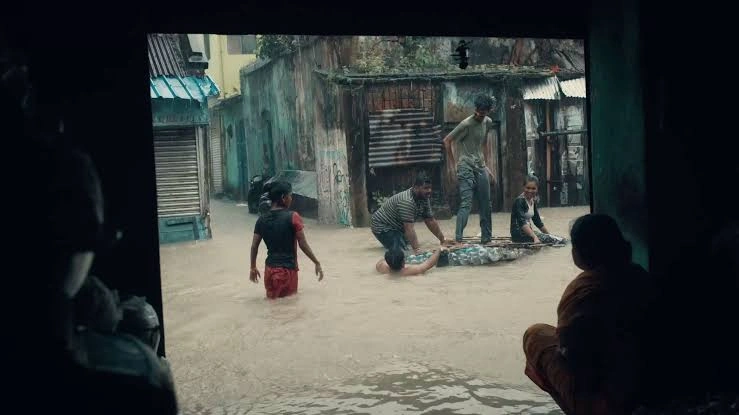
His own history contains enough material for another film. After being separated from his mother and raised by his paternal grandfather because he was a boy, Rabin was kidnapped by his mother at 11. She blindfolded him so he could not find his way back. Basu mentions these events, then moves away before exploring how Rabin understands her actions or how filmmaking became his response to them.
That omission reflects the documentary’s central tension. Basu refuses to define Boro Goli through trauma, a defensible decision in a culture that often treats suffering as the only marketable feature of poverty. Yet withholding detail can create another form of erasure. The people remain dignified, but some remain indistinct.
Afsara Khatun, who plays the younger sister, is present without becoming knowable. Meena’s teenage son, Bunty, skips school and wears the familiar expression of adolescent disdain, though his silences suggest despair beneath it. Each thread appears long enough to gather emotional weight, then slips from view.
The free-form editing mirrors the disorder of the production and the district around it. Scenes arrive as fragments rather than steps along a fixed dramatic path. This gives the documentary spontaneity, particularly when the women shift between household labor and film work. It also means the men handling direction and editing gradually occupy greater narrative space, while the women supplying the film’s emotional material receive less sustained attention.
Who Controls the Story?
The question of authorship gives Redlight to Limelight its cultural importance. Indian screen portrayals of sex workers have often moved between moral punishment, tragic spectacle, and romanticized sacrifice. Basu avoids those familiar poses. Meena and Bilkis are workers, mothers, performers, and collaborators. Their identities cannot be contained by the district’s economy.
Cam On’s fictional film pushes this resistance further by allowing community members to turn shared experience into narrative. The camera ceases to function solely as an instrument arriving from outside. It becomes something they can handle, challenge, and redirect.
Basu’s own camera remains less certain. His restraint protects the women from invasive questioning, yet it limits their individual presence. The documentary records their relief during production with greater clarity than the desires, resentments, and practical calculations shaping their lives beyond it.
This imbalance does not erase the film’s humane access. Meena’s account of arriving with her infant, Bilkis placing plastic jewels onto idols, Bunty withdrawing from school, and Rabin directing a story drawn from inherited wounds give the documentary its sharpest passages. Each moment asks for a little extra time. Basu often cuts elsewhere.
Redlight to Limelight returns the means of storytelling to people accustomed to being turned into stories. Its finest scenes show how performance can create companionship and temporary authority within conditions built to deny both. The film’s hesitation leaves many voices only partially heard, but the images created by Cam On belong to Boro Goli in a way few documentary images ever do.
Redlight to Limelight is an inspiring documentary feature film that made its world premiere at Sheffield DocFest on June 19, 2025. Set in the Kalighat red-light district of Kolkata, the story centers on sex workers and their children who establish a video production group to script, direct, and act in short films reflecting their own lived experiences. Audiences can watch the film through international documentary festivals and broadcasts on BBC Storyville.
Full Credits
Title: Redlight to Limelight
Distributor: BBC Storyville, Touch Narrative, Bindubot Communication
Release date: June 19, 2025
Running time: 100 minutes
Director: Bipuljit Basu
Writers: Bipuljit Basu
Producers and Executive Producers: Nilotpal Majumdar, Bipuljit Basu, John Webster, Uldis Cekulis, Emma Hindley, Somnath Ghosh, Abhijit Dutta
Cast: Rabin Bag, Mina Halder, Afsara Khatun, Bilkis Khatun
Director of Photography (Cinematographer): Subhadeep Dey, Mrinmoy Mondal, Rupesh Chaturbedi
Editors: Anirban Maity, Nilotpal Majumdar, Uģis Olte
Composer: Pessi Levanto
The Review
Redlight to Limelight
Redlight to Limelight captures the Cam On collective with warmth, cultural attentiveness, and respect for the women turning lived pain into filmed fiction. The scenes involving Meena, Bilkis, Bunty, and Rabin reveal how creativity can restore a measure of authorship to people habitually spoken for. Yet Bipuljit Basu’s loose structure repeatedly abandons personal histories just as they gain shape. The documentary gives Boro Goli’s residents control of the camera, then remains too hesitant to ask what they need that camera to say.
PROS
- Intimate community access
- Respectful cultural perspective
- Joyful amateur filmmaking scenes
- Strong reality-fiction interplay
- Memorable personal fragments
CONS
- Women remain underexplored
- Scattered narrative progression
- Key histories left unfinished
- Male filmmakers gain excess attention