

























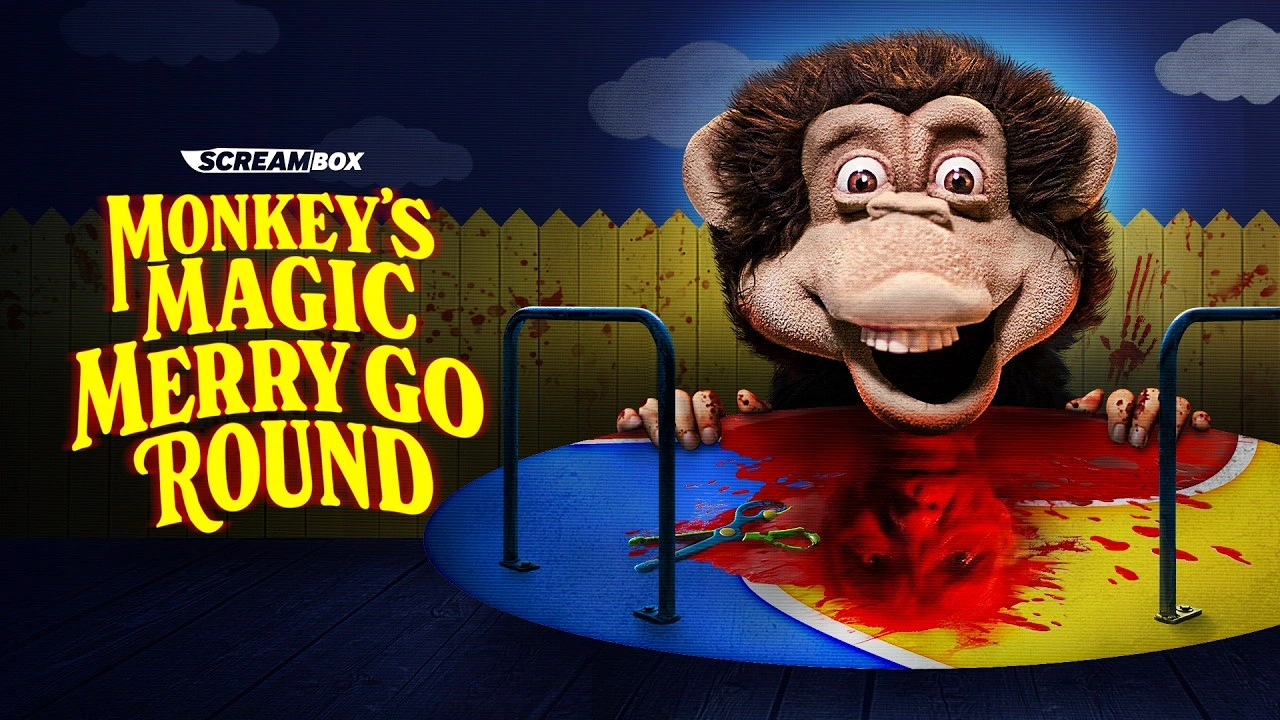

Aidan Leary’s directorial debut enters without the usual genre handrails, dropping the viewer straight into the simulated broadcast of Monkey’s Magic Merry Go Round. Co-written with C.R. Thompson, the film finds James “Jimbo” Jensen mid-sentence, preserved like a pristine artifact from vintage educational television, all crisp cardigan, rigid bow tie, and bright instructional poise. He occupies a hyper-manicured patio beside a small garden and Marty, a sentient mailbox, inside a setting built to radiate complete safety.
That domestic calm begins to split during a themed episode devoted to forgotten memories, a premise that drags buried childhood trauma into the light. Hints of a catastrophic house fire seep into the script, and James suffers a severe psychological rupture. Confined within the physical limits of his television set, he enters a state of existential imprisonment. His puppet co-stars register as possible agents of healing and possible guards assigned to protect his ignorance.
The Architecture of Televised Dissociation
The film uses the slow, therapeutic grammar of educational programming to build a claustrophobic psychological prison. Those older programs were designed to tame complex emotional realities for young viewers, translating disorder into tidy lessons and soft rituals. Leary twists that familiar function into something punitive. Exercises about healing and memory become tools of mental punishment, revealing the ease with which comforting spaces can mutate into systems of control.
The set’s total isolation sharpens that unease. The frame erases the usual scaffolding of television: crew, audience, and off-camera material reality disappear from view. James openly acknowledges the broadcast, and his puppet companions respond with blank incomprehension. They refuse his cues and leave him stranded inside a simulated void, a place where communication moves inward and never returns with an answer.
The narrative develops through surreal interruptions that crack the cheerful surface. An ominous letter arrives on set and addresses a mysterious entity called “The Freak,” weakening James’s command over the space that was meant to obey him. Later, the elusive Post Lady appears and causes James to abandon character entirely. He identifies her as his mother, and the production reveals itself as personal trauma staged through the language of children’s entertainment.
The feature-length structure creates visible strain. The script signals its final revelation early through blunt symbolic objects, including a match, a bottle of whiskey, and a burning family home. That heavy foreshadowing drains energy from the midsection, exposing the narrowness of the central mystery before the film gathers force again for its final sequence.
The Corporeal Strain of Forced Optimism
Michael Gilio carries the runtime as the main flesh-and-blood presence on screen. His performance depends on an intense, highly stylized physical discipline, performed without human co-stars. He takes on the measured miming mechanics of a vintage television presenter, projecting a bright-eyed optimism that feels grotesquely artificial under the circumstances. The cheer becomes a lacquered surface stretched over psychological pain, and the tension between host persona and inner fracture remains visible in his body.
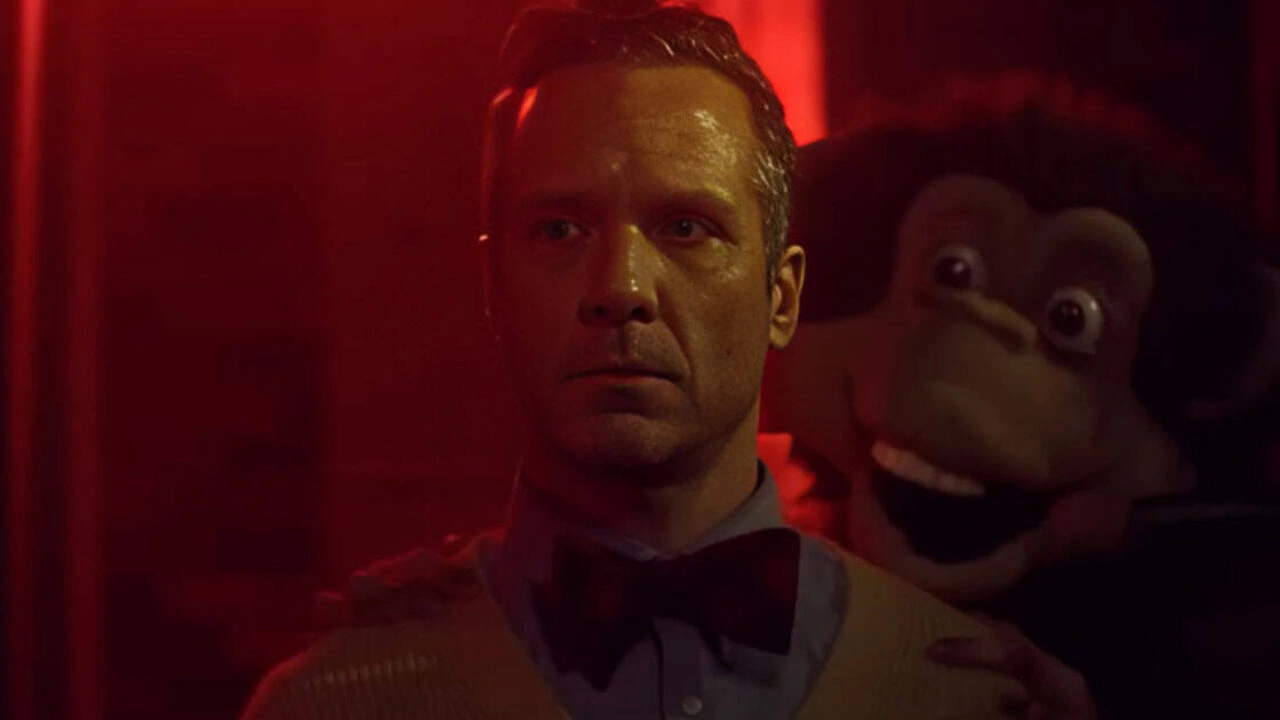
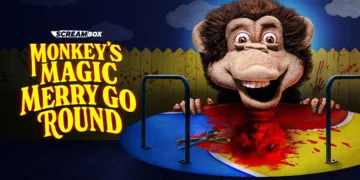
That human presence clashes sharply with the tactile design of the puppet cast, especially the titular Monkey. Giving the primate puppet actual human hands, with visibly dirty fingernails, produces a startling visual wrongness during extreme close-ups. The camera leans into the anatomical mismatch, turning a simple prop into a source of physical disgust.
The most disturbing expression of that dynamic arrives during an improvised theatrical skit. James creates a temporary puppet named Neil out of a marker, a shirt, and his own leg. Gilio shows remarkable control in the sequence, sustaining the soothing host mask while voicing the puppet’s frantic pleas for self-destruction as his own hands push a knife into his flesh.
That act of self-inflicted violence changes the character dynamic. James shifts from passive participant to desperate captive, fighting against the playground world that contains him. His resistance draws open hostility from his plush tormentors, and the broadcast hardens from therapeutic exercise into a fight for survival.
The Analogue Textures of Decay
The film’s formal power comes from its meticulous recreation of obsolete broadcast media. The production design captures the visual vocabulary of the magnetic tape era, using bright, oversaturated colors warped by simulated VHS chromatic aberration, tracking errors, and deliberate video artifacts. That technical precision gives the madness a credible historical texture, making the image feel like a lost broadcast recovered from some contaminated archive.
Kyle William Stephens’s score works with an unstable soundscape to deepen the hostility of the environment. Whimsical, period-accurate sing-alongs often fall into heavy silence or break apart under harsh audio distortions that puncture the domestic calm. Those sonic collapses keep calling attention to the emptiness surrounding the set, replacing warmth with a cold sense of abandonment.
The auditory tension pairs with physical special effects built around tangible gore. The film feeds on the collision between childish imagery and visceral body horror, using real textures for shock. That approach reaches its peak in a surreal passage where the human-handed Monkey performs a graphic, literal version of the children’s game “Operation,” removing real tissue in place of plastic parts.
The technical and thematic design fuse in the final movement. James delivers a mournful closing song as the video image melts into a heavily distorted, dreamlike state. The set takes on the appearance of a burning funhouse, giving visual shape to the buried trauma James has spent the broadcast trying to recover.
Monkey’s Magic Merry Go Round was released for international streaming on May 19, 2026. Audiences can watch the horror feature on the dedicated genre platform Screambox, or choose to rent or purchase the title through Prime Video and Fandango at Home.
Where to Watch Monkey’s Magic Merry Go Round (2026) Online










Full Credits
Title: Monkey’s Magic Merry Go Round
Distributor: Screambox, Cineverse
Release date: May 19, 2026
Rating: TV-MA
Running time: 1 hour 32 minutes
Director: Aidan Leary
Writers: Aidan Leary, C.R. Thompson
Producers and Executive Producers: Joe Swanberg, Jordan Yale Levine, Jordan Beckerman, Ben Gojer, Will Hirschfeld, Nicholas Donnermeyer
Cast: Michael Gilio, Frank Cesario, Jackie Smook, Jordan Olivia Mershon, Connar Brown, Rob Chesler, Erick Heyer-Fogelberg, Roman Gilio, Rob Chesler
Director of Photography (Cinematographer): Kevin Veselka
Editors: C.R. Thompson
Composer: Kyle William Stephens
The Review
Monkey's Magic Merry Go Round
Monkey’s Magic Merry Go Round succeeds as a daring, deeply unsettling dive into the subconscious loops of trauma. While the middle sections endure noticeable narrative drag due to an easily anticipated mystery, the structural audacity and formal precision elevate the production far above standard genre exercises. It serves as a striking exploration of psychological unraveling.
PROS
- Michael Gilio delivers a mesmerizing, physically demanding central performance.
- Meticulous production design beautifully captures a lost era of analogue television.
- Striking practical special effects seamlessly shift the tone from cutesy to grotesque.
- The unsettling tactile design of the human-handed Monkey creates intense visual friction.
CONS
- The core mystery relies on heavily telegraphed clues, causing the narrative to lose momentum midway through.
- The script stretches a concept suited for brief vignettes across a feature-length timeline.