
















Gotham now receives its panic through a television host. Hattie Tetch sits beneath studio lights and explains a city that has slipped past the reach of its police, its courts, and the billionaire vigilante stalking its rooftops. Rupert Thorne is on trial, Harvey Dent is dead, and corruption remains employed by the GCPD with the confidence of a department that has misplaced its shame. Season 2 understands that public order is partly a performance. Hattie does not need a mind-control device. Airtime will do.
Bruce Timm and James Tucker return to the 1940s setting with ten episodes that stretch Batman’s world across gangster drama, pulp science fiction, police procedural, and horror. The structure remains mostly episodic, with Eddie Nygma and a shadowed Joker providing a loose connective thread.
That arrangement gives the writers room to rebuild familiar characters from different social positions, ethnic backgrounds, professions, and moral histories. It also exposes the season’s central imbalance. Gotham changes constantly. Bruce Wayne barely seems to.
A City on Broadcast
The season’s most useful decision is to treat Gotham as a network of institutions rather than a backdrop for costumed conflict. Hattie’s talk show shapes public anxiety. Rupert Thorne’s influence survives his imprisonment. Detective Flass keeps moving through the police force after murdering Harvey Dent, protected by the same structure that should have removed him. Crime is not presented as a collection of isolated bad people. It is employment, access, reputation, and bureaucratic cover.
Barbara Gordon gains particular force within this framework. Krystal Joy Brown voices her as a lawyer who understands that a courtroom can fail long before a verdict arrives. Her work beside Commissioner Gordon and Renee Montoya places legal procedure beside Batman’s private campaign, and the tension is productive. Batman can break into a building. Barbara has to make a case survive contact with a corrupt city.
The show’s casting and character revisions matter because they alter who holds authority. Barbara is Black and positioned as one of Gotham’s sharpest legal minds. Harleen Quinzel is Asian American, separated from the familiar role of Joker’s abused accomplice, and linked romantically to Montoya.
This is not cosmetic franchise maintenance. Harleen’s return from hiding, followed by her uneasy collaboration with Batman at Gotham University, lets her occupy the story as a dangerous thinker with her own politics of punishment.
Television has spent years announcing diverse casting as though producers discovered the population last Tuesday. Caped Crusader is strongest when it skips the announcement and allows each change to reshape the story’s power map.
The Hero as Institution
Batman is still learning how often institutions outlast individual victories. He can stop a robbery, expose a killer, or drag a gangster from a car, yet the city keeps producing conditions that make the next crime possible. His growing alliance with Alfred, the Gordons, and Montoya suggests that the season recognizes the limits of solitary heroism.
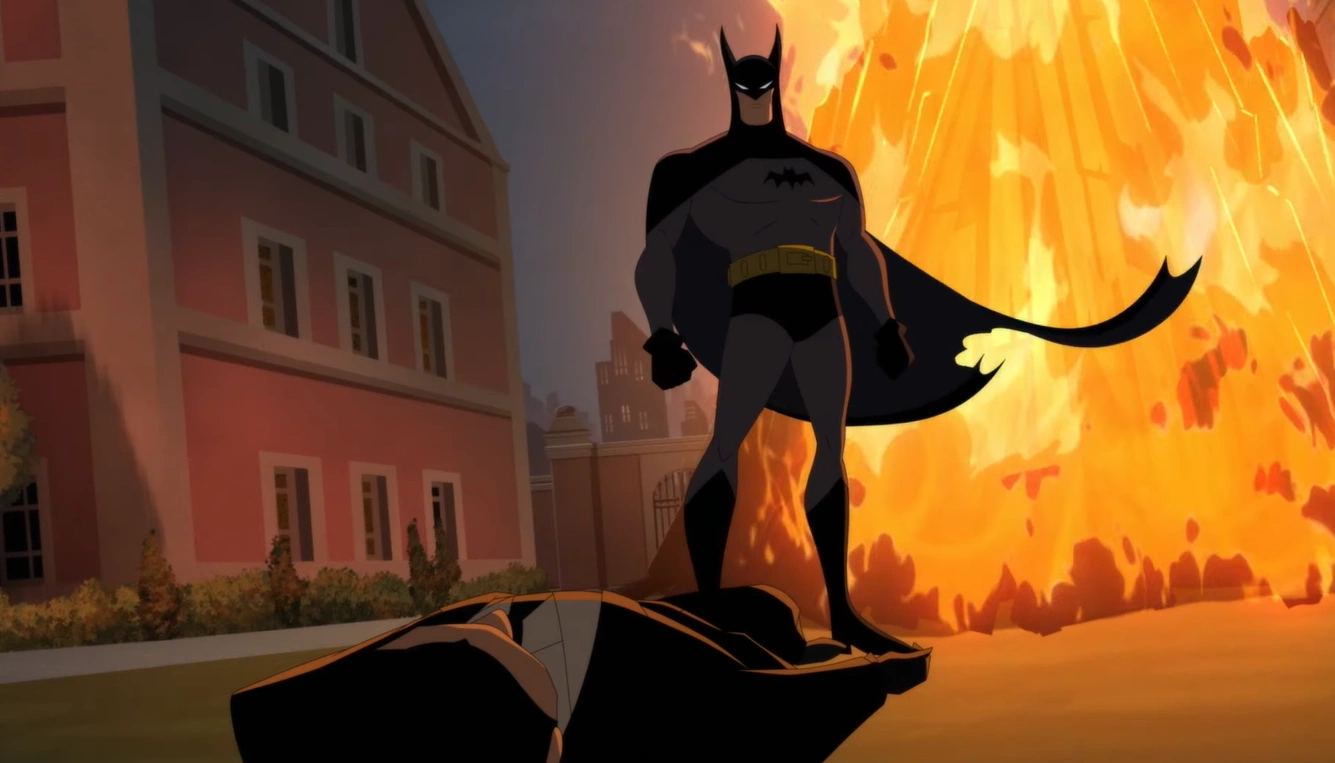
The Roxy Rocket episode turns that lesson into action. Batman pursues Roxanne Sutton during a train heist, following her low-flying rocket across the countryside in the Batmobile. She breaks through a fence and clears a ravine. He cannot. The scene preserves the serial-adventure pleasure of rockets and speeding cars while admitting that expensive equipment has physical limits. Later, his aircraft expands his reach, but machinery never becomes a guarantee of rescue.
People die with unsettling frequency. Some are civilians. Some are police officers. Some are criminals Batman cannot reach in time. That choice raises the stakes and challenges the cultural habit of treating superhero competence as moral proof. This Batman is imposing, clever, and fallible. His failures leave bodies rather than bruised pride.
Hamish Linklater gives Bruce and Batman distinct voices, yet the writing seldom reveals the person connecting them. Season 1 used Harleen’s therapy sessions to place Bruce under examination. Without those scenes, he often becomes a pair of performances: the social mask and the cowl. Episode 3 presses closer to his interior life, while most of the season finds richer contradictions in the people around him.
His relationship with Alfred improves after the chilly employer-servant dynamic of the first season. Bruce now acknowledges Alfred’s judgment and emotional importance. The change is welcome, but the show remains cautious about intimacy, as if one sincere exchange might violate a streaming platform’s noir quota.
Remixing the Rogues
Caped Crusader treats canon as raw material, and Season 2 demonstrates both the freedom and danger of that approach. The best reinventions preserve a character’s dramatic purpose while changing the biography. The weakest retain a famous name after removing the qualities that made it useful.
Roxanne Sutton is recast as a doctor and inventor rather than a stuntwoman chasing thrills. Her rocket technology belongs naturally to this stylized 1940s world, where diesel engines, laboratories, and impossible machines share the same street.
Rose Canton’s episode works differently. Rose and Thorn become the subject of a psychological mystery shaped by vengeance, fractured identity, and a visual vocabulary that recalls Hitchcock’s troubled women without copying one specific film. Fryda Wolff gives the shifts in Rose’s behavior enough tension to make the reveal tragic rather than mechanical.
The Monk pushes the series into horror. His episode does not seek sympathy for its predator. It uses darkness, enclosed spaces, and Batman’s limited knowledge to make evil feel ancient and immediate. The season’s genre flexibility reaches its clearest form here because the supernatural threat changes Batman’s methods instead of serving as a decorative guest appearance.
Harley Quinn remains one of the series’ strongest revisions. Jamie Chung’s performance carries Harleen’s brightness, severity, and wounded conviction through her scenes with Montoya and Batman. Separating her from Joker allows the character to retain cruelty, desire, intelligence, and agency without replaying the most exhausted relationship in Gotham.
Eddie Nygma suffers the reverse treatment. Ronan Raftery voices him with manic aggression, and the Tommy gun gives his violence a blunt rhythm. He threatens businesses, kills subordinates, and turns “riddling” into a joke about bullet holes. Yet puzzles, intellectual vanity, and strategic rivalry with Batman are mostly absent. The result is an energetic gangster using the Riddler’s name after the riddle has left the building.
Hattie Tetch faces a similar problem. The concept of a media personality manipulating Gotham through rhetoric fits the season’s institutional concerns. Calling her Mad Hatter adds recognition but little meaning. Scarecrow’s plague-doctor design is visually sharp, yet his brief appearance cannot develop fear into a sustained psychological weapon. Reinvention requires replacement, not subtraction.
The Laugh Withheld
Joker’s arrival tests the same principle and produces a stronger result. Teased through laughing-gas experiments at the end of Season 1, he spends much of this season in shadow while Eddie occupies the foreground. Episodes 9 and 10 finally reveal the scale of his plan, and the series changes register. Gangster violence gives way to bodily horror, poisoned laughter, and victims transformed into instruments of his performance.
Matthew Needham plays him with a restrained European inflection and very little comic energy. The design reaches back to Golden Age imagery and Conrad Veidt’s Gwynplaine, favoring a rigid smile and expressionistic shadow over carnival color. This Joker rarely laughs. His victims do it for him.
The choice will divide viewers because humor has long been part of the character’s threat. Here, silence creates the pressure. He watches, waits, and treats Gotham like a laboratory. Needham’s stillness can read as control in one scene and stiffness in another, but the final episodes gain a distinct identity from his refusal to behave like the version audiences already know.
His confrontation with Batman returns to an old question: does the vigilante’s darkness inspire the city’s theatrical criminals? Familiar material survives because this Bruce has not examined himself with the same rigor he applies to evidence. Joker’s argument disturbs him because the season has spent ten episodes showing a hero who can read every room except his own mind.
Old Shadows, New Television
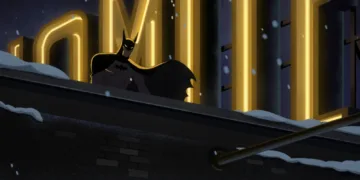
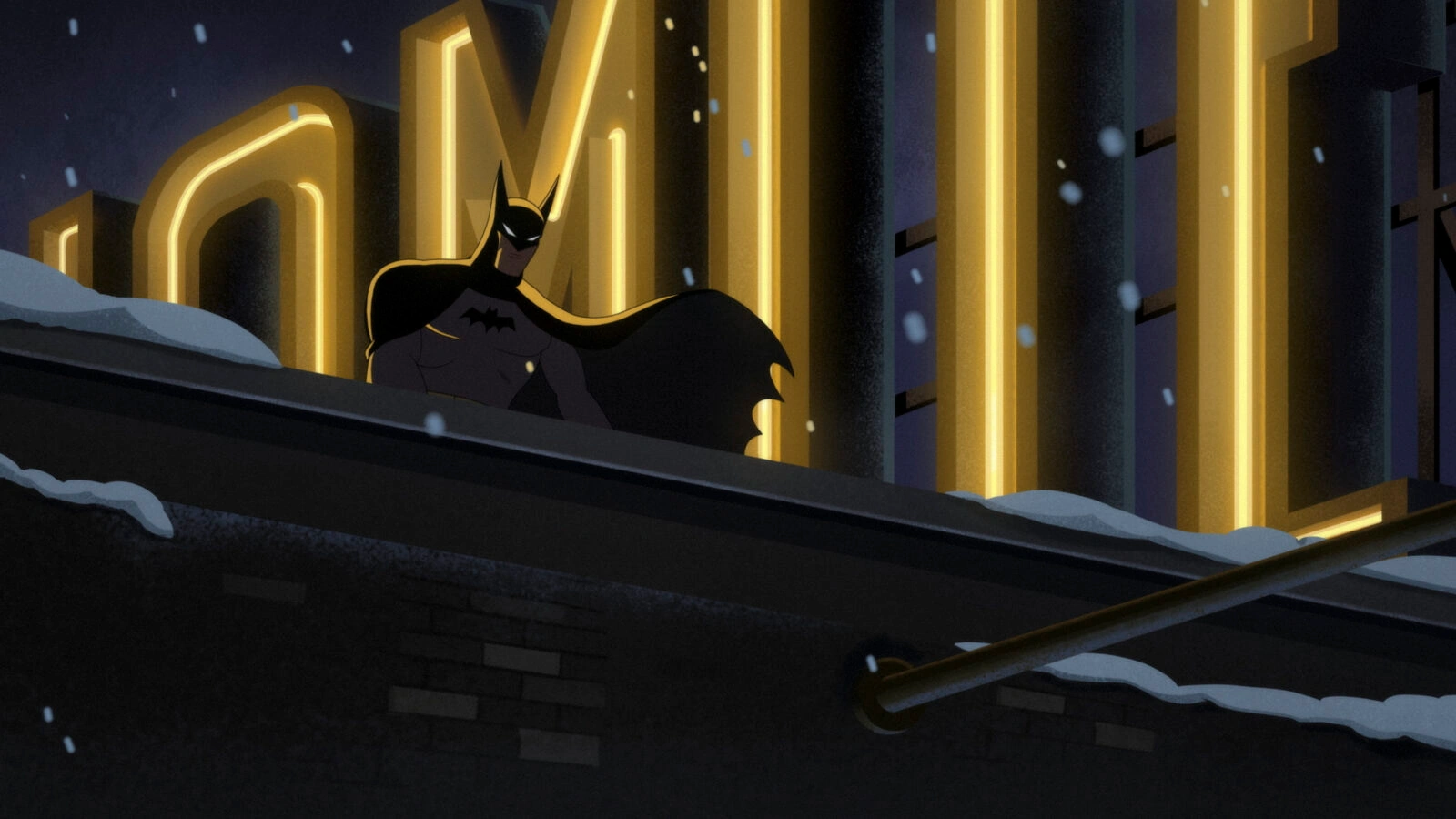
The visual design keeps the silhouette-driven clarity associated with Timm’s earlier work. Narrow offices, train yards, laboratories, news studios, and rain-dark streets let each episode shift genre without losing Gotham’s period identity. Episode title cards strengthen the pulp-anthology character, while the move into horror near the finale feels prepared by the season’s use of shadow and enclosed space.
The animation can appear too clean. Characters sometimes sit on top of textured backgrounds rather than inside them, and computer-generated vehicles lack the weight of the surrounding artwork. The Roxy Rocket chase displays the contradiction clearly: the geography is readable, the concept is playful, and some of the motion feels imported from another production pipeline.
Frederik Wiedmann’s orchestral score supports suspense and nocturnal unease, but it rarely supplies the melodic personality that made Shirley Walker’s work on Batman: The Animated Series inseparable from the drama. The comparison is unavoidable because the new series borrows the visual family resemblance while asking to be judged as a different branch.
Season 2 finds its identity when it treats Gotham as a contested civic space filled with compromised institutions, revised social roles, and villains who expose the city’s preferred lies. Its most frustrating choice is leaving Batman less developed than the world pressing against him. Perhaps that is the industrial irony hiding beneath the cape: the franchise’s safest asset is now the character the writers take the fewest risks with.
Batman: Caped Crusader Season 2 is an animated superhero noir series premiering on Amazon Prime Video on July 31, 2026. Set against a retro 1940s Gotham City, the series continues the dark adventures of Batman as he faces off against a wave of newly emerged criminal masterminds. Viewers can stream all episodes exclusively on Amazon Prime Video.
Where to Watch Batman: Caped Crusader Season 2 Online








Full Credits
Title: Batman: Caped Crusader Season 2
Distributor: Amazon Prime Video
Release date: July 31, 2026
Rating: TV-PG
Running time: 30 minutes
Director: Matt Reeves, J. J. Abrams, Bruce Timm
Writers: Ed Brubaker, Greg Rucka
Producers and Executive Producers: J. J. Abrams, Matt Reeves, Bruce Timm, Ed Brubaker, Sam Register, Rachel Skukert
Cast: Hamish Linklater, Christina Ricci, Jamie Chung, Diedrich Bader, Minnie Driver, Eric Morgan Stuart, McKenna Grace, Tom Kenny
Composer: Frederik Wiedmann
The Review
Batman: Caped Crusader Season 2
Batman: Caped Crusader Season 2 proves that reinvention can refresh a franchise and hollow out its icons in the same hour. Its culturally remixed Gotham gives Barbara, Montoya, Harleen, and Flass richer positions within the city’s power structures, while the period-noir design supports bolder horror and harsher consequences. Yet Batman remains oddly remote, and Eddie Nygma loses the intellectual identity that makes Riddler valuable. The restrained Joker works better, turning silence and institutional fear into menace. Ambitious television, unevenly translated.
PROS
- Strong noir and horror atmosphere
- Distinctive, restrained Joker
- Richer supporting characters
- Inclusive Gotham reinventions
- Higher stakes and consequences
CONS
- Emotionally distant Batman
- Riddler stripped of identity
- Uneven villain reinterpretations
- Loose serialized structure
- Overly clean animation