

























New York loves Spider-Man precisely because it no longer has to know Peter Parker. The city gets the rescues and the clean symbol of sacrifice. Peter gets an attic apartment and the humiliation of watching his old friends live online as if he died without technically dying. Spider-Man: Brand New Day understands this arrangement as a form of civic cruelty. Everyone remembers the mask. Nobody remembers the person who chose it.
Four years after Doctor Strange erased him from the memories of MJ and Ned, Peter has turned heroism into full-time avoidance. He patrols all five boroughs, repairs his equipment, and treats sleep as an administrative error. Detective Jean DeWolff, played by Liza Colón-Zayas, is among the few people who speak to him with concern rather than gratitude. Her warning about his isolation lands because Peter responds like a man who has converted loneliness into a work ethic.
Destin Daniel Cretton directs this fourth Tom Holland film with less adolescent bounce than Jon Watts brought to the earlier trilogy. Overcast streets, corroded interiors, and long pauses around Peter’s empty room announce a harsher emotional climate.
Holland carries the shift. His body has changed, his movements are heavier, and his anger reaches the surface before the jokes can smother it. Watch him study Ned’s social posts, close the screen, and return to his suit. The gesture suggests discipline. It also resembles withdrawal.
The Spider Eats the Man
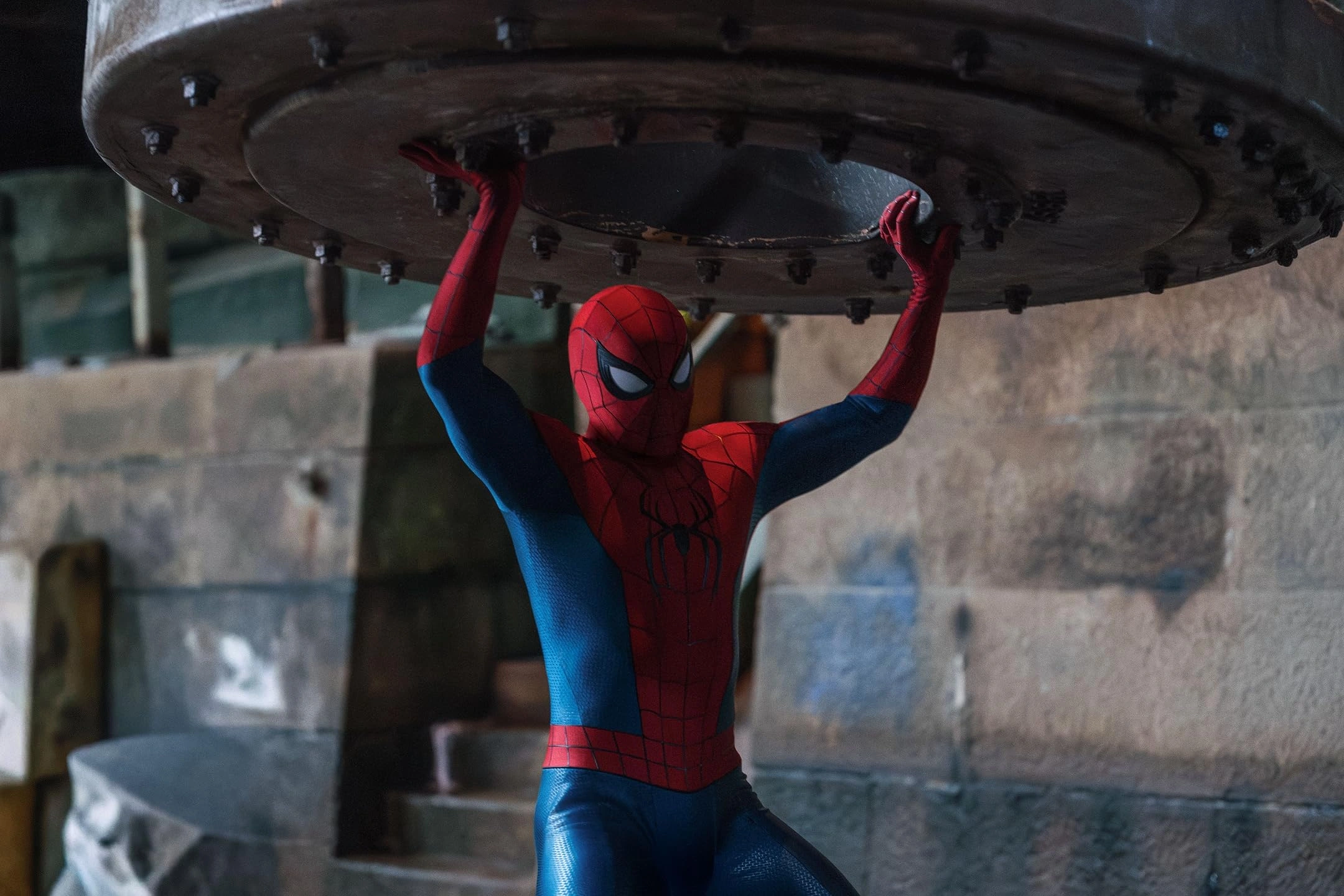
The film’s best idea arrives through Peter’s changing biology. His headaches intensify, his abilities become erratic, and his body starts producing responses he cannot regulate. The usual superhero problem is that power separates the hero from ordinary life. Peter’s problem is nastier: ordinary life has already been removed, so the power has nothing left to balance it.
Call this mask absolutism, the point where an identity created for protection begins consuming every identity it was meant to protect. Peter is admired, useful, and nearly absent from his own existence. The mutation gives that condition flesh. His aggression spikes during combat, his senses flood him with noise, and his control weakens at the exact moment he insists that he needs nobody.
His visit to Bruce Banner’s classroom makes thematic sense before it becomes franchise exercise. Mark Ruffalo plays their exchange with weary patience. Then Savage Hulk emerges, walls collapse, and the metaphor is handed a skyscraper. The sequence works best when Peter uses vertical movement to redirect Hulk’s momentum, turning philosophical kinship into a very expensive physics lesson.
The inhibitor Peter attaches to his neck is a weaker decision. A conflict tied to grief, repression, and identity gets partially solved by a silver device. Superhero cinema has always loved a machine that can fix what therapy would complicate, but the speed of this solution drains pressure from the mutation. Peter’s body was beginning to argue against his choices. The film asks it to lower its voice.
Memory Without Recognition
Peter’s attempts to approach MJ and Ned contain the movie’s most painful scenes because no explosion can simplify them. He enters their party under the improvised name “Maynard,” watches the ease of their shared adult life, and recognizes that his sacrifice did what sacrifices usually do: it benefited other people.
The screenplay refuses to restore the old trio through magical recognition. Ned is curious about Spider-Man, MJ is drawn toward a feeling she cannot name, and Peter fears honesty will endanger them again. Holland plays these scenes with visible calculation. Each sentence is edited before it leaves Peter’s mouth.
Zendaya gives MJ’s uncertainty a physical rhythm. After Spider-Man rescues her, she studies him with the concentration of someone hearing a melody through a wall. Her questions about school and prior meetings are simple, yet her pauses make them feel dangerous. When she asks him to lower the mask and kisses him, the film briefly allows emotion to outrun memory.
Then the telepathic enemy’s influence contaminates the moment. The kiss may carry MJ’s buried attachment, the invader’s manipulation, or both. That ambiguity is cruel in a useful way. Peter cannot trust the evidence of love when it appears directly in front of him. Jacob Batalon provides lighter energy without turning Ned into a souvenir from high school. He and MJ have moved forward. Peter circles them like a ghost with excellent upper-body strength.
Borrowed Bodies, Borrowed Movies
The central enemy moves from mind to mind across Manhattan, leaving bodies recoiling as the consciousness transfers. The effect is disturbing, closer to contagious panic than cosmic spectacle. Spider-Man can sense the passage and resist direct control. He must read a room while every face remains potentially false.
The Department of Damage Control gives that threat an institutional target. Its prisons, confiscated technology, and enhanced detainees extend the MCU’s habit of turning catastrophe into bureaucracy. Bill Metzger, played by Tramell Tillman, runs the operation with the calm assurance of a man who believes containment is a moral philosophy. Peter wears an inhibitor to contain himself. Damage Control builds cells to contain everyone else.
Sadie Sink’s character complicates the villain structure by reflecting Peter’s grief and solitude back at him. Her power has grown around loss, and her apparent cruelty emerges from a motive the film treats with sympathy. Sink makes the confusion credible in scenes where anger collapses into panic. Her face changes before her voice does.
The final confrontation loses force when threat turns quickly toward mutual understanding. Compassion fits Spider-Man, yet the screenplay softens the antagonist before the dramatic conflict has finished extracting a price. A villain can be wounded without becoming harmless on schedule.
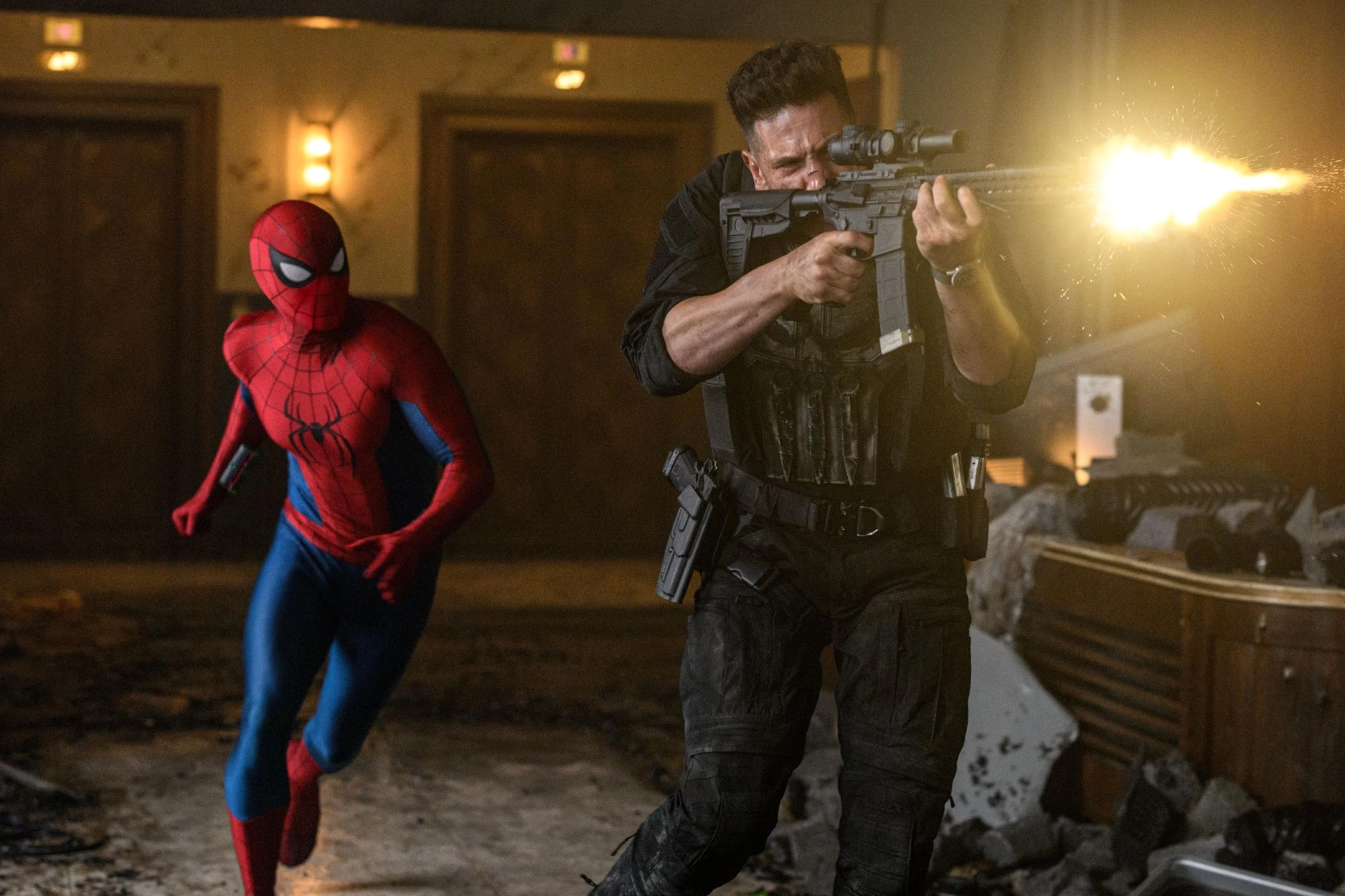
Frank Castle enters as Peter’s ideological opposite and the film’s loudest comic instrument. Jon Bernthal plays him as a man who regards every moral problem as a delayed firearms purchase. Their partnership works when Peter redirects Castle’s brutality rather than merely reacting to it. It works less cleanly when references to Castle’s television history begin functioning like required reading.
Florence Pugh’s Yelena appears during an awkward plunge-pool encounter with a masked, underdressed Peter. The scene is funny because Holland plays embarrassment as a genuine tactical crisis. It also exposes the film’s habit of opening side doors whenever its main room becomes emotionally difficult.
A Colder Swing Through New York
Cretton gives Spider-Man’s movement a denser physical texture than the earlier Holland films. During long falls, the wind narrows to a thin rush before a web line snaps onto metal or concrete. Street noise swells around Peter’s heightened senses. The sound design turns mobility into stress rather than pure release.

Gray skies and dim rooms separate this New York from the bright school corridors of Homecoming. Peter’s attic is crowded with tools and screens but nearly empty of domestic evidence. He has built a command center where a home should be. The film never explains how he funds the equipment, pays rent, or maintains a citywide patrol without Stark resources. Apparently economic precarity was also erased by Doctor Strange.
Several action passages show Cretton’s control of space. The tank chase through Manhattan gives Spider-Man a heavy object to orbit, climb, and redirect. The Hand sequence uses rapid directional changes and close-range martial arts to make his agility legible. Punisher’s gunfire then flattens that elegance into blunt percussion. The contrast tells us who these men are before either speaks.
The Hulk battle has scale, and the Scorpion encounter reconnects Michael Mando’s villain to Homecoming, yet both feel incomplete. The film keeps promising a defining set piece, then disperses its energy across cameos, helicopters, ninjas, prisons, and future implications. Some Glasgow locations struggle to pass for Manhattan beside the polished aerial footage, creating a city assembled from incompatible truths. That may be the most MCU thing about it.
TV on the Radio supplies a sharp needle drop, while Michael Giacchino’s score stays close to Peter’s unease. Cretton can make the film feel singular for several minutes at a time. Then another obligation knocks.
Sequel Suspension
Brand New Day returns Spider-Man to street-level New York after the multiverse congestion of No Way Home, which is the correct instinct. Peter’s problem is intimate: he saved everyone he loved by removing himself from their lives. Holland finally gets room to play the bitterness inside that decision rather than its heroic surface.
The screenplay keeps introducing change, then containing it. Peter’s powers mutate, then the inhibitor regulates them. MJ reaches toward recognition, then possession clouds the moment. Frank Castle gives Peter company, then remains an unstable ally. Sink’s character points toward a new moral and franchise direction, yet her story is preserved for later use.
This is sequel suspension, movement arranged to protect stasis. The film runs for 145 minutes and leaves Peter’s central condition largely intact. He is lonely at the start, lonely in different company near the end, and surrounded by enough crossover potential to populate a shareholder presentation.
Earlier Spider-Man films used rent, work, school, and exhaustion to measure adulthood. Here, Peter can construct sophisticated equipment in a decaying apartment without any visible income. The film wants the emotional symbolism of poverty without the inconvenience of a bill.
Damage Control, Yelena, Banner, Punisher, Scorpion, the Hand, and the withheld implications of Sink’s role keep tugging the story toward other projects. Peter Parker becomes the host body for a franchise that also knows how to jump from vessel to vessel. The final promise that Spider-Man will return lands less like reassurance than policy.
Spider-Man: Brand New Day is a superhero action film released in theaters worldwide on July 31, 2026, where audiences can watch it on the big screen. A forgotten Peter Parker lives alone as a full-time Spider-Man until mounting pressure triggers a dangerous change and a powerful new enemy emerges.
Where to Watch Spider-Man: Brand New Day (2026) Online





Full Credits
Title: Spider-Man: Brand New Day
Distributor: Sony Pictures Releasing
Release date: July 31, 2026
Rating: PG-13
Running time: 145 minutes
Director: Destin Daniel Cretton
Writers: Chris McKenna, Erik Sommers, Stan Lee, Steve Ditko
Producers and Executive Producers: Avi Arad, Kevin Feige, Rachel O’Connor, Amy Pascal
Cast: Tom Holland, Zendaya, Sadie Sink, Jacob Batalon, Jon Bernthal, Tramell Tillman, Michael Mando, Mark Ruffalo, Zarra Kaahn, Jamaal Burcher, Billy Clements
Director of Photography (Cinematographer): Brett Pawlak
Editors: Nat Sanders, Gina Sansom, Harry Yoon
Composer: Michael Giacchino
The Review
Spider-Man: Brand New Day
Spider-Man: Brand New Day understands Peter Parker’s crisis with uncommon clarity: erasing his relationships has allowed the mask to consume the man beneath it. Tom Holland gives that idea pain, anger, and physical force, while Destin Daniel Cretton wraps him in a colder New York. Then the franchise machinery arrives, carrying cameos, future setups, and enough institutional baggage to require its own Damage Control department. Call it sequel suspension: constant movement designed to preserve emotional stasis. A mature Spider-Man emerges, trapped inside a film afraid to let his life change.
PROS
- Tom Holland’s mature performance
- Peter and MJ’s painful chemistry
- Colder, textured visual direction
- Strong sensory sound design
- Sadie Sink’s thematic parallel
CONS
- Overlong, fragmented structure
- Cameos dilute Peter’s conflict
- Unstable powers resolve too easily
- Action arrives unevenly
- Heavy future-franchise setup