































Moses wakes beside a murdered ambassador with a pistol in his hand and a gap where his memory should be. The setup gives Moses & Plato – Last Train to Clawville an immediate mechanical purpose: every clue gathered aboard the Clawville Express must help clear Moses before the train reaches its destination and a fragile peace accord collapses.
Developed by The Wild Gentlemen, this point-and-click visual novel shifts the Chicken Police universe away from 1950s noir and toward the drawing-room logic of Sherlock Holmes, Hercule Poirot, and Murder on the Orient Express. Moses, a composed fox detective, and Plato, his impulsive feline partner, have been sent to protect Stowonian ambassador Ignat. They fail before the first night is over.
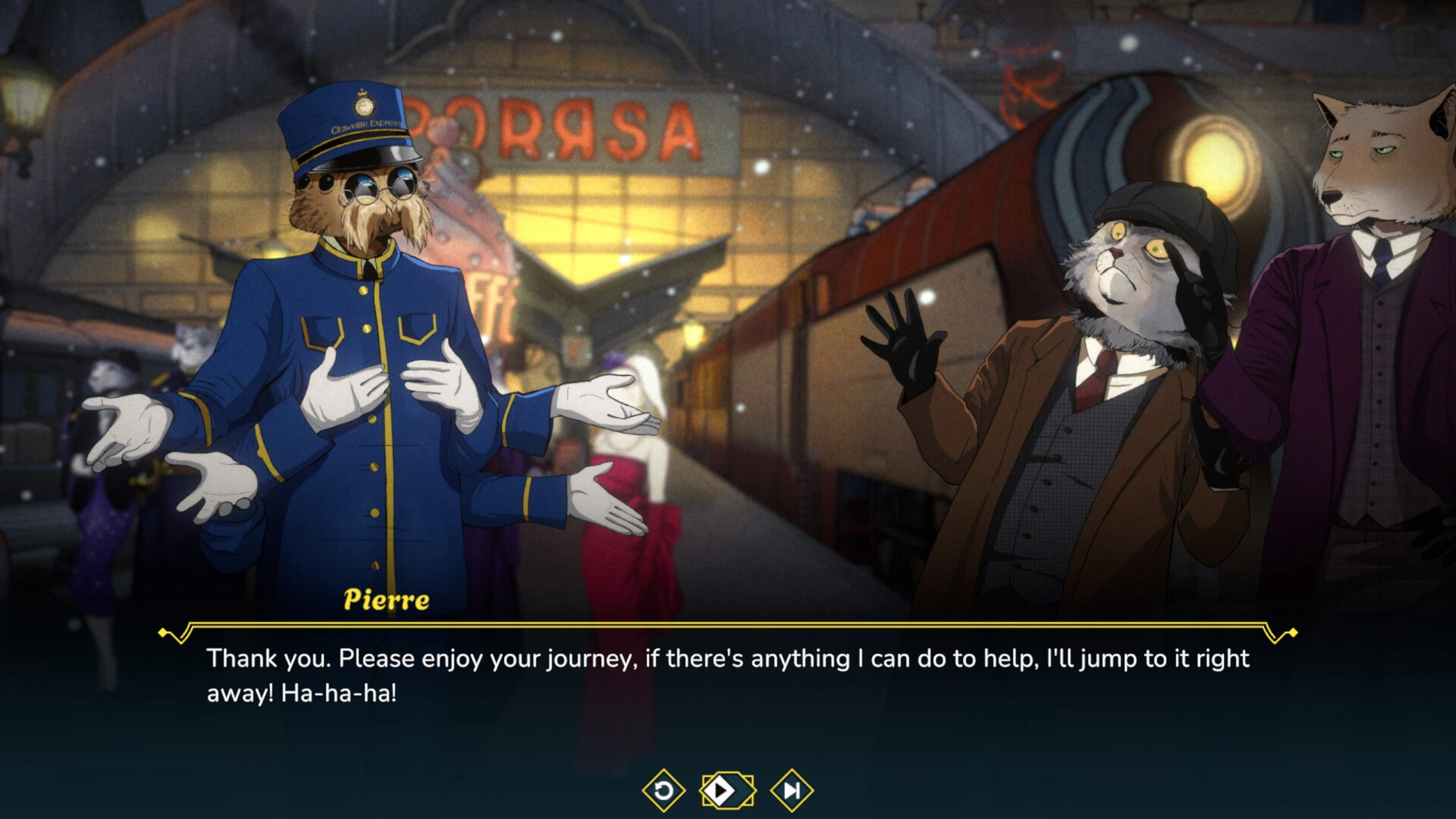
The luxury train makes an effective locked-room environment. Its diplomats, staff members, political operatives, and wealthy passengers occupy a small chain of carriages, each carrying a plausible grievance against Ignat. Snowbound Stowonia, Eastern European accents, Art Deco compartments, and formal costumes establish the literary mystery tone before Moses begins checking alibis.
Every Conversation Costs Time
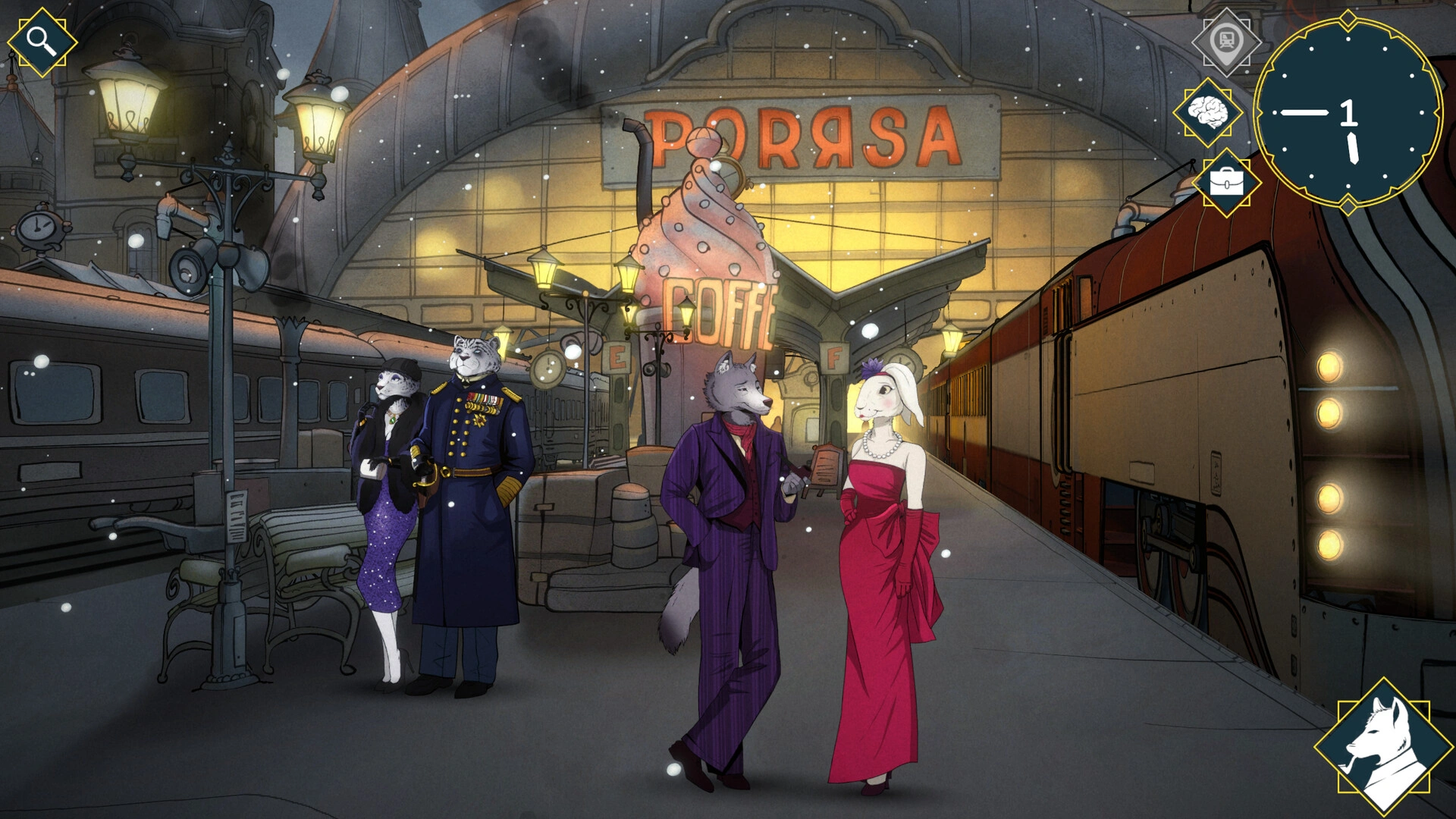
The investigation loop is strongest when the game forces the player to choose which lead deserves attention. A watch tracks the remaining time actions before the next story event. Speaking with one passenger, examining a compartment, or conducting an interrogation may consume a slot, so five available conversations can become a problem when the schedule permits only three.
That restriction gives ordinary dialogue weight. Questioning a diplomat means postponing an inspection elsewhere, while following a suspicious scent may leave another passenger’s new testimony unheard. The game rarely turns these decisions into drastic branching outcomes, yet the limited schedule creates the useful feeling that information has a price.
Moses’ animal senses deepen the clue-gathering loop. Sight exposes small visual details, hearing reveals changes in a suspect’s composure, and smell identifies traces that ordinary inspection misses. Observations can later become dialogue options, allowing Moses to challenge a statement with something the player personally discovered. The mechanic connects his identity as a fox to the investigation instead of leaving the animal cast as visual decoration.
Formal interrogations test how carefully those clues were gathered. A suspect may sound dishonest, though Moses cannot expose the lie without the correct piece of evidence. Choosing the wrong response lowers the interrogation score, which is graded on a five-star scale. Failed attempts can be replayed, reducing the chance that one mistake will damage an entire chapter.
The Mind Garden stores characters, relationships, facts, clues, and world information. Its structure is sensible, yet its feedback often fails. New deductions do not always receive a clear marker, forcing the player to search several categories to locate the latest update. An evidence database should reduce uncertainty. Here, it occasionally creates a second mystery about where the first mystery went.
The Culprit Boards Too Early
The suspect network looks richer than the case supporting it. Passengers have political grudges, private relationships, and personal secrets, though several motives receive too little development to compete seriously with the strongest early lead. One character appears suspicious during the first chapter, and later red herrings rarely redirect that attention.
The eventual reveal still explains the murder’s political and emotional reasoning, yet identifying the culprit feels closer to validating an existing theory than solving a changing puzzle. A locked-room mystery depends on credible alternatives. Once most suspects can be dismissed through basic logic rather than collected evidence, the interrogation system loses some of its intended tension.
Moses works well as the player’s analytical anchor. His controlled delivery suits a detective who must separate observation from assumption, especially when his own missing time makes him part of the evidence. Plato has less to do. He contributes jokes, bad puns, and occasional accidental insights, yet few deductions depend on his actions.
His silhouette-reconstruction minigame, which uses random objects to recreate the dead ambassador’s outline, gives him a brief mechanical identity. The optional card game with Basil supplies another welcome interruption to the dialogue cycle. These diversions vary the rhythm, though neither changes the central relationship: Moses investigates while Plato comments.
Art Deco, Animal Faces, Technical Friction
The train itself carries much of the experience. Polished wood, decorative lamps, period signage, narrow corridors, and Art Deco menus turn each carriage into a readable social space. Character silhouettes reflect species and personality through ears, snouts, posture, clothing, and movement. The illustrated animation also distinguishes this spin-off from the photographic noir presentation associated with earlier Chicken Police games.
Voice performances give the passengers enough personality to sustain long exchanges. Moses’ restraint and Plato’s restless humor create an easy rhythm, while accents and speech patterns help separate a crowded cast. Some jokes land flat, especially during repeated partner banter, yet the delivery usually keeps exposition from becoming inert.
The score is most effective during interrogations. Music tightens when Moses approaches a contradiction and shifts when a response sends the questioning in the wrong direction. Ambient tracks inside the train repeat too frequently across an adventure that can last around eleven hours, making quiet exploration feel musically stuck in place.
Interface problems cause greater damage. Progress sometimes depends on revisiting a specific passenger or clicking an unmarked object, with no hint explaining what remains unfinished. Pressing Escape can skip dialogue or a cutscene instead of pausing safely. Reloading may place the player after the missed exchange, requiring an earlier save to recover it. Controller navigation turns movement and menu selection into slow work, while mouse input fits the point-and-click structure far better.
Quick travel across the train limits repeated walking, yet the unclear clue notifications, manual saving, and unreliable progression cues keep interrupting the deduction loop at the exact moments when the case should be gathering momentum.
The Review
Moses & Plato – Last Train to Clawville
Moses & Plato – Last Train to Clawville builds an intelligent investigation loop from limited actions, sensory observations, interrogations, and evidence management. The trouble lies in the feedback. Mind Garden updates are unclear, progression can depend on an unmarked interaction, and controller navigation turns basic movement into unnecessary work. The suspect system promises competing possibilities, yet the culprit becomes visible before many motives receive proper development. Strong art direction, expressive voice work, and tense interrogation music keep the train moving, while Plato’s limited investigative role leaves half of the title underused.
PROS
- Flexible sensory investigation tools
- Effective time-action pressure
- Detailed Art Deco presentation
- Strong voice performances
- Useful carriage quick travel
CONS
- Predictable culprit
- Unclear Mind Garden updates
- Weak progression signposting
- Awkward controller support
- Plato lacks mechanical purpose