




















Every choice in Advent: Dawn feels heavier once the cave map begins filling with dead ends. Spire Games’ science-fiction visual novel traps neuroscientist Atlas Everly and six strangers beneath a remote South Pacific island, then turns each attempt at escape into another reason to distrust the people beside him. A collapsed entrance, threatening messages, strange symbols, sudden deaths, and voices that only Atlas can hear create an immediate pressure that rarely loosens.
The game takes place six years after The VII Enigma, yet newcomers can follow Atlas’s story without homework. Returning players will catch names and connections that give certain revelations extra weight, while the central crisis remains self-contained. The secret epilogue leans harder on the planned trilogy, but the cave itself gives this chapter a clear identity: enclosed, watchful, and always suggesting that the stone knows something the cast does not.
Routes Through the Dark
The strongest sensation here is curiosity sharpened by unease. Atlas enters the expedition as a man trained to explain the brain, then finds his own perception becoming the least dependable instrument available. Shadows move where nobody else sees them. Voices appear to guide or threaten him. Ancient symbols invite scientific study while Egyptian, Tongan, and Samoan mythology pull his theories toward older, stranger explanations.
That friction carries the best stretches of the story. Atlas’s panic never fully erases his analytical instinct, so his internal conflict feels tied to the mystery rather than pasted over it. The cave can be read as a research site, a prison, a technological experiment, or sacred ground. Each interpretation changes how the group responds to danger.
The narrative spreads its answers across five routes, several terminal endings, and a true route. Choices in the common path build affection with specific characters, deciding which branch becomes available. The structure encourages replay, yet the routes do not contribute equally. Kimika’s branch gives Atlas’s seriousness a lively counterweight, then reveals the pain and maturity beneath her cheerful manner. Other paths spend too long repeating suspicions or unloading lore that gains meaning only after later revelations.
This weakens the final mystery. The true route is tense and satisfying in motion, but too few earlier clues snap into place once the truth arrives. Great branching mysteries let players feel briefly brilliant when scattered details align. Advent: Dawn often keeps its most useful pieces locked away until it is ready to explain them.
People Behind the Suspicions
The cast works best when everyone has a reason to lie that is separate from being evil. Amelia arrives as Atlas’s supposed assistant, though he does not remember hiring her. Her teasing confidence makes her easy company, while the gaps in her story keep every joke slightly unstable. Fabian, the billionaire funding the expedition, controls information with the ease of someone who assumes money counts as an explanation.

Lyra’s kindness and quiet resolve give the group emotional steadiness, even if her romantic material with Atlas never becomes convincing. Jedd brings a calm, paternal presence, but his subplot has little effect on the central conflict. Izak’s claimed amnesia, military clothing, and unexplained gear make him suspicious before he says much at all.
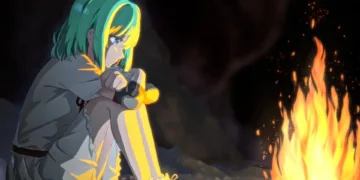
Kimika leaves the deepest impression. Her early mascot energy initially looks like familiar visual-novel shorthand, then her route reveals someone observant enough to recognize the fear everyone else is hiding. Her optimism changes the emotional temperature of the cave without making its danger feel smaller.
The serious character writing makes the lighter romcom scenes harder to accept. Atlas can shift from perceptive scientist to oblivious romantic lead within a few lines, while capable women suddenly perform cutesy routines that do not fit the pressure surrounding them. These scenes do not provide relief. They briefly make the cast feel borrowed from another game.
A Map That Remembers
The electronic map is the design choice that binds the experience together. Inside the story, Atlas uses it to chart the cave. For the player, it becomes a flowchart showing major decisions, locked branches, relationship changes, and completed endings. Reaching a dead end never feels punishing because returning to an earlier choice takes seconds. The interface respects the player’s time while keeping the fiction intact.

The same care does not extend to the puzzles. Symbol combinations, directional challenges, and a memory game modeled after Simon offer brief interaction, with hints available for players who want to continue reading. They rarely ask for genuine deduction, which feels strange in a story built around hidden connections. The player uncovers the mystery mainly by selecting routes rather than solving it.
Visually, the cave avoids becoming a repeated backdrop. Different chambers carry distinct architecture and atmosphere, while pans, zooms, and illustrated flashbacks keep long explanations from settling into static text. The character designs use posture, build, and facial expressions to keep the compact cast readable. Partial voice work is less effective, often sounding flat and synthetic, though it can be disabled.
Caleb Coles’ score supplies much of the game’s pulse. Soft piano gives quieter conversations room to breathe, ominous textures deepen the cave’s isolation, and guitar-driven tracks push the sharpest confrontations forward. A few cues overwhelm scenes that need restraint, yet the music frequently makes the underground space feel larger, darker, and harder to leave behind.
The Review
Advent: Dawn
Advent: Dawn understands that a branching mystery should make every return to an old choice feel charged with new meaning. Its cave map turns repetition into discovery, while Kimika’s route and Atlas’s fractured perception give the conspiracy an emotional pulse. Some branches stall in exposition, the puzzles barely test deduction, and the true route withholds too many useful clues before revealing its hand. Still, Spire Games has built a tense, thoughtful visual novel whose rough edges rarely weaken the desire to see what waits behind the next locked path.
PROS
- Absorbing central mystery
- Excellent route map
- Strong cave atmosphere
- Kimika’s affecting character route
- Memorable, tension-driven score
CONS
- Uneven route development
- Overly simple puzzles
- Forced romantic-comedy scenes
- Final revelations need stronger clues