








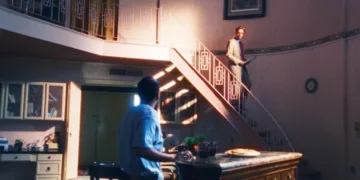


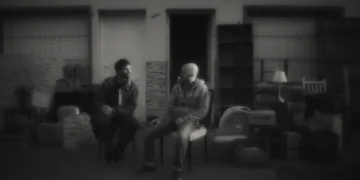

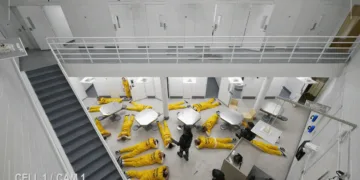

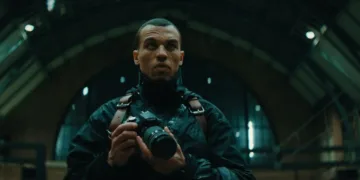












Police remove dancers from a Beijing auditorium while George Michael sings “Freedom,” and the image traps Mike Christie’s documentary inside its richest contradiction. The song is buoyant, the staging bright, the band dressed for release. The room is governed by stillness.
Uniformed authority patrols the aisles, spectators have been told to remain seated, and any body that answers the rhythm too openly risks expulsion. The lighting is flat and practical, almost administrative, which makes the pop spectacle look less like an invasion than an unauthorized color entering a controlled frame.
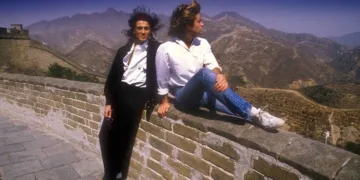
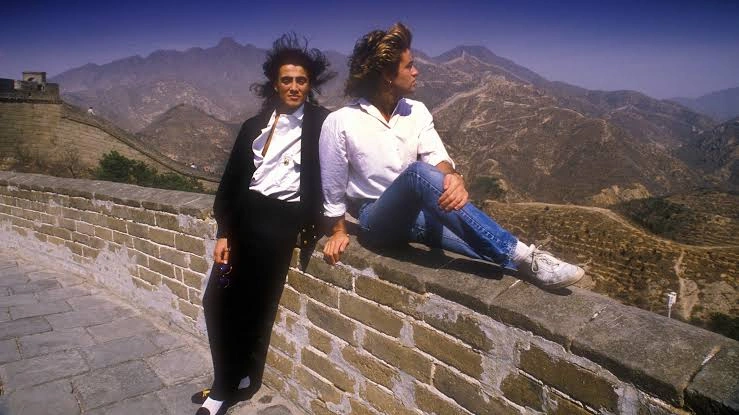
WHAM! 10 Days in China reconstructs George Michael and Andrew Ridgeley’s 1985 visit to Beijing and Guangzhou, where Wham! became the first Western pop act to perform in communist China. Christie draws from restored footage shot for Lindsay Anderson’s abandoned tour documentary, adds unseen material, and places present-day interviews beside the younger men’s candid reactions. Andrew Ridgeley returns to locations from the trip, while band members, managers, crew, and Chinese attendees describe what the visit meant before Western music could cross borders with a click.
The film carries two histories at once. One concerns a British duo chasing American recognition. The other concerns a Chinese audience encountering a form of public pleasure whose rules had not yet been written for them. The overlap is messy, commercial, moving, and occasionally dangerous.
The Price of a First
Wham!’s management did not arrange the trip from pure diplomatic zeal. The group had conquered Britain and several international markets, yet the United States remained the coveted prize. Manager Simon describes the China concerts with refreshing bluntness: being first would create headlines, and headlines would create American curiosity. Ridgeley, looking back, calls the scheme cynical and risky. He does not sound ashamed. He sounds impressed that it worked.
Christie benefits from this candor because it strips the event of ceremonial varnish. The ten-day visit contained only two concerts. The remaining schedule was built from embassy appearances, formal dinners, sightseeing, press conferences, staged encounters, and visits arranged for cameras. Michael and Ridgeley were expected to act as musicians, tourists, diplomats, and marketable symbols, sometimes within the same hour.
The original production hired Lindsay Anderson, director of If…. and This Sporting Life, to film the trip. It was a strange marriage. Anderson had little interest in Wham!’s music, while the duo wanted a film that captured the force of their performances and the scale of their ambition.
His foot injury confined him to a wheelchair for much of the visit, but his camera remained unsentimental. It watched irritation settle across faces. It held on pauses that promotional footage would have trimmed. It recorded the distance between the event Wham!’s team wanted to sell and the experience the young performers were actually having.
Anderson’s footage gives Christie’s film its ethical shadow. The frame often seems to distrust everyone inside it. Managers turn cultural access into strategy. Journalists convert exhaustion into copy. The band performs openness while guarding itself from scrutiny.
Even the documentary apparatus becomes part of the pressure, always present, always hungry. Anderson may have been the wrong director for the tour film Wham! wanted. He was exactly the right witness for the unease they could not hide.
Learning the Beat
The Beijing footage possesses the severe visual clarity of an accidental science-fiction film. Michael and Ridgeley move through streets of muted clothing and functional architecture in oversized jackets, sculpted hair, and the confidence of men accustomed to being watched. Crowds gather around them without the easy choreography of fandom. People stare because these visitors look like evidence from another social order.
One of Christie’s finest sequences follows Chinese teenagers who received Wham! cassette tapes with their concert tickets. They hurry to hear “Wake Me Up Before You Go-Go,” and the camera catches confusion before delight. Their expressions do not require explanation. A new musical language arrives through a cheap plastic object, and the first response is neither reverence nor rebellion. It is curiosity. Then the rhythm takes over.
The Beijing concert gives the documentary its strongest dramatic structure. Wham! enters expecting the visible feedback that drives a pop performance: dancing, shouting, bodies pushing toward the stage. Instead, the audience remains seated under police instruction. Michael and Ridgeley read restraint as indifference because they have no other code available. The crowd, meanwhile, has no sanctioned code for expressing what it feels.
This misunderstanding gives the sequence its tension. Christie cuts between the band searching the room for energy, spectators testing the limits of movement, and security personnel enforcing those limits. The editing turns a concert into a negotiation conducted through glances and half-risen bodies. When dancers are removed, the moral geometry becomes brutally simple. The stage is flooded with motion. The floor is disciplined into stillness.
“Freedom” carries an extra charge in this setting. Management worries that lyrics about prisoners and keys may sound politically provocative. The concern is almost comic until the camera returns to the seated crowd and the officers at the edges of the frame. A song dismissed in Britain as glossy pop suddenly acquires the weight of forbidden interpretation. Location changes the politics of sound.
Guangzhou offers a looser atmosphere, shaped partly by Hong Kong’s cultural influence. The audience responds with greater ease, and the band finally receives the feedback it knows how to use. The performance breathes. Yet the documentary’s tension thins with that freedom. Beijing remains the defining site because resistance, confusion, and desire occupy the same shot.
Faces Behind the Flashbulbs
The archival material is ruthless about the labor of appearing delighted. Michael and Ridgeley smile through sightseeing stops, official receptions, and questions they plainly resent. Michael hides his irritation with greater control. Ridgeley’s politeness looks increasingly brittle, his face tightening before his words catch up. Christie does not turn these differences into a simple personality contest. He watches two men develop separate defenses against the same machinery.
The press conference exposes those defenses. British tabloid reporters arrive ready to puncture the band’s image, while local journalists treat the visit as a rare political and cultural event. Michael and Ridgeley need the coverage that torments them. Their publicity plan depends on people they dislike, and the camera keeps returning to that dependence with a quiet cruelty.
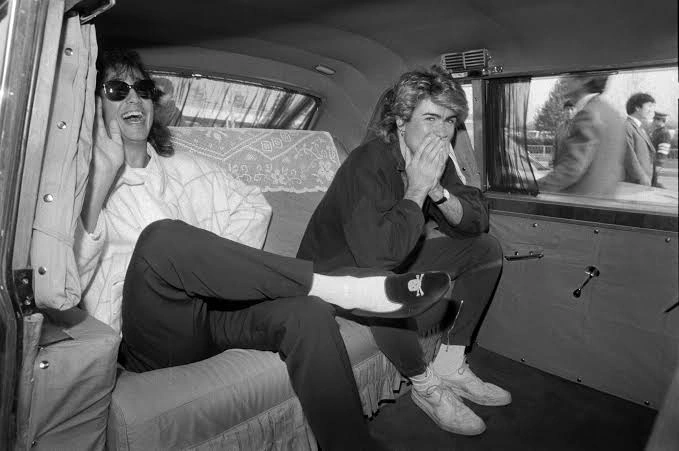
Tension between the duo surfaces in clipped exchanges and small abandonments. Michael leaves Ridgeley alone during one appearance, and the moment lands harder than a staged confrontation would. The gesture is brief, yet it reveals how fame reorganizes friendship through schedules, obligations, and unequal capacities for concealment. Their bond is still visible in backstage laughter and the group singalong to “Runaway,” but warmth here is captured between demands, never outside them.
Christie is less assured when the darkness extends beyond the famous pair. Trumpeter Raul D’Oliveira’s suicide attempt on the flight from Beijing is mentioned with startling brevity. The event points toward a level of psychological strain the film does not examine. That omission is not a missing sidebar. It is a door opened onto another film, then shut before the room can be seen.
The Archive Looks Back
Christie uses a familiar arrangement of talking heads and archival footage, yet the construction works because the past keeps contradicting the present. Ridgeley remembers the trip with wonder, while his younger self complains, withdraws, and braces against each new obligation. Managers describe strategy with the calm language of hindsight, then Anderson’s footage reveals the confusion that strategy produced on the ground.
The restored images carry texture that polished commemorative documentaries often erase. Faces drift in and out of imperfect focus. Public spaces look cold without being stylized as sinister. The camera catches Michael’s concentration before a performance, Ridgeley’s exhaustion during press duties, and Chinese spectators watching with the wary attention of people unsure how much feeling they are permitted to display. Light becomes evidence. So does hesitation.
The concert footage confirms Michael’s command of the stage. During “Everything She Wants” and “Careless Whisper,” his voice remains controlled while his body works the crowd with precision. Ridgeley supplies movement and ease, giving the stage picture its outward confidence. Yet Christie often cuts songs short or allows commentary to run across them. The absence of a full Beijing performance of “Blue” will frustrate viewers seeking a concert document. The choice clarifies the film’s priorities: music appears here as social force, not collectible performance.
Sony Music’s involvement introduces another layer of calculation. The documentary arrives beside renewed archival interest in George Michael, turning a publicity campaign from 1985 into material for a new promotional cycle. Christie does not pursue that parallel as sharply as he might. Still, the contradiction sits inside the film. A corporate product preserves evidence of how corporate strategy collided with state control and produced genuine human release.
The closing use of “Careless Whisper” works because the documentary finally reduces its explanations. Michael sings. The camera watches. In a film crowded by managers, journalists, officials, and competing agendas, the voice is allowed to occupy the frame without an escort.
WHAM! 10 Days in China is a documentary feature film that premiered in cinemas worldwide on July 28, 2026. The film explores the English musical duo’s historic and groundbreaking 1985 visit to perform live concerts in communist China. Viewers can watch the film through current theatrical screenings and upcoming broadcast platforms such as BBC Two.
Where to Watch WHAM! 10 Days in China (2026) Online





Full Credits
Title: WHAM! 10 Days in China
Distributor: Trafalgar Releasing
Release date: July 28, 2026
Running time: 90 minutes
Director: Mike Christie
Producers and Executive Producers: Alice Popplewell
Cast: George Michael, Andrew Ridgeley
Editors: Xanna Ward-Dixon
Composer: Dru Masters
The Review
WHAM! 10 Days in China
WHAM! 10 Days in China finds its sharpest image in the Beijing auditorium, where police remove dancers while George Michael sings “Freedom” to a crowd ordered to remain seated. Mike Christie lets that contradiction breathe, using Lindsay Anderson’s restored footage to expose the commerce, irritation, and fragile human contact behind the historic tour. The film occasionally retreats from darker material, especially Raul D’Oliveira’s crisis, and its interrupted songs may frustrate fans. Still, the archive carries rare tension: pop spectacle caught inside a machinery of control.
PROS
- Remarkable restored archival footage
- Frank treatment of the publicity strategy
- Powerful Beijing concert sequences
- Revealing Michael and Ridgeley interactions
- Strong Chinese attendee testimony
CONS
- Limited uninterrupted concert footage
- D’Oliveira incident lacks examination
- Guangzhou section loses tension
- Corporate framing remains underexplored