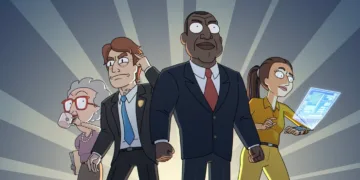











Curtis announces that he killed Paul Bunyan with the solemnity of a man discussing infrastructure spending. Keith David delivers the line without a wink, which is exactly why it works. The absurdity belongs to the office, not the voice.
President Curtis takes a recurring Rick and Morty character and gives him the full weight of the United States government, plus an alarming willingness to punch folklore. Across ten episodes, President Andre Curtis handles vampires, ghosts, secret territories, and historical loopholes himself. His administration has departments, protocols, and advanced weapons for problems that should not exist. Apparently Congress approved the cryptid budget.
The premise exposes a familiar political fantasy: the leader who rejects procedure and simply fixes things. Curtis is a president imagined through action cinema, part commander-in-chief, part Batman, part man desperate to remain the most impressive person in every room. Call it executive heroism, the belief that public authority becomes legitimate once the president personally suplexes a monster.
That idea gives the series a clearer moral shape than Rick and Morty. Rick treats competence as permission to abandon responsibility. Curtis treats responsibility as permission to demonstrate competence loudly. His ego remains enormous, yet he still wants to protect people. The distinction sounds small. It changes the entire temperature of the show.
History Becomes Government Property
The strongest episodes treat American history as a vault of unresolved supernatural paperwork. Abraham Lincoln returns as a ghost with unfinished business. A hidden clause inserted into the Louisiana Purchase by Napoleon threatens the country’s claim to the territory. Citizens demand that Lincoln’s face on Mount Rushmore receive a giant stone top hat.
These jokes work because they reduce national mythology to administration. Monuments become maintenance disputes. Treaties become cursed contracts. Dead presidents remain trapped inside the mythology built around them, forced to keep serving the country long after the country has finished using their faces.
The JFK archival joke, in which Texas is described as his favourite place, represents the show at its sharpest. It is blunt, historically loaded, and delivered quickly enough that the series refuses to admire its own cleverness. The humour assumes some familiarity with American history, though the basic cruelty of the joke survives without a textbook nearby.
At first, I wondered if the density of these references would restrict the audience. That concern faded. Specificity is the series’ best defence against becoming an accessory to Rick and Morty. The parent show built its identity from science-fiction obsession. Curtis needs his own field of knowledge, and American civic mythology gives him one with an almost endless supply of absurdity. Few nations have worked so hard to turn their leaders into architecture.
The People Behind the President
Curtis is joined by chief of staff Banks and bodyguard O’Doyle, two characters designed around revelations before they are fully designed around personalities. Banks has a robotic brain and data cables hidden in her ponytail. O’Doyle is half-leprechaun, cannot lie, and approaches personal protection with the rigid seriousness of a man guarding both the president and the concept of masculinity.
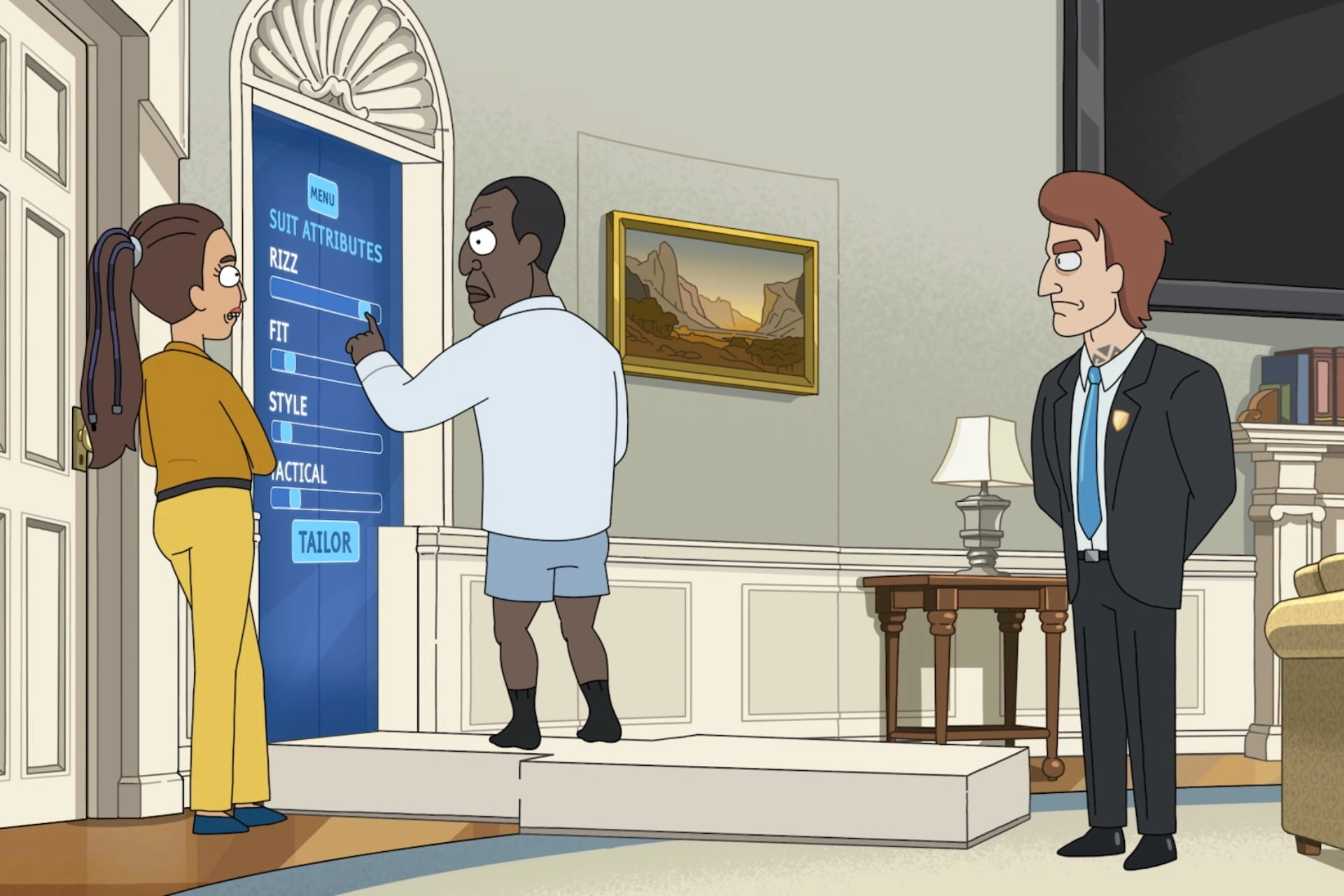
Stephanie Beatriz gives Banks a brisk warmth that keeps exposition from becoming an obstacle. Jim Rash plays O’Doyle with square-jawed discipline, pushing far away from the anxious comic energy associated with many of his roles. Their petty arguments with Curtis create a functional workplace rhythm, especially when national catastrophe pauses for wounded pride or procedural bickering.
The trouble arrives when Curtis leaves the scene. Banks and O’Doyle carry mysteries concerning their origins, yet mystery is not the same thing as depth. The season keeps asking what happened to them before it gives enough attention to who they are now. This is narrative credit, borrowed against future episodes.
Curtis’ ex-wife, a powerful governor, creates a richer pressure point. His attempts to impress her expose the insecurity beneath his authority. He can defeat Paul Bunyan and still lose control of a conversation with someone who remembers him before the office. The series touches this contradiction, then returns to monster containment before it can become dangerous.
A Spinoff Caught Between Two Countries
Visually, President Curtis remains close to Rick and Morty: bright colours, simple outlines, blotchy pupils, and dialogue delivered at a speed that suggests silence has been outlawed. The calmer sitcom-style opening theme introduces a useful tonal counterweight. Each episode also ends with Curtis singing about the latest crisis in the shower, turning presidential self-mythology into a private musical ritual.
Those choices hint at a separate identity. The weaker episodes abandon it.
Curtis’ trip into Hollow Earth and the mission involving a secret monster prison in the Bermuda Triangle resemble plots that could have been assigned to Rick with minimal alteration. Science fiction itself is not the problem. The missing ingredient is presidential specificity. Curtis becomes less interesting whenever he functions as a generic action hero moving through leftover franchise machinery.
The season’s repeated structure makes this drift easier to notice. A strange entity appears, Curtis mobilises the administration, the team argues, and the threat is contained. Political conflict, approval ratings, party pressure, and bureaucracy appear in brief bursts, then retreat. The series has access to the entire machinery of American power and sometimes chooses another dungeon.
Curtis survives that limitation through David’s performance. His deep, controlled delivery makes every declaration sound constitutionally binding, including the ridiculous ones. The shower songs reveal the same man from another angle: heroic, theatrical, faintly lonely, and incapable of experiencing an event without casting himself as its legend.
There is a sharper series hiding inside this one, somewhere between Abraham Lincoln’s ghost and a disputed clause in the Louisiana Purchase. It already knows that America is a supernatural idea maintained through paperwork, monuments, violence, and branding. It simply needs to stop visiting places Rick Sanchez could reach first.
This animated sci-fi comedy series premiered on Adult Swim and Max on June 14, 2026, serving as a spin-off of Rick and Morty. The show follows the United States President as he deals with extraordinary government crises and cosmic threats without the help of his former scientific acquaintances.
Where to Watch President Curtis Online







Full Credits
Title: President Curtis
Distributor: Adult Swim, Max
Release date: June 14, 2026
Rating: TV-14
Running time: 22 minutes per episode
Director: Jacob Hair, Kyoung Hee Lim
Writers: Dan Harmon, Alex Rubens, Albro Lundy
Producers and Executive Producers: Dan Harmon, Scott Marder, Steve Levy, James Siciliano
Cast: Keith David, Chris Parnell, Kari Wahlgren, Tom Kenny, Spencer Grammer, Sarah Chalke, Ian Cardoni, Harry Belden
Editors: Lee Harting
Composer: Ryan Elder
The Review
President Curtis
President Curtis finds its sharpest identity when American history becomes a supernatural filing cabinet and Keith David is handed the key. Curtis carries the show through sheer vocal authority, wounded pride, and the conviction that every national crisis requires presidential hand-to-hand combat. Call it executive exceptionalism (with vampires). The season weakens when its missions resemble discarded Rick and Morty premises, while Banks and O’Doyle remain better concepts than characters. Still, the historical satire offers a sturdy foundation for a stranger, sharper second term.
PROS
- Keith David’s commanding performance
- Sharp American history satire
- Strong presidential action-comedy premise
- Playful shower-song endings
- Lighter tone than its parent series
CONS
- Repetitive weekly structure
- Generic science-fiction detours
- Thin supporting characters
- Limited development for Curtis
- Ongoing plots lack weight