




























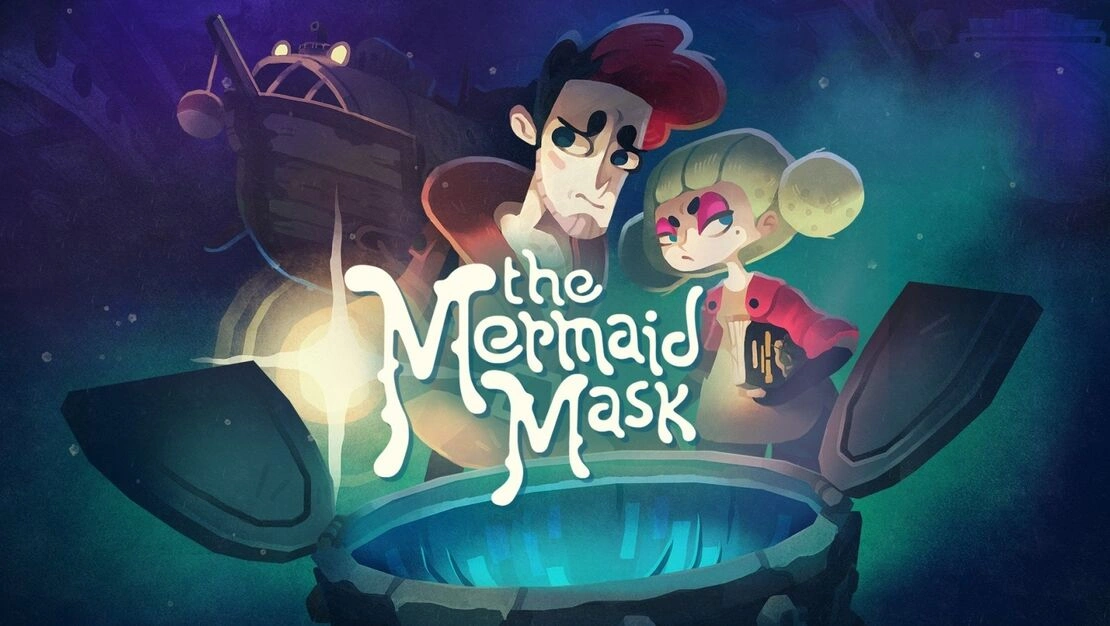

Tangle Tower left Detective Grimoire with a difficult act to follow. Its colorful suspects, hand-drawn animation, and conversational deductions gave SFB Games’ mystery series a clear identity, yet its final explanation struggled to match the strength of the investigation. The Mermaid Mask keeps that same structure and fixes the part that mattered most: the case itself.
Grimoire and his assistant Sally are summoned to the Mortuga Submarine after its owner, Magnus Mortuga, is found dead inside a locked chamber. The door was sealed, the captain was alone, and a mysterious cauldron sits beside the body. It is a classical locked-room setup placed inside an unusual crime scene, since the submarine already functions as an enclosed community where every resident has some personal connection to Mortuga.
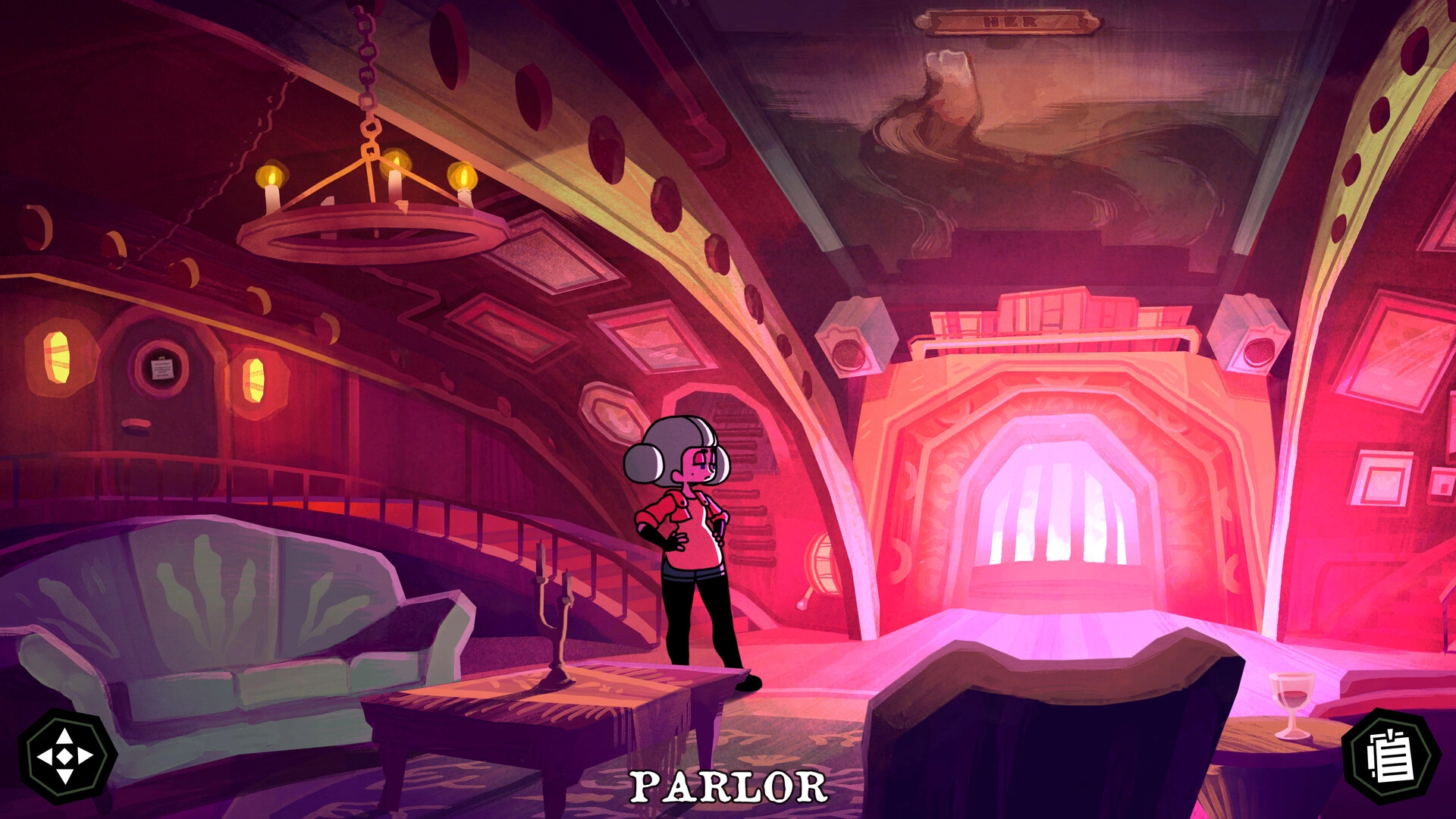
The location gives the story a tighter shape than Tangle Tower. Rooms branch from a manageable central map, suspects remain nearby, and new evidence regularly changes the meaning of places already searched. The mystery still indulges supernatural suggestions and eccentric detours, but the solution rests on clues placed throughout the investigation. Its final confrontation lands because the game has taught the player where to look.
A Ship of Suspects
Mortuga’s passengers resemble the cast of a stage production assembled by someone with questionable hiring practices. Sinthia, the submarine’s enthusiastic new captain, speaks with an earnestness that makes every accusation feel slightly rude. J.D. Wirman hunches over his glasses while struggling to write a sequel to his successful novel. Symmetry turns ordinary conversation into theatrical recital. Dr. Zephyr’s slow movements and low delivery make even harmless statements sound like warnings.
Then there is Mr. Gripp, an airborne merchant who arrives with Cornelius Cane, a walking cane with a face, and immediately opens a shop interface in a game with no currency. It is a small joke, yet it captures SFB Games’ approach to character writing. Each suspect receives one strong comic idea, then enough history and contradiction to avoid becoming trapped inside it.
Questioning the crew reveals how Mortuga collected people who were lonely, unsuccessful, displaced, or hiding from something. Some saw him as a rescuer. Others depended on his money, influence, or protection. Those relationships give the murder motives with emotional weight rather than reducing the cast to a row of colorful alibis.
Grimoire and Sally remain the series’ strongest pairing. His deliberate questioning and her sharper reactions create a natural rhythm during long conversations. Their comments on background objects are often funny, but the humor also establishes how differently they interpret the same room. The full voice cast gives each suspect a distinct cadence, which matters in a game where listening occupies far more time than moving.
Clues You Must Earn
The basic investigation loop will be familiar to returning players. Grimoire searches each room, collects evidence, questions suspects, and presents objects to anyone who might recognize them. Physical clues can be rotated in three dimensions, revealing switches, markings, or concealed compartments that a flat inventory image would hide.
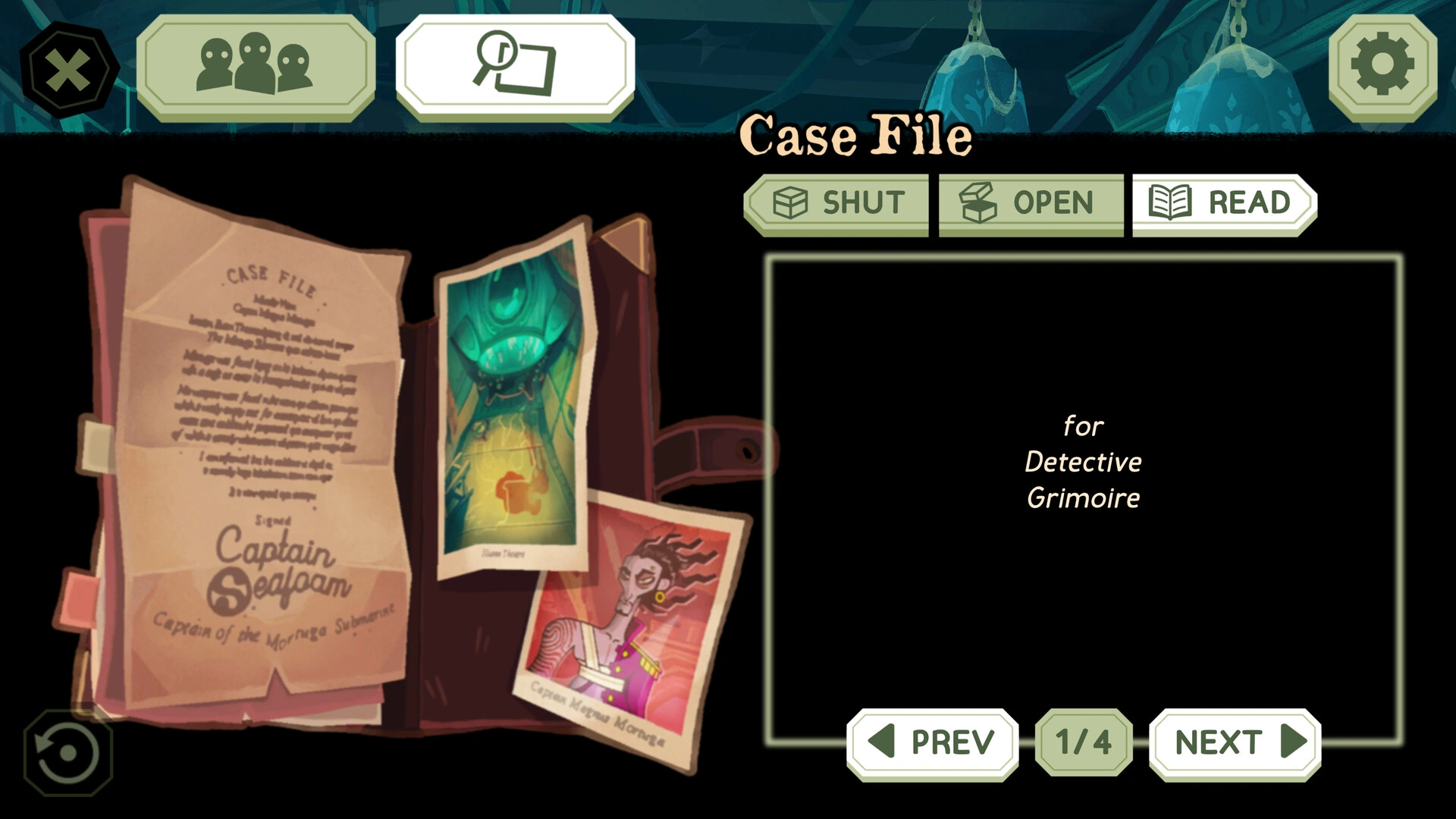
The submarine contains roughly 50 pieces of evidence, and many acquire several comments from different characters. This creates dense chains of information. A strange object may appear meaningless until one suspect explains its purpose, another reveals who owned it, and a third accidentally contradicts the established timeline. The notebook records those details, sparing the player from maintaining an actual detective wall covered in string.
Freedom creates one weakness. Any clue can be presented to any character, so a stuck player can cycle through the entire inventory until something triggers. I did this rarely, but the possibility weakens the satisfaction of choosing evidence through deduction. Later sequences can also stall when progress depends on one overlooked object or one specific conversation.
The thought-mapping confrontations remain the better half of the deduction system. Once enough evidence has been collected, Grimoire assembles a suspect’s history through fill-in-the-blank statements and supporting clues. These sequences ask the player to reconstruct motives, expose false alibis, and distinguish between closely related interpretations. Some answer choices use similar wording, which can make a correct idea feel rejected on a technicality, yet the process gives every major revelation a mechanical step.
Boxes, Bones, and Pig Faces
Mechanical puzzles interrupt the questioning at useful intervals. One safe requires twisting a pig’s expression into number combinations. Another challenge involves arranging peculiar skulls across a grid. Elsewhere, Grimoire catalogues mushroom species, sorts damaged compasses according to navigational conditions, and rotates components to reproduce specific patterns.
These puzzles rarely depend on obscure adventure-game logic. Most can be solved by studying the object, reading nearby information, and testing a clear theory. Failed attempts prompt Grimoire or Sally to offer increasingly useful remarks. The separate hint system can point toward the next productive location without charging a resource or punishing the player, and much of the assistance can be ignored by deduction purists.
A few interactions demand exact placement, especially when manipulating objects in three dimensions. Controller support also treats the analogue stick like a mouse cursor, making small targets awkward to select. These problems are most noticeable during the first half, where a stubborn puzzle can interrupt the case before its main relationships have gathered momentum.
The presentation carries those slower passages. Characters shift posture, polish glasses, lean forward, or recoil during questioning, giving the hand-drawn figures a physical presence missing from many dialogue-led adventures. Each room reflects its occupant, while Raphael Benjamin Meyer’s score assigns musical identities to characters and several minigames without competing with the voice work.
The unlockable art gallery reveals early concepts and artist commentary for the cast. It also shows how carefully SFB Games built a crew whose silhouettes, gestures, rooms, voices, and secrets all point in the same direction, right up until the evidence proves they do not.
The Review
The Mermaid Mask
The Mermaid Mask refines the Detective Grimoire formula without discarding what made Tangle Tower memorable. Its locked-room case is better resolved, its suspect investigations give evidence a clearer purpose, and its mechanical puzzles consistently reward observation. The unrestricted clue system occasionally permits brute-force progress, while some early puzzles slow the case at awkward moments. Those issues barely disturb a mystery carried by sharp dialogue, expressive animation, distinct musical themes, and a cast worth interrogating long after their alibis collapse.
PROS
- Satisfying locked-room mystery
- Memorable, fully voiced suspects
- Inventive mechanical puzzles
- Stronger ending than Tangle Tower
- Expressive animation and music
CONS
- Some finicky puzzle interactions
- Occasional clue brute-forcing
- Early pacing can stall
- Closing references favor returning players