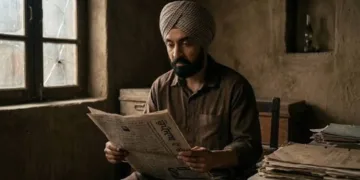



















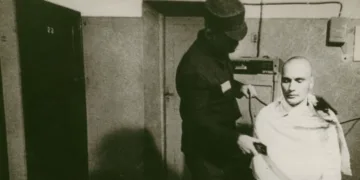









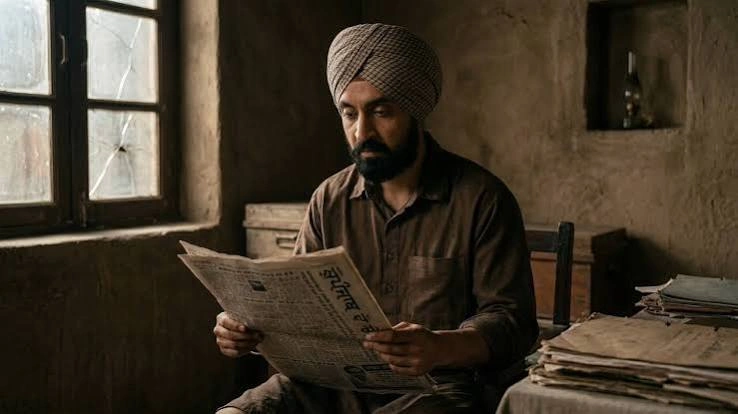

The most devastating discovery in Satluj is a clerical one. Jaswant Singh Khalra finds that people still listed as missing have already been registered as unclaimed bodies, cremated at public expense, and reduced to entries in municipal ledgers. Honey Trehan builds his film around that rupture between official language and lived reality. A disappearance becomes a statistic. A corpse becomes an expense. A grieving family becomes an administrative inconvenience.
Previously titled Panjab ’95, the film chronicles Khalra’s investigation into extrajudicial killings in Punjab during the 1990s. Diljit Dosanjh plays him as a bank manager, husband, father, and devout Sikh whose familiarity with figures and records proves unexpectedly dangerous. His friend Kirpal is found dead after disappearing. Kirpal’s mother, Gurpej, later vanishes after confronting the police. Jaswant’s search for her leads through hospitals, morgues, crematoriums, and police stations, each place offering another fragment of a system designed to conceal its own violence.
The film’s own troubled release history sharpens that premise. Removed from the Toronto International Film Festival lineup in 2023, delayed through years of censorship disputes, and briefly released on ZEE5 before being withdrawn, Satluj has been subjected to the same struggle over access and public memory that drives its narrative. Trehan’s subject is the destruction of evidence. The film’s circulation became part of that argument.
The Ledger of the Dead
Indian political cinema often turns injustice into speech. Trehan begins with paperwork. Jaswant notices dates that fail to align, names that disappear between registers, and cremation expenses that suggest a scale nobody wants to acknowledge. His banker’s eye becomes an investigative instrument. He does not uncover the machinery through a single confession or dramatic raid. He reconstructs it through repetitions, discrepancies, and signatures.
The method gives Satluj the texture of a procedural. Gurpej’s name appears in crematorium records while her family is still searching for her. Workers describe bodies arriving in large numbers. Postmortem reports are issued with suspicious speed. Police officers label civilians as militants, stage encounters, dispose of bodies, and claim professional rewards for their supposed victories. In one of the film’s most horrific details, corpses are cut before being thrown into canals so they will not float back to the surface.
Trehan gives each stage of this process a concrete institutional location. The police station refuses to register complaints. Hospitals formalize the deaths. Crematoriums erase identities. Senior officers protect the chain. The violence is physical, yet its survival depends on administration.
The screenplay also exposes an extortion racket built around uncertainty. Families are told that missing relatives may be held by militants. Money is demanded for their release. Parents borrow heavily, clinging to the possibility that their children remain alive, while the same authorities may already have destroyed the bodies. The cruelty lies in the killing and in the calculated preservation of false hope.
Jaswant’s investigation expands from one missing woman into evidence of a coordinated practice. Public meetings, legal petitions, international attention, and witness testimony follow. The film changes shape with him, moving from mystery to procedural, then into courtroom drama and political thriller. At times, the transitions rely too heavily on voiceover, with information recited after the images have already made the point. Still, the accumulated documents create their own dramatic pressure. Each page narrows the distance between rumor and proof.
Faith Under Surveillance
Dosanjh refuses the usual performance of biographical greatness. He does not turn Jaswant into a speech-making monument. His voice remains soft. His posture is composed. Fear registers through pauses, lowered eyes, and the effort required to keep speaking in rooms controlled by hostile men.
The line that defines him comes during a conversation with his wife Paramjeet: “I can’t unsee what I’ve seen.” Dosanjh delivers it without theatrical force. The sentence lands as a private admission, one that explains why retreat has become impossible. Jaswant understands the danger to himself and his family. His courage grows from that understanding rather than ignorance of it.
Sikh faith is central to the performance and to Trehan’s conception of activism. Prayer does not replace evidence gathering. It sustains it. Jaswant’s spiritual life is expressed through service, responsibility, and the refusal to abandon people whose names have been removed from public record. The film places devotional feeling beside registers, court petitions, and witness statements, drawing no separation between moral belief and practical action.
Geetika Vidya Ohlyan gives Paramjeet a quiet authority that keeps the family scenes from becoming sentimental pauses. She respects her husband’s purpose and fears the price it may demand. Her glances toward their children carry the argument that the script rarely states aloud: public courage can create private catastrophe.
Their marriage is defined through restraint. Jaswant does not pretend that his campaign leaves the household untouched. Paramjeet does not exist simply to bless his sacrifice. The pressure between them remains unresolved because no reassuring answer exists. A principled choice can still wound the people closest to the person making it.
That tension extends to Satnam Singh, Jaswant’s childhood friend within the police force. Saurabh Sachdeva plays him as a man trapped inside the institution he quietly betrays. He supplies information while knowing that access offers little protection. His remark about dark truths written on black pages captures the central paradox of the film: evidence can exist everywhere and remain unread.
The Banality of Authority
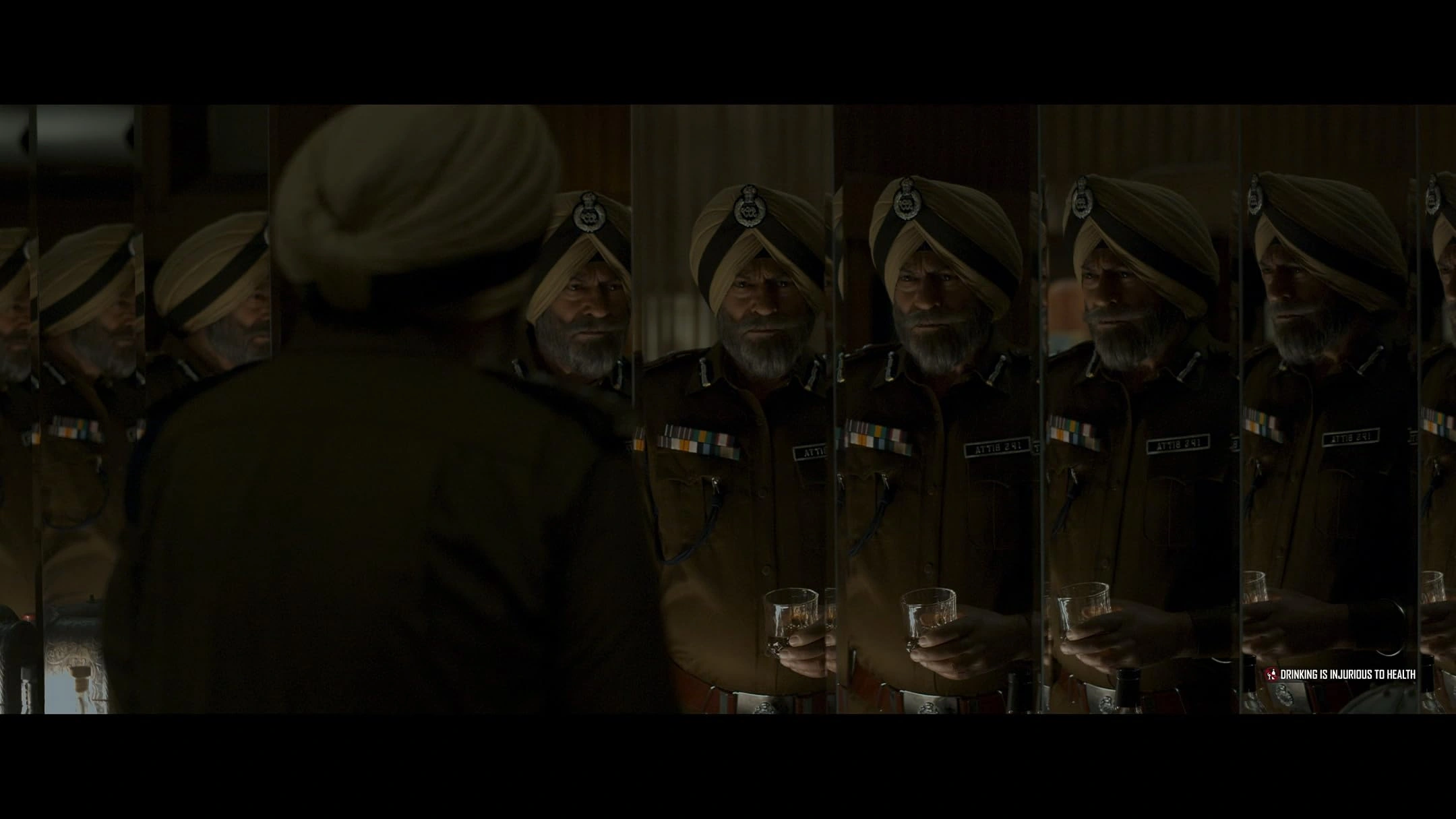
Suvinder Vicky’s SSP Sugga rarely needs to shout. His calmness is the source of his menace. He enters conversations knowing that rank, weapons, and institutional loyalty have already arranged the outcome.
The sequence inside Satnam’s home displays that power with brutal precision. Sugga occupies a domestic room as though it belongs to him. He stretches the visit, watches the family’s discomfort, and turns ordinary conversation into interrogation. Satnam sits nearby, terrified and ashamed, unable to protect his own household. Violence has entered the home before anyone raises a hand.
Vicky plays Sugga as a careerist who has converted murder into professional routine. His cruelty is connected to promotion, prestige, and obedience. He does not view himself as an aberration. He sees himself as an efficient officer operating under permission from above.
Kanwaljeet Singh’s DGP Bitta supplies that permission with polished language. When Jaswant presents evidence, Bitta dismisses human rights activism as foreign-funded theatre. The accusation does two things at once: it avoids the substance of the records and recasts the investigator as an enemy. The same rhetorical move remains familiar across democracies where criticism of state violence is treated as disloyalty.
Trehan situates this machinery within the political history of Punjab. The trauma of the 1984 anti-Sikh violence, separatist militancy, assassinations, and counterinsurgency forms the atmosphere surrounding every conversation. The film does not attempt a complete account of the Khalistan movement. Its narrower concern is the moment when the state stops distinguishing between militant, civilian, witness, and critic.
Arjun Rampal’s CBI officer Samudra Singh provides an institutional counterweight. He reminds a rogue officer that past violence cannot grant endless permission for planned killings. His presence keeps the film’s critique focused on impunity rather than reducing the state to a single villainous body. Law remains present, though weakened by those charged with enforcing it.
The film’s strangest scene arrives when a dead man appears before Kuljit, a witness who withdrew his testimony after police intimidation. The ghost describes his death, and Kuljit later returns to Samudra. He had feared the police. Now he fears God. The shift into the supernatural works because the film has already treated the missing as a presence pressing against every official lie.
Punjab Noir
U. Mohanan photographs Punjab as a landscape where visibility itself has become political. Roads, canals, crematoriums, and police compounds sit beneath heavy shadow. The darkness does not hide the crimes completely. It makes them legible in fragments.
The opening establishes this visual grammar. Police officers speak casually before carrying out executions under moonlight. Their ordinary tone clashes with the violence that follows. Trehan avoids frantic cutting. The composure makes the scene harder to escape because the men behave as though nothing exceptional is happening.
The Satluj River becomes the film’s defining geographical image. Bodies are thrown into its water to remove them from courtrooms, families, and public memory. Punjab’s rivers carry deep cultural and spiritual meaning, tied to land, livelihood, partition, migration, and song. Here, the river is forced into service as an accomplice. Its flow offers concealment, yet the film restores what the current was meant to erase.
Marc Marder’s music supports the spiritual register without softening the political one. Punjabi poetic language enters conversations and testimony, while the credited influence of Shiv Kumar Batalvi can be felt in the film’s union of longing, death, and landscape. Trehan draws from regional literary and cinematic traditions rather than dressing a standard Hindi biopic in Punjabi detail.
A few stylized touches, including an overhead coin toss rendered in black and white, interrupt the procedural realism. These moments place Satluj near noir, where institutions manufacture uncertainty and evidence can place the investigator in greater danger than ignorance. Mohanan’s lighting gives moral pressure a physical shape. Faces emerge from darkness, then retreat into it.
The 163-minute runtime tests the film’s control. Courtroom statements repeat facts established through earlier scenes, and voiceover occasionally treats viewers as inattentive jurors. Trehan’s insistence has a historical reason, since suppressed evidence often requires repetition before it enters public consciousness. On screen, the same insistence can flatten tension.
The film regains its force whenever it returns to people confronting the administrative remains of the dead: Gurpej striking a police vehicle in grief, Paramjeet watching Jaswant leave the safety of home, Satnam sitting powerless before Sugga, Kuljit choosing truthful testimony after being visited by a ghost. These scenes give the records their human weight. A ledger proves that someone died. Satluj asks who will speak the name.
This powerful biographical drama premiered on ZEE5 on July 3, 2026, after facing years of censorship battles and delays. The film follows human rights activist Jaswant Singh Khalra as he investigates extrajudicial killings and enforced disappearances during the Punjab insurgency.
Where to Watch Satluj (2026) Online
Full Credits
Title: Satluj
Distributor: ZEE5
Release date: July 3, 2026
Running time: 164 minutes
Director: Honey Trehan
Writers: Honey Trehan, Niren Bhatt
Producers and Executive Producers: Ronnie Screwvala, Abhishek Chaubey, Honey Trehan
Cast: Diljit Dosanjh, Arjun Rampal, Suvinder Vicky, Geetika Vidya Ohlyan, Kanwaljit Singh, Rupan Bal
Director of Photography (Cinematographer): P. K. Varma
Editors: Amit Sharma
Composer: Sneha Khanwalkar
The Review
Satluj
Satluj turns the bureaucratic record into an instrument of remembrance, placing Jaswant Singh Khalra’s moral courage within the political and cinematic history of Punjab. Honey Trehan’s direction, K. U. Mohanan’s shadowed images, and Diljit Dosanjh’s restrained performance prevent the film from becoming a hollow monument. Its 163-minute structure repeats evidence and arguments that have already landed, yet the accumulation carries its own force. This is Indian political cinema at its most direct, mournful, and necessary.
PROS
- Diljit Dosanjh’s restrained performance
- Powerful procedural structure
- Haunting nocturnal cinematography
- Rich Punjabi cultural grounding
- Formidable supporting ensemble
CONS
- Repetitive courtroom material
- Heavy reliance on voiceover
- Overextended runtime