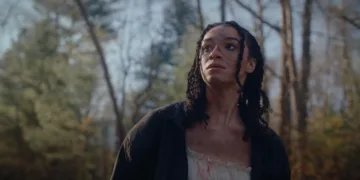





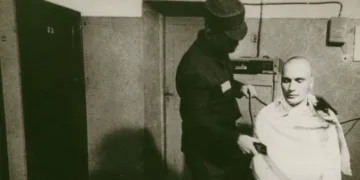

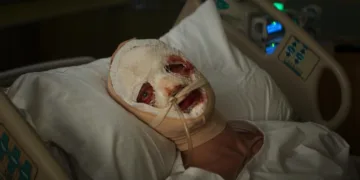
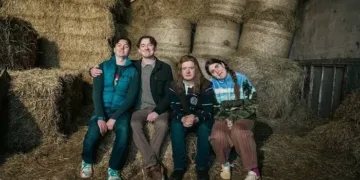




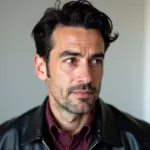
Vivian is asked to accept a family history she can watch but cannot remember. A home movie places her beside Ellis, the man who identifies himself as her adoptive father, but the images cannot supply the recognition she lacks. They establish that these people have shared time together. The meaning of that time remains largely in his custody. Having woken in an open grave in the woods, Vivian has immediate reasons to accept shelter and explanations. Ellis provides both, attributing her memory loss to an accident and treating her nighttime excursions as a recurring nuisance.
The house extends his authority into space. Vivian may recuperate there, but the attic is forbidden because, Ellis says, it contains dangerous mold. The restriction belongs to a Gothic vocabulary that has traveled far beyond its European literary origins: a household shelters a vulnerable newcomer while withholding access to its history. Evan Showalter gives that inherited prohibition a mundane explanation. Mold makes curiosity sound medically irresponsible. Vivian must investigate a place whose self-appointed protector has already defined investigation as a danger to her.
This is fertile ground for the religious horror running through The Leaching. Ellis’s devotion accompanies his insistence on an account of Vivian’s life that she cannot independently confirm. Belief becomes a practical condition of living under his roof. Accepting his care involves accepting his explanations, including the limits he places on her movements. The film’s interest in faith acquires force here, where trusting a parent and submitting to authority become difficult to separate. Its secluded household gives those questions an intimate scale, without needing to make Ellis representative of an entire religious culture.
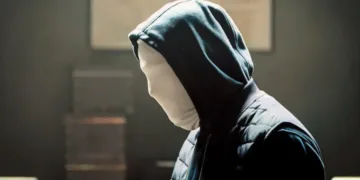
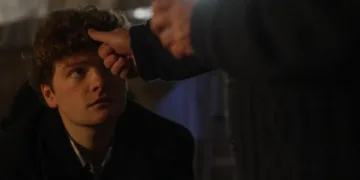
DeVaughn Loman makes that intimacy unpleasant through the persistence of his smile. Its apparent friendliness survives changes in the substance of his exchanges with Vivian, leaving an expression of reassurance attached to increasingly threatening behavior.
The effect is stronger than a simple alternation between kindly father and obvious villain would have been. Reese Parish gives him a responsive counterpart: Vivian’s initial caution develops into fear as the explanations available to her become harder to inhabit. Parish keeps the amnesia from functioning solely as a mechanism for withholding plot. Having no secure account of herself leaves Vivian dependent on each new encounter.
Showalter’s visual approach gives her uncertainty a form beyond those conversations. Visions of another woman, broken memories, dreams, and supernatural intrusions interrupt the available account of events. These experiences offer possible routes toward knowledge without arriving neatly labeled as reliable evidence. The fragmented editing by Theo Sanders and Showalter keeps Vivian’s identity under construction. A remembered image might challenge Ellis’s version of her past, but experiencing something vividly does not immediately make it intelligible. The psychological mystery benefits from that gap between receiving an impression and knowing how to use it.
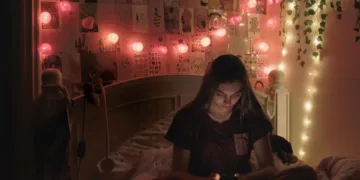
Amarillys Velasquez’s photography makes the physical search uneasy, too. Nighttime roads and tight corridors retain enough definition to invite scrutiny within the dark, grainy image. Subtle handheld movement prevents the confined spaces from settling into reassuring stability. The house’s restrictions are therefore felt through the difficulty of looking and moving, alongside Ellis’s verbal prohibitions. This is where the Gothic enclosure and the fractured identity story cooperate: a woman denied access to her own history occupies surroundings that remain difficult to read.

The dialogue repeatedly interrupts that cooperation. Strange discoveries lead into discussions, and extended explanations allow the film to restate pressures its images have already made available. Religious speech can be threatening when it shows Ellis imposing meaning on Vivian’s experience; it becomes tiring when the film itself seems intent on explaining its concerns.
At approximately 76 minutes, The Leaching is compact without being consistently economical. The recurring movement from disturbance to discussion gives portions of it a stop-start rhythm. With several horror forms competing for attention, these pauses consume space that might have allowed an encounter or suspicion to develop through action.
The leech creature changes the terms of that encounter. Gothic mystery encourages us to inspect what a household conceals; creature horror eventually asks us to inspect a body. Showalter’s mixture of practical and visual effects works best when darkness, close framing, and sound give the monster a concentrated physical presence. Its intermittent appearances can serve the mystery, preserving the sense that Vivian has entered a world whose threats exceed the explanations offered to her. Simply increasing its screen time would not resolve the film’s unevenness. The question is what each appearance permits us to perceive.
Dylan Obrochta gives the creature a tortured quality that complicates its place among those threats. Its distress makes sympathy possible, unsettling the division between the reassuring human figure and the frightening body. That complication suits a film concerned with the risks of accepting appearances and inherited accounts of identity. The creature’s gestures are especially useful because they give bodily expression a role in a story so frequently conducted through explanation. For a time, the monster can hold attention without another conversation interpreting it.
Those gestures also expose the uneven effects work. The mask offers a stronger impression than the arms, hands, and nail makeup, yet extended passages repeatedly direct attention toward those less finished areas. Close framing can concentrate the force of a design; sustained scrutiny can reveal how incompletely its parts belong together. Obrochta’s expressive work needs the hands to remain visible, so concealing every weakness would carry a dramatic cost. During these passages, the same gestures that make the creature seem distressed leave the viewer examining the comparatively unpersuasive body through which that distress must be communicated.
The Leaching released on Digital and On Demand on July 7, 2026, co-distributed by Dark Star Pictures and Uncork’d Entertainment. Written and directed by Evan Showalter, the indie psychological creature feature follows a young woman suffering from memory loss who wakes up in a grave and must navigate backwoods religious horrors and supernatural forces to uncover the unsettling truth about her family.
Where to Watch The Leaching (2026) Online






Full Credits
Title: The Leaching
Distributor: Dark Star Pictures, Uncork’d Entertainment
Release date: July 7, 2026
Rating: Not publicly specified
Running time: 1 hour 25 minutes (85 minutes)
Director: Evan Showalter
Writers: Evan Showalter
Producers and Executive Producers: Evan Showalter, Reese Parish, Devaughn Loman
Cast: Reese Parish, Devaughn Loman, Dylan Obrochta, Joseph Miller, James Lee
Director of Photography (Cinematographer): Evan Showalter
Editors: Evan Showalter
The Review
The Leaching
The Leaching carries Gothic anxieties about family and forbidden knowledge into a household where accepting care means accepting someone else’s account of your life. Parish and Loman make that dependence unsettling, while the fractured imagery gives Vivian’s uncertainty a persuasive visual form. Repetitive explanations drain the mystery’s momentum. The creature introduces a welcome possibility of sympathy, though its expressive performance exposes uneven makeup work.
PROS
- Family authority gives the religious horror substance.
- Parish and Loman sustain an uneasy relationship.
- Dark, readable photography supports Vivian’s uncertainty.
- Obrochta gives the creature a sympathetic presence.
CONS
- Repeated explanatory conversations interrupt suspense.
- Extended gestures expose unfinished creature makeup.