

























Alice Brauner’s decision to write and produce Block 10 carries an inheritance from postwar German cinema. Her parents, Artur and Maria, survived the Holocaust; her father’s filmmaking repeatedly sought to restore the victims of Nazism to public attention. Directed by Marcus O. Rosenmüller and drawing on survivor testimony and court records, this film continues that work through the women subjected to medical experiments at Auschwitz. Its place in that tradition makes the distribution of attention within the drama especially consequential.
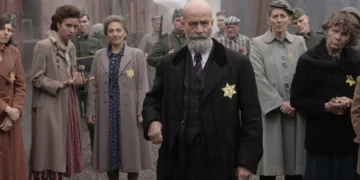
The principal character is Dr. Maximilian Samuel, a Jewish gynecologist separated from his wife and daughter upon arrival at the camp. Christian Berkel plays him as a man trying to preserve some purpose within a profession being used against its patients. Forced to assist Carl Clauberg’s sterilization experiments, Samuel complies under the threat of his daughter’s murder. We understand what he fears losing and how he explains his participation to himself. The women undergoing the procedures receive much less room for their lives beyond the treatment rooms, creating a troubling imbalance within the film’s memorial purpose.
Rosenmüller’s handling of space makes the prisoners’ lack of control immediately tangible. Peter Krause’s camera moves through dim corridors whose meaning changes with the people occupying them. Officers stride through territory they command; prisoners enter rooms without knowing what will happen inside. The camera’s exploratory movements offer little reassurance. Once a room becomes familiar, its repeated use makes familiarity itself oppressive. Remaining close to the characters prevents the architecture from becoming a detached historical exhibit. We learn the building through the permissions, threats, and routines governing movement inside it.
A comparison with the Hungarian Son of Saul clarifies this method. László Nemes restricts vision through shallow focus and a close attachment to one prisoner, leaving much of the surrounding violence blurred or offscreen. Block 10 also denies a commanding overview, yet its medical procedures repeatedly become explicit objects of attention. These films establish different relationships between proximity and knowledge. Rosenmüller keeps us spatially confined while giving us images we might wish to escape. His approach places considerable responsibility on repetition: each return to a procedure must communicate something beyond the fact that the violence continues.
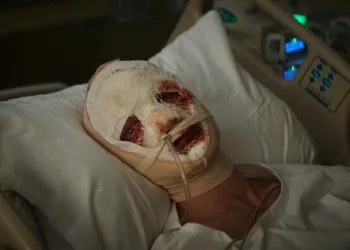
At its strongest, that repetition makes the organization of abuse unmistakable. The removal of a healthy ovary is followed by another procedure, without the release that a change of location or a reassuring subplot might provide. Medicine becomes a sequence of tasks in which the arrival of another patient supplies the next demand. Instruments appear chiefly while being used, rather than receiving decorative scrutiny. Clauberg’s enormous formalin syringe is a conspicuous exception, concentrating attention on the apparatus of his authority. The procedures continue after their cruelty has already been established, forcing recognition of their routine character.
There is a cost to that persistence. Once the sequence becomes predictable, another injured body can register chiefly as another instance. The absence of musical reassurance leaves the procedures exposed, while threatening, indistinct sounds make the surrounding rooms feel active even when their contents remain unseen. These choices create sustained pressure, but sustained pressure does not guarantee sustained attention to separate people. The film’s refusal of relief sometimes narrows the women’s visibility to the injuries being inflicted upon them.

Samuel receives a different kind of continuity. His appointment as head inmate doctor allows him to believe that remaining useful might let him alleviate suffering. His concern for patients exists alongside his participation in their abuse, and the possibility of research benefiting ovarian-cancer treatment offers another means of making that participation bearable to himself. Berkel’s anguished performance gives weight to this damaged professional reasoning. Samuel needs to believe that some recognizable part of medical practice survives in what he does. His actions repeatedly confront him with evidence against that belief.
The threat to his daughter prevents this from becoming an abstract debate about professional ethics. His captors have made his attachment to another person an instrument of control. Any assessment of his behavior must preserve the enormous difference between his constrained position and the Nazi doctors’ power. Axel Prahl’s leering Clauberg presents medical authority joined to personal domination; his conduct leaves little space for the comforting idea that scientific ambition has merely gone astray. Against that authority, Samuel’s attempts at compassion become painfully limited interventions within procedures he cannot make harmless.
The doctor who refuses further participation complicates Samuel’s accommodation without making refusal an easy prescription for every prisoner. Polish medic Alina Brewda, played by Marta Sroka, likewise introduces a different response to the camp’s demands. Such figures matter because they prevent Samuel’s reasoning from becoming the film’s sole available moral language.
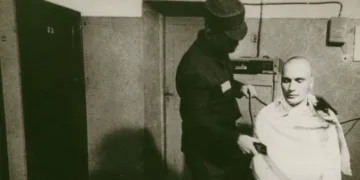
The limits of the film’s perspective are especially visible in the treatment of exposed bodies. Fragmentary views reduce the extent of exposure, apart from a collective nude scene, but the fragments remain connected to the abusive doctor’s position. Limiting what is shown cannot by itself change the relationship through which a woman becomes visible. Shorn hair, identical clothing, and numbers establish the camp’s systematic assault on identity. When successive procedures then make the women difficult to distinguish, the film risks allowing the institution’s imposed sameness to govern our own attention. Its historical subject demands that we recognize this process; its dramatic form struggles to give individual lives sufficient space beyond it.
The women’s quiet singing together permits a different relationship to emerge. Their voices make them audible to one another outside the medical routine, producing a shared activity that the doctors have neither prescribed nor organized.
Block 10 premiered at the Munich Film Festival on July 3, 2026, ahead of its European film festival circuit tour and theatrical release via Camino Filmverleih. Directed by Marcus O. Rosenmüller and written by Alice Brauner, the historical Holocaust drama follows Dr. Maximilian Samuel, a Jewish gynecologist in Auschwitz who is coerced by Nazi officers to assist in brutal forced sterilizations to protect his daughter’s life.
Full Credits
Title: Block 10
Distributor: Camino Filmverleih, Atlas International, CCC Cinema und Television, MZ-Film
Release date: July 3, 2026 (Munich Film Festival)
Rating: 16 / Unrated
Running time: 1 hour 44 minutes (104 minutes)
Director: Marcus O. Rosenmüller
Writers: Alice Brauner
Producers and Executive Producers: Alice Brauner, Michael Zechbauer
Cast: Christian Berkel, Axel Prahl, Bibiana Beglau, Moritz Führmann, Johannes Zirner, Marta Sroka, Talia Dogan
Director of Photography (Cinematographer): Peter J. Krause, Ulrich Stiehm
Editors: Claudia Klook
Composer: Martin Stock
The Review
Block 10
Block 10 carries the Brauner family’s commitment to remembrance into a punishing account of medical persecution. Its confined spaces and Berkel’s distressed, coerced doctor make the machinery of abuse painfully legible. Yet the women’s individuality receives less sustained attention than Samuel’s predicament, while repeated procedures risk dulling recognition of separate lives. The prisoners’ shared singing offers a brief, valuable change in perspective.
PROS
- Confined camera work makes unequal power tangible.
- Berkel gives weight to Samuel’s compromised medical identity.
- Unsettling sound extends the threat beyond the frame.
CONS
- Repeated procedures can blunt attention.
- Women’s individual lives remain underdeveloped.
- Fragmentary bodily framing retains the abusive doctors’ viewpoint.