











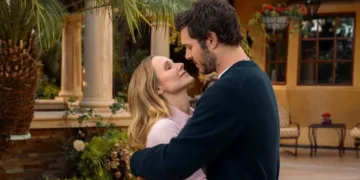










You are supposed to notice that the babies are dolls. Susanne Heinrich’s The Miserable Mother makes no effort to conceal the substitution, and accepting it changes where you look. With the infant temporarily removed as a source of spontaneous reactions, the adults become unusually exposed: their instructions, their routines, their ideas about what a mother ought to be doing. This is a Brechtian device, meaning that something familiar is made conspicuously strange so we can examine it. Here, it clears a little space around the baby for the exhausted woman holding it.
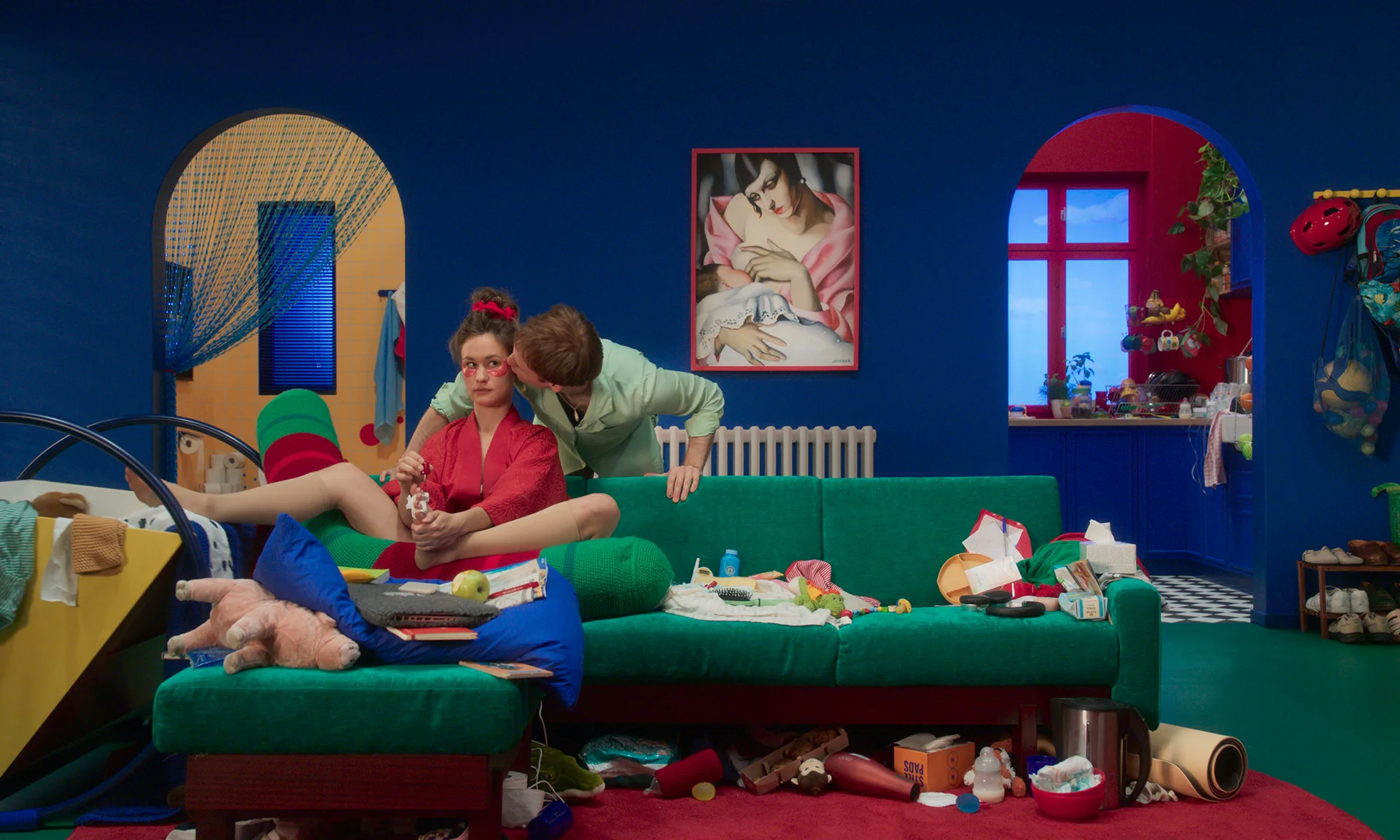
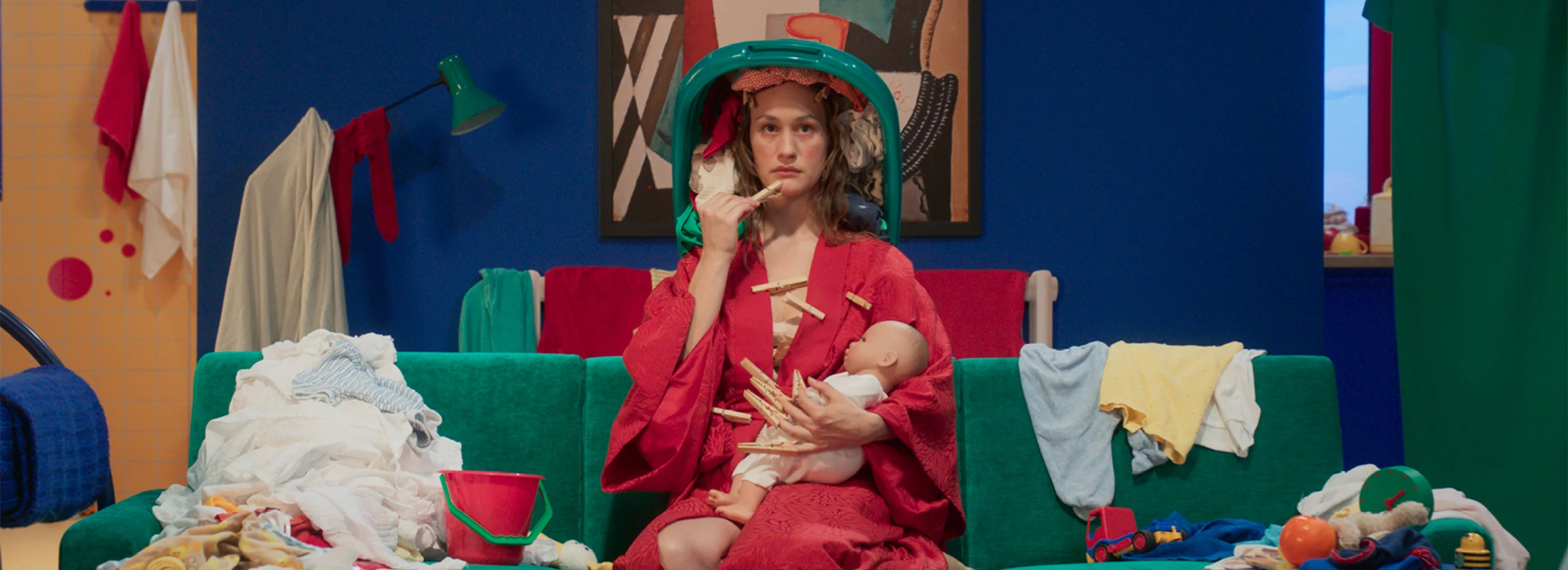
Rosa Landers fills that space with a performance built through posture. Her unnamed new mother can look rigidly assembled, then bend until maintaining an upright position seems like another household task. Pushing a stroller becomes an awkward physical routine; leaning over the sink lets the tension drain from her body. Graham Smith’s choreography makes these movements precise enough to read without turning them into realistic gestures. We can see the work involved in performing motherhood because Landers makes the performance itself visible. Her body keeps registering demands that the reassuring language around her cannot accommodate.
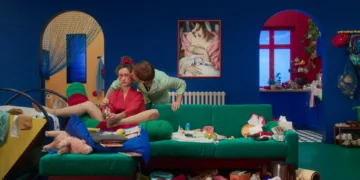
That language has an equally artificial home. Production designer Miren Oller gives the apartment strong blocks of red, green, blue, and yellow, while the mother-and-baby café offers softer pinks and blues. The distinction is useful: domestic life looks boldly arranged, and the café looks packaged for its intended customers, yet neither provides much room for disorderly feelings. The apartment, café, and park form a restricted circuit through which the mother repeatedly moves. Heinrich needs little conventional action to communicate how small her world has become. Its bright surfaces make her confinement disconcertingly cheerful.
Her partner has a different relationship with space. Played by Theo Colarusso and named Peter Pan, he can jump over the sofa with a freedom that makes Landers’s constrained movements newly revealing. The name supplies an obvious joke about a father reluctant to grow up, but the movement gives that joke substance. He approaches parenthood as something he is trying to learn, while she is already expected to possess the necessary expertise. His appeal to her greater experience is especially sharp. She acquires that experience by doing the work; having acquired it, she becomes the apparent choice to keep doing it.
Heinrich gives this imbalance an actual consequence when Peter Pan leaves for several months because he feels overwhelmed. His distress permits a departure. Hers must be managed around the child’s continuing needs. The film’s politics become legible through that unequal permission, without requiring the father to be a villain in every interaction. Meanwhile, the mother’s frustrated attempts to work at her desk show what is being displaced. Intellectual activity requires time that can remain uninterrupted, and her new responsibilities keep making claims on it. Knowing how to discuss equality offers little protection against an arrangement that quietly reproduces its opposite.
Much of that discussion arrives through song. Written by Heinrich with Willi Sieger, the musical passages grow out of stylized speech, insistent phrases, and dialogue that slips toward melody. It is an apt way to handle advice that already behaves like a refrain: heard repeatedly, passed between people, ready to be produced again without much thought. At the café, mothers sing about their reasons for having children, including the wish for a domain of their own and the desire to escape an uneventful bourgeois existence. Setting those explanations to music lets their confident delivery rub against the uncertainty of what they describe.
I particularly like how the mother-daughter duet complicates the surrounding satire. The older woman’s insistence that she had no time to reflect on her difficulties carries an uncomfortable authority. She endured; her daughter is questioning. As their disagreement gathers musical force, endurance begins to sound like a standard the younger woman is failing to meet. Yet the older mother’s position also exposes the scarcity under which she lived. Heinrich allows the exchange to hurt without switching into a naturalistic register. The deliberate performance style can hold a conflict between generations instead of merely displaying an amusing assortment of parental opinions.
The difficulty is sustaining that method. Chapter intertitles divide the film into inquiries, and the repeated combination of mechanical movement, elevated discourse, and absurd invention eventually becomes predictable within its own unusual terms. Across 82 minutes, I sometimes wanted a passage to change the argument sooner. Once the café’s coordinated behavior has established the pressure to conform, further variations can prolong the recognition without substantially altering it. Limited plotting is appropriate to a film concerned with recurring duties; the pacing problem comes when its formal repetitions begin to feel as settled as the routines they expose.
The fairies and children’s choir bring fresh textures, though their arrival also contributes to the feeling of accumulating devices. One detail within that extravagance is wonderfully exact. Offered wishes, the mother immediately asks for additional changing facilities. The answer is funny because an unrestricted possibility produces such a practical request. It is sad because practical provision has become the scale on which relief can be imagined. Heinrich leaves both meanings available. A changing table would help, and the fact that she has to wish for one remains part of the problem.
The appearances of real babies and children adjust the film’s attention again. Their presence interrupts the doll-based arrangement and restores the particular small person around whom all this activity is organized. Tenderness becomes possible without cancelling the anger.
The children’s choir similarly admits comfort into a film whose mother has ample reason to distrust comforting formulas. That tension reaches the filmmaking itself in the closing passage, when the camera reveals the crew and Heinrich stops a scene after a baby begins to cry. Heinrich laughs and judges the crying too dramatic, a response that lets us see her selecting the emotional register even as an actual infant disrupts it.
The Miserable Mother held its world premiere at the Shanghai International Film Festival on June 14, 2026, followed by its European premiere at Filmfest München in June 2026. Written and directed by Susanne Heinrich as an absurdist musical comedy, the film centers on a new mother confined to her apartment alongside her partner, named Peter Pan, who finds herself grappling with existential burnout and the suffocating confines of early motherhood.
Full Credits
Title: The Miserable Mother (German: Die miserable Mutter)
Distributor: Coproduction Office, Reynard Films, Essential Filmproduktion GmbH
Release date: June 14, 2026
Rating: 18+ / Unrated
Running time: 1 hour 22 minutes (82 minutes)
Director: Susanne Heinrich
Writers: Susanne Heinrich
Producers and Executive Producers: Katharina Weser, Philippe Bober, Solal Coutard, Maurane Cugny
Cast: Rosa Landers, Theo Colarusso, Johanna Spantzel, Julia Klotz
Director of Photography (Cinematographer): Agnesh Pakozdi
Editors: Clémentine Decremps
Composer: Willi Sieger
The Review
The Miserable Mother
Heinrich turns the routines of new motherhood into a musical whose artificiality makes its pressures easier to recognize. Visible dolls, rehearsed advice, and Rosa Landers’s extraordinary body control expose how parental responsibility becomes unequally assigned. The repetition occasionally stalls the argument, and the late flourishes feel crowded, but the mother-daughter duet shows how much emotional seriousness this playful method can hold.
PROS
- Landers’s precise, expressive physical performance.
- Choreography makes unequal responsibility visible.
- Songs expose the pressure within familiar advice.
- Mother-daughter duet complicates the satire.
CONS
- Formal repetition sometimes stalls the argument.
- Late fantasy embellishments crowd the design.