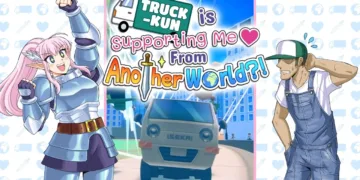

























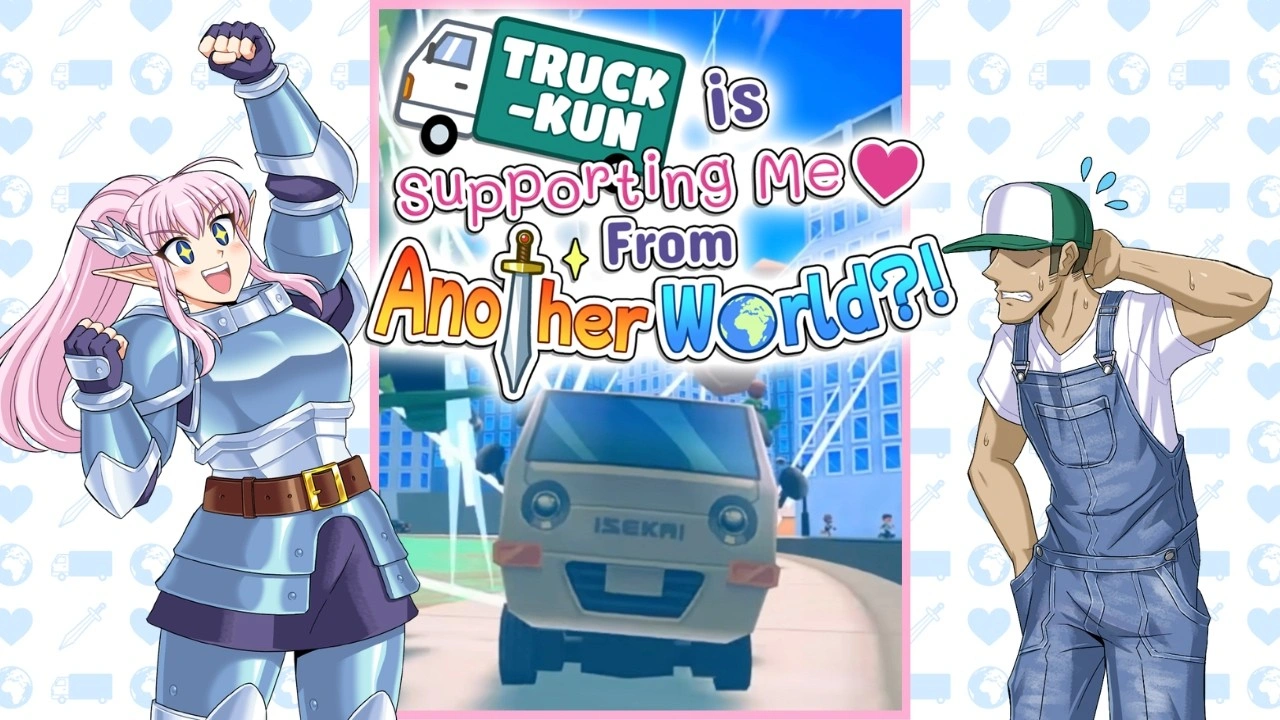

Most isekai stories treat the vehicle responsible for sending their protagonist into another world as an opening gag. Strange Scaffold builds an entire game around the driver left behind. Carissa Ward has spent years sacrificing sleep, hobbies, and relationships for a corporate promotion. She finally earns it, runs home to celebrate, and gets flattened by a truck before her new position begins.
Carissa awakens in Talinfold as a muscular elf warrior, yet she retains a connection with the driver who killed her. She wants to defeat the Skeleton King, locate a resurrection portal, and return before work on Monday. The driver, burdened by guilt, agrees to help.
The premise works because Carissa understands every isekai convention while her reluctant accomplice has never watched anime. She explains experience points, fantasy kingdoms, and heroic destinies with the impatient tone of an employee walking someone through a spreadsheet. Her enthusiasm for being reincarnated lasts only until she remembers the office.
Truck-kun is Supporting Me from Another World?! initially resembles the kind of parody that could keep pulling from decades of isekai conventions. Instead, it spends its strongest joke during the setup and then asks one limited arcade loop to carry the rest of its three-to-four-hour campaign.
Two Worlds, One Destruction Loop
Each outing places the truck in Wenvale for a timed rampage. Randomized objectives appear on the right side of the screen, asking the player to destroy parked cars, flatten chairs, smash fences, drift around corners, gain airtime, honk repeatedly, or locate a specific target such as a cement mixer. Completing tasks grants stars, extends the timer, or contributes toward story milestones.
Package deliveries give these runs their clearest sense of direction. A large marker leads the truck across town while smaller objectives compete for attention along the route. This is where the comparison with Crazy Taxi feels most appropriate, since the player must learn Wenvale’s streets and judge when a detour is worth the remaining seconds.
The fantasy adventure continues in a pixel-art window along the bottom of the screen. Pedestrians struck by the truck become monsters for Carissa to fight. Destroyed scenery fills her power gauge, and honking once it reaches capacity triggers an attack that clears several enemies. Defeating enough monsters earns additional stars.
During the early outings, this division of attention creates an enjoyable rhythm. The player can plough through a crowded pavement, cut through a parking area for destructible cars, monitor Carissa’s enemy queue, and trigger her attack before turning toward the next delivery. Wenvale gradually becomes a set of useful locations: the garage supplies parked vehicles, the beach supplies chairs, and fixed potion spawns provide extra time.
Police chases add pressure as the heat meter rises. Patrol cars appear from nearby streets and attempt to box the truck in. Boosting or side-slamming can destroy them, though both manoeuvres feel unreliable. A police car can materialise beside a jump, ruin the approach, and leave the player circling back through the same streets. The truck itself has a floaty weight that makes tight corners and recoveries less satisfying than the precise handling expected from an arcade driving game.
Milestones Become Management Targets
The largest problem is the gap between individual outings and campaign progression. Story scenes unlock after completing milestones such as earning a set number of stars, travelling long distances while boosting, drifting for extended periods, defeating enemies, or finishing deliveries.
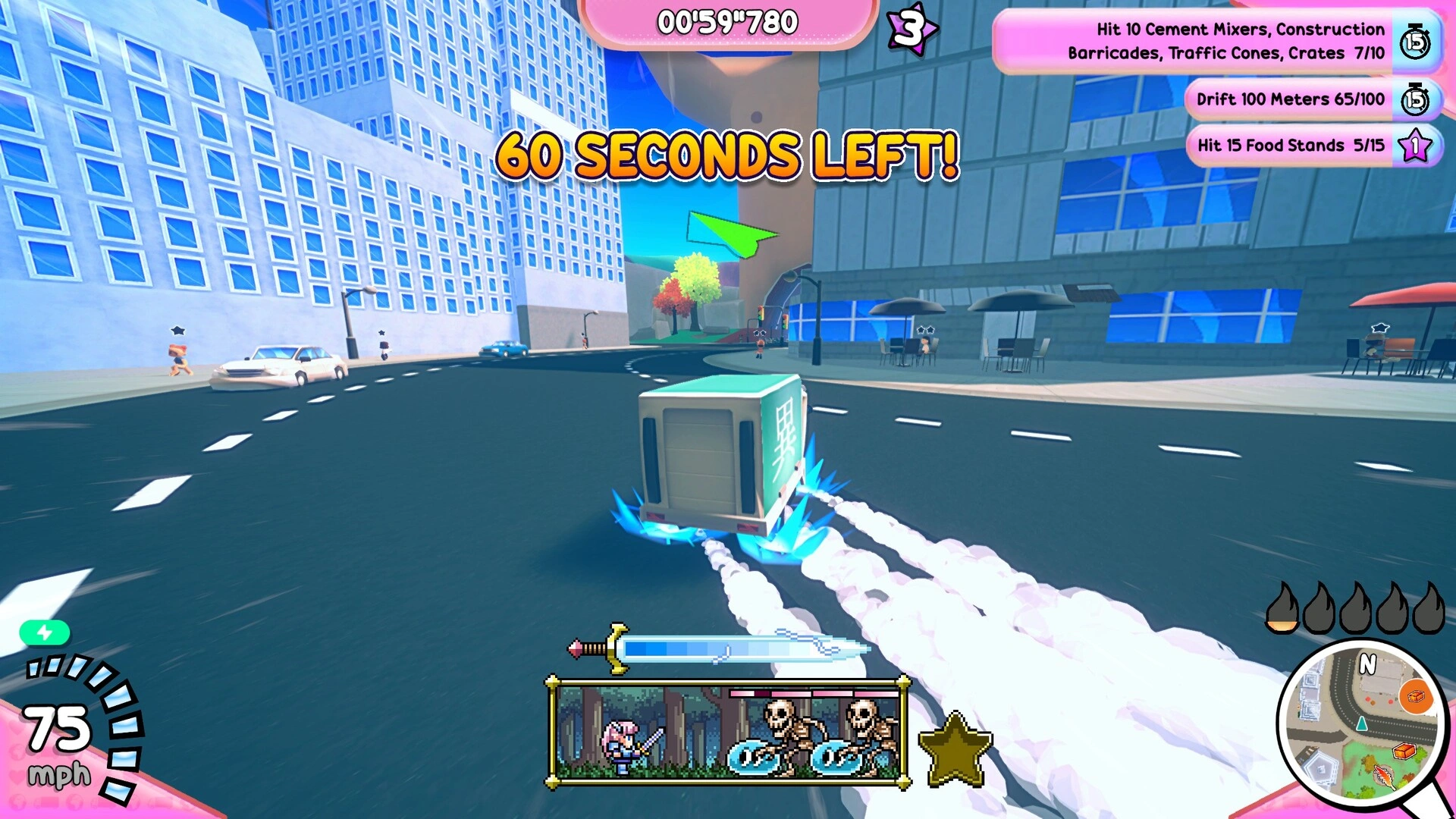
Early milestone groups progress alongside normal play. Later requirements demand focused grinding. A drifting target can turn an outing into several minutes of circling an intersection. A boosting requirement encourages straight-line repetition rather than creative destruction. Large totals for parked cars send the player back to the same garage because experimenting elsewhere wastes time.
That structure makes the city feel smaller with every run. The objective list changes, yet the practical solutions rarely do. Wenvale contains one map, one pool of police vehicles, and a handful of dependable farming locations. Once those routes are learned, success relies on repeating them while hoping the randomized tasks cooperate.
Nothing arrives to alter the pattern. The truck gains no substantial abilities. Carissa does not learn attacks that change how the player supports her. Police escalation never introduces vehicles that demand fresh tactics. Even the final encounter adjusts the existing formula rather than testing a developed set of mechanics.
Arcade games survive repetition through mastery, scoring, and clean physical feedback. Crazy Taxi invites another run because better knowledge of its city produces faster routes and higher scores. Here, milestones function as mandatory work orders. Free roam removes the timer and objectives, leaving a city with few secrets or bespoke challenges. A garage offering cosmetic truck skins provides decoration, though the campaign needs mechanical variation first.
Corporate Burnout in a Bare Fantasy
Carissa and the driver eventually move past jokes about reincarnation and begin discussing work. She admits that her promotion cost her the games, anime, and personal connections she once enjoyed. He describes growing up without money for those hobbies and later finding satisfaction in a job that suits him.
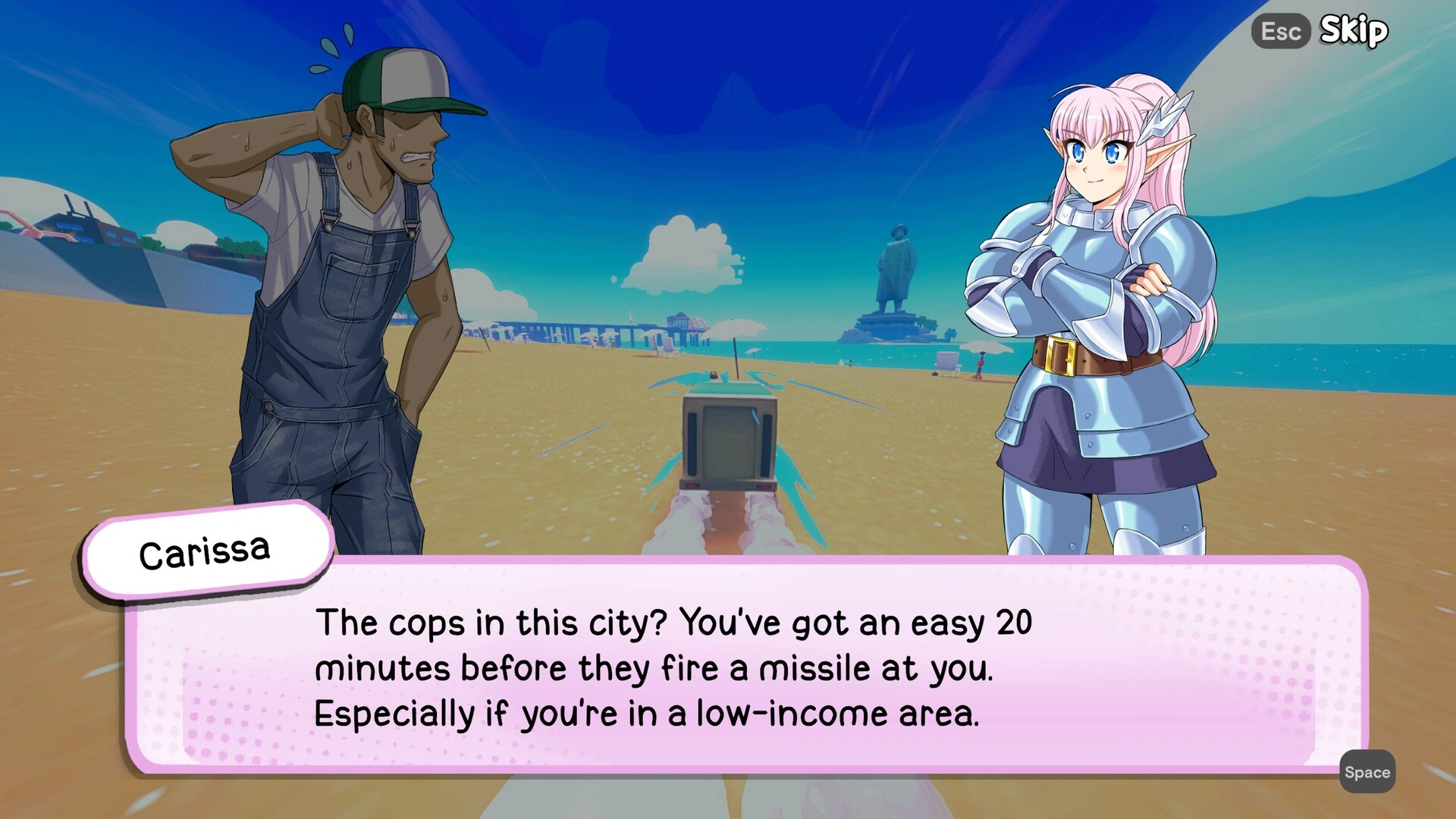
These conversations give the story a sharper concern than its title suggests. Carissa has entered a fantasy world built around escape, yet she treats defeating the Skeleton King as another deadline. Her heroic campaign becomes an emergency assignment that must be cleared before Monday morning.
The idea could have supported a pointed character arc. Talinfold, however, exists mainly inside the small combat window. Carissa meets no memorable companions, makes no significant decisions there, and forms no attachment to the world she is rushing through. Her changing attitude toward work is explained through conversations rather than tested by events.
The presentation supplies some missing personality. Hand-drawn scenes borrow the bright visual language of early visual novels, while Carissa’s pixel adventure features playful monster designs. David Mason’s ska and reggae-influenced music suits the reckless driving, though the limited selection repeats as frequently as the objectives.
Strange Scaffold has found a clever answer to a question few isekai stories ask: what happens to the driver after Truck-kun does its job? The game answers quickly. Everything after that answer keeps circling the same block.
The Review
Truck-kun is Supporting Me from Another World?!
Truck-kun is Supporting Me from Another World?! turns one of isekai’s oldest running jokes into an energetic arcade loop, then repeats it until the joke loses its force. Smashing through Wenvale while supplying Carissa with monsters and power creates an amusing split-screen rhythm, especially when deliveries, police chases, and randomized objectives collide. Yet the single map, unreliable defensive moves, rigid milestones, and absent mechanical progression make its brief campaign feel padded. The corporate burnout subplot has promise, but Talinfold remains too thinly drawn to support it.
PROS
- Clever isekai parody
- Enjoyable split-screen concept
- Energetic pixel art and music
- Satisfying early destruction
- Amusing character banter
CONS
- Repetitive milestone grinding
- Only one playable map
- No meaningful progression
- Inconsistent driving abilities
- Underdeveloped fantasy storyline