


















Few historical films make political power feel this physically present. Dau spends 195 minutes surrounding its central physicist with institutions that feed him, protect him, threaten him, and eventually reshape the terms by which he can live. Ilya Khrzhanovsky turns the life of Lev Landau into a study of what happens when intellectual freedom survives only at the pleasure of the state.
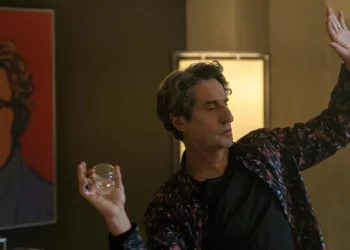
Teodor Currentzis plays the fictionalized Dau from his rebellious youth in 1928 Leningrad through decades of scientific prominence. Early on, his wild hair, gaunt face, and restless movements make him look permanently charged by some private current. He is brilliant enough to earn privileges that other scientists cannot count on. When colleagues resist military demands, some disappear into prisons or penal colonies. Dau takes a beating, bends, and keeps working.
His conversations with mentor Krupitsa, played by Anatoly Vasiliev, keep returning to the same uncomfortable question. What responsibility does a scientist have once knowledge becomes useful to people with guns? The exchanges can become repetitive, yet the repetition has a function. Dau keeps revisiting the principle because every new stage of his career requires him to surrender another piece of it.
Freedom for One
The most revealing compromises happen at home. Dau meets Nora, played by Radmila Shchogolieva, during his younger years, and their marriage becomes the film’s strongest emotional throughline. He argues for sexual freedom, then constructs a version of it that mainly serves himself. Mistresses, assistants, and colleagues’ wives pass through his life while Nora is expected to accommodate arrangements she clearly experiences as humiliation.
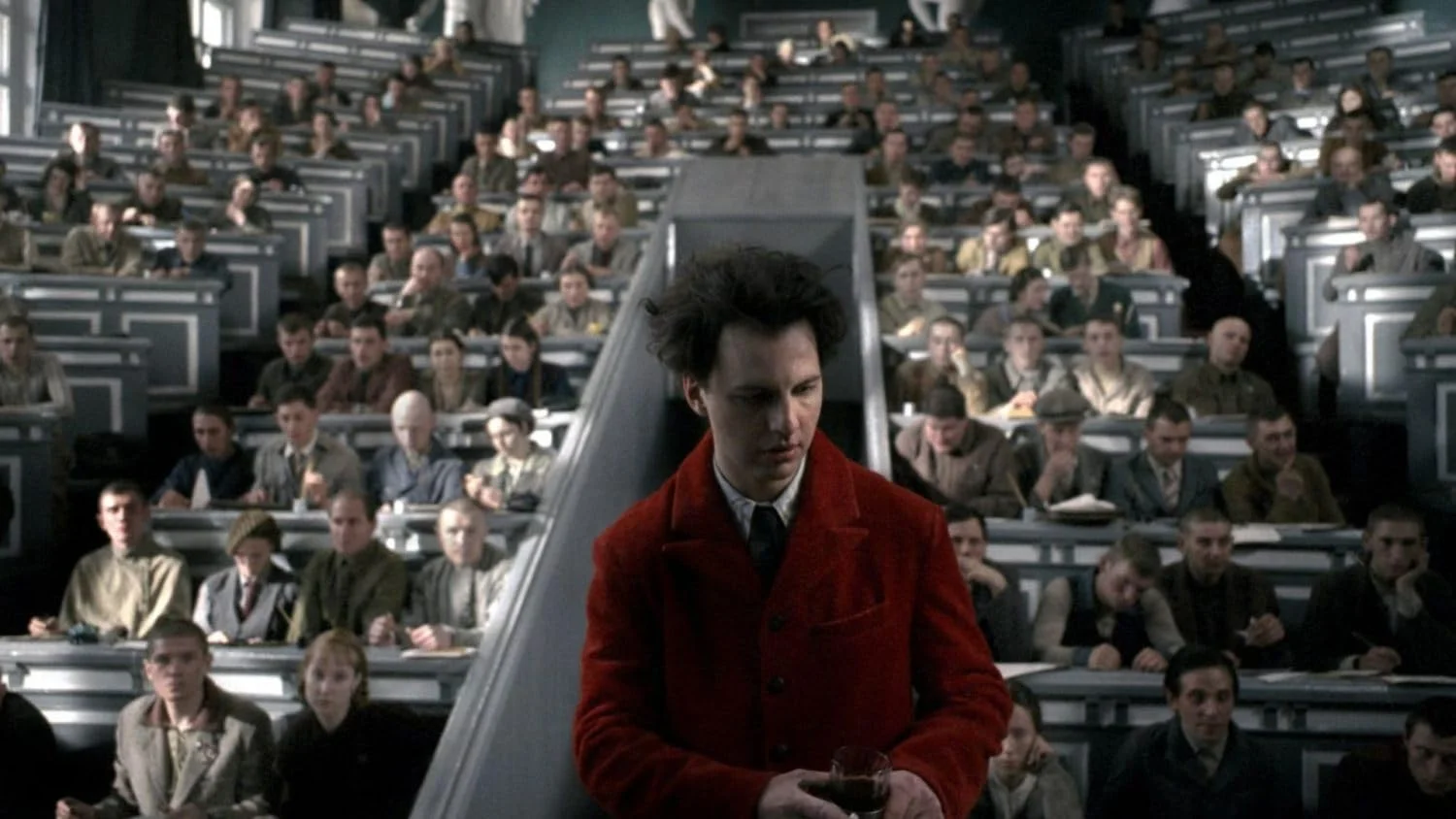
Shchogolieva gives those scenes their sting. Watch how Nora’s posture changes across the decades. The younger woman still seems capable of confronting Dau on equal terms. Later scenes place exhaustion into the pauses before she responds, as if every argument has already happened several times before we arrived.
Currentzis is harder to pin down, which works for the character until the film’s improvisational approach leaves him stranded inside a scene. His awkwardness can suddenly turn electric, especially during fights with Nora. Elsewhere, the loose blocking produces flailing gestures and performers obscuring one another at precisely the wrong moment.
I kept thinking about the imbalance between Dau’s public and private lives. The Soviet system limits his autonomy while granting him tremendous status, and he recreates that arrangement within his marriage. He resents being controlled while treating Nora’s emotional freedom as negotiable. The symmetry is ugly.
Building the Soviet World
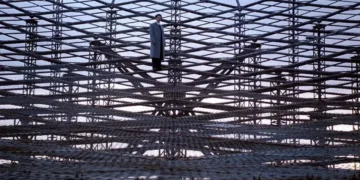
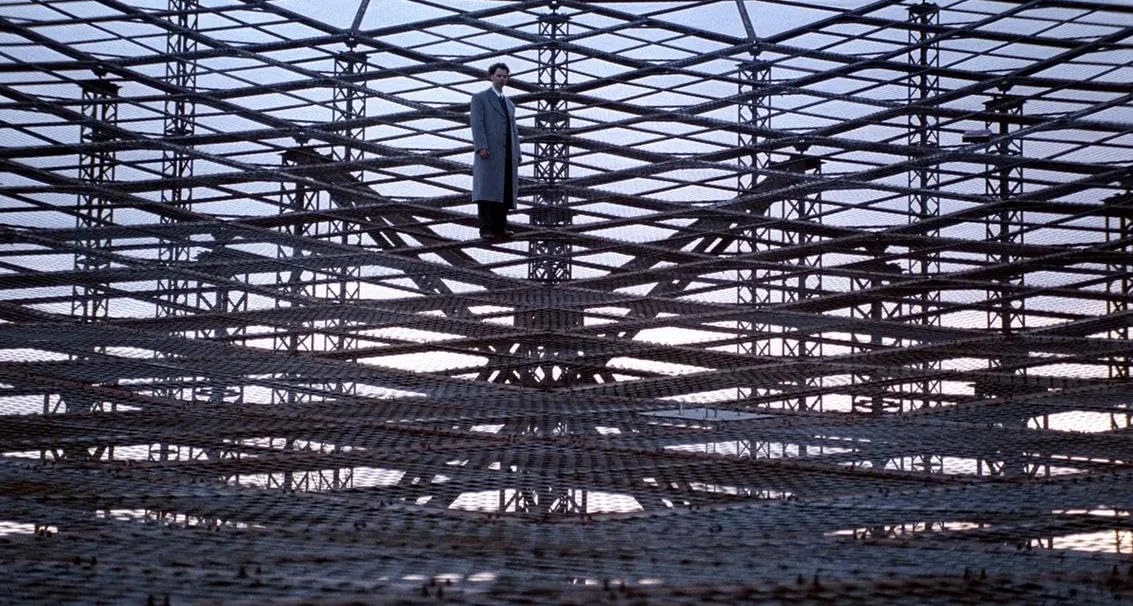
Khrzhanovsky’s greatest achievement is architectural. The production reconstructed an enormous functioning Soviet environment, and the camera constantly reminds us that the world continues far beyond whichever character happens to occupy the foreground.
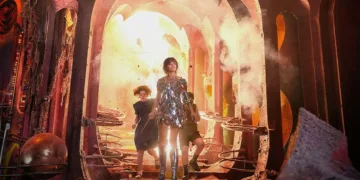
Early Leningrad feels almost chemically unstable. Streets are crowded with rats, rubbish, saturated clothing, jazz, parties, and human movement. People scramble around mountains of cabbage. Scientists throw sheep heads at each other. Factory workers manufacture clay rabbits only to smash them farther down the line. One surreal sequence sends people walking across a sharply tilted landscape, while another places half-naked bodies against a towering structure.
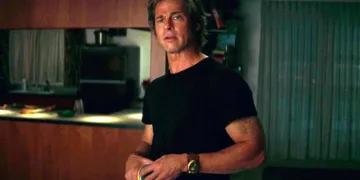
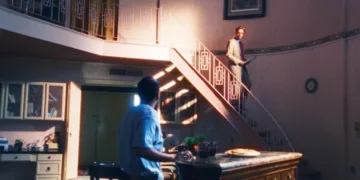
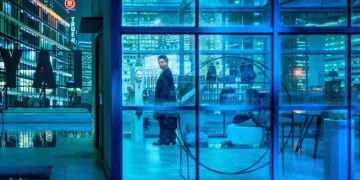
These images could easily become expensive decoration. The cinematography by Jürgen Jürges, Lol Crawley, and Manuel Alberto Claro gives them dramatic purpose through a gradual visual contraction. The early reds and dense bursts of color recede. Concrete grey and unhealthy green begin dominating the Moscow institute.
That shift matters because cinematography is doing historical storytelling here. Color temperature, spatial depth, and background activity tell us how the environment is changing before a character explains anything. The institute initially looks like a protected laboratory where scientists can debate theory, host foreign visitors, drink, sleep with one another, and pursue eccentric experiments. Then the walls seem to move inward.
Vladimir Azhippo’s security official makes the transformation explicit. Interrogations force friends and family members toward betrayal, while people nearby learn the safest response to violence: keep your head down.
When the Experiment Frays
The film’s strange production methods create some of its best material and several of its weakest stretches.
Khrzhanovsky often lets interactions unfold with the untidiness of real behavior. People interrupt each other, drift out of position, hesitate, and talk past the point where a conventional screenplay would cut. During Dau and Nora’s arguments, this can make their marriage feel frighteningly unperformed. During repeated debates about scientific responsibility, the same freedom produces scenes that lose dramatic pressure.
The editing tries to counter that looseness with sudden eruptions. Equations, bloody flesh, disconnected images, and blasts of sound tear through the film at intervals. The first few montages are genuinely disorienting. Later repetitions become easier to anticipate, and shock turns into punctuation.
The slower Moscow passages work better when Khrzhanovsky trusts smaller details. A visit from a friend released from prison carries paranoia through guarded speech and ordinary movements. Nobody needs to announce that surveillance has altered these people. Their bodies already know.
Late sections push toward nuclear destruction, disturbing experiments, physical decline, and a bizarre extended epilogue in which an incapacitated Dau sits near the ruins of the family he helped create. By then the film has spent so long studying freedom that the word itself has become slippery. Dau has intellectual privilege, sexual access, professional status, and considerable protection. The man sitting near the end of the film scarcely resembles someone who ever possessed control over his own life.
Dau had its world premiere in the main competition at the 83rd Venice International Film Festival on September 9, 2026. Spanning four decades from 1928 to 1968, the drama follows a brilliant physicist inside a secretive Soviet research institute as he is forced to serve a totalitarian state.
Full Credits
Title: Dau
Distributor: Phenomen Berlin Filmproduktions, Essential Films, Parisienne de Production, Plattform Produktion
Release date: September 9, 2026 (Venice International Film Festival)
Running time: 3 hours 15 minutes (195 minutes)
Director: Ilya Khrzhanovsky
Writers: Ilya Khrzhanovsky, Vladimir Sorokin
Producers and Executive Producers: Ilya Khrzhanovsky, Philippe Bober, Leonid Lebedev, Susanne Marian, Solal Coutard, Svetlana Dragayeva, Erik Hemmendorff
Cast: Teodor Currentzis, Radmila Shchogolieva, Anatoly Vasilyev, Vladimir Ajippo, Dmitry Chernyakov, Dmitry Scheglakov, Demian Kudryavtsev, Maria Nafpliotou
Director of Photography (Cinematographer): Jürgen Jürges, Manuel Alberto Claro, Lol Crawley
Editors: Ilya Permyakov, Rob Myers
Composer: Ilya Demutsky
The Review
Dau
Dau turns its immense production history into something genuinely cinematic, especially when the research institute shifts from intellectual refuge to surveillance chamber. Khrzhanovsky’s 35mm imagery, crowded sets, violent montages, and increasingly drained color palette make Soviet repression feel physical. The looser performances sometimes produce startling intimacy between Dau and Nora, then just as easily leave scenes wandering past their strongest beat. At 195 minutes, repetition becomes a real burden, yet the film’s scale and strange formal confidence keep pulling it forward. Few historical dramas feel this unruly or this difficult to shake.
PROS
- Extraordinary 35mm cinematography
- Immense, tactile production design
- Strong Dau and Nora dynamic
- Powerful visual progression
- Unsettling surveillance sequences
CONS
- Repetitive scientific debates
- Uneven improvised performances
- Overextended late passages
- Recurring montages lose impact