































Teagan Tao wins a race while her life is falling apart behind the spectators. It is a wonderfully efficient piece of television engineering. Teagan, played by Miku Martineau, is still powering her single scull toward the finish while her hotelier father David slips away, leaving an apology text before federal agents arrive to expose the financial crimes that funded the family’s comfortable Los Angeles existence. The girl crosses the line a champion. By the time she understands what happened on shore, the future she was rowing toward has vanished.
Crew Girl gets a lot of mileage from that contradiction. Six months later, Teagan and her mother Ella have traded money, hotels, and athletic certainty for Ella’s worn childhood home in Eagle’s Cove, Massachusetts. Teagan lands at Easton Prep with Stanford and Olympic ambitions intact, only to discover that the recently coed school has managed the remarkable administrative feat of admitting girls without giving them a rowing team.
Coach Matt Hayden explains the economics. The boys are losing. Losing teams do not excite donors. Without donors, there will be no girls’ program. Teagan therefore takes the available position as coxswain, facing eight male rowers while steering, calling race strategy, and telling them exactly how badly they are doing.
The premise requires a generous suspension of disbelief around what this detour does for Teagan’s solo-rowing ambitions. The scripts never find a persuasive answer. They do, however, find a much better television series once Teagan stops being alone in the boat.
Eight Boys and One Actual Sport
Sports dramas often use athletics as decorative scaffolding for romances that could happen in a bakery, record store, or suspiciously attractive vampire coven. Crew Girl actually cares about rowing. That specificity saves it repeatedly.
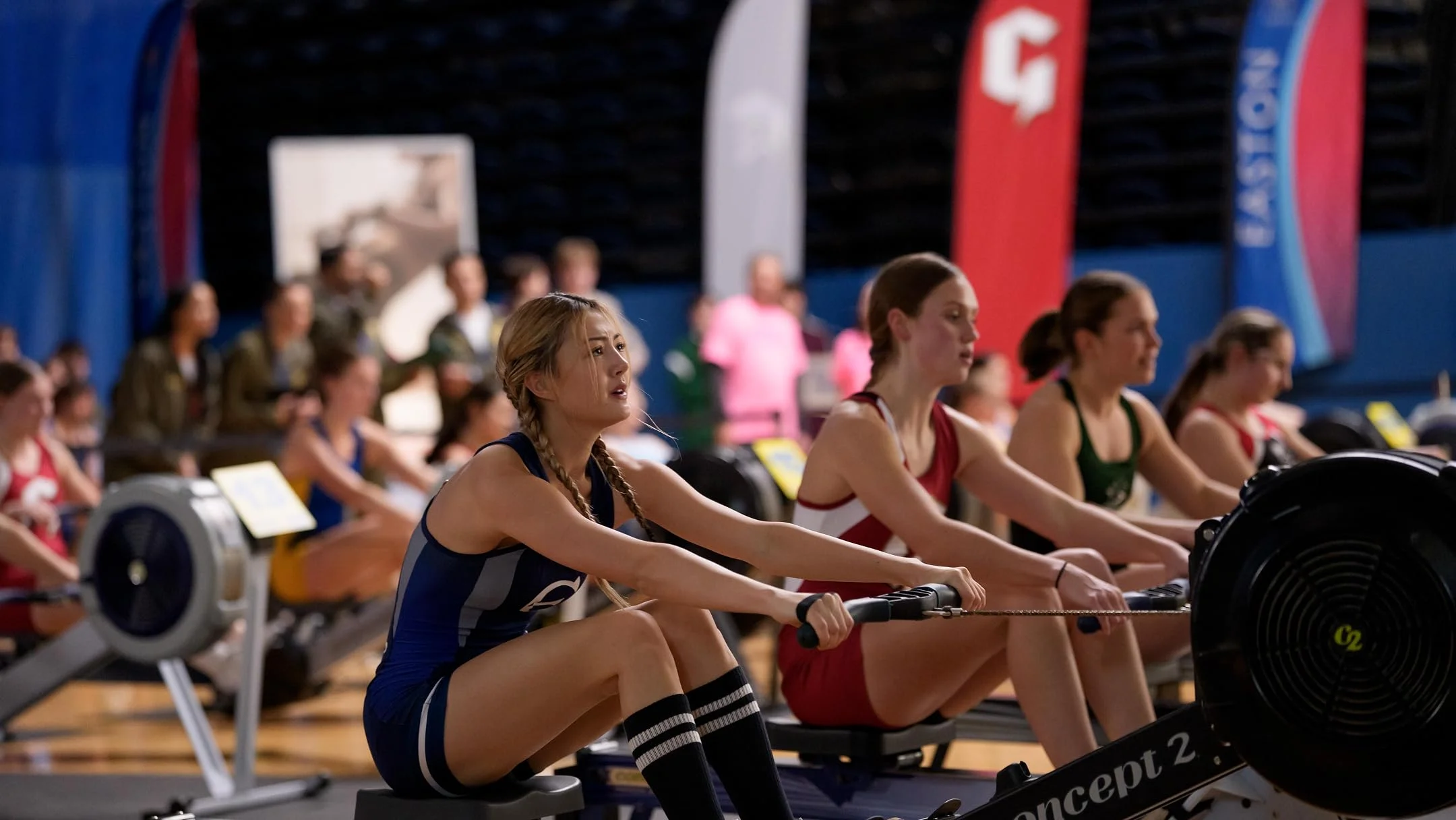
Teagan earns Coach Hayden’s attention by reading what is happening on the water before she has any official place in the crew. Once she takes the coxswain seat, the series gives her something active to do beyond staring moodily at Cam or Josh. She calls splits, watches the crew’s rhythm, corrects stroke rates, and tries to turn eight individual egos into one moving machine. The Haverford Cup material works because the outcome depends on synchronization the season has spent building rather than on a conveniently timed inspirational speech.
The show is equally comfortable throwing rowing vocabulary at the audience. Stroke seat, engine room, puddles, rushing the slide, catching a crab. It trusts viewers to learn by watching, which is a refreshing choice in a streaming era where someone usually stops every six minutes to explain what everyone just saw.
The photography helps. Wide aerial shots let the shells carve through fir-lined water, then race sequences move closer to the repeated physical violence of eight bodies driving backward in unison. Those cuts between Teagan’s face, the rowers’ legs, and the blades entering the water give competition a pulse that several romantic scenes conspicuously lack.
The team becomes appealing once the scripts allow its members to be idiots together. Baloo asking his boatmates to help choose a thirst-trap photo for a guy he likes has the loose embarrassment of teenagers killing time around friends. Noah’s doomed attempt to make a collection of rowers participate seriously in his Roaring Twenties murder-mystery party is funnier because nobody has to learn anything from it.
Those scenes understand what Teagan means when she says teammates can become “your people.” The season’s sweetest relationship is between nine people and a boat. Netflix may have accidentally made a workplace comedy for teenagers.
The Triangle Needs Better Geometry
Then there are the boys Teagan is supposed to kiss. Cam Dillinger and Josh Regis have been built with the architectural subtlety of opposing campaign posters. Cam is the financial-aid student who works in his father’s garage and knows exactly how rich kids at Easton see him. Josh comes from the family whose money helped buy the boathouse, carries himself like the building should thank him personally, and initially treats Teagan as an intrusion.
Teagan meets Cam by crashing her bicycle into his truck and flipping into the bed. It is shamelessly broad meet-cute staging, but Kyle Clark sells Cam’s irritation without smothering the attraction underneath it. His stronger scenes come later, when the “Faid” nickname and his discomfort around Easton’s wealth expose how carefully he monitors his place among classmates who never have to think about theirs.
Josh has fewer surprises. Sam Braun can give his competitive irritation a useful edge, particularly when Josh treats crew success as something inseparable from his own status, but the scripts keep returning him to the standard prep-school princeling position. Teagan’s attraction to him therefore feels dictated by genre paperwork. Enemies must flirt. Forms have been filed.
The love triangle grows stranger because all three characters care far more convincingly about rowing than romance. Teagan evaluates Cam and Josh partly through what they contribute to the crew, and the boys repeatedly place racing above their hormonal confusion. That should make the triangle distinctive. Instead, the scripts rarely articulate what Teagan wants from either relationship once everybody leaves the boathouse.
Josh’s rivalry with Ryder has similar trouble. Their fight over the stroke seat carries naturally into competition on the water, then the family-business inheritance material strains for glossy dynastic drama. A teenage rowing dispute somehow finds itself adjacent to an aviation fortune. Television has certainly asked less of a stroke seat.
Britney, Josh’s girlfriend, receives the roughest treatment. Her jealousy toward Teagan places her in the familiar queen-bee role, and Sage Linder is asked to deliver hostility far more often than contradiction. The series hints that desperation and family pressure sit behind the nastiness, then keeps sending Britney back into scenes designed primarily to obstruct Teagan. The rowing team gets to become complicated through repetition. The romantic rivals mostly get assigned lanes.
Mother and Daughter, With Federal Agents Somewhere
Jessica Paré is doing quieter work in a louder show. Ella initially attempts to keep the remains of her old lifestyle standing, including spending Teagan immediately recognizes they can no longer afford. Later, taking work at Jim’s Crab Shack strips away the performance. Coach Hayden’s memory of Ella working a second job to buy a car so she could drive to her first tells us far more about her than another flashback to luxury could have managed.
Paré is particularly effective when Ella’s optimism becomes visibly laborious. She can smile through a conversation while tightening her posture enough to suggest the panic underneath. Martineau responds by keeping Teagan’s anger specific rather than turning her into the spoiled rich kid the premise could easily have produced. Teagan objects to the credit-card spending because she understands their circumstances. Her frustration about Eagle’s Cove comes from losing a future she had worked for, not from discovering that normal houses contain old plumbing.
Their scenes possess an easy affection that the season rarely gives its romances. They can snap at each other, recover, and keep moving without every disagreement turning into a cliffhanger. Which makes David’s disappearance increasingly peculiar.
The premiere deploys FBI agents, investor fraud, vanished money, a fugitive father, and a family whose economic status collapses almost overnight. Those are substantial stakes. Once Easton’s crew season takes hold, David becomes largely an origin story for the relocation. Teagan’s endangered tuition receives attention when the plot needs pressure, then the financial disaster retreats again.
The same narrowing happens to Eagle’s Cove itself. The premiere places Teagan inside a classroom and establishes Easton as a social world, but schoolwork soon becomes nearly mythical. If Teagan owns homework, it may be hiding with her father.
Juliet suffers most from the compressed world. Olga Petsa gives her a spectacular introduction when Juliet sets fire to her own car as a cry for attention from emotionally absent parents. It is the kind of entrance that announces a significant character. Then she vanishes for stretches long enough to make Teagan’s claim that they are close friends feel like information from a deleted episode. The show has built a town, a private school, a criminal investigation, and several troubled families. It keeps rowing past most of them.
Pretty Water, Messy Television
There is something strangely likable about how little Crew Girl disguises its intentions. The athletes train shirtless. EDM pounds over rowing machines. Wealth sits in the background as expensive architecture, immaculate clothes, and parents who apparently conduct family warfare around airplanes. The camera knows exactly which moments will become social-media clips, and pretending otherwise would insult everyone involved.
Yet the production becomes noticeably steadier when it returns to the water. The race photography has spatial clarity. You can tell who is gaining, where rhythm breaks, and why Teagan is shouting. Away from competition, the editing can become aggressively eager, pairing voiceover, reaction shots, and romantic music as if one emotional cue might escape unsupervised.
Teagan’s narration carries some of the season’s most familiar writing. Her declarations about one life ending and another beginning arrive exactly where a seasoned YA viewer expects them. Martineau fares better when she has physical or tactical business to play, particularly while directing the crew or challenging a teammate’s selfish decision. Give her a race plan and she becomes precise. Give her a romantic stare and the show occasionally seems to turn the intensity knob two clicks too far.
Clark finds a natural looseness as Cam, while Paré gives the adult material its strongest texture. The broader ensemble becomes livelier in group scenes, where interruptions and jokes let the actors bounce off one another instead of waiting for their appointed line of exposition.
That leaves Crew Girl in an amusing position. Its fugitive-financier setup is less interesting than practice. Its love triangle is less persuasive than stroke rotation. Its rich-kid warfare cannot compete with eight teenagers learning to move at the same speed. For a glossy Netflix teen soap, discovering that discipline beats scandal may be the season’s finest plot twist.
Crew Girl premiered on Netflix on September 10, 2026. The coming-of-age sports drama follows a disgraced teen athlete who becomes the coxswain for a chaotic boys’ prep school rowing team.
Where to Watch Crew Girl Online


Full Credits
Title: Crew Girl
Distributor: Netflix
Release date: September 10, 2026
Rating: TV-MA
Running time: 45–52 minutes per episode
Director: Simon Barry
Writers: Vivian Lin
Producers and Executive Producers: Vivian Lin, Morwyn Brebner, Matthew Hornburg, Mark J.W. Bishop, Jennifer McCarron, Donna Luke, Michael MacMillan, Jeff Norton, Lindsay Macadam, Hillary Zwick Turner, Tony Chung, Lori Massini, Jason Fischer
Cast: Miku Martineau, Samuel Braun, Kyle Clark, Jessica Paré, Thomas Cadrot, Baloo Garner, Connor Paton, Sage Linder
Director of Photography (Cinematographer): Mathias Herndl
Editors: Bridget Durnford, Colin Patton
Composer: Todor Kobakov
The Review
Crew Girl
Crew Girl keeps drifting whenever it leaves the boathouse. The love triangle arrives preassembled, the fugitive-father plot loses momentum, and Easton Prep sometimes feels like a school where nobody has homework. Yet the rowing scenes have real snap. Teagan calling splits, correcting rhythm, and slowly winning over the varsity eight gives the season a sturdy dramatic engine, while Miku Martineau and Jessica Paré keep its family material human. Netflix has assembled another glossy YA soap, but this one occasionally remembers that teamwork makes better television than abs.
PROS
- Strong rowing sequences
- Engaging team chemistry
- Martineau’s grounded lead performance
- Paré’s convincing family drama
- Specific rowing detail
CONS
- Weak romantic triangle
- Underdeveloped father subplot
- Thin school world
- Stiff dialogue
- Familiar YA archetypes