





























Giving Lucie Manette a profession, a sexual will, and a hand in her own rescue changes the moral balance of this adaptation before the guillotine ever enters the frame. The change is deliberate. Lucie is no longer positioned chiefly as the moral light around which damaged men arrange themselves. She studies surgery in secret, pursues the truth about her imprisoned father, and becomes an active force in the fates of Charles Darnay and Sydney Carton. A Tale of Two Cities uses that redistribution of agency as its clearest argument for modernization. The difficulty arrives when the same instinct begins simplifying the contradictions it wants to refresh.
The largest alteration is the romance. Dickens gives Carton a love whose hopelessness is tied to his self-contempt; this version makes Lucie’s attraction to him reciprocal. That choice gives Mirren Mack’s Lucie desire rather than symbolic purity, and it gives Kit Harington’s Carton a plausible place beside François Civil’s Darnay. It also converts an unusually painful emotional geometry into the familiar pressure of two men competing for one woman.
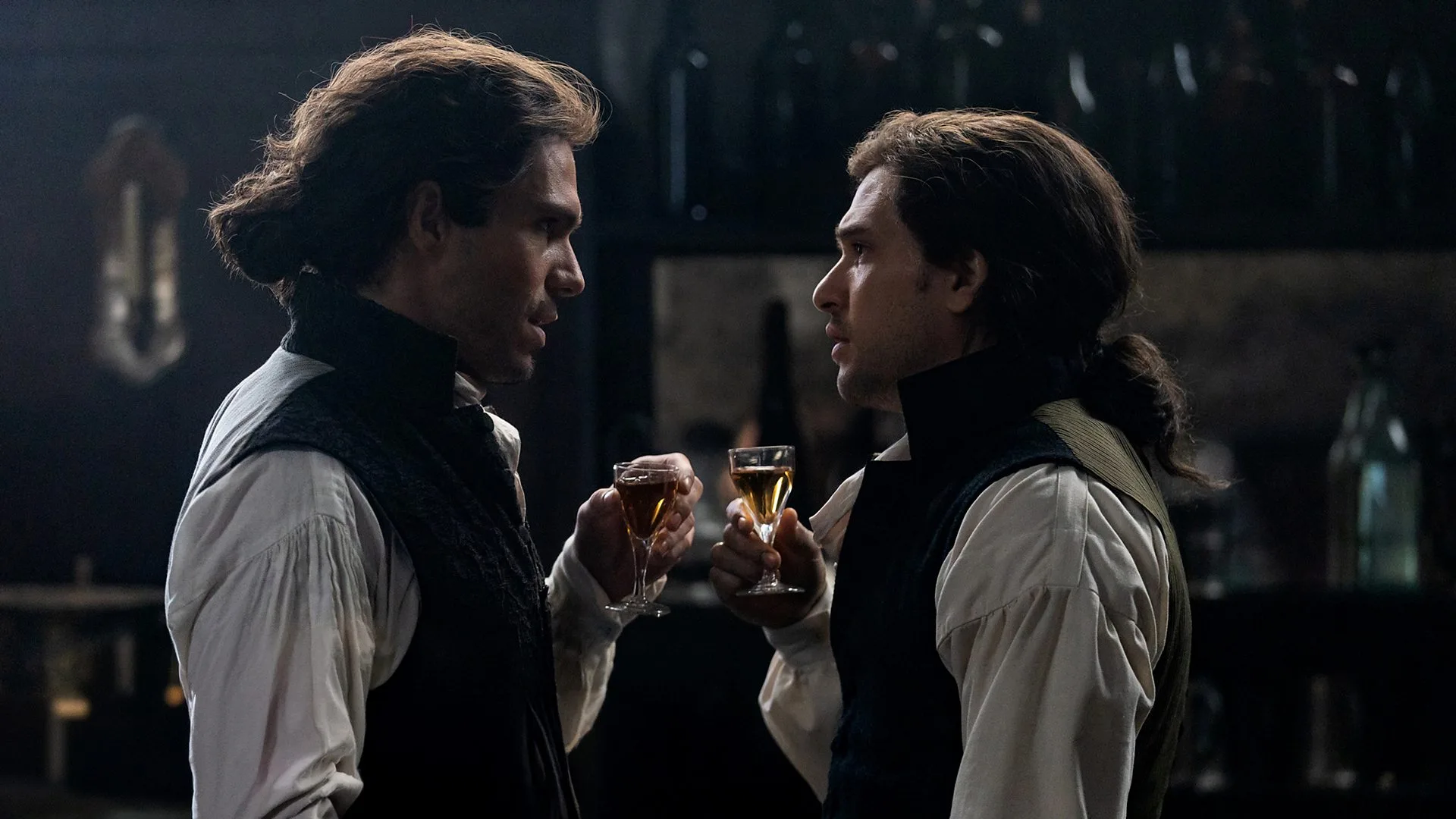
The change has immediate dramatic advantages. Carton can challenge Darnay directly, and the long drinking-table exchange between them turns resemblance into rivalry. Their similarity stops being a plot curiosity and becomes a social irritation. Each man can see a version of himself he dislikes in the other. Darnay’s decency throws Carton’s waste into relief; Carton’s intelligence and volatility expose the complacency that can cling to Darnay’s virtue.
Yet Carton pays a price for becoming a viable romantic hero. His devotion becomes easier to read and easier to package. The earlier he is allowed to function as a genuine alternative for Lucie, the less strange his emotional position becomes. Harington restores some of that strangeness through Carton’s conduct. The drinking, abrasiveness, flashes of cruelty, and self-disgust keep romance from cleaning him up. His value lies in the tension between his capacity and his refusal to believe that capacity matters.
Lucie’s rewritten agency works on a cleaner line. Her interest in surgery gives her an intellectual and practical life beyond marriage, and her role in recovering Dr. Manette lets filial devotion become action. The adaptation occasionally strains to announce that modernity. Even so, Lucie has decisions to make, risks to take, and desires that belong to her. Mack benefits from the added friction because Lucie can move between tenderness, urgency, and romantic uncertainty without becoming a decorative moral reward.
The political world is less consistently sharpened. Individual figures gain motive, especially Madame Defarge, whose revolutionary anger grows from recognizable injury rather than abstract villainy. Roxane Duran’s presence gives that anger a human scale, and the writing allows Defarge’s fury to remain understandable after it becomes dangerous. The larger class picture is broader. Aristocratic decadence is painted in strokes of cruelty and excess, while revolutionary crowds tilt toward rage, drunkenness, and spectacle. The people caught between those poles, including the central characters, receive the richest moral texture.
That imbalance matters because the series modernizes private agency with far greater confidence than public conflict. Lucie becomes harder to reduce to an ideal, and Carton becomes harder to reduce to a martyr in waiting. The Revolution itself often arrives already sorted into familiar prestige-drama imagery: dim rooms, filthy streets, elaborate interiors, swelling menace, beautiful clothes beside hunger. The production is handsome, yet its naturalistic darkness sometimes pushes scenes into murk. Gloom becomes less an atmosphere than an obstruction.
There is a revealing symmetry here. The romantic rewrite makes Dickens easier to process through current television grammar, and the visual treatment often performs the same translation. Familiarity helps the story move quickly. It can also make the adaptation feel pre-interpreted, as if the audience already knows what decadence, poverty, revolutionary anger, and romantic danger should look like.
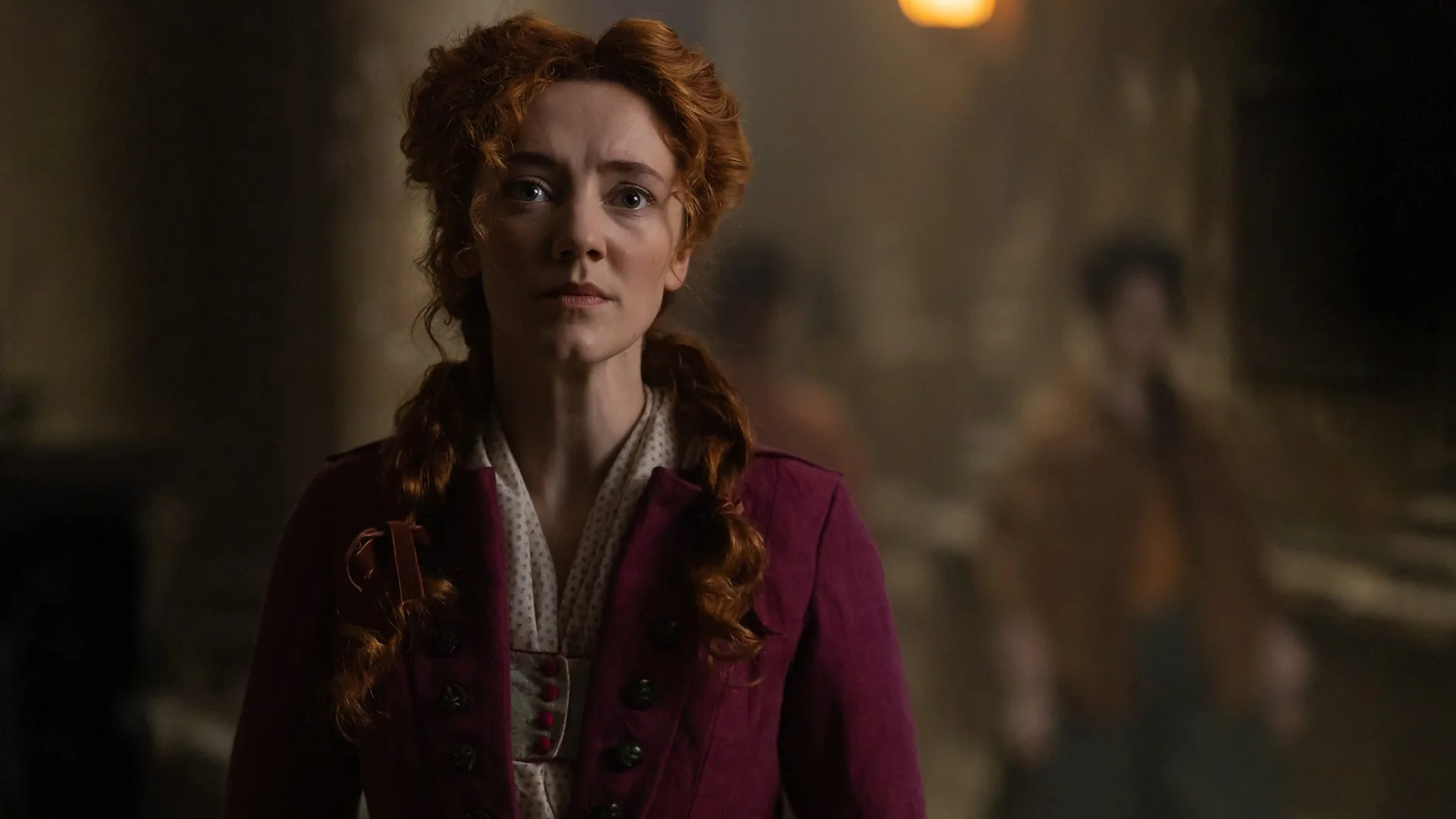
The performances keep resisting that neatness. Harington’s Carton is the clearest case because his cynicism is allowed to curdle rather than charm on command. His hostility toward Darnay has an edge that romance cannot fully domesticate, and his drinking reads as self-erasure rather than roguish decoration. Civil has the less volatile role, which is partly the point: Darnay’s moral steadiness gives Carton something solid to strike against. Mack’s Lucie has enough agency to make her final choices feel authored rather than assigned.
The adaptation’s famous final movement tests every earlier change at once. Carton’s greater romantic viability could have reduced his moral action to a gesture of lost love. The series avoids that reduction because his self-contempt has been planted across the drama as a problem larger than romance. His late moral weight comes from the distance between the man he has chosen to be and the man his actions reveal he could have been.
That is where this modernization finds its strongest justification. Agency helps when it gives an old character room to act without sanding away the contradiction that made the character difficult in the first place. Carton reaches the end carrying both versions of himself, and the adaptation finally trusts that tension to speak for itself.
Where to Watch A Tale of Two Cities Online





Full Credits
- Title: A Tale of Two Cities
- Distributor/Platform: MGM+ (United States); BBC One (United Kingdom)
- Release date: Series premiere September 6, 2026, on MGM+, releasing weekly through a September 27, 2026 finale (4 episodes)
- Running time: 4 episodes, approximately 60 minutes each
- Director: Richard Clark, Hong Khaou
- Writers: Daniel West (creator/writer), based on the 1859 novel by Charles Dickens
- Producers and Executive Producers: Producer: Simon Meyers. Executive Producers: Kit Harington, Daniel West (for Thriker Films), Hong Khaou, Polly Williams, Sarah Best (for Federation Stories), Léo Becker (for Federation Studio France), Michael Wright
- Cast: Kit Harington, François Civil, Mirren Mack, Ian Pirie, Roxane Duran, Sharon Duncan-Brewster, Yannick Renier, Fehinti Balogun, Barry Aird, Theo Costa-Marini, Guillaume Gallienne
The Review
A Tale of Two Cities
This adaptation earns its boldest changes when they create real agency instead of merely updating Dickens for prestige television. Mirren Mack gives Lucie a life beyond symbolic virtue, Roxane Duran keeps Defarge's anger morally legible, and Kit Harington's abrasive Carton carries the climax with genuine tragic weight. The love triangle makes Carton easier to understand, while the Revolution receives broader strokes than its central characters. The cast keeps complexity alive where the adaptation sometimes tidies it away.
PROS
- Lucie's expanded agency
- Harington's conflicted Carton
- Strong Mack and Duran performances
- Powerful final movement
CONS
- Conventionalized love triangle
- Simplified class conflict
- Familiar prestige-drama imagery
- Excessively murky lighting