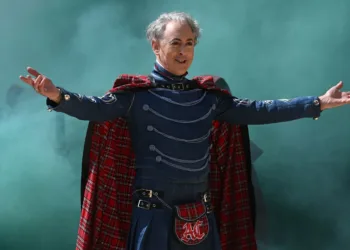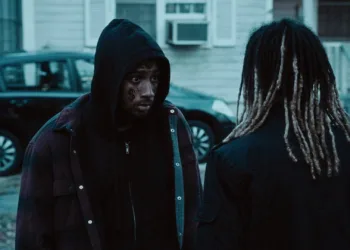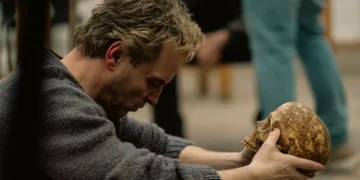
























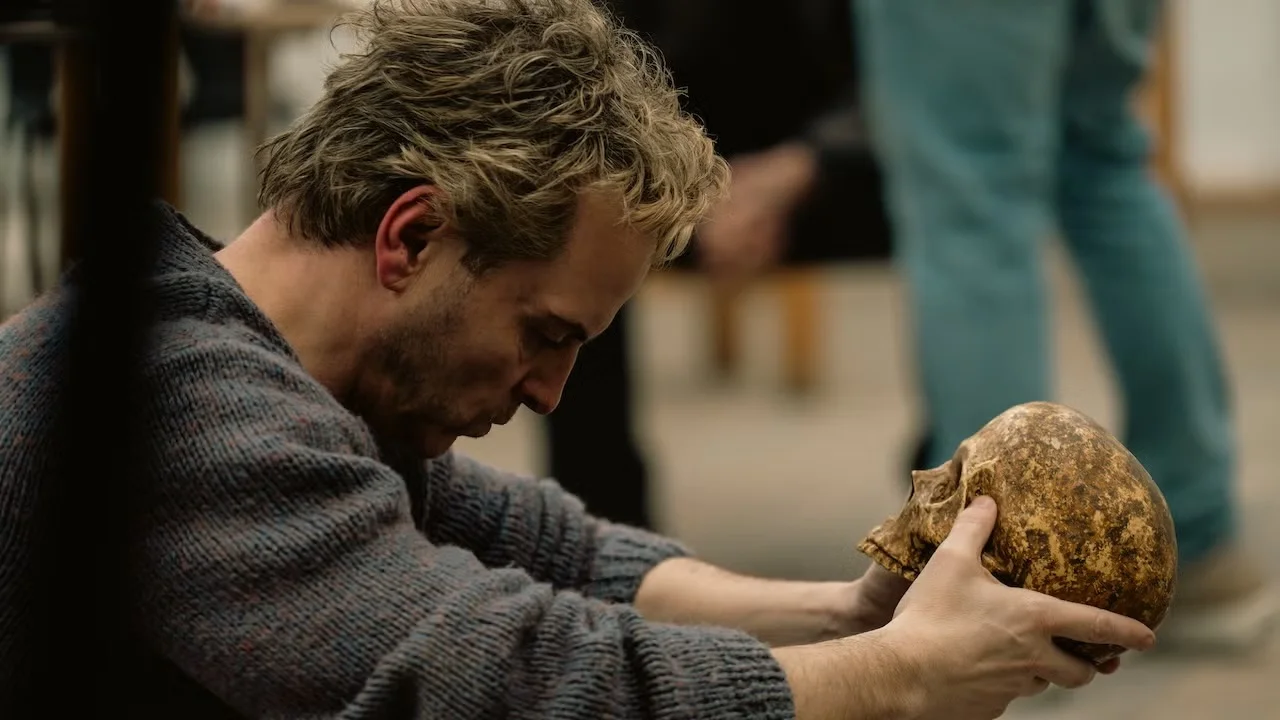

Ian Charleson’s greatest professional opportunity arrives precisely when his body begins issuing its final warnings. Simon Stone’s Elsinore, written by Stephen Beresford, finds its drama in that cruel convergence. In 1989, Charleson is HIV-positive, his screen career has stalled, and the fame earned through Chariots of Fire has become a mildly absurd burden. A cab driver humming Vangelis’s famous theme captures the problem neatly: people recognize the cultural object while barely remembering the actor inside it.
Then Daniel Day-Lewis leaves Richard Eyre’s National Theatre production of Hamlet, creating an opening Charleson never expected to receive. Eyre, played with measured warmth by Johnny Flynn, offers him the title role. Charleson responds by revealing his condition and accepting anyway.
Andrew Scott makes that decision feel neither saintly nor suicidal. His Charleson wants the role because he is ambitious, frightened, vain, disciplined and ravenously alive. Heroism would be an easier character to play. Scott chooses a man.
Playing Against Death
The screenplay gives Charleson a ritual that turns illness into private suspense. He examines his body with a hand mirror, searching for Kaposi’s sarcoma lesions. When a purple mark finally appears on his temple, mortality acquires a visible address.
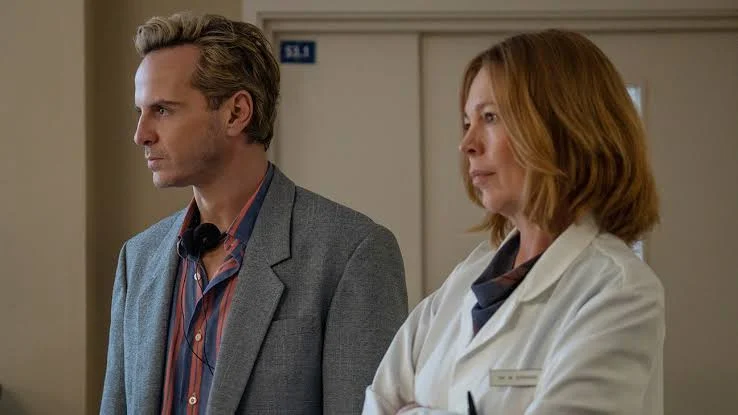
Olivia Colman’s Dr. Margaret Johnson treats the development with the clinical severity of someone who has watched too many men disappear. She orders Charleson to attend regular appointments and regards Hamlet as an unnecessary physical danger. Charleson regards stepping away from it as another form of dying. Their disagreement gives the film one of its most productive tensions because neither position needs to be falsified for the other to matter.
Charleson rehearses through exhaustion, deteriorates during previews and eventually lands in hospital. His insistence on continuing carries ego alongside bravery. Stone is perceptive enough to preserve both. Art here is neither miracle medicine nor decorative metaphor. It gives Charleson a reason to spend the strength medicine is trying to conserve.
Scott makes the Shakespearean passages carry this tension directly. Hamlet’s fixation on mortality begins brushing against Charleson’s own circumstances until actor and role become difficult to separate. Yet Stone occasionally distrusts the material he has assembled.
Rehearsals and performances are compressed into rapid montages when Scott’s stage work could have been allowed to breathe. A film fascinated by the value of sustained theatrical presence sometimes chops that presence into cinematic shorthand. The late crosscutting between Hamlet and Charleson’s final decline is powerful for the same reason it is slightly obvious. Shakespeare has already done much of the work.
Public Silence, Private Community
Charleson’s illness exists inside another performance, one imposed by British cultural life rather than the National Theatre. He moves comfortably through gay London while protecting a public image he believes his screen career still requires. The distinction may look timid from a safer historical distance. Elsinore understands it as professional survival shaped by prejudice.
David Dawson’s Derek Jarman refuses to accept that compromise. Living with AIDS himself, Jarman presses Charleson to speak publicly, arguing that visibility carries responsibility during an epidemic killing their friends. Their confrontations sharpen the film because both men possess defensible positions and painful reasons for holding them. During their encounters, political disagreement remains entangled with affection, shared history and the knowledge that either goodbye could be permanent.
Charleson’s conversations with his parents make secrecy intimate rather than ideological. Jean, played by Georgie Glen, absorbs the revelation with immediate anguish. Peter Mullan’s Jack takes longer. His reaction surfacing outside the hospital lands harder precisely because the film permits silence before speech.
Around them sits a larger network of care. Billie Piper gives Patsy Pollock a brisk, affectionate loyalty free from sanctification. Matthew Beard’s Sean helps shoulder the practical work of illness. Luke Thompson’s Georgie turns the epidemic’s scale into something personal: another familiar face becoming frail, another friendship acquiring an expiration date.
Stone repeatedly treats the Royal Free Hospital and the National Theatre as parallel institutions. One contains frightened patients, doctors and visitors; the other actors, technicians, wardrobe staff and directors. Both become communities organized around keeping people going.
That parallel prevents misery from monopolizing the picture. Monica Dolan’s stage-door supervisor greets the replacement Hamlet as “Takeover Tina,” puncturing theatrical solemnity in seconds. Better still is the hospital sequence built around Ethel Merman’s disco recording of “There’s No Business Like Show Business,” where sick men lip-sync and dance. The scene refuses the cultural habit of remembering AIDS victims only at the point of suffering.
Prestige and Presence
Mike Eley’s handheld cinematography keeps backstage corridors and hospital rooms tactile rather than embalmed. Natural light can be glaring, while domestic interiors sink toward darkness without announcing symbolism in capital letters. Valerio Bonelli’s editing works best when moving quietly between medicine and theatre, letting similar gestures or spaces create the connection.
Stefan Gregory’s orchestral score is less restrained. Certain scenes already contain enough emotion in Scott’s face or Colman’s clipped delivery, yet the music occasionally arrives to certify what has plainly happened. Elsinore has the recognizable architecture of prestige tragedy, and Stone sometimes polishes its grief until its historical roughness starts disappearing.
The actors resist that tendency. Colman gradually reveals Johnson’s compassion beneath professional discipline. Flynn makes Eyre’s protection of Charleson practical rather than paternal. Dawson gives Jarman anger that feels earned rather than conveniently confrontational.
Scott remains the reason the machinery never closes around the man. Watch Charleson joke about Chariots of Fire, bristle at medical instructions, push himself through rehearsal, or disclose his condition to colleagues. Each situation produces a slightly different version of him. Elsinore may sometimes arrange Ian Charleson’s final months into familiar prestige shapes, but Scott keeps interrupting the arrangement with something far less convenient: a human being who still wants applause, sex, friendship, work and another night onstage.
Elsinore premiered at the 53rd Telluride Film Festival on September 4, 2026, ahead of its scheduled theatrical rollout by Focus Features. The biographical drama chronicles Scottish actor Ian Charleson as he confronts severe health struggles while preparing to play Hamlet at the National Theatre in the final months of his life.
Where to Watch Elsinore (2026) Online
Full Credits
Title: Elsinore
Distributor: Focus Features, StudioCanal
Release date: September 4, 2026 (Telluride Film Festival)
Running time: 1 hour 44 minutes
Director: Simon Stone
Writers: Stephen Beresford
Producers and Executive Producers: Andrea Occhipinti, Gabrielle Tana, Carolyn Marks Blackwood, Pete Shilaimon, Mickey Liddell, Stefano Massenzi, Andrew Scott
Cast: Andrew Scott, Olivia Colman, Billie Piper, Johnny Flynn, Peter Mullan, Sadie Soverall, Juliet Stevenson, Joe Locke
Director of Photography (Cinematographer): Mike Eley
Editors: Valerio Bonelli
Composer: Stefan Gregory
The Review
Elsinore
Elsinore occasionally presses too hard on emotions that Andrew Scott can communicate with a glance, especially when Stefan Gregory’s score and the late montages underline Charleson’s decline. Yet Simon Stone finds greater strength in the spaces surrounding death: backstage jokes, hospital friendships, difficult disclosures and an actor refusing to surrender the work that still makes him feel alive. Scott gives Ian Charleson wit, fear, vanity and ferocious purpose without turning him into a martyr. The film may package history conventionally, but the life inside that package remains painfully immediate.
PROS
- Andrew Scott’s extraordinary performance
- Strong queer historical perspective
- Olivia Colman and David Dawson
- Theatre and hospital parallels
- Sharp flashes of humor
CONS
- Over-insistent orchestral scoring
- Performance scenes cut too rapidly
- Familiar prestige-drama framing