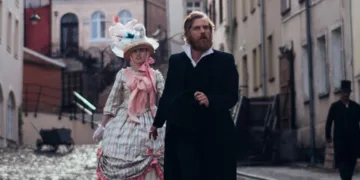








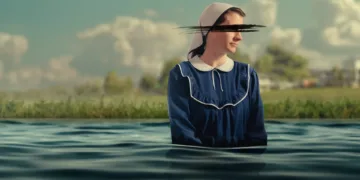




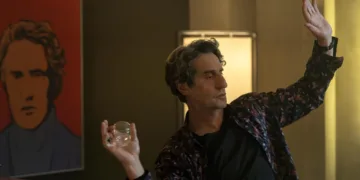






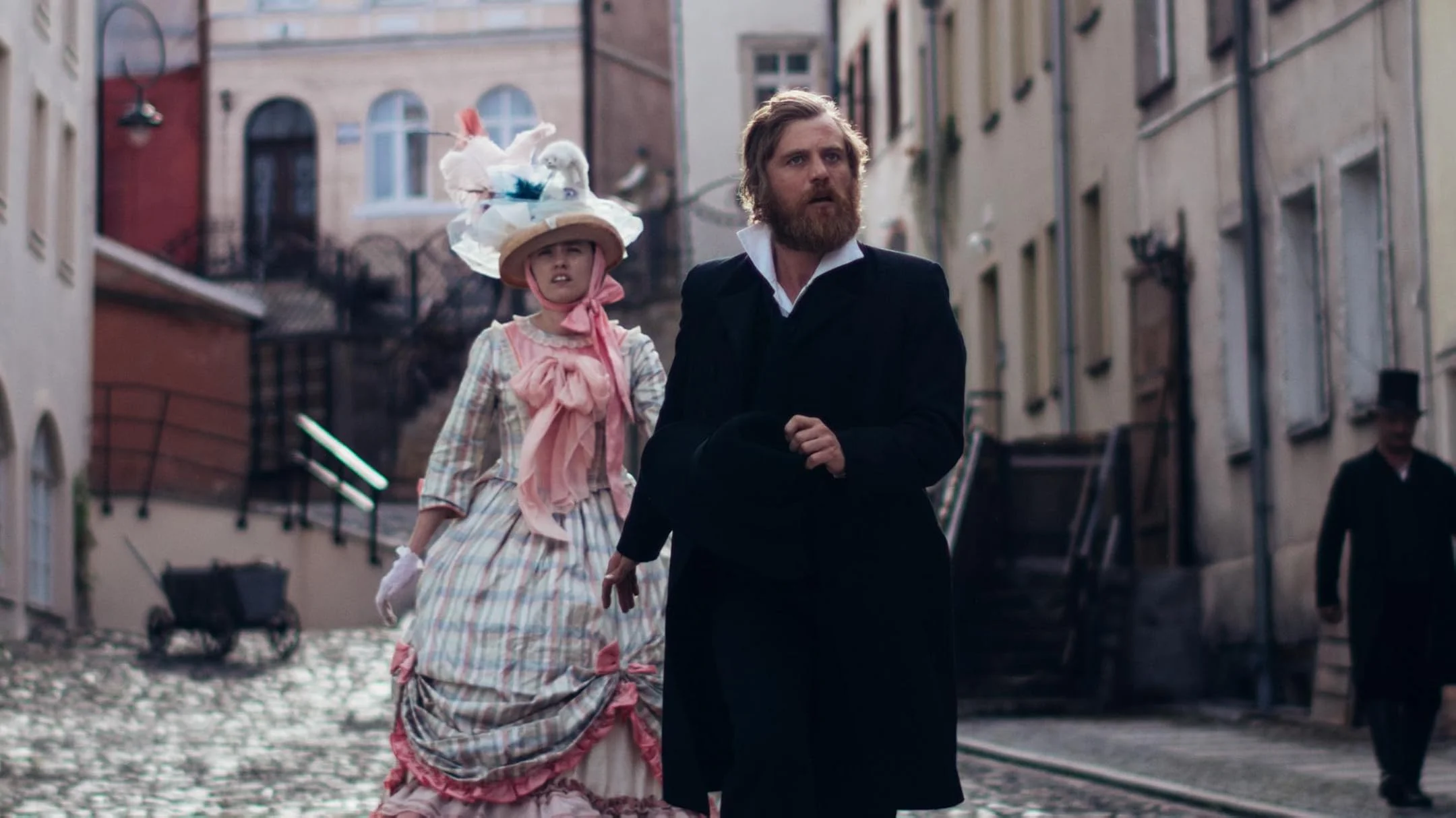

Fyodor Dostoevsky has already written Crime and Punishment, yet the achievement has left him behaving less like a literary titan than a man who has misplaced both his money and the instruction manual for adulthood. Johnny Flynn’s Fyodor arrives in 1860s Germany with his new wife Anna, played by Aimee Lou Wood, theoretically prepared to begin The Idiot. The notebook remains empty. The roulette table does not.
Małgorzata Szumowska and Michał Englert build The Idiot(s) around that imbalance. Drawing from Andrew D. Kaufman’s The Gambler Wife and material connected to Anna Dostoevskaya’s own writings, the film relocates creative mythology into unpaid bills, sexual embarrassment, artistic jealousy and repeated financial catastrophe. Fyodor may possess the famous name, but Anna spends much of the film performing the practical work required to keep that name attached to new pages. This is literary biography conducted with very little interest in literary dignity.
Anna Writes Around Him
Wood’s strongest scenes come when Anna is forced to convert devotion into logistics. She urges Fyodor to write, checks notebooks that contain doodles instead of prose and scrambles to keep them solvent after another gambling loss. As their circumstances worsen, possessions disappear and food becomes harder to obtain. Eventually she goes further, secretly producing pages herself and attempting to move them toward Fyodor’s publisher through his rival Ivan Turgenev.
That fictionalized act captures the film’s main intellectual provocation. Authorship looks clean on a book cover. Creative life rarely is. Anna manages deadlines, money, moods and domestic survival while Fyodor supplies the prestige and, eventually, the sentences. When she later calls the completed work “our best novel” before correcting herself, the mistake sounds closer to the truth than the correction.
Wood prevents this arrangement from turning Anna into a solemn martyr. Her anger has teeth. Fantasies of killing Fyodor give private shape to frustrations she cannot easily act upon, while her sexual confidence and blunt practicality keep her from existing as a moral counterweight to him.
Flynn takes the opposite route. His Fyodor begs, sulks, boasts, flirts and crawls through the consequences of his own impulses. After gambling losses, desperation becomes almost physical; he drags himself toward Anna for forgiveness or another chance. The performance is funniest when self-pity and arrogance occupy the same gesture.
Their marriage remains harder to solve. Bedside affection, jokes involving hard-boiled eggs and Fyodor’s humiliation fantasies create a sexual familiarity that prevents the relationship from becoming purely punitive. Scenes involving Anna’s pregnancy, the birth of their child and later tragedy expose tenderness in a man the film otherwise enjoys dragging through the mud. The love is present. Its logic is murkier.
Dostoevsky Without the Pedestal
Szumowska and Englert seem allergic to the museum-glass treatment usually reserved for canonical writers. Fyodor drinks, vomits, humiliates himself and turns his rivalry with Turgenev into something approaching playground combat. Their absurd dance confrontation reduces literary nationalism to masculine showing off, which may be closer to history’s emotional truth than another candlelit conversation about genius.
One gathering offers a darker version of the same method. Asked to entertain wealthy company with a personal story, Fyodor recounts an account involving child abuse. The room’s amused curiosity curdles as Flynn shifts from performance to accusation. His gift for storytelling survives the degradation around it, and that survival is precisely what makes him difficult to dismiss.
The film keeps destabilizing period decorum elsewhere. Someone performs A-ha’s “Take On Me” roughly a century too early. A grotesque dessert emerges from a porcelain dog. Nightmares introduce executions, decapitation and a gigantic roulette ball bearing down on Fyodor. Historical realism is treated as something elastic rather than sacred.
Vicky Krieps’ Natasha F extends that slipperiness. She operates partly as a worldly temptation and partly as an apparition connected to Nastasya Filippovna, allowing Dostoevsky’s unfinished fiction to seep into his lived environment. Biography and imagination begin contaminating each other.
Englert’s cinematography and Ewa Mroczkowska’s production design support that instability with visual precision. Aristocratic interiors feel lush enough to provoke Fyodor’s resentment, while the Dostoevskys’ own spaces grow meaner as debts accumulate. Cemeteries, wet landscapes and dim rooms make Europe look caught between storybook elegance and rot. It is beautiful decay, which feels entirely appropriate for a man who keeps insisting suffering has spiritual value while sending his wife to pawn household objects.
The Roulette Wheel Keeps Turning
The film is wise to avoid explaining The Idiot as a series of biographical clues. There is no neat scene where Fyodor meets a stranger and mentally files him away as Prince Myshkin. Ideas from the novel appear instead through dreams, jealousy, arguments and figures like Natasha F. Viewers familiar with Dostoevsky can enjoy that porous border between life and fiction.
The cost is accessibility. Anyone without much familiarity with the novel may struggle to separate historical figures, fictional manifestations and deliberate invention. That ambiguity could still work if every emotional connection landed with equal force. It does not.
The larger problem arrives through repetition. Fyodor loses money, begs Anna for help, receives another chance and returns to gambling. The cycle is purposeful at first because addiction is repetitive by definition. After several rounds, the film begins dramatizing the same knowledge twice.
A giant roulette ball chasing Fyodor visualizes a crushing addiction the casino scenes have already communicated perfectly well. A nightmare punishment for his treatment of women arrives after his behavior toward Anna has made the charge fairly difficult to miss. The surrealism begins explaining what the drama has already proved.
That weakens the strange unpredictability of the earlier sections, where a literary icon could move from sexual humiliation to nationalist dancing to financial collapse without warning. By the later passages, chaos has developed a schedule. Anna remains the stronger mystery: intelligent enough to recognize the damage, resourceful enough to survive it, loving enough to stay. The Idiot(s) can show every task she performs for Fyodor. It never quite finds the psychological equivalent of those pages.
The Idiot(s) premiered at the 53rd Telluride Film Festival on September 4, 2026. The historical period drama centers on the volatile early marriage of Russian author Fyodor Dostoevsky and his wife Anna during a European honeymoon, where his severe gambling addiction threatens financial ruin while sparking the creation of his iconic literary masterpiece.
Full Credits
Title: The Idiot(s)
Distributor: The Match Factory
Release date: September 4, 2026 (Telluride Film Festival)
Running time: 1 hour 58 minutes
Director: Małgorzata Szumowska, Michał Englert
Writers: Małgorzata Szumowska, Michał Englert, Kasper Bajon, Bríd Arnstein
Producers and Executive Producers: Ilya Stewart, Vladimir Zemtsov
Cast: Aimee Lou Wood, Johnny Flynn, Vicky Krieps, Christian Friedel, Barbara Marten, Rainer Bock
Director of Photography (Cinematographer): Michał Englert
The Review
The Idiot(s)
The Idiot(s) is funniest when it treats literary genius as an administrative emergency: Fyodor gambles, sulks and produces blank pages while Anna quietly keeps both household and masterpiece alive. Its anachronisms and grotesque fantasies give the costume drama a welcome instability, yet the second half keeps replaying Fyodor’s self-destruction after the point has landed. Wood gives Anna agency without sanding away her devotion, while Flynn makes brilliance look thoroughly exhausting to live beside. The film demystifies Dostoevsky with considerable wit, then struggles to explain the marriage that made his work possible.
PROS
- Aimee Lou Wood’s layered Anna
- Johnny Flynn’s abrasive comic performance
- Playful historical irreverence
- Lavish, decaying period design
- Sharp focus on invisible creative labor
CONS
- Repetitive second-half gambling cycle
- Surreal imagery sometimes overexplains
- Anna’s devotion remains psychologically thin
- Literary references can exclude newcomers