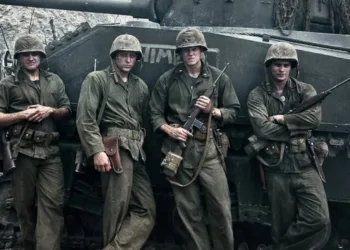

















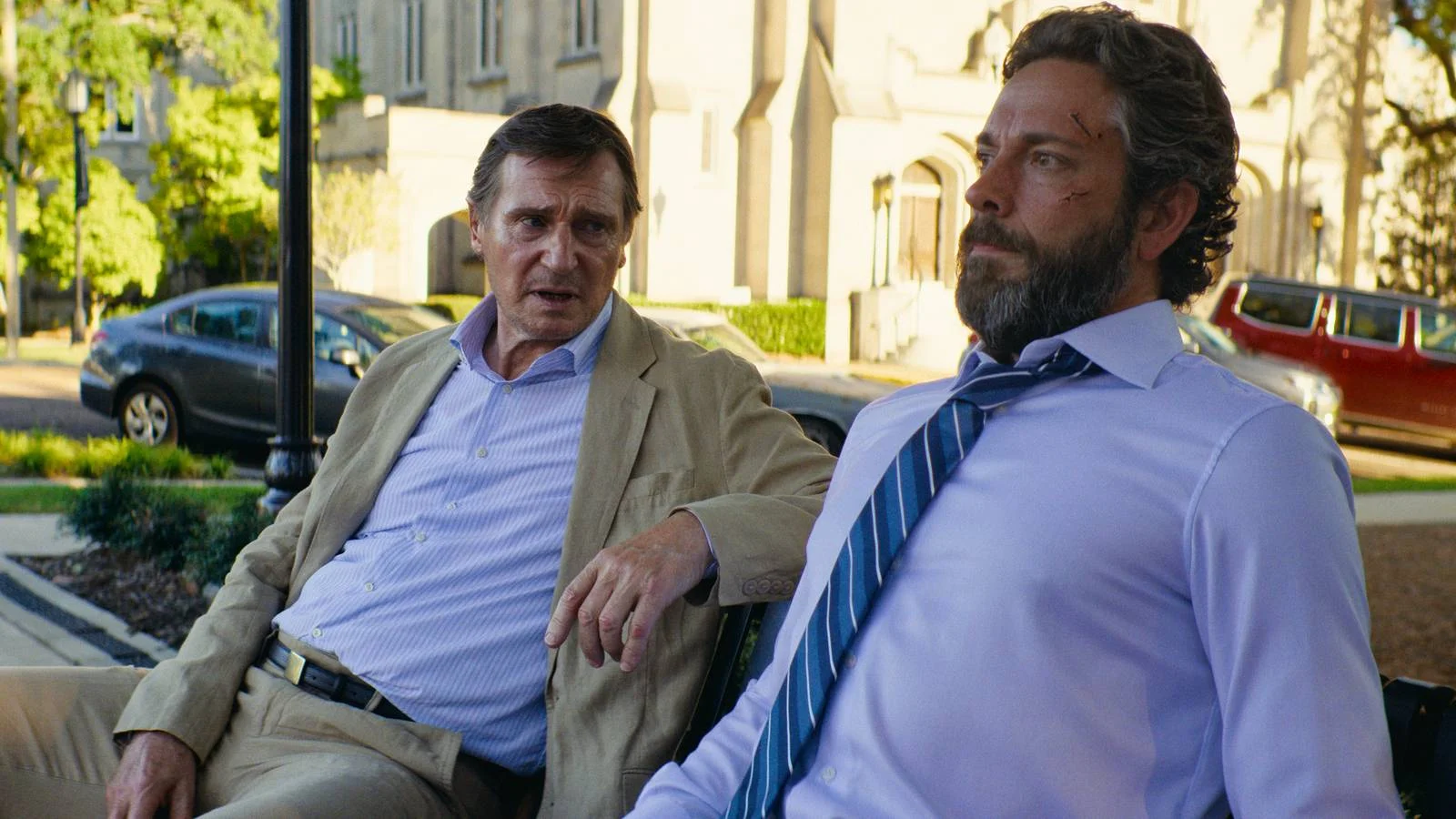

The cleanest idea in The Fix arrives before its plot becomes crowded: Tucker and his team have spent years surrendering their identities to institutions that can erase them with a signature. Guy Moshe stages that idea through a disastrous extraction during the American withdrawal from Afghanistan. CIA handler Larry (Liam Neeson) has ignored orders and sent Tucker (Zachary Levi) and his unit after a local informant they refuse to abandon. Taliban fighters reach him first. Bullets take over.
Moshe understands the brutal geometry of this sequence. Tucker’s squad fires across distance rather than charging through conveniently arranged corridors, Clay (Quincy Isaiah) operates as the unfamiliar sniper replacing a dead teammate, and the informant remains physically separated from the people trying to save him. When Tucker finally shoots the captured man rather than leave him to torture, the composition turns distance into culpability. He can barely reach the person he came to rescue, yet he can reach him with a bullet.
Then bureaucracy performs its own execution. Larry sanctioned an operation that his superiors had forbidden, and everyone except Clay pays for it with careers and pensions. The film has found an ugly premise: violence conducted on behalf of a state can remain morally binding long after the state decides the people who committed it are expendable.
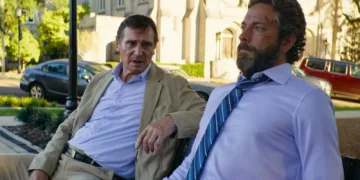
Years later, Tucker returns to Larry and finds his former handler suffering severe cognitive decline. Larry mistakes him for a dead colleague and reveals that $25 million was hidden inside a Tehran hotel decades earlier. Tucker hears less a secret than an invitation. The war has already thrown him out. He goes looking for another one.
The Long Road to Tehran
For a thriller about stealing buried intelligence money from Tehran, The Fix spends an extraordinary amount of time avoiding Tehran. Tucker needs to rebuild his old unit. The hidden cash can supposedly repay men who lost everything after Kabul, and the crew’s willingness to reunite carries a second motive that the screenplay understands without examining deeply enough: they miss operations.
Civilian life has not replaced the structure of deployment. Tucker’s estrangement from his wife Sophie (Annet Mahendru) and son gives that dependence a domestic cost, yet the film treats his damaged family largely as evidence of sacrifice rather than as a judgment on his choices.
Access to the money comes through an Iranian former intelligence asset living in Paris. She will reveal its location if Tucker extracts her activist daughter from Iran. Zara (Elnaaz Norouzi) joins the mission to pose as Tucker’s wife, giving him cover as a Persian-rug businessman with New Zealand connections. This is enough machinery for several thrillers, and Moshe, writing with Mark Bacci, keeps adding gears.
Nearly an hour passes before the team reaches Iran. Much of that time is devoted to recruitment, briefings, explanations, old resentments, Larry’s deterioration, Tucker’s family troubles, and clarification of who knows which part of the operation. The quieter scenes occasionally find a believable rhythm when the operatives speak casually. Their clipped exchanges suggest men who have repeated the same terminology for years and can communicate through shorthand. Give the dialogue a plot assignment, however, and every seam begins to show. Information arrives in blocks. Characters explain danger, reconsider danger, then explain a new danger attached to the previous danger.
The irony is that Moshe’s framing often possesses greater discipline than his screenplay. Tucker is frequently isolated within wide compositions or positioned apart from the unit he nominally leads. The film keeps finding visual ways to suggest a man separated from civilian life, his family, and his old institution. The dialogue then walks into the room and explains something else.
The hotel operation eventually uncovers only a fraction of the expected cash, alongside negative film strips containing evidence tied to another secret. By then, the original robbery has been fitted with extraction drama, conspiracy mechanics, political intrigue, romance, and betrayal. A lean heist is somewhere inside this movie. It has been detained for questioning.
The Cowboy Problem
Tucker is repeatedly coded as a cowboy, and Moshe takes the association seriously. Zachary Levi lowers his voice, restricts his gestures, hardens his face, and carries himself like someone conserving movement for the next threat. Several standoffs borrow Western grammar, with armed figures separated across open space and violence delayed until the frame can no longer contain it.
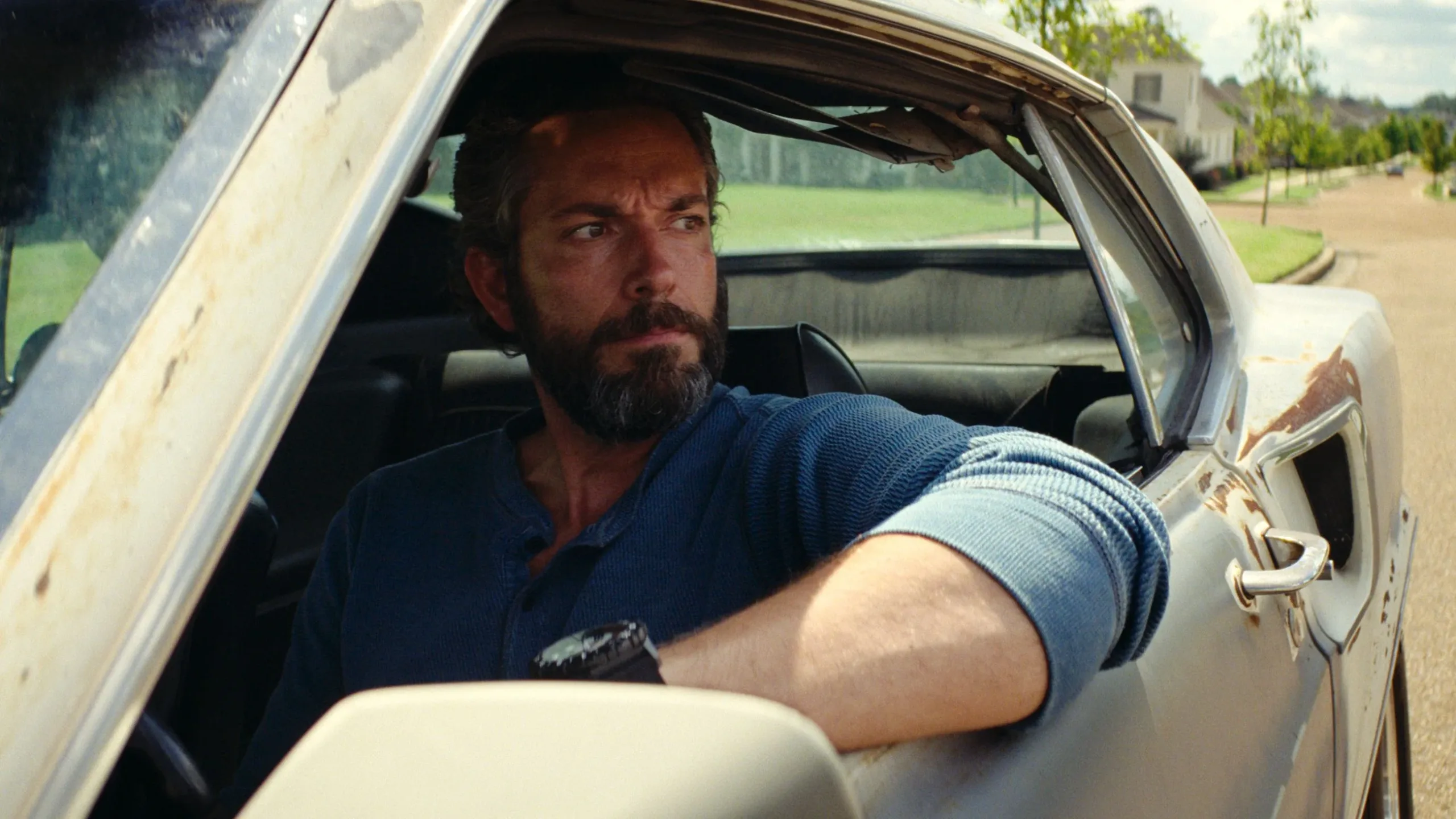
The difficulty is that stoicism requires visible pressure behind the stillness. Levi is effective once Tucker has something immediate to do. During tactical movement, gunfights, and later emotional confrontations, his physical confidence gives the character weight. His body understands Tucker better than his silences do. In extended dialogue scenes, the performance becomes so sealed that the moral damage Moshe wants us to read remains largely theoretical.
That hurts the film’s central question. Tucker supposedly doubts the machinery that shaped him after Kabul, yet those doubts rarely alter his conduct. The script tells us that his years overseas destroyed his relationship with his son. When they reconnect, the emotional framing leans toward restoration before Tucker has faced much accountability for having repeatedly chosen the work that kept him absent.
Neeson faces a different problem. Larry’s severe presence suits the Kabul material, particularly when he backs Tucker’s unauthorized attempt to save the informant, yet the character quickly becomes a mechanism for moving secrets into Tucker’s hands. His dementia supplies the information about Tehran and later feeds a major twist. The decline itself receives far less attention.
Quincy Isaiah fares better because Clay enters with a distinct position inside the unit. He is the younger sniper, the replacement, the man without the same relationship to the doomed Kabul asset. Isaiah gives him enough confidence and looseness to separate him from a squad whose other members sometimes disappear into matching tactical attitudes.
Zara should provide another point of resistance. Norouzi has energy, and her presence changes the temperature whenever Tucker’s grim professionalism threatens to flatten a scene. Yet the screenplay keeps altering her function. She is cover, romantic interest, endangered civilian, emotional provocateur, and occasional source of avoidable complication. Tucker attempts to send her away for her safety, she stays, and romance grows inside a mission already carrying half a dozen motives. The film gives Tucker a false wife because the operation needs one. Then it asks chemistry to turn logistics into intimacy.
When the Guns Start Talking
Moshe’s direction becomes considerably sharper once conversations stop carrying the whole load. The Kabul extraction has a grim tactical clarity that many later scenes lack. The shooters occupy discernible positions, the informant’s capture changes Tucker’s options, and every burst of gunfire forces another decision. Smaller Tehran confrontations work for similar reasons. People want something immediate. Space matters. Movement has consequences.
The hotel raid finally lets the third act compress the film’s separate threads into physical action. Extraction, robbery, surveillance, and pursuit begin colliding within the same stretches of time. After long scenes spent discussing the impossibility of the mission, the movie suddenly has momentum because nobody can convene another meeting about it.
The Western influence helps here. Some confrontations are staged closer to saloon shootouts than sleek contemporary espionage, with adversaries occupying opposing zones before chaos breaks the arrangement. Tucker’s “cowboy” label stops being characterization-by-dialogue and becomes a principle of staging.
Other visual choices undermine the effect. Daylight imagery can take on a smeared quality, night scenes sink into murk, and several digital effects pull attention toward their artificiality. CGI drones are particularly conspicuous because the movie elsewhere pursues a gritty physical texture. Explosions occasionally land with the weight of placeholders rather than events happening in the same world as the performers.
Tehran itself is repeatedly filtered through yellowed, desaturated imagery. That palette makes hostility environmental. Threat exists before anyone speaks, embedded into walls, skies, streets, and military checkpoints. It is an old visual shortcut for Western thrillers set across the Middle East, and using it here carries political meaning regardless of authorial intent. Moshe can be unusually precise about the placement of armed bodies in a firefight, then remarkably blunt about the placement of an entire country inside his visual imagination.
The Light Goes Out on Ambiguity
Tucker’s most revealing contradiction arrives once he has already broken with the American intelligence establishment. He regards himself as discarded, betrayed, and spiritually detached from its acronyms, yet his proposed solution is another illegal covert operation conducted on foreign soil. He has left the institution. Its logic has not left him.
The screenplay comes close to recognizing this. Tucker’s team lost careers after attempting to save an abandoned asset. Their eagerness to risk their lives for hidden money suggests men whose capacity for ordinary existence has been hollowed out by service. The gas station seen after the Afghanistan chapter briefly places their return beside an emblem of the petroleum economy that has always haunted American intervention in the region. Moshe does not pursue that association, but the cut leaves a residue.
The Tehran mission raises harsher questions. Tucker refers to people obstructing the operation as “fair game,” a chilling phrase from someone supposedly reconsidering what years of violence have done to him. Women and civilians across the Kabul and Iran sequences often appear as signs of danger, repression, or collateral vulnerability rather than as people allowed comparable interiority.
One scene gives the political machinery unusual clarity. Tucker seeks assistance from Israeli operatives working undercover in Tehran. Faced with their reluctance, he argues that failure would reduce his group to “stupid Americans,” while success could weaken the Iranian government and create an opening for another strategic strike.
For a moment, the film’s shadows finally align with its politics. Tucker imagines himself independent, yet every route he takes reproduces the architecture he resents: clandestine alliances, expendable assets, foreign intervention, deniable violence, ends offered as absolution for means.
Moshe keeps lighting Tucker like a man trapped between moral positions. The screenplay rarely allows him to occupy that darkness for long. Each time the ambiguity starts to deepen, another plot turn drags him back toward the reassuring silhouette of the righteous operator. The most revealing image of Tucker, then, may be the one the film keeps repeating in different forms: a cowboy standing outside the system, carrying its gun.
The Fix arrives in theaters on September 11, 2026, distributed by Inaugural Entertainment. The action thriller follows a group of disillusioned ex-CIA operators who head to Tehran to execute a high-stakes rescue mission.
Where to Watch The Fix (2026) Online





Full Credits
Title: The Fix
Distributor: Inaugural Entertainment
Release date: September 11, 2026
Running time: 2 hours 21 minutes
Director: Guy Moshe
Writers: Guy Moshe, Mark Bacci
Producers and Executive Producers: Marina Grasic, Matthew G. Zamias, Wendy Sweetmore, Guy Moshe, Bazzel Baz
Cast: Liam Neeson, Zachary Levi, Annet Mahendru, Grant Harvey, Augusto Aguilera, Elnaaz Norouzi, Despina Mirou, Oliver Trevena, Lara Wolf
Director of Photography (Cinematographer): Daniel Dor
Editors: Guy Moshe
Composer: Federico Bisozzi, Davide Tomat
The Review
The Fix
The Fix has the visual vocabulary of moral uncertainty without the nerve to inhabit it. Guy Moshe finds tension in the Kabul extraction and Tehran raid, where gunfire, murky light, and tactical movement give Tucker's world a physical grammar. The screenplay is less disciplined. Its 142 minutes bury a leaner thriller beneath exposition, romantic detours, conspiracies, and political ideas it raises then abandons. Zachary Levi's rigid stoicism compounds the distance, leaving Tucker's supposed crisis of conscience visible mainly in theory. The shadows promise ambiguity. The story keeps switching on the lights.
PROS
- Tense Kabul extraction
- Stronger third-act action
- Effective Western visual influence
- Quincy Isaiah's energetic supporting turn
- Interesting institutional-disillusionment thread
CONS
- Bloated 142-minute structure
- Clumsy plot-heavy dialogue
- Underwritten moral conflict
- Levi's overly closed-off performance
- Simplistic geopolitical framing