

























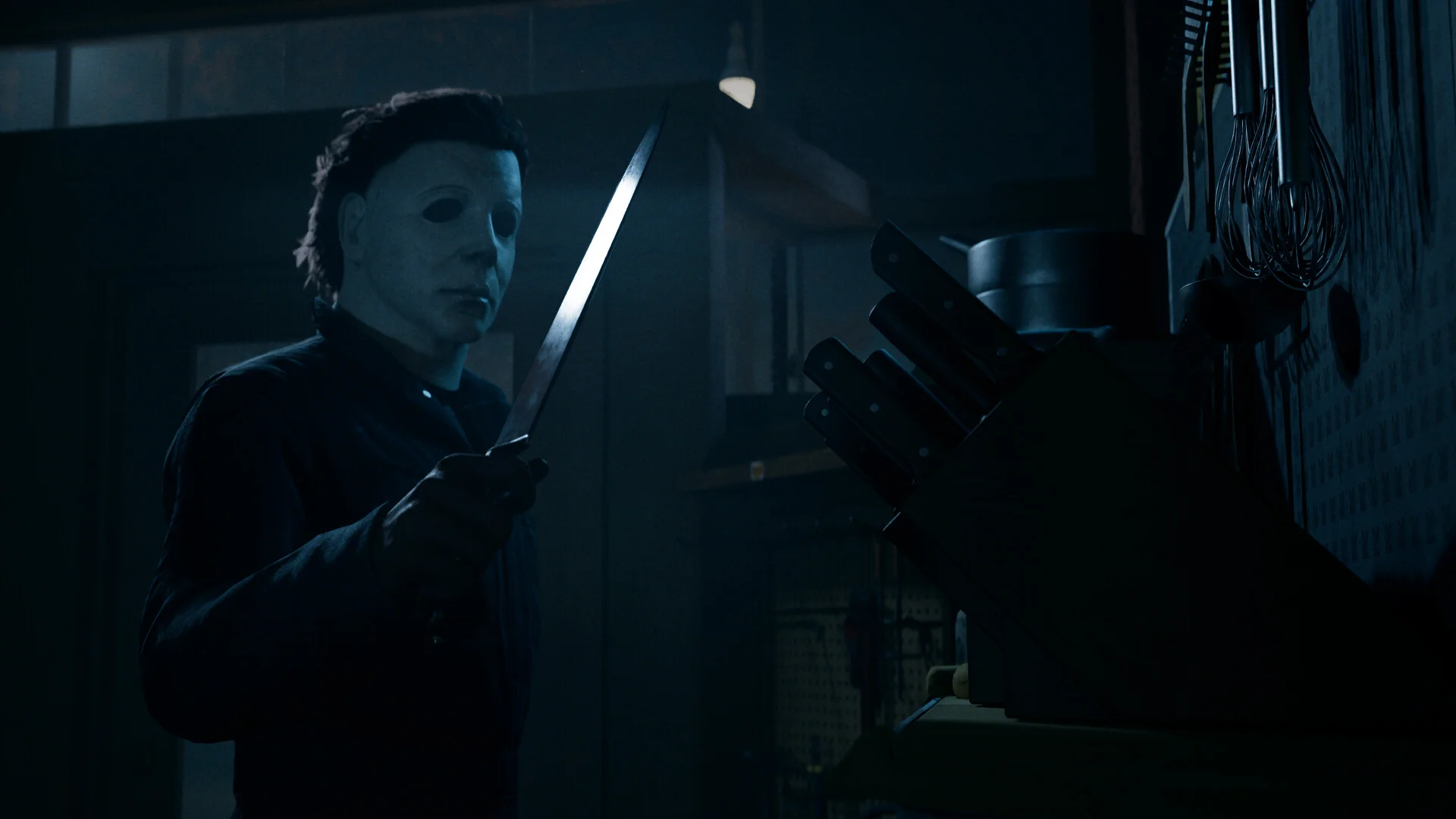

Seven civilians can lose you a match before Michael Myers ever lays a hand on another player. That single scoring rule tells you where Halloween: The Game separates itself from most asymmetrical horror games. IllFonic and Gun Interactive return to familiar territory after Friday the 13th: The Game, placing one player behind Michael’s mask while four others control residents of Haddonfield. Yet surviving personally is only one piece of the resident side’s job. Several NPCs are scattered across the neighborhood, and every one Michael kills strengthens his score. Every one the residents evacuate works against him.
It turns Haddonfield itself into the contested resource. That change matters because asymmetrical horror can easily collapse into familiar routines. Dead by Daylight builds much of its tension around pursuit and objective completion. Friday the 13th made escape preparation a communal problem. Here, the primary question is how much damage each side can inflict or prevent across an entire neighborhood.
The idea gives Halloween: The Game a mechanical identity tied specifically to its license. Its best systems understand Michael Myers surprisingly well. Its weakest ones involve the people supposedly intelligent enough to run away from him.
Becoming the Boogeyman
Michael’s painfully slow walking speed initially seems strange for a multiplayer killer. Try chasing a competent resident down an open street and you will quickly discover why walking is rarely the point. Shape Jump solves the movement problem while reinforcing the character fantasy.
When Michael is outside direct observation and away from strong light, he can enter a spectral state and move rapidly across the map. He can vanish from one part of Haddonfield, reposition and emerge somewhere a resident thought was safe. Light therefore becomes part of the chase system.
Blackout allows Michael to knock out power around specific locations. A darkened building can then be entered through Shape Jump without smashing a door and broadcasting his arrival. Leave the lights intact and those physical barriers matter again. There is even a nasty risk attached to careless use: if power returns while Michael is trapped somewhere without an accessible exit, his supernatural entrance suddenly becomes a very mundane logistical problem. His stalking mechanic is even better.
Shape Stalk shifts the perspective into first person and rewards watching potential victims without being noticed. Building the stalk meter expands Michael’s killing options. At higher levels, environmental executions let him use televisions, stovetops, rocks, workshop machinery and wall telephones against nearby victims. The important part is not the execution catalogue itself. It is what the meter asks the player to do before reaching it.
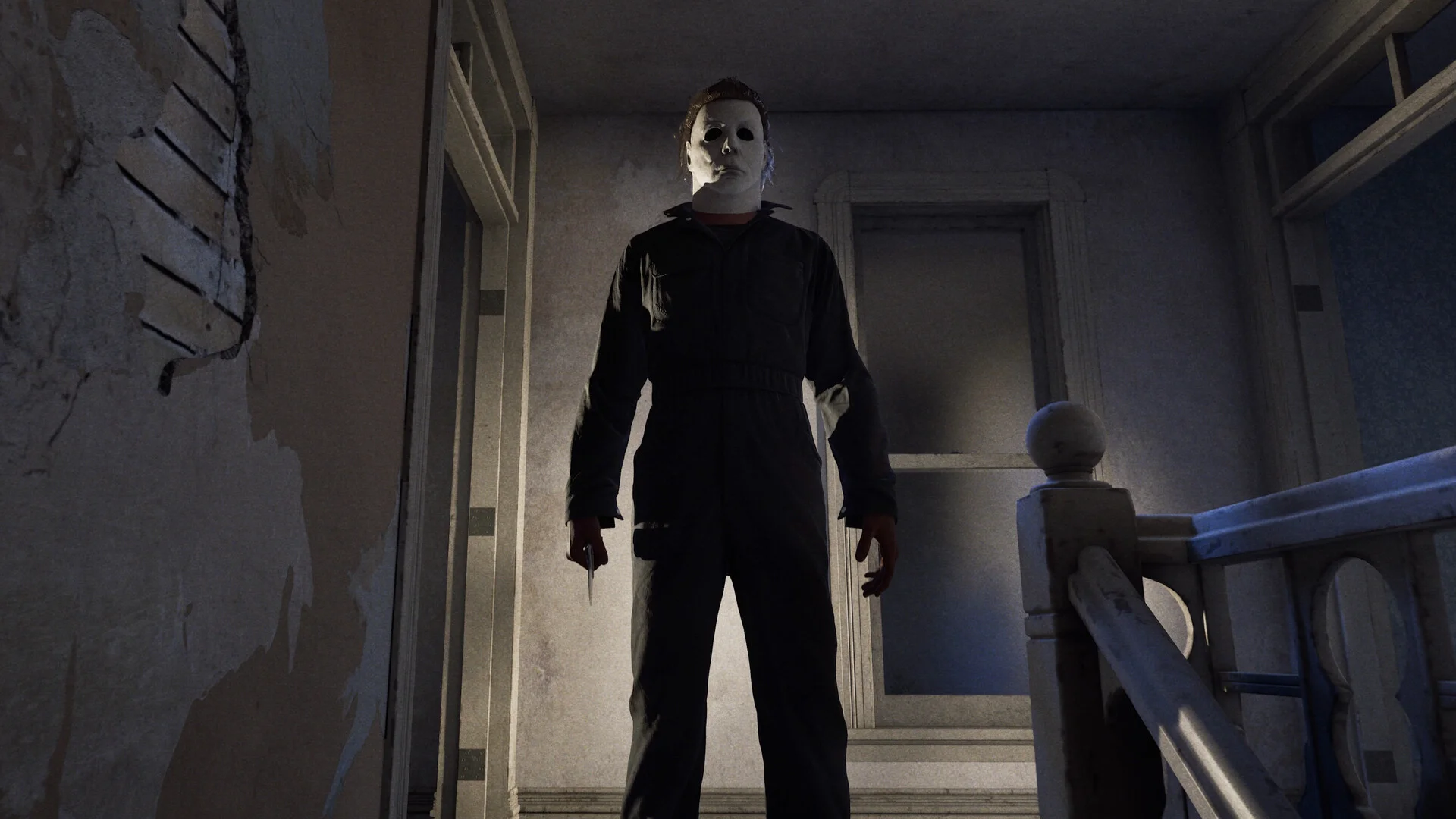
Instead of sprinting toward every target, Michael benefits from standing across the street, waiting near a window or watching somebody from darkness. For the resident on the receiving end, spotting his white mask motionless in the distance can be scarier than getting chased.
This is where comparisons with Jason become useful. Both characters are physically overwhelming killers whose games need alternative methods of controlling distance. Jason frequently felt like a force bearing down on a group trying to assemble an escape. Michael plays closer to an ambush predator. Power, visibility and observation shape his rhythm.
There are rough edges. Lower stalk levels still allow straightforward weapon executions once Michael gets close enough, and residents can die extremely quickly after a grab. Some elaborate kills also suffer from stiff animation work, robbing a particularly gruesome interaction of the impact its setup earned. Still, the basic design succeeds. Shape Jump, Blackout and stalking produce a killer whose systems describe Michael before the game ever needs to explain him.
The Neighborhood Becomes the Objective
The resident side has the harder design problem because it needs to make protecting NPCs interesting. Each house can contain civilians who need convincing before they will react sensibly to the serial killer roaming their street. Players complete short conversation interactions and can tell residents to follow them, hide, call the police or head toward an available escape.
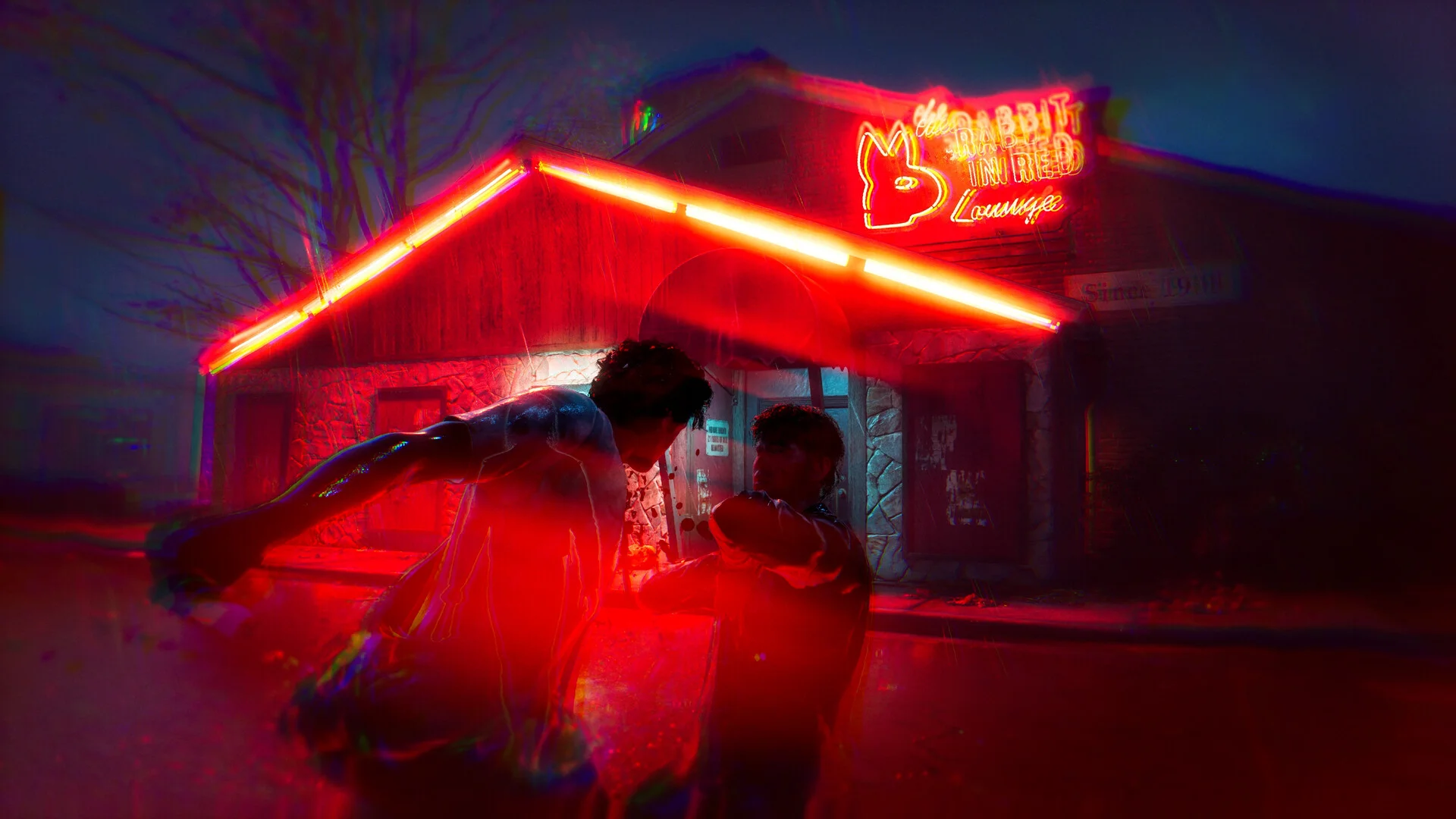
This makes a match less about personal evacuation and closer to damage control. One encounter demonstrates the scoring system nicely. Michael spent most of a match pursuing a single player. He eventually caught and killed that person, which would normally read as a clear victory for the killer. Yet the chase consumed so much time that the remaining civilians escaped. Michael won the duel and lost the larger contest.
Escape routes give residents several competing priorities. A sedan can be repaired. A storm shelter can be opened. Repeated calls to law enforcement can raise police activity until a police wagon becomes available.
Finding the necessary equipment introduces a lot of variance. One match can place shelter supplies close enough that an escape plan forms almost immediately. Another can send you through house after house searching for a component the car still needs.
Character traits create smaller differences inside that loop. One resident may be stronger at persuasion, another better at sustained movement. Players can find weapons, arm civilians, use telephones and ride bicycles to cross Haddonfield quickly. There is almost always something useful to do. The problem is that useful work does not always mean cooperative work.
Friday the 13th naturally pushed players toward each other. Somebody found fuel. Somebody else located the battery. Another player distracted Jason while the group tried to get the car moving. Successful escape stories often became improvised team exercises.
Halloween frequently rewards division instead. Four residents spreading across four areas can warn civilians faster than four people traveling together. A capable player can spend large portions of a match barely interacting with teammates.
Public matchmaking adds another layer of unpredictability. In one match, a player collected civilians into a group and repeatedly tried to knock Michael down instead of directing them toward exits that had already been prepared. Michael eventually converted that misplaced aggression into a perfect result. The scoring model is asking players to protect Haddonfield. Some players will still treat Michael like a target dummy with a kitchen knife.
Nobody Leaves the Match Quietly
The single-player mode solves a different multiplayer problem: teaching somebody to control Michael without throwing them directly into a live match. “The Night He Came Home” consists of a prologue and five short chapters, taking roughly an hour to complete. It begins at Smith’s Grove Sanitarium on October 30, 1978, with Dr. Samuel Loomis narrating Michael’s escape.
The earliest encounters teach stalking by placing orderlies nearby and asking the player to remain undetected while building the required meter. Grabbing and killing then introduces the basic input sequence. On PS5, the L2 grab followed by an L1 kill feels slightly awkward unless two fingers are already resting across the left triggers.
Later chapters introduce Shape Jump, Blackout, bloodlust and Michael’s other tools piece by piece. The structure works because every tutorial concept arrives inside a situation that resembles actual play.
The campaign also spends time outside direct recreation of Carpenter’s film. One chapter introduces original Haddonfield residents, including a young woman whose romantic encounter takes a lethal turn, a biker trying to convince his grandmother to leave town and an athlete whose father encourages him to attend a party.
They only receive brief scenes, yet their presence gives Michael victims who are characters rather than targets already defined by the movie. Optional objectives ask players to terrify or kill specific numbers of people, while scoring targets and cosmetic rewards offer reasons to replay chapters.
Multiplayer elimination gets similar attention. A dead resident can complete short QTE sequences that send perks to living teammates. Under the right conditions, a player can return as a police officer or Dr. Loomis through the CB radio system. It is a clever response to one of asymmetrical multiplayer’s oldest problems: dying early is boring.
It does not entirely fix it. Someone killed during the opening minute of a full 20-minute match can still spend too much time waiting for meaningful participation. The support activities reduce dead air rather than erase it.
Great Atmosphere, Questionable Neighbors
Haddonfield itself often carries the game when its supporting systems stumble. Lighting shifts naturally between suburban interiors and shadowed streets, while Carpenter’s synthesizer-driven musical identity gives approaching danger a familiar pulse. The soundscape intensifies as a threat grows closer, turning an ordinary search through somebody’s home into a warning long before Michael enters the room.

Some residential maps initially blur together, but Haddonfield Town Center gives the formula stronger spaces to work with. One match led into a record store with an apartment above it. After persuading the owner to cooperate, I helped secure the building, called the police, gathered weapons and prepared an escape while Michael moved through the district. The nearby cemetery and varied building sizes gave the encounter a shape the repeated suburban houses sometimes lack. Then the NPCs start making decisions.
Residents may fail to react to danger standing directly in front of them. Some hide in obvious locations. Others choose distant telephones instead of nearby ones, occasionally placing Michael directly between themselves and their destination. Followers can disappear from your route and reappear later as death notifications.
Locked houses create another irritation. Warn an NPC and they may seal themselves inside, leaving the player unable to return once an escape route opens unless the right lock-related option is available.
Police officers fare little better. They can arrive, slowly fire at Michael and barely inconvenience him before being cut down. Even after residents repeatedly stun him near responding officers, the arrest behavior can fail to materialize.
The technical problems make these failures harder to dismiss. NPCs can appear on rooftops. Residents may become trapped inside repair animations. Locked doors behave inconsistently. Proximity chat can malfunction. Collision and camera problems interrupt movement.
Single-player progress has reportedly failed to save properly under certain server conditions, while completed chapters can restart unexpectedly. Host-based multiplayer means the wrong disconnection can return an entire lobby to the menu. None of those faults change the strength of the central systems. They keep interfering with them.
When Michael cuts the electricity, disappears into darkness and emerges inside a building while residents scramble to move civilians toward an exit, every mechanic is telling the same horror story. Then an NPC runs toward the man holding the knife.
The Review
Halloween: The Game
Halloween: The Game finds a smart mechanical identity by making Haddonfield itself the contested resource. Saving civilians, opening escape routes and manipulating police pressure gives residents meaningful work, while Shape Jump, Blackout and stalking make Michael feel distinctly different from Jason or a Dead by Daylight killer. The problem is execution. Weak NPC logic, thin cooperation incentives and frequent technical faults keep disrupting systems that should generate tense neighborhood-wide horror. When everything connects, though, few asymmetrical games capture their licensed killer this precisely.
PROS
- Excellent Michael Myers mechanics
- Civilian rescue changes the victory loop
- Strong 1978 atmosphere
- Useful single-player campaign
- Smart post-death participation
CONS
- Frequently poor NPC AI
- Limited incentive for teamwork
- Repetitive door-to-door objectives
- Numerous technical problems
- Host-based lobbies feel fragile