





























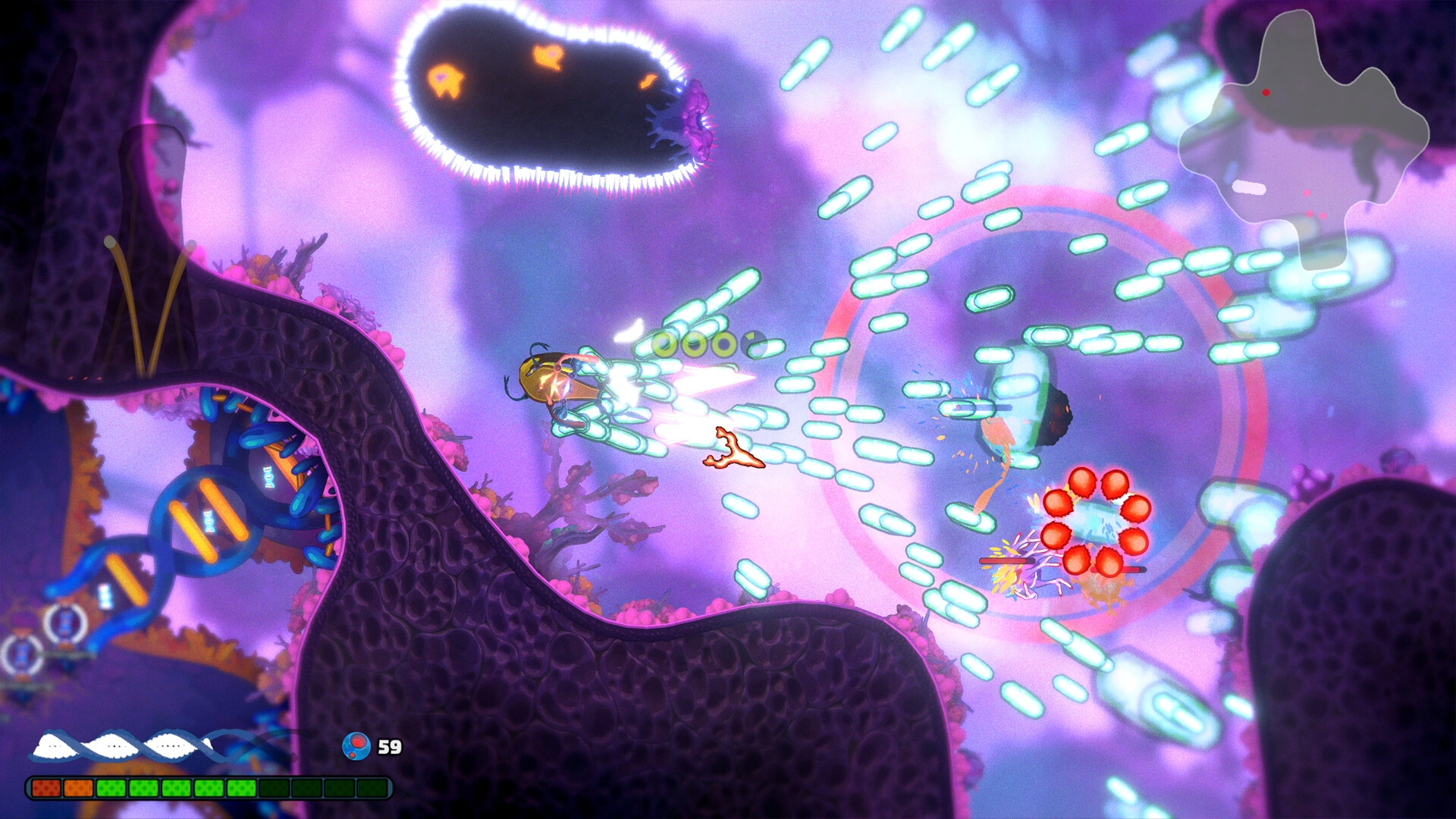

Pathogenic turns the cell stage of Spore into a full roguelite, then gives the idea a sharper mechanical identity than that comparison first suggests. Developed by Aberrant Labs and published by Slug Disco, it casts you as a microscopic organism spilled from a laboratory test tube into a scientist’s body. The route begins at the skin and pushes through organs such as the intestines, stomach, liver, lungs, and heart, with every region acting as a new combat ruleset.
There is almost no narrative beyond the accident and the organism’s drive to spread. That restraint suits the game. The body itself supplies the story, charting the pathogen’s rise from a weak bacterium into something capable of overwhelming an immune system. Where The Binding of Isaac uses grotesque imagery to decorate familiar room clearing, Pathogenic makes biology determine the enemies, terrain, upgrades, and shape of the player character.
Build-a-Pathogen
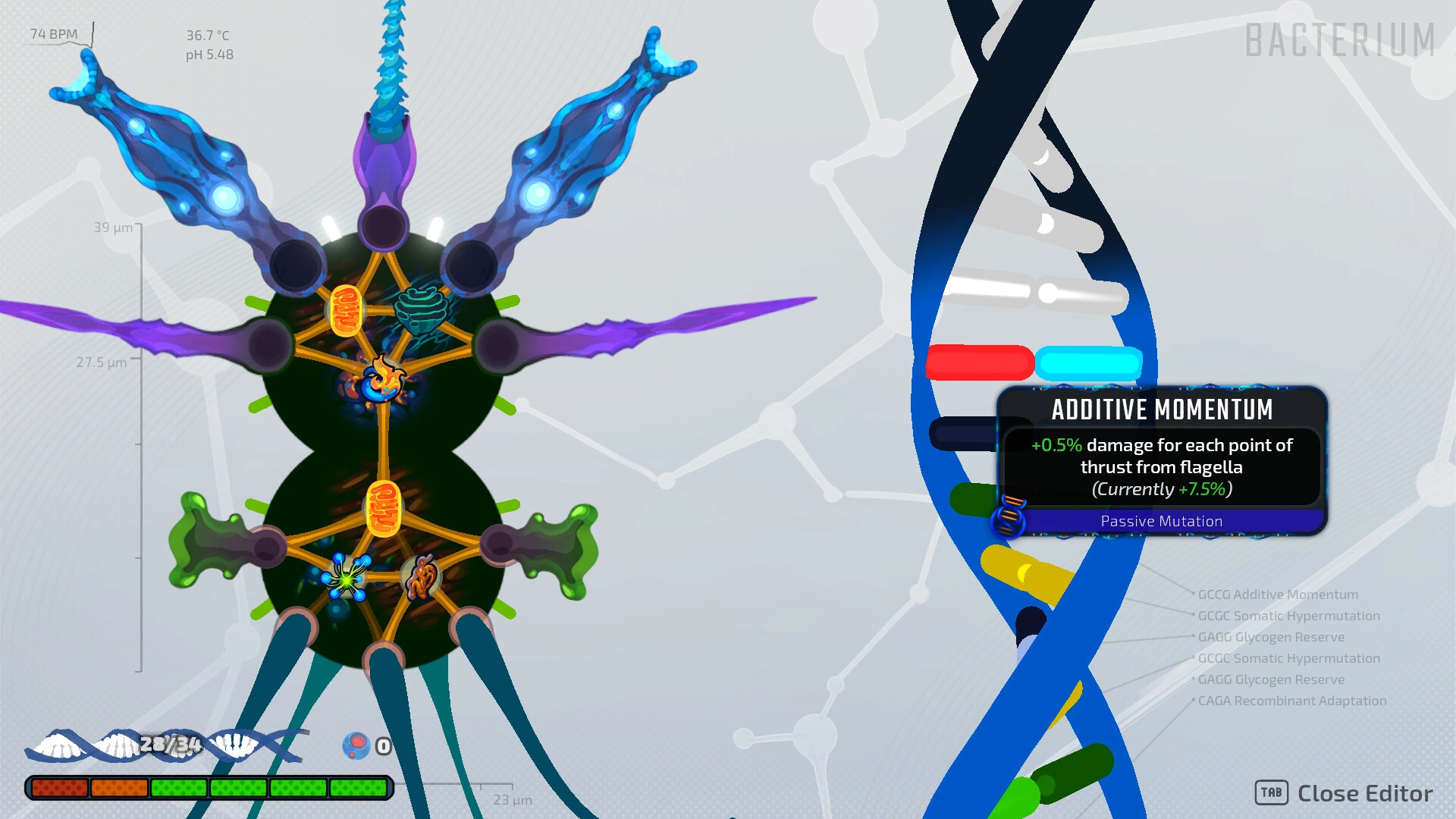
The most distinctive system is the way organelles attach directly to the organism. External pieces control weapons and movement, while internal slots hold passive effects and conditional bonuses. Placement matters. A gun fixed to one side of the bacterium covers a specific firing angle, so adding a powerful weapon can still weaken a build when its orientation leaves a blind spot.
That physical layout gives each pathogen its own design problem. The starting bacterium is balanced and easy to read. The helminth uses its tail to block attacks and favors close-range pressure. The fungal spore cannot rotate, forcing the player to arrange weapons around its body for full coverage.
The amoeba grows extra bulbs instead of following a rigid form, while the nanobot allows freer construction. The co-op diatom splits movement and aiming between two players, turning coordination into part of the creature’s anatomy.
Between fights, every component can be moved or replaced. That flexibility recalls Hades at its best, where a run’s identity forms through linked choices rather than a pile of unrelated stat increases. DNA earned from enemies raises the pathogen’s level and can trigger a full evolution, increasing its size and opening new slots. An evolution can also ruin a carefully arranged build, so declining it is sometimes the smarter decision. Growth is useful only when the new body still supports the weapons attached to it.
Stamina Under Pressure
Pathogenic’s twin-stick combat is built around one stamina bar shared by shooting and dodging. Empty the meter into a long burst and there may be nothing left when a macrophage charges. Dodge repeatedly and the pathogen survives the pattern but cannot answer it. The result is a slower, more deliberate rhythm than the constant firing common to many arena shooters.
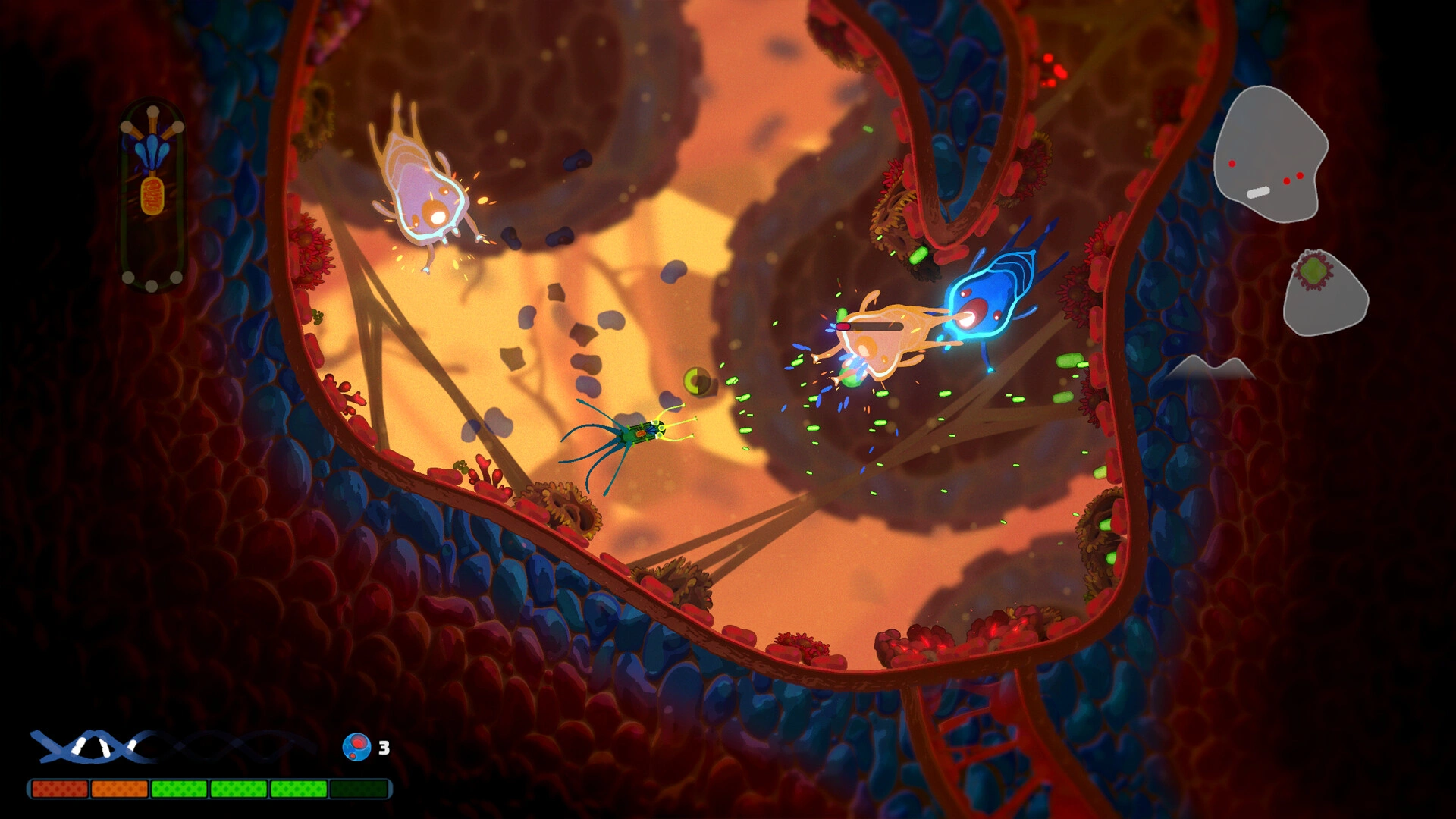
Enemy behavior keeps that resource choice active. Macrophages appear in armored, charging, and projectile-firing forms. Monocytes close distance quickly. Neutrophils rush forward like disposable attackers. Bosses add larger patterns, including the tapeworm in the intestinal stage and the multi-phase heart encounter, where several threats compete for attention at once.
Each organ changes the fight before another enemy appears. Spiked intestinal growths punish careless movement. Stomach acid jets cut across safe lanes. Lung currents push the pathogen away from its intended position. Blood flow in the heart drags enemies and projectiles through branching routes. These hazards stop the campaign from becoming a sequence of identical rooms with different wallpaper.
Later stages can become difficult to read. Player effects, enemy fire, and active terrain overlap until tactical pressure turns into visual noise. Accessibility options help, including automatic aiming or shooting, easier difficulty settings, and the ability to disable the cytokine-storm hazard. Players seeking harsher runs can activate antibiotic modifiers that increase enemy strength, speed, and numbers for greater rewards.
Evolution Has a Cost
Progression is divided cleanly between each run and the larger campaign. DNA, organelles, weapons, and bodily evolutions disappear after death. Plasmids remain and feed pathogen-specific skill trees, gradually improving base statistics. Challenges unlock new organisms and starting equipment, giving experimentation a clearer purpose than a simple currency grind.
The early hours still lean heavily on random upgrade offerings. Before enough plasmids are collected, success may depend on finding organelles that fit the current body rather than on executing a planned build. Death near the heart can feel severe because there are no continues, and permanent growth arrives slowly enough to make repeated opening stages familiar.
The presentation carries those repetitions. Organisms wobble, stretch, and deform when struck, giving every collision visible weight. The intestines use sickly green, yellow, and brown tissue with worm-like walls and grasping growths. The stomach shifts toward purple and green acid, while later organs alter both color and movement rules. The soundtrack follows the same regional structure, moving from lighter exploration tracks into harder electronic combat music. Certain abilities even reward attacks timed to the musical bar.
Handheld graphics and physics options show practical care, though crowded encounters can still cause occasional performance dips. Some organelle descriptions also demand too much study during a run. Pathogenic works best when its systems are readable at a glance, because the pleasure lies in seeing a biological plan take shape, then testing how long that plan survives inside a hostile body.
The Review
Pathogenic
Pathogenic gives the twin-stick roguelite a biological identity that changes how its familiar systems behave. Mounting organelles directly onto each pathogen makes body shape, weapon direction, and evolution matter in ways simple upgrade menus rarely manage. The shared stamina resource gives combat a restrained rhythm, while immune cells and organ-specific hazards keep the route through the body mechanically varied. Early progression can drag, crowded late-game encounters lose clarity, and several organelle descriptions need cleaner wording. Those weaknesses never dilute the pleasure of engineering a grotesque build and watching it overwhelm the immune system.
PROS
- Flexible organelle construction
- Tactical stamina management
- Distinct pathogen playstyles
- Inventive biological environments
- Excellent music and animation
CONS
- Slow early progression
- Cluttered late-game battles
- Unclear upgrade descriptions
- Heavy reliance on random rewards