




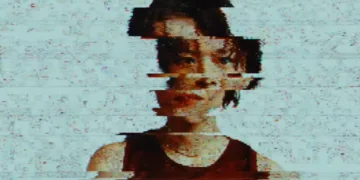










Robbie Lyle films his mother because conversation has failed them. Three years after his sister Noelle vanished near a secluded New Jersey road, the camcorder gives him a role he can perform: investigator, documentarian, rational son. Anything, really, except grieving brother.
Robbie Banfitch plays this fictional version of himself while serving as writer, director, cinematographer, editor, producer, and several other jobs that larger productions divide across a small army. His mother, Leslie Ann Banfitch, plays Robbie’s mother, also named Leslie. The arrangement could have felt like a budgetary necessity dressed as realism. Instead, it gives Tinsman Road an intimacy that conventional casting would struggle to manufacture.
Robbie tells Leslie that he is making a documentary about angels and spirits. His real subject is Noelle. Leslie believes her missing daughter remains inside the family home, announcing herself through flickering lights, nighttime footsteps, and a music box that opens without visible assistance.
Robbie suspects his mother is finding supernatural explanations because the human alternatives are intolerable. The film appears to ask which of them is right. Its deeper question is crueler: what happens when belief and skepticism are simply two methods of surviving the same absence?
Grief Becomes Evidence
Leslie has converted Noelle into a spiritual presence. Robbie converts her into a case file. Both insist they are preserving her, and both gradually reveal how grief can turn memory into private property. This tension emerges during the film’s quietest scenes.
Mother and son watch old home videos, discuss happier years, and sit among photographs that keep Noelle visually present. Leslie speaks about angels with the settled conviction of someone who cannot afford doubt. Robbie listens through the camera, occasionally challenging her, occasionally letting the lens absorb what he cannot answer.
Leslie Ann Banfitch gives these exchanges their bruised credibility. Her pauses often carry the scene before her dialogue does. When Leslie sleepwalks or speaks in a fugue-like state, the performance never announces a theatrical transformation. Her body simply seems to have slipped into another frequency. The effect is frightening because it remains emotionally recognizable.
Robbie’s interviews with locals widen Noelle’s disappearance beyond the house. Heather and Nancy recall seeing her near the road, turning the family tragedy into a piece of communal folklore. Everyone has a fragment. Nobody has the whole story.
Call it narrative hunger: the human tendency to prefer a terrible explanation over an unfinished sentence. Robbie believes facts will free the family. The film keeps testing that assumption (facts have an unfortunate habit of arriving without mercy).
Home Video as Haunted Space
The found-footage form has a clear purpose here. Robbie is not carrying the camera because the film needs an excuse for cheap images. He records because mediation feels safer than presence. The screen between him and Leslie functions like emotional protective glass.

The early-2000s camcorder texture supports that idea. Blown highlights, murky corners, awkward reframing, and long stretches of domestic stillness make the footage resemble material discovered in a family archive. Photographs receive patient close-ups. Empty rooms linger after people leave them. Noelle’s cassette tapes, decorated with drawings of trees and fallen leaves, begin to resemble clues before Robbie knows what they are pointing toward.
Sound carries much of the horror. Footsteps cross rooms outside the frame. Floorboards complain. The household room tone seems to change whenever Noelle’s presence becomes possible. Her music box repeatedly opens to play “The Blue Danube,” its tiny ballerina turning in circles while the family remains trapped in its own repetition.
That object could have become a blunt horror prop. Banfitch uses it as a miniature model of the film itself: wound by unseen hands, replaying the same movement, unable to progress beyond its assigned pattern.
Noelle’s songs, performed by Salem Belladonna, deepen her strange double existence. She is absent from the present yet audible throughout it. Robbie can replay her voice whenever he chooses, which grants him access without relationship. Recording preserves the dead and missing with terrifying efficiency. It also freezes them where the living last understood them.
The Edit Refuses to Let Go
Tinsman Road runs for 159 minutes, and patience becomes part of its design. Then patience becomes collateral damage. The month-based structure, quiet holiday passages, repeated nighttime addresses, interviews, tape examinations, and rural walks establish a life stalled by uncertainty. Early repetition feels truthful. Grief does repeat itself. It asks the same questions after forgetting that no answer came yesterday.
Yet the film keeps returning to emotional and investigative beats after their meaning has settled. Robbie reviews another recording. Leslie restates her belief. A sound interrupts the night. Another stretch of road offers another possibility. The tension begins to thin because the edit mistakes duration for accumulation.
This is the film’s central contradiction. Banfitch understands that unresolved loss distorts time, but recreating that distortion at feature length risks making the audience feel the delay rather than its emotional meaning. A tighter cut could have preserved the suffocating rhythm while giving each supernatural disturbance greater force.
The third act regains that force once Robbie enters the wooded area he has been warned against. His search stops behaving like documentation and becomes a form of self-endangerment. The camera can no longer protect him from the story he has been constructing.
What he finds matters less than the transformation of his need. Robbie wants closure, yet closure is another narrative fantasy, a clean border drawn around something that continues to injure everyone involved. Tinsman Road reaches its most disturbing insight when the investigation starts resembling the haunting. Both keep Noelle present. Both demand repetition. Both require someone to keep winding the mechanism.
Tinsman Road is an independent found-footage horror film that premiered at the Philadelphia Unnamed Film Festival on October 3, 2025. Shot entirely on mini-DV, the film follows a young man investigating the mysterious disappearance of his long-missing sister as he returns to his family’s old home in the backwoods of New Jersey. Viewers can watch the film through independent theatrical screenings and digital video-on-demand platforms.
Where to Watch Tinsman Road (2025) Online


Full Credits
Title: Tinsman Road
Distributor: Blue Finch Film Releasing
Release date: October 3, 2025
Running time: 121 minutes
Director: Robbie Banfitch
Writers: Robbie Banfitch
Producers and Executive Producers: Robbie Banfitch
Cast: Robbie Banfitch, Leslie Ann Banfitch, Salem Belladonna, Noelle Faccone, Heather Middleton
Director of Photography (Cinematographer): Robbie Banfitch
Editors: Robbie Banfitch
The Review
Tinsman Road
Tinsman Road understands grief as a form of authorship: Robbie films because an unresolved disappearance has left him without a usable ending. The camcorder, music box, cassette tapes, and footsteps turn memory into evidence, then quietly expose the danger of treating pain like a mystery that must be solved. Leslie Ann Banfitch gives the film its bruised emotional gravity, while the sound design makes an ordinary house feel mentally occupied. The 159-minute edit tests that gravity until dread begins to evaporate, yet the final descent restores its unnerving force.
PROS
- Leslie Ann Banfitch’s raw performance
- Purposeful found-footage format
- Precise, unsettling sound design
- Strong meditation on unresolved grief
- Disturbing final act
CONS
- Excessive 159-minute runtime
- Repetitive investigative passages
- Uneven escalation of suspense
- Long stretches with little development