





















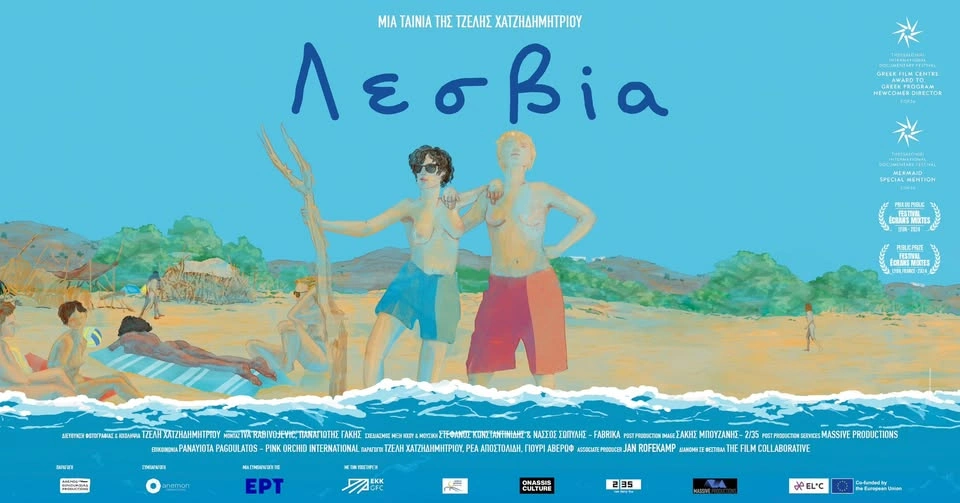

Freedom in Lesvia arrives through texture: bodies drying in the sun, bamboo shelters pressed against the beach, diary pages carrying the language of inherited shame, and the Aegean rolling beneath almost every recollection. Tzeli Hadjidimitriou’s documentary understands that a sanctuary can be remembered through its physical sensations long after its institutions disappear.
Hadjidimitriou was born on Lesvos and first visited Eressos in August 1980. The distance was small on a map, yet the life waiting there felt removed from the social rules surrounding her upbringing. Women had travelled from across Europe and farther afield, drawn partly by Eressos’s connection to Sappho, whose writing made the island an enduring symbol of love between women. On the beach, that literary inheritance became something immediate and bodily.
The director combines her photographs with home movies, diary fragments, interviews, and present-day footage. Her early diary describes meeting seven women and labels six of them with a prejudiced term absorbed from her mother. That entry reveals how liberation often begins with the slow removal of borrowed language. Hadjidimitriou does not dramatize the change through a staged confession. She lets an old sentence expose the person she had been taught to become.
Bodies Outside the Frame
The archival photographs carry the film’s strongest emotional force. Women swim naked, sleep in improvised shelters, eat together, dance, argue, fall in love, and occupy the beach without shaping themselves for male approval. Their comfort gives the images an unusual calm. Nudity appears casual rather than presented as spectacle, a condition made possible by the women controlling both the space and the camera.
Hadjidimitriou’s background in photography gives these materials clarity and tenderness. Faces are rarely treated as anonymous evidence from a social movement. A smile, a hand resting on another woman’s shoulder, or someone looking straight into the lens preserves the personality within the history. The recurring underwater shots extend that feeling into the present, turning the sea into a sensory bridge between the community that existed and the one trying to remember it.
Sound performs similar work. Waves continue beneath interviews and transitions, keeping the island physically close when the film moves into testimony. The effect can become languid, yet it also explains why Eressos inspired such attachment. This was never a meeting point chosen solely for its connection to Sappho. The landscape supplied privacy, beauty, and enough distance from ordinary life for another rhythm to take hold.
The director gradually steps behind the women she interviews, allowing their voices to form a collective account. That decision gives the documentary breadth, though it weakens the autobiographical thread. Her diary suggests a private transformation filled with fear and discovery, yet those emotions recede as the chorus expands. The community becomes vivid while the woman assembling its history sometimes fades from view.
Sanctuary and Territory
The arrival of lesbian visitors changed Eressos, and the film is at its sharpest when affection gives way to friction. One older resident remembers wondering why the women’s husbands never joined them. Her confusion draws laughter, capturing a period when curiosity could soften cultural distance.

Later memories are harder. Men intruded on the beach to stare at naked women. Butch members of the community forced them away. Villagers complained about behavior in shared spaces, while one visitor admits that some women acted without respect for the people already living there.
These accounts prevent the documentary from presenting a spotless paradise. The beach offered safety to women escaping hostility elsewhere, yet their presence could feel invasive to residents watching foreign tourists reshape local customs and businesses. Women-owned bars and hotels eventually opened, property changed hands, and the money brought by visitors produced what one speaker calls a “financial truce.”
That phrase contains an entire uneasy relationship. Acceptance tied to spending power can vanish when the money does. It can also hide resentment rather than resolve it.
Lesvia raises the question of ownership without pressing it far enough. Did Eressos belong to the villagers, the recurring visitors, or the women who stayed and built lives there? The class divide deserves closer attention too. Many travellers could spend a summer seeking freedom before returning to wealthier countries, while residents lived with every lasting economic and cultural shift.
The film’s claim that all bodies were welcome carries another tension. Its photographs overwhelmingly show young, white, conventionally attractive women. Those images may reflect the director’s surviving archive, yet the gap between the spoken ideal and the visible record remains. Hadjidimitriou allows these complications into the film, then often moves away before they can disturb its nostalgic current.
What Remains on the Shore
The improvised beach culture gradually became organized tourism. Women-only hotels, bars, and festivals expanded through the 1990s and early 2000s, giving the community permanent spaces while changing the rough freedom that had defined its earliest years. Commercial success offered stability, then exposed the enclave to the pressures that affect every place turned into a destination.
After Greece’s financial crisis began in 2009, many lesbian-run businesses closed. Digital communities also reduced the need for queer people to travel across borders to find one another. Younger generations arrived with different ideas about gender, friendship, and women-only spaces. Eressos did not disappear, though its purpose shifted.
The film’s chronological structure makes this change easy to follow, sometimes too easy. A living community becomes a familiar rise-and-decline narrative: discovery, flourishing, commercialization, loss. The younger women interviewed near the end complicate that pattern.
Their desire to meet older lesbians, hear their stories, and encounter possible futures suggests that Eressos still carries emotional weight. Hadjidimitriou preserves that feeling through photographs, voices, water, and weather. The bars can close. The beach remembers.
Lesvia is a documentary feature film that premiered at the Thessaloniki Documentary Festival on March 7, 2024. The film explores forty years of history in Eressos, a village on the Greek island of Lesbos that became a global haven and pilgrimage destination for lesbian women. Viewers can watch the film through international film festivals, specialized queer cinema showcases, and independent platform distributions.
Full Credits
Title: Lesvia
Distributor: Anemos Dimiourgias NPO, Salzgeber
Release date: March 7, 2024
Running time: 78 minutes
Director: Tzeli Hadjidimitriou
Writers: Tzeli Hadjidimitriou
Producers and Executive Producers: Rea Apostolides, Yuri Averof, Antigoni Rota
Cast: Tzeli Hadjidimitriou, Catharsys, various local and international community members
Director of Photography (Cinematographer): Yiannis Misouridis, Tzeli Hadjidimitriou
Editors: Chronis Theoharis
The Review
Lesvia
Lesvia feels most alive when its photographs, diary fragments, and sea-washed soundscape recover the freedom of women building a home where none had existed for them. That emotional record is precious. The film grows less certain when Eressos becomes contested ground, raising questions about class, tourism, beauty standards, and local ownership without staying with their discomfort. Its paradise has cracks, yet Hadjidimitriou preserves the warmth that once passed through them, and the younger women arriving today can still feel its trace.
PROS
- Intimate archival photography
- Evocative coastal sound design
- Rich lesbian oral history
- Tender generational perspective
- Nuanced local testimony
CONS
- Class tensions lack depth
- Ownership question remains unresolved
- Narrow archival representation
- Chronology becomes predictable