
















Truxton Extreme arrives 34 years after Truxton II, carrying the weight attached to any dormant arcade series. Its strongest credential is the team behind it. Tatsujin was founded by former Toaplan developers, including original composer and designer Masahiro Yuge, so this sequel understands why the earlier games remain admired. Fast aimed bullets, brutal recovery after death, weapon routing, and stage memorization are treated as foundations rather than artifacts requiring replacement.
The story takes place in 2200, after humanity has expanded across several planets and entrusted much of society to artificial intelligence. That peace ends when the self-replicating Geranium forces invade. Humanity responds by creating Javelion ships that demand a severe sacrifice from their pilots, who must abandon their physical bodies and become cybernetic Tatsujin.
Story Mode follows Ash, Bergamot, and Cyrilla through manga-style scenes placed between stages. The lightly animated panels give each pilot a motive for accepting that transformation, yet the campaign never pauses long enough for the premise to develop much emotional force. These scenes work best as texture around the missions, particularly when they frame the next planet or mechanical threat before returning control to the player.
Old Pressure, New Scoring Decisions
The basic controls remain easy to understand. The Javelion moves with one stick, fires continuously, launches a screen-clearing bomb, and switches between weapons collected during each stage. Death still comes from a single hit. Losing a life sends the ship back to a checkpoint with reduced firepower, which can turn one error into a collapsing run.
That punishment closely resembles the original Truxton. Enemy formations fire at different speeds, smaller ships enter from dangerous angles, and bosses demand knowledge that rarely comes from the first attempt. One encounter may funnel the ship between rotating spreads, while the next adds aimed shots that punish remaining still. Survival comes from learning when those patterns begin, where enemies enter, and which side of the screen offers the safest route.
The adjustable speed system gives players extra control over that process. Collecting S icons fills the Speed Bar, then a button press cycles through several movement settings. Higher speeds help cross the screen when an enemy wave enters from the opposite edge. Lower settings allow precise movement through clustered projectiles. Once the bar is full, later S icons become score items, rewarding players who have already settled on a preferred configuration.
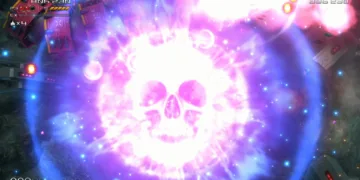
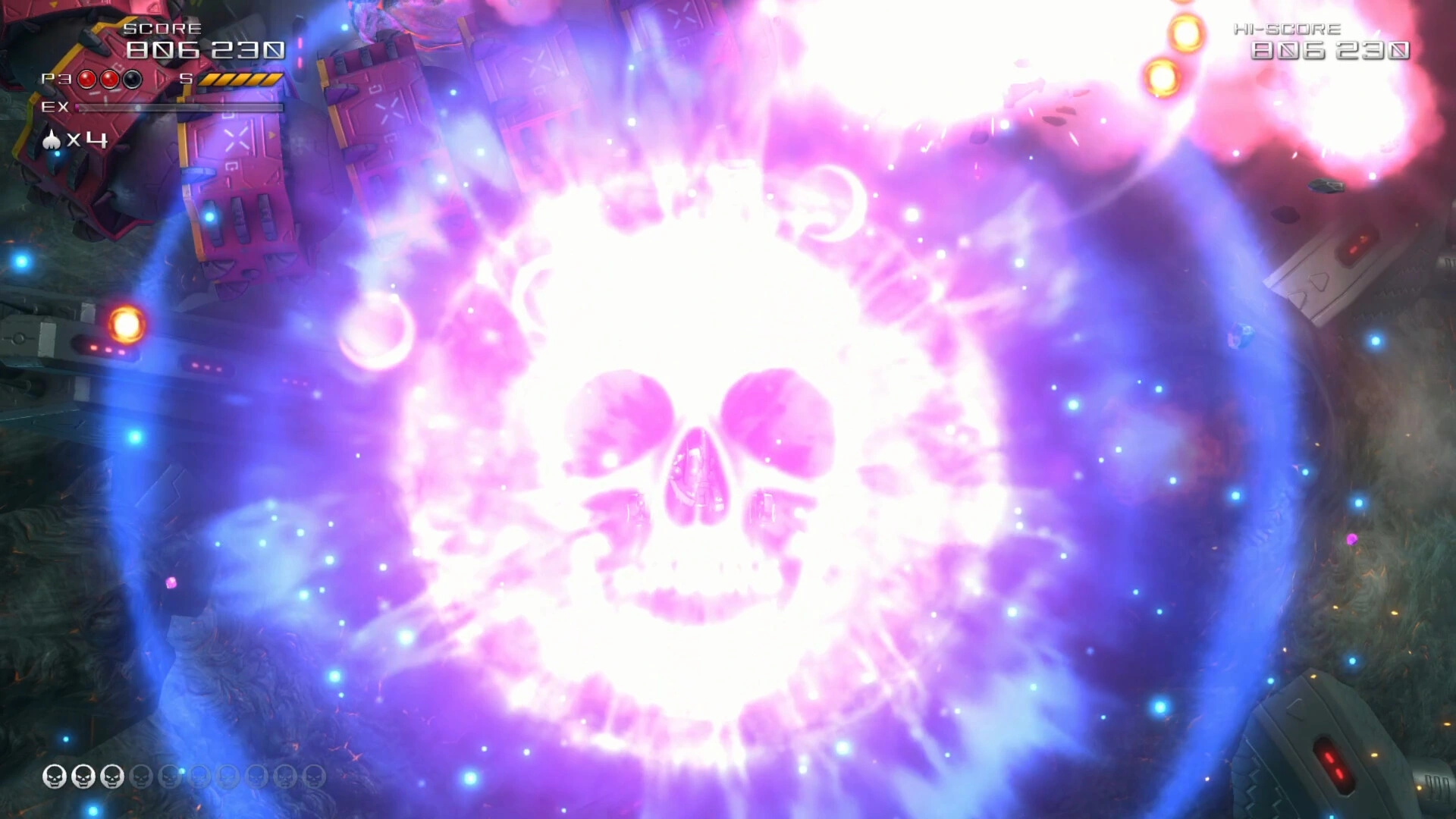
The EX gauge introduces the largest mechanical change. Holding the EX attack consumes stored energy and creates score items from destroyed enemies. Using it on a few weak ships wastes its potential, while saving it for a dense formation or durable target can produce a substantial scoring burst. The same attack can damage incoming threats and help protect the Javelion, forcing a choice between defensive use and leaderboard ambitions.
That tension gives Truxton Extreme a scoring layer closer to later arcade shooters without converting the game into a conventional bullet hell. The player hitbox is smaller than the ship model suggests, yet the bullet patterns retain Toaplan’s preference for quick projectiles and aggressively aimed fire. The result feels connected to the series while accommodating players accustomed to Cave-style scoring systems.
Five Weapons Across One Very Wide Screen
Weapon selection still dictates how a stage is approached. Focused fire can tear through bosses quickly, while wider patterns provide safer coverage against groups. The returning Thunder Laser and Homing Shot sit beside additions such as the Star Mine, offering clear differences in range, spread, and positioning.
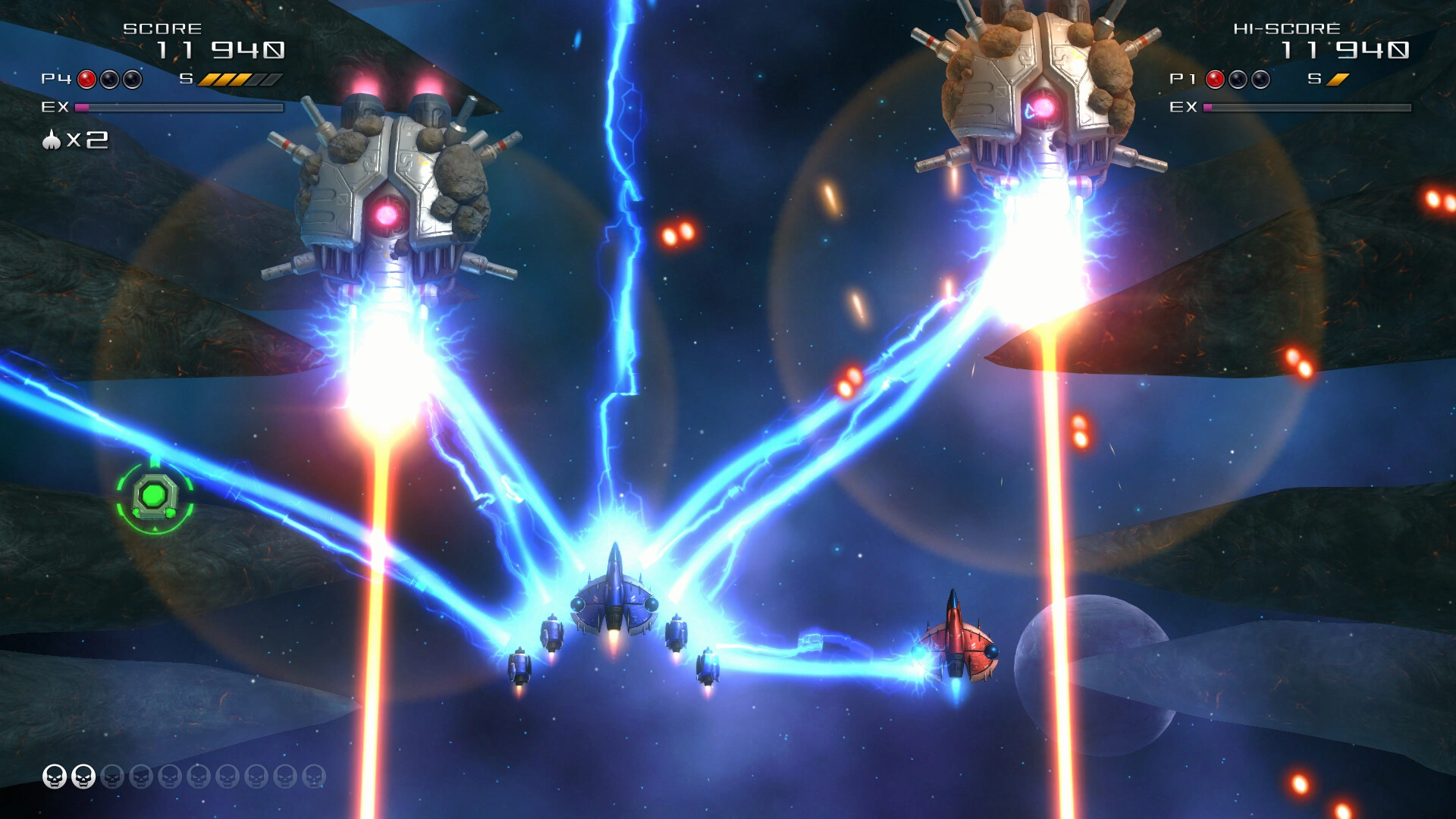
The Homing Shot creates the largest balance problem. Once upgraded, its projectiles track targets entering from several directions, including enemies arriving near the lower portion of the screen. That coverage removes much of the risk attached to positioning and makes other weapons harder to justify during unfamiliar stages. Focused alternatives can produce faster boss kills, yet the Homing Shot is usually the safest choice when learning a route.
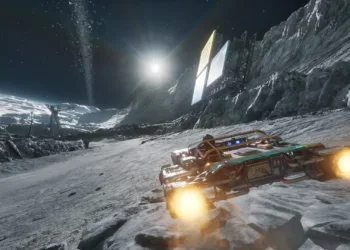
This imbalance is tied to the full 16:9 battlefield. Earlier Truxton games were built around narrow vertical spaces where a forward-firing weapon could cover a meaningful share of the playfield. Here, enemies can enter far from the ship’s firing line, forcing frequent horizontal movement. The speed controls compensate for that distance, though crossing the screen can expose the player to attacks that began outside their immediate focus.
The wider format also increases the importance of memorization. A formation arriving from the far edge may become dangerous before the player has time to respond, especially when using a weapon with limited lateral reach. The optional Ruler places coordinate indicators along the screen edges to help track the ship during explosions and dense fire. It is a practical accessibility feature, though its usefulness also reveals how difficult the enlarged battlefield can be to read.
A Strong Arcade Package With Familiar Repetition
Story Mode is joined by Arcade, Heart Starter, Arena, and Team modes. Arcade removes much of the narrative framing and concentrates on the traditional run structure. Heart Starter offers a more approachable route into the systems. Arena isolates score-focused challenges, while Team allows two local players to share the battlefield, lives, and score. Online leaderboards connect those modes by giving route optimization and EX timing a visible target.
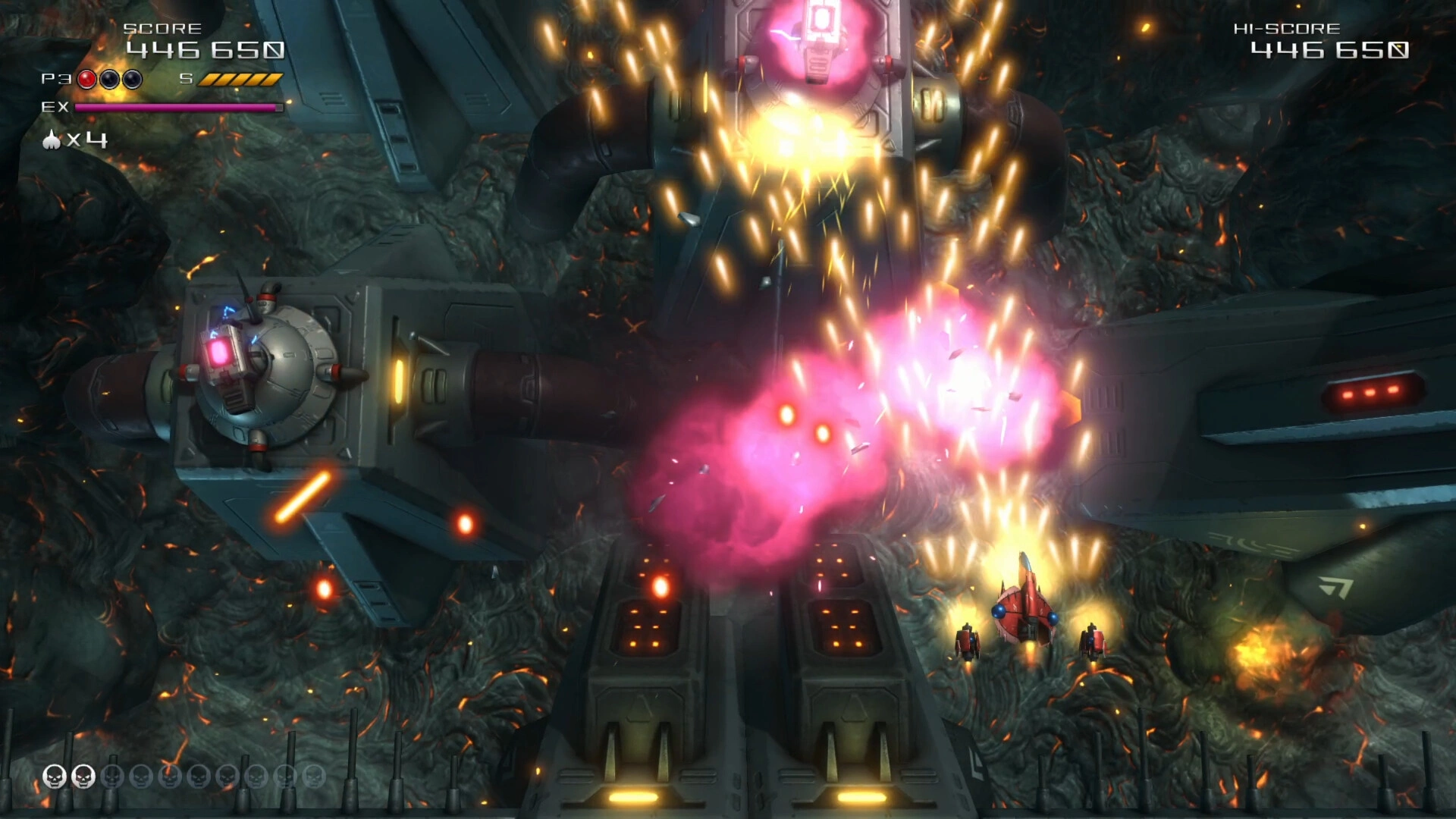
The absence of online cooperative play limits Team mode, and a boss rush would have suited a game built around learning large mechanical encounters. Stage repetition presents a larger issue. Several missions rely on similar stretches of enemy waves and extended backgrounds before reaching their strongest bosses. Replaying them for score exposes that pacing, particularly when an early mistake forces a full restart.
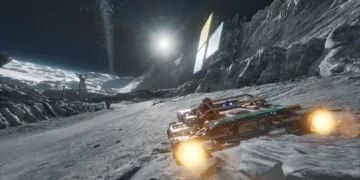
The move to 3D models preserves the clarity required by the genre. Ships remain readable against particle effects, while large enemies break apart through layered explosions. The presentation resembles modern Raiden and R-Type revivals, though the bright palettes and oversized mechanical designs retain some of the arcade games’ visual character.
Yuge’s soundtrack carries the clearest connection to the series’ past. Familiar compositions return with denser instrumentation, while new tracks sustain the same urgent rhythm across stages that run longer than their arcade predecessors. The music does what the best returning element should do: it identifies the series immediately, then adapts its language to a sequel built decades later.
The Review
Truxton Extreme
Truxton Extreme earns its place beside the earlier games by preserving their fast bullets, severe recovery loops, and weapon-driven stage planning while introducing meaningful scoring systems. The EX attack and variable speed deepen each run, yet the 16:9 battlefield creates coverage problems that the dominant Homing Shot solves a little too conveniently. Repeated environments and missing modes limit its long-term variety, but Masahiro Yuge’s team has delivered a demanding sequel shaped by the series’ identity rather than nostalgia alone.
PROS
- Responsive variable-speed controls
- Deep EX scoring system
- Distinct returning and new weapons
- Excellent rearranged soundtrack
- Strong arcade difficulty
CONS
- Homing Shot disrupts weapon balance
- Widescreen increases forced memorization
- Stages become repetitive
- No online cooperative mode