














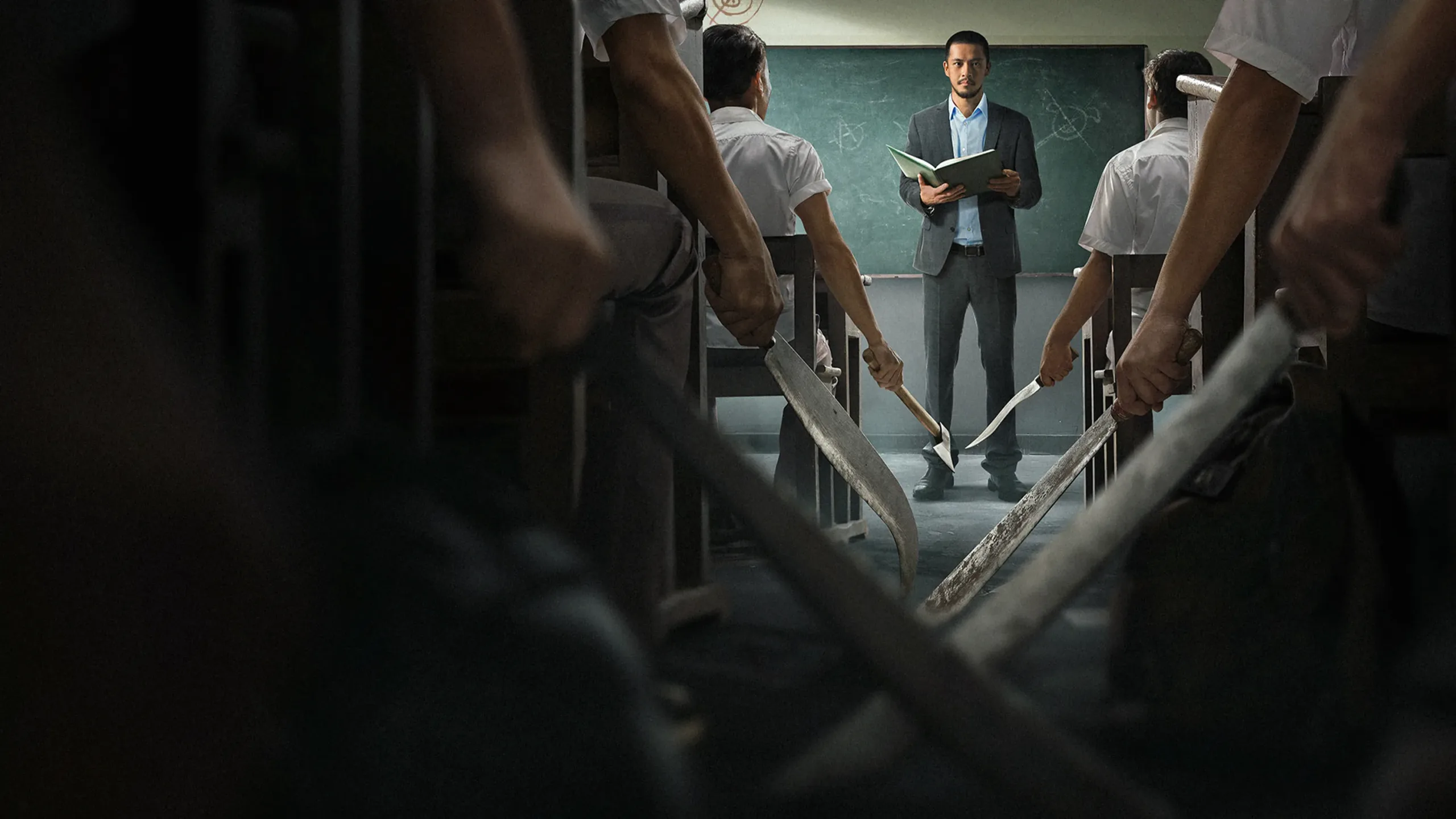

Joko Anwar’s The Siege at Thorn High imagines a Jakarta just a few years from now, in 2027, but the air is thick with old hatred. This is a city haunted by the ghosts of past racial riots, a place where societal wounds have been left to fester. We enter this world through Edwin, a man who takes a job as a substitute teacher at a notorious high school.
Thorn High itself is less an educational institution and more a high-security holding pen for the city’s most troubled youth. Edwin walks these oppressive halls with a quiet, personal mission driving him. Before he can find what he is looking for, the city’s simmering tensions boil over. A new wave of ethnic violence erupts, the school goes into lockdown, and the simmering conflicts inside its walls are trapped with nowhere to go.
The Slow-Burning Fuse
The film dedicates its first half to a deliberate, slow build, a risky structural choice that prioritizes atmosphere over immediate action. This pacing functions much like the opening hours of a narrative-heavy game, demanding the audience invest in the world before the mechanics of conflict are fully engaged.
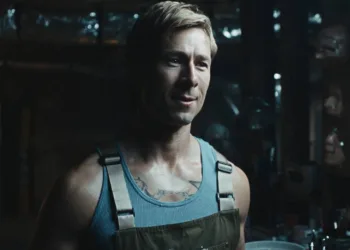
It uses this time to establish Thorn High as a character in its own right: a failed institution with phone scramblers and prison-like corridors that mirror the broken society outside. We watch Edwin, played with a weary, internalized restraint by Morgan Oey, navigate this hostile space. His passivity can be frustrating, as he absorbs verbal abuse with little reaction, yet it speaks to the deep trauma that governs his actions.
His attempts to connect with students, particularly the artistically gifted Khristo, feel like small acts of resistance against the school’s oppressive culture. His main foil is Jefri, a student leader portrayed with ferocious, kinetic energy by Omara Esteghlal.
Jefri is a vessel for inherited hatred, his prejudice against Chinese-Indonesians a raw and unthinking force. Their dynamic is the film’s central pillar, a microcosm of a national sickness played out in classroom standoffs and tense hallway encounters.
When the Walls Close In
Once the riot begins, the film’s slow-burning fuse finally ignites. The transition into a survival thriller is abrupt, locking the doors and trapping the audience in the chaos with the characters. The action that follows is defined by its brutal honesty.

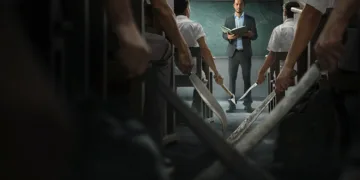
This is not the clean, choreographed violence of a Hollywood blockbuster. Every fight is a desperate, clumsy struggle, aligning it with the visceral realism of films like Green Room, where survival is awkward and ugly. Anwar’s direction emphasizes this lack of polish; characters stumble, miss punches, and use makeshift weapons with frantic inefficiency.
The cinematic technique reinforces this feeling of entrapment. Handheld camerawork creates a disorienting, subjective experience, while the tight framing makes every corridor and classroom feel suffocating. Flickering fluorescent lights and deep shadows turn a familiar school setting into a labyrinth of potential threats.
The sound design is a key player, using the muffled sounds of the distant riot to create a constant sense of external pressure while focusing on the sharp, immediate sounds of the internal hunt. The film’s momentum is sometimes undercut by its script, which pauses the physical chase for extended verbal confrontations. This stop-start rhythm can occasionally break the immersion, stalling the carefully built tension.
The Poisoned Inheritance
The film’s purpose crystallizes in its devastating final act with a narrative twist that re-contextualizes every preceding scene. The revelation that Jefri is Edwin’s long-lost nephew transforms the story from a tense thriller into a profound tragedy. This is not merely a shocking plot point; it is a mechanism that exposes the story’s thematic core.

The physical siege becomes secondary to the emotional one, as Edwin is forced to confront the cyclical nature of hatred in its most personal form. His search for redemption and family connection culminates in the horrifying discovery that the boy he sought has been irrevocably poisoned by the very ideology that destroyed his family.
The film powerfully argues that prejudice is a sickness passed from one generation to the next. Morgan Oey’s performance excels here, his quiet facade finally cracking to reveal a universe of pain. Omara Esteghlal, in turn, allows flickers of vulnerability to pierce Jefri’s armor of rage.
The Siege at Thorn High is a challenging piece of cinema whose flaws are born from ambition. It is a powerful, unflinching work that uses the language of genre to ask difficult questions about trauma and inheritance, refusing to provide any easy answers.
“The Siege at Thorn High” is an Indonesian dystopian action thriller directed by Joko Anwar. It had a theatrical release in Indonesia on April 17, 2025. The film was co-produced by Amazon MGM Studios and Joko Anwar’s Come and See Pictures. It is also available to stream on Prime Video starting August 15, 2025.
Full Credits
Director: Joko Anwar
Writers: Joko Anwar
Producers & Executive Producers: Joko Anwar, Tia Hasibuan
Cast: Morgan Oey, Omara Esteghlal, Hana Malasan, Endy Arfian, Fatih Unru, Satine Zaneta, Dewa Dayana, Florian Rutters, Faris Fadjar Munggaran, Sandy Pradana, Farandika, Raihan Khan, Kiki Narendra, Landung Simatupang, Sheila Kusnadi, Millo Taslim, Bima Azriel, Emir Mahira, Shindy Huang, Lia Lukman
Director of Photography (Cinematographer): Ical Tanjung
Editors: Joko Anwar, Erwin Prasetya Kurniawan, Teguh Raharjo
Composer: Aghi Narottama
The Review
The Siege at Thorn High
The Siege at Thorn High is a challenging, ambitious film that succeeds despite its flaws. Its slow pacing gives way to a brutal and visceral survival story, anchored by a devastating narrative twist that elevates it beyond a simple thriller. It is an unflinching look at generational hatred, using its claustrophobic setting and raw action to deliver a powerful, uncomfortable, and ultimately unforgettable cinematic reckoning.
PROS
- Potent social commentary on cyclical violence.
- Grounded, visceral, and impactful action sequences.
- Strong lead performances that carry significant emotional weight.
- A tense, claustrophobic atmosphere is effectively maintained.
- The central plot twist is both shocking and meaningful.
CONS
- The deliberate pacing in the first half may feel sluggish.
- Momentum is sometimes stalled by repetitive dialogue.
- Secondary character motivations can feel underdeveloped.
- The protagonist's initial passivity may frustrate some viewers.