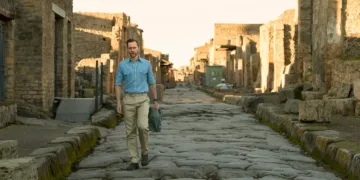

















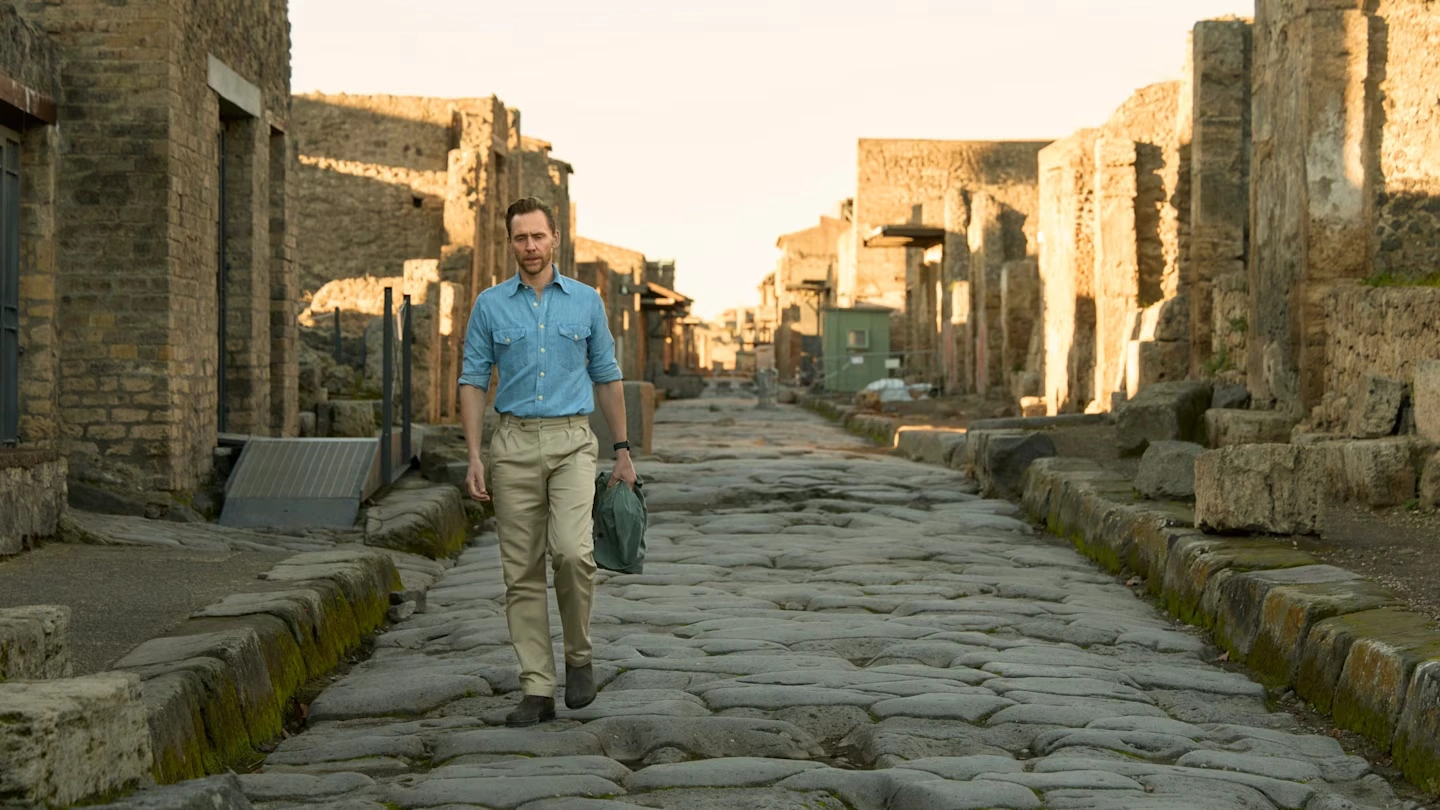

Tom Hiddleston turns a professor’s spreadsheet into a glowing three-dimensional display, then credits his familiarity with Avengers movies. It is a funny moment because the research itself is far less flashy. Professor Steven Tuck has used inscriptions to trace over 200 possible Pompeii survivors across 12 Roman cities, converting scattered names into evidence that the eruption’s history did not end beneath the ash.
That survivor-focused approach gives Pompeii: Out of Time with Tom Hiddleston its strongest idea. The three-part National Geographic docudrama moves through “Tremors,” “Eruption,” and “Survival,” reconstructing the final 24 hours of Pompeii and nearby Herculaneum. Instead of centering the preserved bodies that have defined popular images of the disaster, the series studies people who faced warnings, made decisions, and may have escaped.
Hiddleston’s interest carries some personal weight. Photographs show him visiting Pompeii in 1998 at age 17, a trip he says influenced his decision to study Classics and Latin at Cambridge. His affection for the site is easy to believe. The production still works hard to prove it, surrounding him with corkboards, timers, holograms, scripted discoveries, and enough pensive staring to keep several portrait photographers employed.
Three Romans, Partly Recovered
The series builds its reconstruction around three historical figures: Avianius, a teenage blacksmith’s apprentice; Julia Felix, a wealthy property owner in Pompeii; and an unnamed Praetorian whose possessions were found near Herculaneum’s ancient shoreline.
This method resembles dramatic reconstruction, a technique that uses surviving evidence to stage events the camera could never have recorded. The key is making clear where the evidence ends and invention begins. Out of Time usually maintains that distinction, yet its emotional arcs sometimes feel suspiciously tidy.
Avianius receives the weakest material. His arguments with the blacksmith who supervises him include dialogue shaped like a modern teenage rebellion. The conflict gives the episode an accessible emotional line, but it also makes ancient Pompeii sound like an after-school drama with sandals.
Julia Felix fares better. Her estate, commercial activity, and social position provide firmer material for the writers. Lubna Azabal plays her with calm practicality, especially when Julia assesses the growing danger without collapsing into theatrical panic. Caitie Barrett’s explanation of Roman women’s property rights also gives the character social grounding after Hiddleston comically mistranslates the painted sign outside her home.
The Praetorian’s story produces the most effective reenactment. A sword, belt, and money clip lead to a speculative evacuation scene in which he organizes frightened residents on the beach, calls for sailors and doctors, and demands a head count. The writing invents his words, yet the objects establish a credible starting point for his military behavior.
Science Under Television Pressure
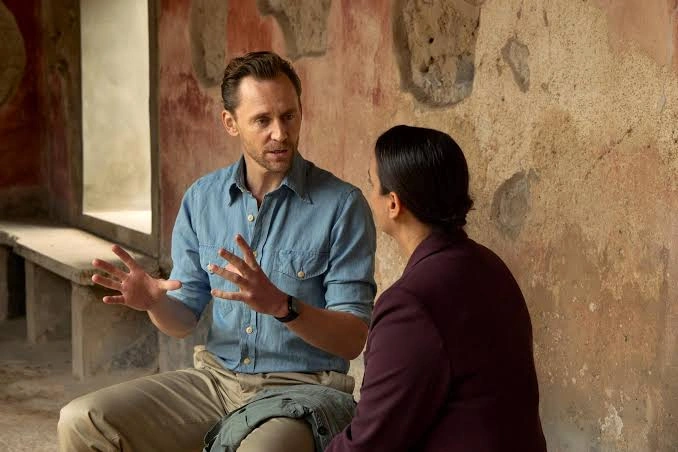
The documentary is at its clearest when specialists explain how survival might have been possible. Geoscientist Chris Jackson walks Hiddleston through the tremors, ash clouds, darkness, and pyroclastic surges that transformed familiar streets into deadly terrain. Hiddleston later enters the blackened city with a flashlight while a timer counts toward the eruption.
The timer is a simple editing device. By measuring the hours before Vesuvius reaches its most destructive phase, the series gives scientific information a dramatic shape. Viewers can understand that Pompeii was not erased in one instantaneous blast. There were warnings and periods when leaving remained possible.
Disaster psychologist Sarita Robinson adds another useful perspective by discussing fight, flight, and freeze responses. These terms describe the automatic reactions people may experience under immediate threat. Placed beside the three Roman stories, the explanation helps the reenactments feel connected to recognizable human behavior rather than manufactured suspense.
The production sometimes mistrusts the clarity of its own material. Hiddleston pauses and rewinds scenes with a Loki-like hand gesture. Digital displays float around him. His office shakes in sympathy with earthquakes that occurred nearly two thousand years earlier. Each idea is understandable on its own. Stacked together, they begin to resemble a history lesson trapped inside a superhero interface.
Sincerity Beneath the Gimmicks
Hiddleston approaches every inscription, volcanic fact, and imagined decision with visible seriousness. His scripted exchanges with experts can sound stiff, especially when he reacts to information with a long stare toward the floor or middle distance. The camera frequently holds on his face as he processes the scale of the destruction, sometimes with tears gathering in his eyes.
I found that performance easy to tease and difficult to dismiss. Hiddleston understands that his job is partly educational. He repeats technical ideas in plain language, asks questions that casual viewers might ask, and uses his training as an actor to examine how fear could shape a person’s choices.
Director Tom Barbor-Might supports that approach with unusually polished reenactments. Ash blocks the sunlight, streets become confusing, and the Herculaneum beach turns into a compressed space filled with frightened residents. The scenes communicate physical conditions without adopting the inflated spectacle of a disaster blockbuster.
The series becomes less persuasive when Hiddleston’s detective board treats existing scholarship like a personal breakthrough. Historians and archaeologists have long combined physical evidence with informed interpretation. Placing Hiddleston at the center of that process helps package the material for television, but it can make the experts seem like supporting players in his investigation.
Still, his enthusiasm creates a welcoming route into the research. When the holograms, index cards, and dramatic pauses briefly fall away, the camera returns to a name on a wall, a weapon near a shoreline, or a businesswoman’s property. Those fragments carry the people of Pompeii closer than any digital effect.
Pompeii: Out of Time with Tom Hiddleston premiered on National Geographic on May 12, 2026, and is available for streaming on Disney+. The documentary special features actor Tom Hiddleston as he joins archaeologists on an immersive journey through the ancient city of Pompeii, revealing new insights into its tragic final hours and the lives of its inhabitants.
Where to Watch Pompeii: Out of Time with Tom Hiddleston Online








Full Credits
Title: Pompeii: Out of Time with Tom Hiddleston
Distributor: National Geographic, Disney+
Release date: May 12, 2026
Rating: TV-PG
Running time: 44 minutes
Director: David Shulman
Writers: David Shulman
Producers and Executive Producers: David Shulman, Tom Hiddleston, Tom McDonald
Cast: Tom Hiddleston, Gabriel Zuchtriegel, Sophie Hay, Massimo Osanna, Llorenç Alapont
Director of Photography: Luke Bryant
Editors: Sam Sant
Composer: David Julyan
The Review
Pompeii: Out of Time with Tom Hiddleston
Pompeii: Out of Time with Tom Hiddleston turns archaeology into approachable television by anchoring the eruption to Avianius, Julia Felix, and the Praetorian. Hiddleston’s sincerity carries the series through its corkboards, holograms, staged reactions, and occasional melodrama. The strongest passages let inscriptions, belongings, and survivor records shape the drama; the weakest keep decorating evidence that already holds attention. Its reenactments look polished, its science stays clear, and its focus on escape gives Pompeii a welcome human dimension. The production can feel busy, yet its curiosity remains infectious.
PROS
- Hiddleston’s infectious enthusiasm
- Polished historical reenactments
- Accessible scientific explanations
- Survivor-focused perspective
CONS
- Overloaded visual gimmicks
- Occasionally scripted expert exchanges
- Familiar dramatic inventions
- Excessive pensive staring