




















The first breath belongs to the company. André De Shields gathers the performers backstage, asks them to breathe for community, for presence, for love, and then walks toward a tragedy whose ending has already been written. Brett Sullivan’s filmed capture understands that this small ritual contains the production’s deepest tension. Everyone knows where Orpheus will look. Everyone hopes he will keep walking.
Anaïs Mitchell’s sung-through musical joins the myths of Orpheus and Eurydice with Hades and Persephone, placing them inside a Depression-era world of jazz rooms, industrial labor, hunger, and failing seasons. Five original Broadway principals reunite during the West End run: De Shields, Reeve Carney, Eva Noblezada, Amber Gray, and Patrick Page.
Sullivan cannot reproduce the heat of a live room. Brass feels different when it shakes the floor beneath the listener, and swinging lamps carry another threat when they pass through shared air. Yet his camera discovers details the theatre can conceal. A close-up catches hesitation forming before a lyric. A low angle turns the trapdoor into a grave opening its mouth. The stage loses some scale and gains a face.
The Machinery Below
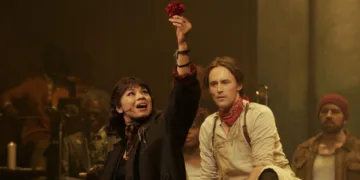
Rachel Hauck’s set remains fixed, but nothing within it feels still. The central platform rotates, workers walk against treadmill-like floors, lights descend through darkness, and musicians sit visibly beside the action. Hadestown is built less through scenery than repetition. Bodies move in circles until labor begins to resemble captivity.
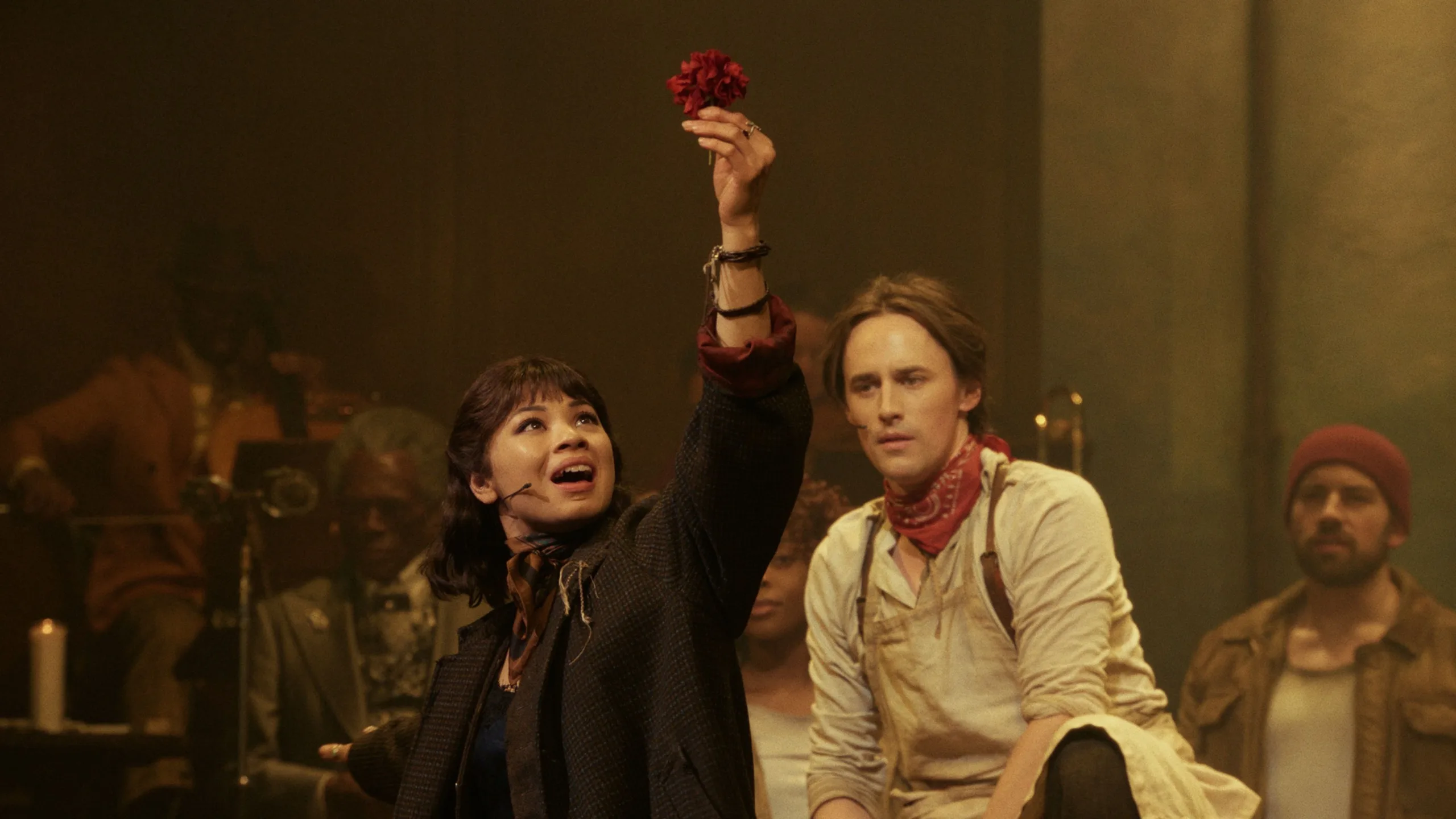
Sullivan respects that physical language. Wide shots preserve the ensemble’s geometry during “Way Down Hadestown,” while the camera grows restless during “Wait for Me.” Lamps cut through smoke, Orpheus disappears among moving bodies, and the editing makes descent feel like panic given rhythm. During “All I’ve Ever Known,” the framing contracts around Carney and Noblezada, allowing their voices to occupy a space the set no longer needs.
Close-ups sometimes interrupt Chavkin’s larger compositions. A performer’s expression may be worth seeing, yet the surrounding choreography often carries equal meaning. The film occasionally chooses the trembling eye and loses the workers behind it. This is the compromise of filmed theatre: intimacy asks the whole stage to step aside.
Still, the spatial clarity rarely falters. Even from overhead angles or the camera placed beneath the trapdoor, the production never becomes visually confused. The Underworld remains a place with rules. That makes its cruelty colder.
Love Under Pressure
Orpheus and Eurydice are divided by two versions of faith. He trusts that a song can bring spring. She trusts the ache in her stomach. Carney’s high, fragile voice suits a man whose idealism seems almost physically unsuited to winter. “Wait for Me” gives his devotion force, while “If It’s True” lets anger enter the softness. Noblezada finds greater dramatic depth in “Flowers,” where Eurydice confronts what security has cost her. Her voice carries the weight of a person who chose survival and discovered that survival can resemble disappearance.
Their romance remains thinly drawn. They fall quickly, speak in declarations, and often serve the musical’s ideas before they become fully distinct people. The imbalance grows clearer beside Hades and Persephone.
Patrick Page plays Hades as a monument learning that stone can crack. His bass in “Hey, Little Songbird” turns temptation into gravity, while “Why We Build the Wall” reduces oppression to a chant repeated until fear sounds reasonable. Page performed with a leg brace after an Achilles injury, yet the restriction folds into Hades’ imposing stiffness.
Amber Gray’s Persephone enters with wild laughter, liquor, and the exhausted brightness of someone performing happiness for a room. “Our Lady of the Underground” lets her revelry sour around the edges. During “How Long?” she and Page barely need exposition. Their posture carries centuries. Her plea for the younger lovers becomes a plea for whatever remains alive inside their own marriage.
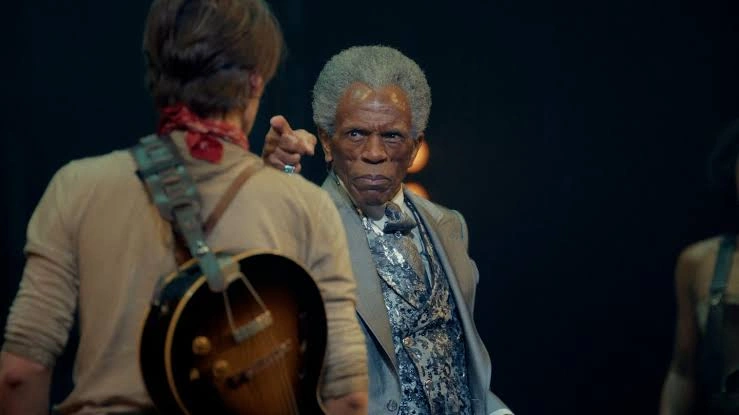
De Shields moves between both couples with quieter authority. His Hermes knows the ending and still guides the tale toward it. The knowledge does not make him distant. It makes his tenderness unbearable.
The Song After Failure
Hadestown promises warmth in exchange for memory, identity, and freedom. Eurydice accepts because cold has stripped principle of comfort. The workers build Hades’ wall while repeating his explanation of why it must exist, each answer closing another door inside them. Mitchell wrote the song years before its modern political associations, yet its logic belongs to every system that teaches fear and calls the lesson safety.
Orpheus answers with music. His melody briefly awakens something in Hades, something buried beneath ownership and control. The show never treats art as a guaranteed rescue. A song can open the gate. It cannot silence doubt.
The final walk is staged with brutal simplicity. Eurydice follows. Orpheus cannot hear her. The distance between them fills with every fear the Fates have planted, until he turns and loses the future he had nearly reached.
The deeper wound arrives afterward. Hermes asks the company to begin again. De Shields’ face changes as the familiar words return, confidence giving way to grief, grief giving way to the faint discipline of hope. The tragedy survives because people keep singing it. They know the ending. They breathe, step into the light, and try once more.
Hadestown: The Musical premiered in North American cinemas on July 24, 2026, capturing a live stage recording of the acclaimed theatrical production. The narrative weaves together the intertwined ancient myths of Orpheus and Eurydice alongside Hades and Persephone.
Where to Watch Hadestown: The Musical (2026) Online






Full Credits
Title: Hadestown: The Musical
Distributor: Crosswalk, Bleecker Street, LD Entertainment
Release date: July 24, 2026
Rating: PG
Running time: 142 minutes
Director: Brett Sullivan
Writers: Anaïs Mitchell
Producers and Executive Producers: Mara Isaacs, Dale Franzen
Cast: Reeve Carney, André De Shields, Amber Gray, Eva Noblezada, Patrick Page, Bella Brown, Madeline Charlemagne, Allie Daniel
Director of Photography: Clayton Jacobsen
Editors: Brett Sullivan
Composer: Anaïs Mitchell, Liam Robinson
The Review
Hadestown: The Musical
The camera cannot preserve the full heat of a live room, yet it catches something theatre seats often hide: the tremor behind a voice, the grief inside a glance, the instant faith begins to fail. André De Shields guides the tragedy with gentle authority, while Patrick Page and Amber Gray make an ancient marriage feel painfully weathered. Reeve Carney and Eva Noblezada carry less dramatic weight, but their fragility suits a story where hope survives through repetition. The song ends badly. They sing it again.
PROS
- De Shields’ compassionate narration
- Page and Gray’s wounded chemistry
- Intimate, spatially clear filming
- Powerful live musical performances
- Haunting labor and poverty themes
CONS
- Younger romance lacks depth
- Some close-ups weaken the staging
- Live theatrical force remains diminished