





























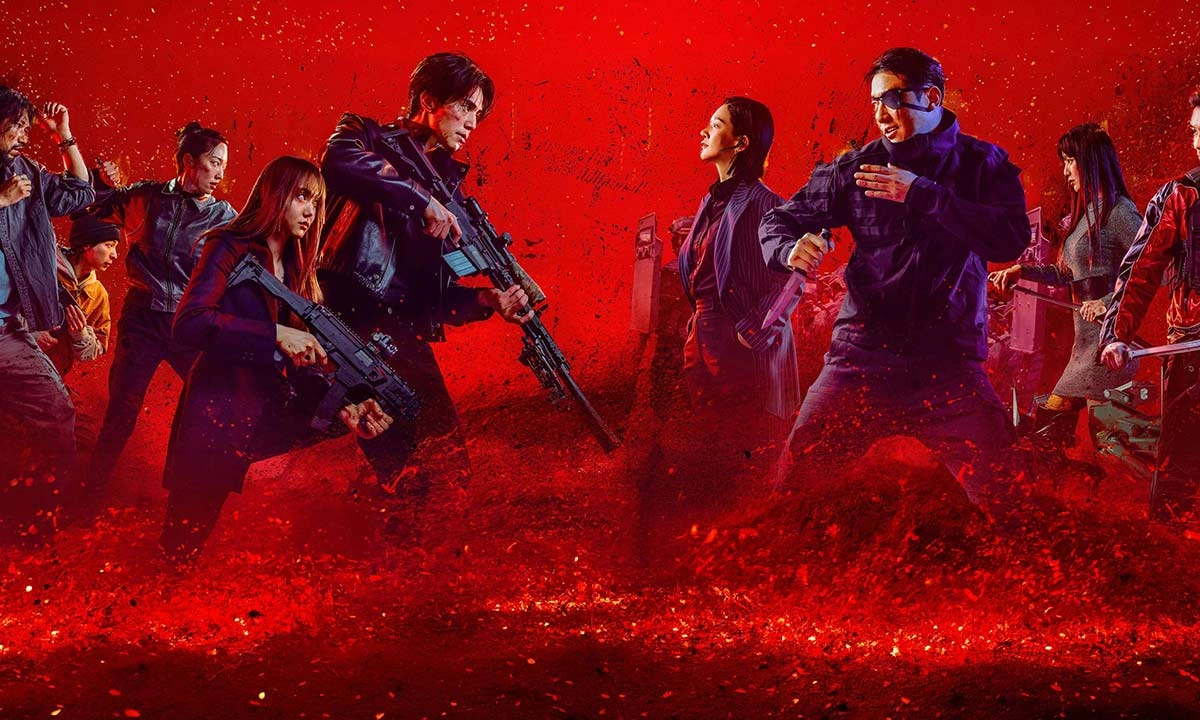

Jeong Jin-man watches his own corpse resting in a bathtub while another man prepares to discover it. The image is absurd, efficient, and morally accurate. Jin-man has always treated death as a logistical problem. Here, even his funeral becomes operational cover.
Season 2 rewinds to the day Ji-an’s home was attacked and reveals the parallel mission unfolding beyond her knowledge. While she fought assassins inside the weapons shop, Jin-man hid in an underground bunker with police officer Park Jin-woo, Pasin, and Cheol-seung, a North Korean defector skilled in hacking and prosthetics. Babylon believes Jin-man is dead, leaving him 62 hours to steal its central server and kill Bale.
The structure transforms the first season’s siege into a missing half of the same equation. Ji-an experienced chaos without explanation. Jin-man was constructing explanations without telling her. Protection, in his private vocabulary, means controlling what another person is allowed to know.
Call it custodial violence: the damage caused by someone who believes secrecy is a form of care. Jin-man does want Ji-an safe. His plan to steal Babylon’s records is designed to purchase her freedom. He also lets her mourn him while armed men close in on her home. The contradiction is not hidden beneath his affection. It constitutes his affection.
Lee Dong-wook understands this without forcing visible remorse into every scene. Jin-man remains calm while explaining the timetable, the server inspection, and the method of entry through Babylon’s disguised rice factory. His emotional life appears in brief hesitations rather than speeches. He looks like a man who has already accepted his own reasoning and has begun to suspect that acceptance was the easy part.
Babylon’s Office Culture
The infiltration works because it treats corporate murder with the administrative seriousness of a quarterly audit. Cheol-seung copies guard Kim Jung-ho’s identification, hacks his phone, creates a prosthetic mask of Bale, and enters the ventilation system to seize control of the cameras. Jin-woo drives a garbage truck into the compound. Pasin and Cheol-seung hide inside X-ray-resistant barrels. Babylon’s server, normally stored underwater, rises at 3 p.m. for inspection.
Everything depends on routine. This is the season’s sharpest enlargement of its world. Babylon is no longer a vague source of contracts and killers. It has shift patterns, security procedures, internal promotions, technological redundancies, and employees who notice when the same executive badge enters twice. Evil has acquired human resources. The joke is dry, mostly because Babylon would probably describe its assassins as field personnel.
Jin-man’s entry under Bale’s identity produces a chain of small failures. He does not know the password. Two vehicles are registered under Bale’s name. Security robots scan him and detect the disguise. Cheol-seung must keep repairing the operation from above while waiting for the server to rise. The suspense comes from accumulated procedural friction, not random gunfire.
The robots are especially revealing. Human guards can be deceived through posture, hierarchy, and confidence. Machines compare data. Jin-man can perform Bale socially, yet the armoury’s automated systems reject the performance. Identity inside Babylon has become a technical permission level, which makes the organisation feel colder than the killers it employs.
Then the plan begins to fracture. Pasin leaves after Brother reports that Min-hye has been injured during the assault on Ji-an. Cheol-seung rappels into the server room, knocks out a guard, and prevents the machine from descending. The guard wakes and activates the alarm. Jin-man blasts through a wall and meets the real Bale. This is where preparation gives way to appetite.
Their fight crosses a narrow bridge above a rice silo, with each strike framed by the knowledge that Jin-man entered the facility partly to kill this man. Bale eventually drops into the rice on purpose, turning a fatal fall into another escape. His survival may feel convenient, yet it suits his function. Bale is the human remainder that refuses to be solved by systems.
The Logistics of Spectacle
The rooftop escape is staged with tremendous confidence. Explosives tear open the ground around the server room. Jin-woo and Cheol-seung arrive in a helicopter with Babylon’s server hanging below it. Jin-man runs across the roof and leaps toward them as the compound collapses into alarm. It is an excellent action sequence. It is also missing a step the episode worked hard to make us care about.
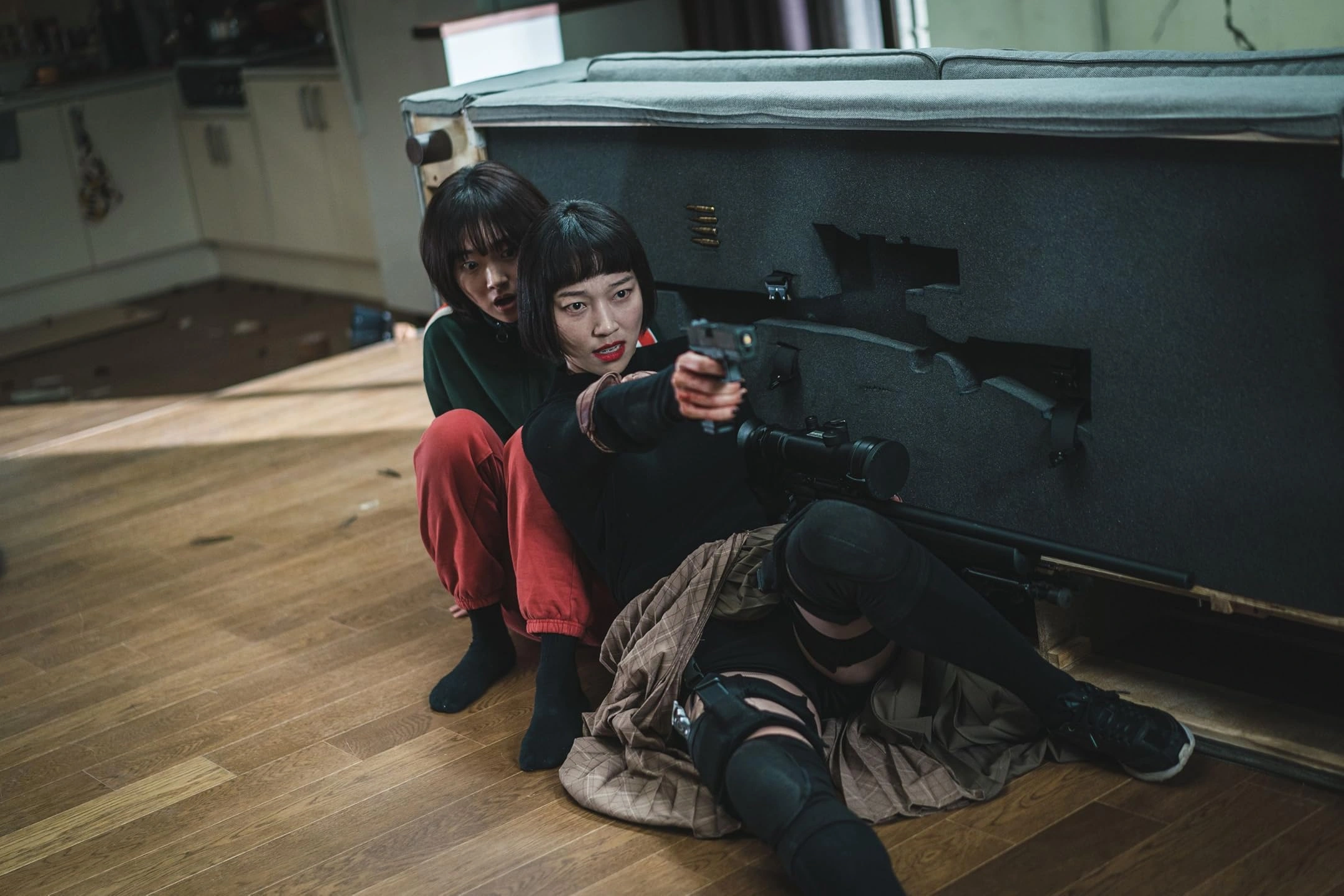
The server is large, submerged, guarded, and central to the mission. Cheol-seung’s attempt to raise it receives detailed attention. The escape then skips past the practical matter of attaching that machine to a helicopter and lifting it through the damaged facility. For a show built on procedural pleasure, the omission feels peculiar. We are asked to admire the plan precisely when the plan becomes magic.
I initially considered this a minor continuity issue. It is minor. It also exposes a tension within the new season. The series wants the credibility of tactical detail and the velocity of action fantasy. Usually, those desires cooperate. Here, one briefly consumes the other.
The same tension appears in Jin-man’s fake death. The episode shows him observing the staged corpse and lets Cheol-seung’s prosthetic abilities suggest an explanation, but the physical construction of the body remains unclear. Jin-woo’s position as a police officer may account for the official handling of the scene. The evidence points toward a solution without quite supplying it.
None of this breaks the premiere. The action remains readable because each person occupies a defined space and pursues a visible objective. Cheol-seung moves through vents and server rooms. Jin-man pushes from the armoury toward Bale. Jin-woo controls the exit route. Pasin leaves for Ji-an. The editing cuts among these lines without dissolving them into noise.
The tense score helps, especially during the countdown to the server inspection. It drives the scene without attempting to manufacture urgency from empty movement. When the security alarm sounds, the episode has earned it.
Ji-an’s Quiet War
Episode 2 shifts to Ji-an living on a small island, trying to occupy a life without gunfire. The attempt is doomed before any enemy arrives. She watches people too closely. Friendly gestures register as possible traps. Silence gives her room to remember.
Kim Hye-jun plays this change through restraint. During the first season’s siege, Ji-an’s fear was tied to immediate problems: hidden corridors, ammunition, surveillance, attackers approaching the house. On the island, the threat has become interpretive. She must decide what a glance means, why someone has approached her, and how much trust can be extended before it becomes fatal.
Her trauma appears through nightmares and waking visions of the man she killed. This could have become a cheap horror device, a villain inserted into reflections whenever the episode needed a jolt. Instead, the visions mark the moral difference between Ji-an and the professionals around her. She can kill. She cannot file the killing away.
The series refuses to transform survival into emotional immunity. Ji-an has hardened since the attack, but her coldness has texture. She acts faster and speaks with greater caution, then reveals vulnerability through the fraction of a second she spends reconsidering a stranger. Kim makes that delay visible.
A seemingly kind young man enters her island life, and every ordinary interaction becomes infected by the show’s history of betrayal. Ji-an’s suspicion may prove correct. It may also destroy the possibility of any peaceful relationship before danger has time to reach her. That uncertainty gives the quieter scenes their pressure. Jin-man’s return should provide relief. It does, briefly. It also confirms that he chose to let her believe he was dead.
This is the emotional debt beneath the season’s expensive machinery. He staged his death to protect her, then left her to experience its consequences without him. Ji-an’s anger is not a misunderstanding waiting to be cleared through one sincere conversation. It is a rational response to being treated as the final object in someone else’s plan.
The opening episodes keep uncle and niece apart for long stretches, which weakens the immediate dramatic payoff of their reunion. Their relationship remains the series’ strongest element, yet much of the runtime is spent mapping Babylon and positioning new players. Expansion has a cost. Here, the cost is intimacy.
A Larger Map of Violence
Season 1 gained force from confinement. Ji-an’s home became a fortress, a trap, a classroom, and an inheritance dispute conducted with bullets. Season 2 moves through Babylon’s compound, hidden bunkers, an island community, a helicopter route, and a club in Osaka. The world is larger because the organisation behind the violence is larger.
The Sigma epilogue introduces a woman who recognises Jin-man’s name and smiles when contacted. Yong-han offers Mr Kim money and a position inside Babylon in exchange for turning against Jin-man. New factions appear around an organisation that may no longer be the dominant force in its own ecosystem.
Bale’s continued place inside Babylon creates a useful contradiction. The organisation discards liabilities, yet it tolerates a mercenary whose pursuit of Jin-man has caused diplomatic and operational damage. His competence may explain the exception. His standing among other killers may explain it better. Bale appears to command loyalty that institutional authority cannot manufacture. Still, an organisation this ruthless cannot indulge him forever. His survival in the rice silo delays that reckoning rather than resolving it.
The second episode’s elevator sequence offers the clearest proof that the broader scale can retain emotional precision. A dying director’s final words to his son are intercut with a brutal fight, allowing grief and violence to occupy the same rhythm. The scene does not pause action to explain why the death matters. It makes the action carry the explanation.
Season 2 is slower than the first season because it must assemble a larger political machine. The pace is not weak, but it is less immediate. Viewers entering here without knowledge of Ji-an’s childhood, Jin-man’s rules, Bale’s history, or the siege will find little assistance. The series assumes memory and rewards it.
Its danger lies elsewhere. Babylon can become so elaborate that the people begin to look like access points in its network. The first two episodes resist that fate whenever Ji-an’s fear interrupts the machinery or Jin-man’s pauses reveal the cost of his certainty. The bullets remain impressive. The silence between uncle and niece is where the season has placed the real threat.
A Shop for Killers premiered on Disney+ on January 17, 2024, presenting a gripping South Korean action drama. The narrative follows a young woman who must fight for survival after discovering the dangerous truth behind her late uncle’s mysterious online business.
Where to Watch A Shop for Killers Season 2 Online


Full Credits
Title: A Shop for Killers
Distributor: Disney+
Release date: January 17, 2024
Rating: TV-MA
Running time: 44–62 minutes
Director: Lee Kwon, Noh Kyu-yeob
Writers: Ji Ho-jin, Lee Kwon
Producers and Executive Producers: Yoo Jung-hoon, Cha Sang-min, Kim Kyung-jae, Lim Ra-kyung, Jung Geun-wook, Kang In, Seo Kyung-joon, Kim In-ae, Lee Sung-hoon
Cast: Lee Dong-wook, Kim Hye-jun, Seo Hyun-woo, Jo Han-sun, Park Ji-bin, Geum Hae-na, Kim Min, Lee Tae-young
Director of Photography: Lee Sung-jae, Kim Gi-hyun
Editors: Choi Jae-geun
Composer: Primary
The Review
A Shop for Killers Season 2
Season 2 turns survival into infrastructure: masks, servers, helicopters, and corporate murder arranged with unnerving efficiency. Jin-man’s return supplies the tactical pleasure, while Ji-an’s island exile gives the violence its moral bill. The first two episodes occasionally mistake expansion for depth, especially when logistics vanish and the reunited leads remain separated. Still, the series understands its sharpest idea: Babylon is less an enemy than a workplace culture with ammunition. Grim, slick, and uncomfortably plausible.
PROS
- Precise, readable action choreography
- Ji-an’s trauma carries real weight
- Lee Dong-wook’s controlled performance
- Strong heist structure
- Babylon’s expanded mythology
CONS
- Jin-man and Ji-an stay separated
- Convenient gaps in the heist
- Weak entry point for newcomers
- New factions crowd the opening