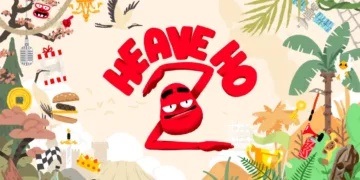

























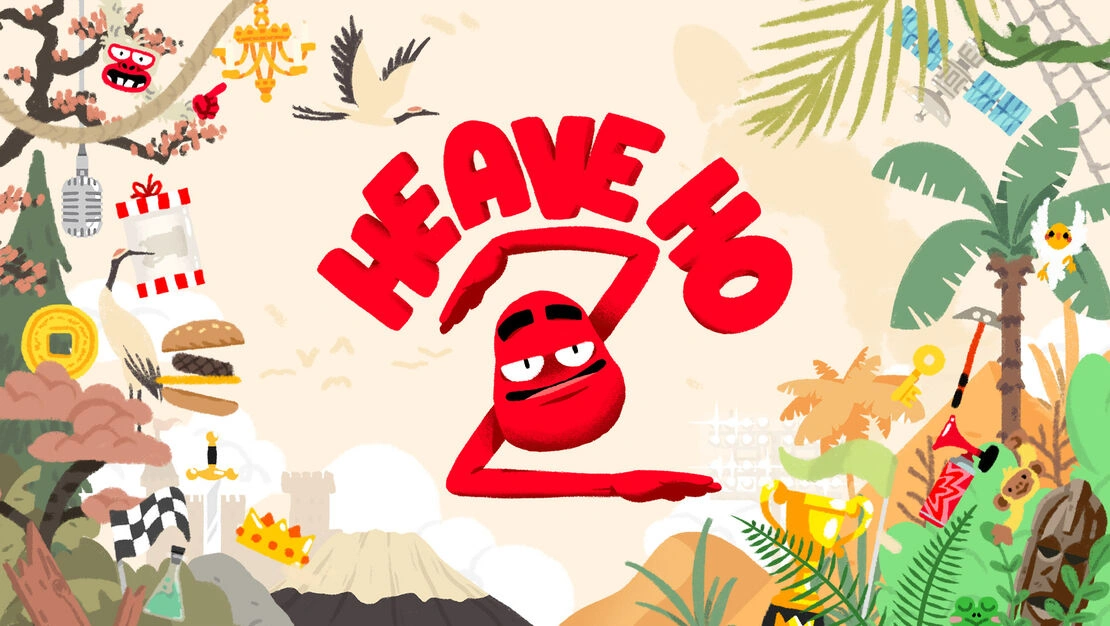

Releasing the wrong trigger in Heave Ho 2 can drop an entire team into a pit. The mistake takes half a second. The laughter lasts much longer. Le Cartel Studio’s sequel keeps the original game’s sharpest idea intact: movement depends entirely on two arms, two hands, and the players operating them. The analogue stick points both limbs, while the shoulder buttons control each grip.
Hold the left trigger and the left hand clings to a surface. Release it at the correct moment, rotate around the right hand, and momentum carries the character across a gap. Mix up left and right while hanging upside down, and gravity handles the rest.
The system works because its physics remain readable beneath the slapstick. A failed launch rarely feels random. Someone released too early, built insufficient momentum, or trusted a teammate who had already demonstrated questionable moral character. Consistency gives every accident a clear cause, which lets players improve without draining the comedy from failure.
Cooperation expands the movement model. Players can hold hands to form chains, stretch across wide openings, or create a pendulum that launches one member toward a distant ledge. A stable bridge can collapse when one person adjusts their grip. A careful rescue can become murder when somebody lets go. The controls are simple enough for a newcomer to understand within minutes, yet coordinating four independent pairs of hands creates a rich mechanical problem.
Eight Worlds, One Flexible System
The first Heave Ho built its stages around reaching an exit. The sequel keeps that objective while giving the route far greater variety across eight themed worlds. A museum asks players to locate keys. A restaurant turns loose ingredients into cooperative cargo.
Laboratory stages alter the characters’ bodies, changing how groups distribute weight and approach gaps. Elsewhere, players cross ski lifts filled with irritated passengers, bounce from neon surfaces that cannot be grabbed, activate spacecraft, and manipulate oversized machines.
These ideas succeed because they modify the established control system instead of burying it beneath isolated gimmicks. Carrying an object changes hand availability. Activating a switch forces the group to divide its attention. Moving a ladder requires positioning, momentum, and the game’s charged fart, a propulsion tool that can lift objects or send nearby characters flying. It sounds disposable. Mechanically, it creates another force players must account for.
Each world ends with a larger stage that combines lessons from its preceding levels. The structure gives those mechanics room to develop before testing them together. Progression occasionally stumbles, since the displayed difficulty ratings do not always reflect the challenge waiting inside. Certain object interactions also lack the dependable feedback of the grabbing system, making a few puzzles feel awkward for reasons unrelated to player execution.
Optional tasks give skilled groups extra reasons to return. Players can carry relics to the finish, beat time limits, locate hidden character outlines, and reproduce their strange poses. Completing these objectives unlocks costumes, crossover skins, and new fart effects. The rewards are cosmetic, but the challenges alter how a stage must be solved. Carrying a relic means sacrificing a free hand, turning a familiar route into a new coordination test.
Failure Without Friction
Quick respawns keep mistakes from becoming interruptions. Falling removes a player for only a moment before placing them back near the group, preserving the rhythm of repeated attempts. The assistance systems follow the same principle. A player who reaches the goal can control a rescue drone and retrieve anyone left behind.

Groups that remain stuck receive help from a bird that grants flotation rings. These tools soften difficulty without pretending the failed sequence never happened. The successful player earns a role in the rescue, while struggling teams can continue before frustration hardens into silence.
This generosity matters because solo play is absent. Two players can complete the campaign, though three or four create stronger chain-building possibilities and greater instability. Local cooperative play remains the ideal setup, while online sessions and Nintendo Switch 2 GameShare remove the geographical restriction that limited the first game.
The lack of a practice mode is harder to excuse. Solo training would let players learn momentum, grip changes, and fart-assisted movement before joining a group. A level creator could have extended the game’s life by letting the community build new tests around its flexible physics. The existing challenge pages provide substantial replay value, but their supply is finite.
Cooperation Turns Hostile
Showdown mode takes the same controls and changes the social contract. Instead of dragging friends toward an exit, players race through laser grids and portals, fight for safe territory, or try to remain alive on moving stages. The first competitor to win five rounds takes the match.

Weapons such as dart guns add direct interference, while charged farts can break an opponent’s grip or launch them away from safety. These tools fit the existing rules, so Showdown feels connected to the cooperative campaign rather than a separate collection of minigames. It lacks the campaign’s elaborate spatial puzzles, yet it provides a useful release after a long session of forced teamwork.
The presentation supports both modes with clear visual communication. Gloves help distinguish left and right hands. Grabbable surfaces are easy to read. Character animations exaggerate every stretch, impact, and panicked rotation, while the sound design gives grabs, slips, shots, falls, and bursts of propulsion distinct feedback.
Heave Ho 2 understands that physical comedy needs dependable mechanics. Its controls create the setup, its physics preserve accountability, and its players supply the disastrous timing. Few cooperative games make failure this instructive or this funny.
The Review
Heave Ho 2
Heave Ho 2 turns two triggers, a pair of arms, and consistent physics into one of the sharpest cooperative systems in the party-game field. Every swing asks players to communicate, manage momentum, and decide who can be trusted with the last grip. The eight worlds keep reshaping that loop through movable objects, puzzles, rescue tools, and wonderfully undignified propulsion. Uneven difficulty and the lack of solo practice create avoidable friction, yet neither weakens the brilliance of playing with a full group.
PROS
- Precise, dependable physics
- Excellent cooperative level design
- Varied themed worlds
- Strong optional challenges
- Chaotic competitive minigames
CONS
- No solo play
- Uneven difficulty ratings
- Occasional unreliable interactions
- No level creation tools