
















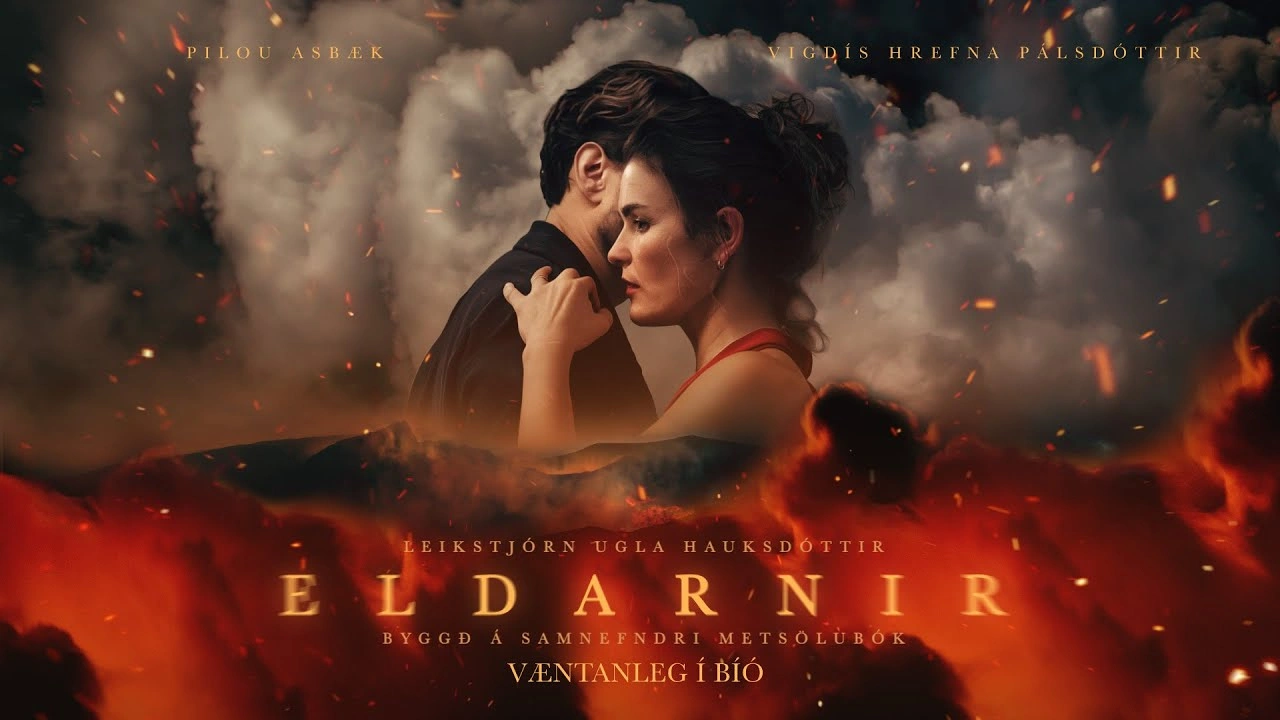

Reykjavík’s possible destruction enters The Fires through graphs, helicopter surveys, and arguments about public messaging. Ugla Hauksdóttir’s feature debut treats catastrophe first as an administrative problem. The earth may be shifting beneath Iceland, yet the people responsible for acknowledging it remain fixated on tourism, panic, and reputational damage. Lava has competition.
Adapted from Sigríður Hagalín Björnsdóttir’s novel, the film follows volcanologist Anna Arnardóttir as tremors and offshore eruptions spread across the Reykjanes Peninsula. Anna, played by Vigdís Hrefna Pálsdóttir, suspects that systems long considered separate may share a vast magma source. Her theory transforms several local incidents into a threat capable of reaching Reykjavík and continuing for years.
The scientific material arrives in thick bursts. Specialists point at computer models, draw underground channels on blackboards, and trade geological terminology with grave faces. Hauksdóttir keeps the exposition legible by tying each explanation to a visible escalation: another tremor, another gas cloud, another eruption breaking through the sea. The method is conventional, yet the accumulating evidence gives the danger persuasive weight.
Anna’s warnings meet resistance from officials who fear the economic consequences of speaking plainly. Their caution creates the film’s sharpest moral shadow. Suppressing information is framed as prudence, then quietly becomes negligence. The rooms where these decisions occur are evenly lit and visually restrained, stripped of the fiery spectacle outside. Bureaucratic danger seldom receives dramatic lighting. It prefers office furniture.
The opposition remains weakly written. Anna’s colleague Jóhannes resists her conclusions, partly through professional pride, yet Þór Tulinius plays him with enough concern that he never becomes a credible obstacle. Few characters appear to believe Anna is wrong. They merely prefer that she be less publicly correct.
Domestic Seismicity
Anna’s private life develops along the same metaphorical fault line. She lives with her husband Kristinn and their daughter in a home defined by pale colors, soft jazz, and orderly routines. During a helicopter trip over an eruption, she meets Thomas, a Danish photographer played by Pilou Asbæk. His camera turns volcanic destruction into seductive imagery, and Anna soon becomes one of his subjects.
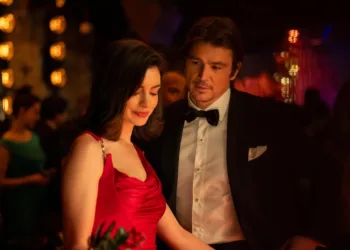
Their attraction is immediate. Thomas photographs Anna looking toward the gas clouds, invites her into a home filled with sharper music and darker textures, and draws her onto the dance floor during a party. Pálsdóttir and Asbæk create genuine physical ease together. Their smiles in the dance sequence verge on excess, yet the scene communicates what Anna finds intoxicating: she is being watched as a person rather than consulted as an expert.
Hauksdóttir gives the affair its clearest meaning through objects. Thomas presents Anna with a black-and-white photograph of the eruption. She hangs it inside her family home, where its severe greys interrupt the warmer palette surrounding it. Later, an earthquake knocks over a photograph of the family. The visual grammar is hardly covert, though it is effective. Thomas and the volcano have entered the house through the same symbolic doorway.
The screenplay wants Anna’s affair to complicate her public heroism. She may save thousands while betraying the people closest to her. That contradiction could have sharpened every decision she makes, especially once gossip about Thomas begins weakening her authority. Instead, the two conflicts run beside each other without forming a single dramatic current.
One scene has Anna attempt to explain love through scientific language. The exchange is meant to reveal a logical mind losing control of itself, yet it reduces her intellect to a romantic cliché. Pálsdóttir often repairs such writing with stillness. Her gaze lingers after conversations have ended, suggesting an internal argument the dialogue cannot express. The camera trusts her face. The script keeps interrupting.
Ash and Exposure
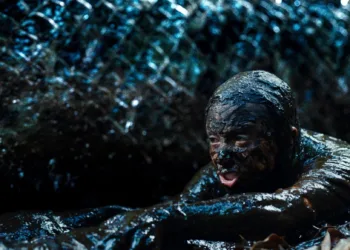
The film becomes visually stronger once the eruption can no longer be managed through meetings. Offshore fire tears through black water. Gas clouds expand across wide aerial frames. Reykjavík gradually disappears beneath smoke and ash, reducing people to uncertain silhouettes moving through streets they no longer recognize.

Cinematographer Eli Arenson repeatedly places human figures low within landscapes that dominate the frame. Iceland appears magnificent, indifferent, and faintly predatory. Drone photography occasionally slips toward tourist-board grandeur, yet the erupting terrain poisons that beauty. The images advertise the country and warn against visiting it in the same breath.
Sound supplies much of the physical fear. Low-frequency tremors arrive before visible movement, allowing the audience to register danger through vibration. Doors shake, glasses rattle, and domestic spaces begin sounding structurally unreliable. Herdís Stefánsdóttir’s score extends that instability through dissonant strings and sustained drones. The music rarely announces a scare. It creates the sensation that the ground has already made a decision.
The final movement delivers panic, ash-covered streets, and impressive effects on a scale that exceeds the film’s modest production. Hauksdóttir understands how to make limited spectacle feel expansive by restricting visibility. Smoke conceals the boundaries of the set, while figures emerge from darkness without clear direction. Confusion becomes part of the composition.
Yet the shift toward disaster pushes Anna’s emotional conflicts aside. Kristinn, Thomas, and the marriage receive no confrontation equal to the visual fury surrounding them. A late child-in-danger sequence supplies urgency through a familiar genre mechanism, then the ending arrives before the political, geological, and domestic consequences settle. The frame fills with smoke, but the unresolved material remains visible.
This intense Australian drama miniseries premiered on Netflix on April 23, 2026. The story draws inspiration from the catastrophic 2019-2020 bushfires, following ordinary people and emergency responders as they make split-second decisions during an unprecedented environmental disaster.
Full Credits
Title: The Fires
Distributor: Netflix
Release date: April 23, 2026
Rating: TV-MA
Running time: 60 minutes per episode
Director: Wanuri Kahiu, Greg McLean
Writers: Tony Ayres, Belinda Chayko
Producers and Executive Producers: Tony Ayres, Andrea Denholm, Liz Watts
Cast: Miranda Otto, Richard Roxburgh, Sam Corlett, Anna Torv, Mark Coles Smith, Hunter Page-Lochard, Heather Mitchell, Toby Schmitz
Director of Photography (Cinematographer): Shelley Farthing-Dawe
Editors: Deborah Peart, Dany Cooper
Composer: Cornel Wilczek
The Review
The Fires
The Fires locates its clearest moral argument in the distance between visible danger and institutional response. Ugla Hauksdóttir gives the eruptions physical authority through ash-filled compositions, low-frequency tremors, and Herdís Stefánsdóttir’s discordant score. Anna’s affair receives the same symbolic framing, yet the screenplay rarely lets domestic betrayal and geological crisis collide with equal force. Vigdís Hrefna Pálsdóttir supplies the missing interior tension through watchful silences, while the abrupt final act leaves both the marriage and the public catastrophe suspended in smoke.
PROS
- Striking ash-covered imagery
- Forceful sound design
- Ominous orchestral score
- Strong central performance
- Convincing volcanic effects
CONS
- Hastily developed affair
- Weak institutional opposition
- Underwritten family conflict
- Familiar child-in-danger device
- Abrupt, incomplete ending