
















The golden spork tells you almost everything about the tone of Chickenhare and the Secret of the Groundhog. It is a ridiculous treasure, treated with enough sincerity to power a trap-filled escape, and it later proves useful rather than remaining a disposable gag. Benjamin Mousquet’s sequel works in much the same way. Its bright animal designs and broad comedy suggest lightweight children’s fare, yet the story keeps finding practical uses for ideas that initially look silly.
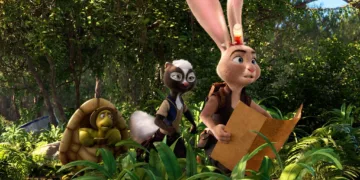
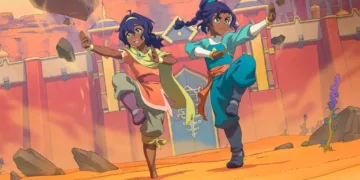
Chickenhare returns as the adopted son of King Peter, now established as an adventurous relic hunter alongside Meg, a martial-arts-trained skunk, and Abe, a sarcastic tortoise who would prefer every expedition to involve less running. Their opening mission sends them through collapsing ruins and into conflict with Crolloq, a feline rival carrying unresolved anger toward Meg. The sequence borrows freely from Indiana Jones, right down to the mounting traps and narrow escapes, but it has enough speed and visual clarity to justify the homage.
The real quest concerns the Backward-Facing Groundhog, a legendary creature capable of changing one event from the past. King Peter wants that power secured before it reaches someone willing to misuse it. Then Gina arrives.
She reveals herself as Chickenhare’s long-lost sister, a harechicken whose body leans further toward the avian half of their shared heritage. Her appearance changes the film’s emotional scale. Chickenhare spent the first movie learning to accept his mixed identity. Here, he meets someone who appears to understand that identity from the inside.
One Story Becomes Three
The screenplay’s smartest structural choice is separating Chickenhare, Meg, and Abe during the middle act. A film this busy could easily turn its supporting characters into luggage carried between action scenes. Instead, each member of the trio receives a distinct conflict tied to forgiveness, loyalty, or family.
Chickenhare’s scenes with Gina hold the largest emotional burden. He accepts her quickly, treating their biological connection as something precious before he understands why she sought him out. Gina serves King Barthemelow, whose people believe an ancient curse damaged their community. She wants the Groundhog to reverse that history, and her deception grows from grief rather than greed.
That distinction matters. The film never asks viewers to approve of her plan, but it gives the plan emotional logic. Gina sees the past as a faulty draft that can be corrected. Chickenhare must decide how much inherited pain can excuse rewriting the lives of everyone who came after it.
Meg’s reunion with Crolloq gives the sequel its most charged relationship. Their fights carry the rhythm of old friends who know exactly where to strike. Crolloq’s anger stems from personal abandonment, while Meg’s toughness repeatedly fails to solve the resentment between them. The screenplay leaves parts of their former closeness unstated, which suits a relationship shaped by things neither character can comfortably say.
Abe’s detour with Pigsqueak is broader and sillier. Their mismatched partnership supplies physical comedy while the other plots grow heavier, yet the thread is folded back into the climax rather than abandoned. That payoff helps the film’s crowded structure feel planned, even when the pacing has little room to breathe.
Changing History, Keeping the Wound
Time travel in family animation often serves as a repair device. A character makes a mistake, revisits the past, and restores the preferred version of events. The Secret of the Groundhog takes a sharper route. The Groundhog’s power exposes the fantasy behind that structure: changing history does not heal pain so much as redistribute it.

The climax becomes most effective when the characters stop treating the past as a puzzle with one correct solution. Gina’s community has real grievances. Chickenhare’s adoptive family is real too. One history cannot be erased without damaging the other.
That idea gives familiar lessons about acceptance greater weight. The first film asked Chickenhare to stop hiding what made him different. This sequel asks him to live with several truths at once. He can value King Peter as his father, care about his biological people, and reject Gina’s plan without dismissing the hurt behind it.
The 90-minute runtime limits how deeply these ideas can develop. Gina’s change of direction arrives quickly, and Meg’s conflict with Crolloq could support several extra scenes. The film keeps moving because it has another chase to stage, another joke to land, or another magical rule to explain. Children are unlikely to feel stranded. Older viewers may wish the emotional turns had another minute before the next trapdoor opens.
Comic-Book Memories and Feathered Flight
The animation has the clean, rounded finish common to contemporary European CG features. The animals are built from simple shapes, the environments favor soft pastel colors, and the action remains easy to follow even when several characters occupy the frame. Some designs recall Zootopia and Over the Hedge, especially Abe’s expressive shell-bound grumpiness, but the film finds its own movement through Chickenhare’s body.
His feathered ears become functional during the action. With enough momentum, he can glide or briefly fly, turning his mixed anatomy into part of the staging rather than a purely thematic feature. A running jump can become an escape route. A fall can become a clumsy takeoff. The visual joke and the character idea are doing the same job.
The hand-drawn passages are even stronger. Historical accounts and legends shift into illustrated, comic-book-like sequences, giving the exposition a distinct texture. These scenes separate remembered history from the present-day adventure and create a visible connection to Chris Grine’s graphic-novel source. They also prevent long explanations about curses and ancient peoples from becoming static conversations.
Puggy’s returning score keeps the chase scenes buoyant and gives the family material a gentle sentimental pull. The voice cast matches that flexibility. Chickenhare sounds confident until Gina challenges his sense of belonging. Meg’s clipped toughness softens around Crolloq. Abe delivers every inconvenience as if adventure were a clerical error someone else should correct.
The film rarely surprises at the level of basic design, yet it knows how to make craft serve character. The 2D memories carry history. Chickenhare’s ears carry him across gaps. Even the golden spork earns its keep.
This animated adventure film premiered in late 2025 and is available via select international theatrical distributors and home media platforms. The story follows the hybrid hero Chickenhare as he teams up with his friends and long-lost sister to find a legendary groundhog with the power to reverse time and save their species.
Where to Watch Chickenhare and the Secret of the Groundhog (2025) Online

Full Credits
Title: Chickenhare and the Secret of the Groundhog
Distributor: SND
Release date: October 15, 2025
Rating: PG
Running time: 89 minutes
Director: Benjamin Mousquet
Writers: Dave Collard, Chris Grine
Producers and Executive Producers: Matthieu Gondinet, Matthieu Zeller, Ben Stassen
Cast: Jordan Tartakow, Joe Ochman, Laila Berzins, Bernardo de Paula, Christopher Bass, Michael Ornstein, Xanthe Huynh
Composer: Puggy
The Review
Chickenhare and the Secret of the Groundhog
Chickenhare and the Secret of the Groundhog gives its returning heroes a busier, warmer adventure built around inherited pain and the dangerous appeal of rewriting history. The separation of Chickenhare, Meg, and Abe lets each friendship carry its own conflict, while Gina’s divided loyalties bring genuine weight to the time-travel plot. I wish the 90-minute runtime gave those relationships room to breathe, yet the energetic chases, expressive animation, and hand-drawn flashbacks keep the packed story moving. Familiar ingredients, carefully prepared.
PROS
- Gina’s emotionally grounded conflict
- Stronger individual character arcs
- Energetic artefact-hunting sequences
- Stylish hand-drawn flashbacks
- Thoughtful treatment of identity
CONS
- Overcrowded 90-minute story
- Familiar acceptance message
- Some emotional turns feel rushed
- Designs echo larger studio films