

















Three weeks after Andrija dies by suicide, his school sends the people connected to his suffering on a class trip. Grief has already been converted into scheduling. The adults wonder privately if the excursion is wise, then board the bus anyway.
Miroslav Terzić establishes this moral climate through an apartment fire. Tzotza (Jovan Ginić), Andrija’s closest friend, watches flames tear through a building while the surrounding estate remains strangely empty. No neighbours gather. No sirens approach. The image is blunt, perhaps excessively so, yet its accusation is clear: destruction can become ordinary when responsibility belongs to everyone in theory and nobody in practice.
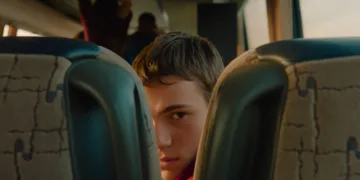
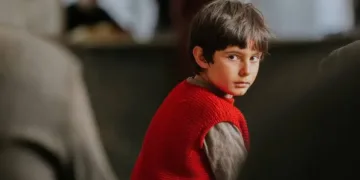
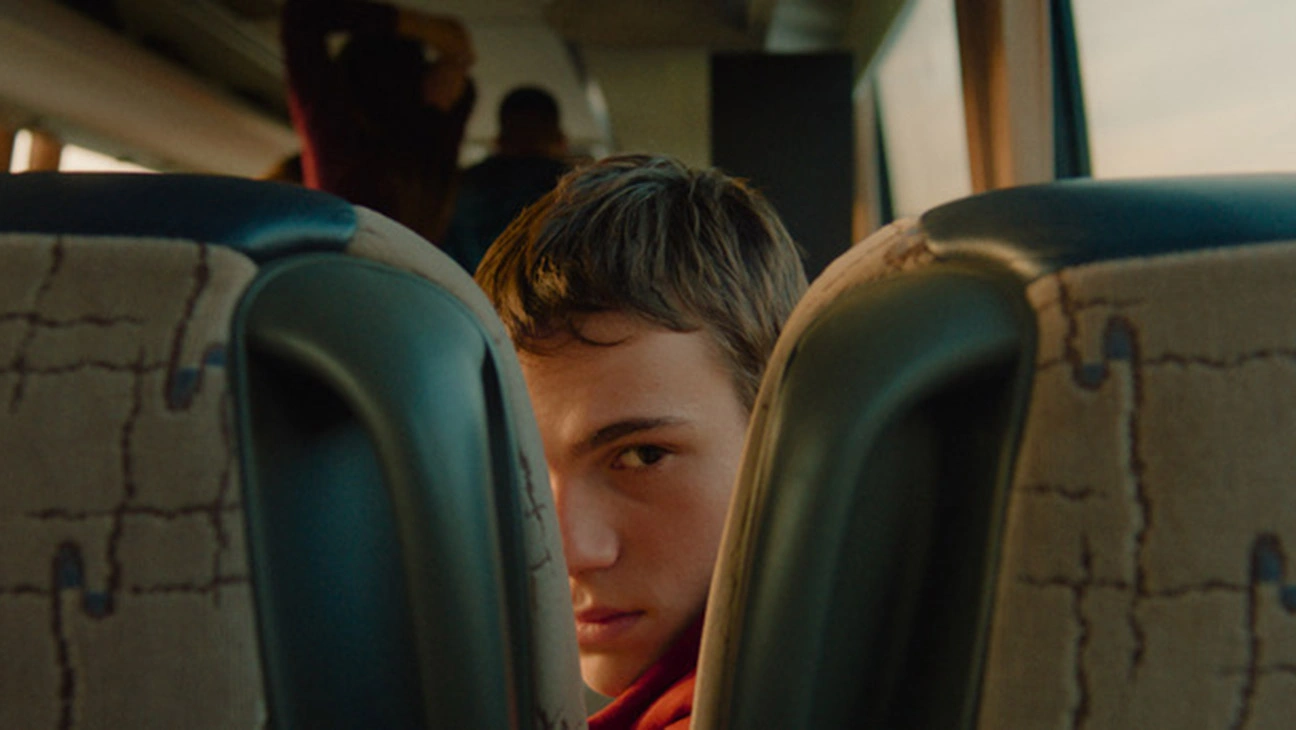
Tzotza soon joins his classmates for the journey to Bulgaria. Some are surprised to see him. Others appear irritated, as though his presence violates an agreement. He carries Andrija’s absence onto the coach, and the group responds as people often respond to a witness they cannot silence through denial. They decide to hurt him. The dead boy is everywhere precisely because he is nowhere.
The Bus as a Small Country
Damjan Radovanović’s camera moves down the coach aisle with the patience of something searching for a weakness. The seating arrangement forms its own social order: loud, confident students occupy the back, while Tzotza sits nearer the front beside Darija (Andjela Alavirević), his only uncertain ally. Teachers Viktorija (Tihana Lazović) and Markuš (Branislav Trifunović) possess microphones, titles, and almost no authority.
Viktorija attempts to lecture the class about Balkan history and Ivo Andrić. The students continue vaping, shouting, and discussing cosmetic surgery, weight loss, gambling, and crime. Their indifference is treated as cultural emptiness, though the dialogue also suggests imitation. These teenagers have learned the language of appetite from the adult world. They speak of bodies as projects, money as rescue, and humiliation as entertainment.
Miloš (Andrija Marković), one of the chief tormentors linked to Andrija’s death, has been banned from the trip. His girlfriend Milica (Klara Karaulić) helps him sneak aboard during a rest stop. Neither teacher notices. Their failure would be comic in another film. Here it feels like a door left open in a burning house.
Tzotza’s presence forces the class to remember what happened. Their cruelty has a practical purpose: if he can be discredited, frightened, or broken, the group may preserve its preferred fiction that Andrija’s death occurred without cause. When Miloš invokes the dead boy during the walk toward the hotel, Tzotza punches him. The blow is brief, desperate, and useless. Violence cannot restore moral balance when violence already owns the room.
Night Without Adults
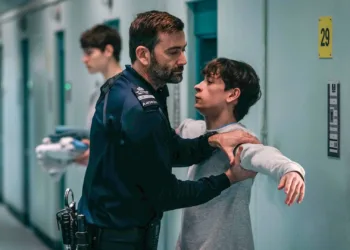
A blocked road and damaged tyre strand the group at an isolated resort near the forest. The hotel is preparing to close for the season. Staff members are absent. Corridors stretch into darkness. Terzić slowly removes every remaining witness until the students seem to inhabit a world built solely for pursuit.
The teachers recognise the danger and retreat from it. Viktorija calls the children heartless, while Markuš shares her exhaustion. Later, they shut themselves inside a room and use headphones, sealing away the noise they were brought there to hear. Their withdrawal is the film’s cruelest gesture. Miloš may initiate the hunt, yet the adults make it possible by choosing comfort over attention.
Ginić gives Tzotza a body permanently braced for impact. His shoulders tighten on the bus. His eyes measure exits before conversations. During a phone call with his parents, he cries while insisting that he is fine, protecting the very adults who should be protecting him. The scene refuses theatrical release. His pain emerges in small failures of control, then disappears beneath reassurance.
Later, as the students chase him beyond the hotel and into the forest, the camera preserves the geography of his fear. Darkness obscures faces without reducing the pursuit to confusion. Branches, corridors, and cave walls become temporary borders that fail one after another.
Milica’s behaviour during an off-screen beating is colder than the violence itself. She scrolls through her phone, glances toward the assault, and complains of boredom once it ends. The screen in her hand does not create her indifference. It gives that indifference somewhere comfortable to rest.
The Shape of Blame
Tzotza eventually accuses the class and its teachers of sharing responsibility for Andrija’s death. The statement breaks through the evasions that have governed the trip. Miloš delivered the cruelty. Others laughed, watched, remained silent, or found language that made intervention unnecessary.
Terzić links this moral paralysis to a society carrying memories of war, crime, poverty, and institutional decay. Songs tied to Serbia’s post-1990s culture drift through scenes of intoxication and aggression. The students inherit a world they did not build, then reproduce its harshness in miniature. The film’s bleakness grows from this repetition: each generation receives the wound, changes its clothing, and passes it forward.
Yet the portrait becomes too complete. Nearly every student behaves with sadism, vanity, or blank submission. Darija offers hesitation, though even her loyalty bends under pressure. A group this uniformly cruel begins to resemble an argument arranged by the filmmaker rather than a class of recognisable people. Ordinary cowardice would have been harder to forgive. Absolute monstrosity creates distance.
The final movement abandons some of the physical realism that gives the hotel sequences their force. Tzotza’s retaliation unfolds through phantasmagoric imagery, and fire returns as both punishment and possible fantasy. The beauty of the closing composition cannot recover the human complexity the screenplay has gradually burned away.
Still, one image remains difficult to escape: two teachers placing headphones over their ears while a child is hunted nearby. Evil is loud in 3 Weeks After. Neglect barely makes a sound.
This drama film premiered at the 60th Karlovy Vary International Film Festival on July 7, 2026, where it won the Europa Cinemas Label Award. Inspired by real events, the story follows a group of high school students whose class trip takes an unsettling turn after they become stranded in a remote mountain hotel.
Full Credits
Title: 3 Weeks After
Distributor: Bendita Film Sales
Release date: July 7, 2026
Director: Miroslav Terzić
Writers: Miroslav Terzić, Vladimir Arsenijević, Bojan Vuletić
Cast: Jovan Ginić, Klara Hrvanović, Andjela Alavirević, Tihana Lazović, Branislav Trifunović
Director of Photography (Cinematographer): Damjan Radovanović
Composer: LP Duo
The Review
3 Weeks After
3 Weeks After turns a school trip into a sealed chamber where grief, cowardice, and cruelty feed one another. Jovan Ginić gives Tzotza’s silence the weight of an accusation, while Damjan Radovanović’s prowling camera and the oppressive soundscape make every corridor feel complicit. The film’s vision of adolescence becomes too absolute, stripping the students of the contradictions that might have made their violence truly frightening. Its final symbolic turn also loosens the tension so carefully tightened before it. Still, few films stare this coldly at the comfort of looking away.
PROS
- Jovan Ginić’s tense performance
- Menacing camera movement
- Powerful sound design
- Unflinching moral atmosphere
CONS
- Uniformly monstrous teenagers
- Negligent adults feel engineered
- Less persuasive final act