



















Dusty Boyd has spent half his life mistaking a broken wrist for a stolen destiny. Once a junior tennis prodigy known as “The Hammer,” he now teaches indifferent nine-year-olds at the club owned by his father, Chuck, and repeats the story of Andy Roddick’s alleged sabotage with the conviction of a man defending national history. His vanity plate still reads “DE-HAMMR.” His assistant PJ still listens. The rest of the world has moved on.
That arrested identity gives The Dink its strongest idea. Josh Greenbaum’s comedy places a man built around force inside a sport defined by touch. Pickleball, with its small court, plastic ball, soft drop shots, and large population of older players, becomes an affront to everything Dusty believes masculinity should look like.
Chuck calls it the “novel coronavirus of sports” and appoints tennis culture as the vaccine. The language is ridiculous, yet the panic beneath it is familiar. A recreational game has become a referendum on status, age, and athletic legitimacy.
The film belongs to the sports-comedy tradition in which a threatened institution, a humiliated former talent, and a decisive match are arranged toward redemption. Its references are easy to spot, from the damaged ego of Happy Gilmore to the eccentric team energy of DodgeBall. The Dink has less appetite for humiliation than either film. Its instinct is affectionate, sometimes to a fault.
The Hammer’s Myth
Dusty’s version of the past requires Andy Roddick to be a villain. During their junior match, Roddick supposedly engineered a bathroom mishap that caused Dusty to fall, break his wrist, and lose the future waiting for him. The story has expanded with every retelling.
PJ now accepts that Dusty lost championships, fame, and even Brooklyn Decker to the conspiracy. Aaron Chen plays this devotion without irony. PJ’s solemn admiration turns Dusty’s self-pity into a private religion with two members.
Jake Johnson keeps Dusty from becoming intolerable by locating the panic inside his arrogance. Watch the speed with which he insults Candace after her pickleball crosses onto his tennis court. The hostility is excessive because the ball represents a threat he already understands. Tennis gave him a hierarchy in which he once mattered. Pickleball arrives with different rules, older women who can beat him, and no interest in his abandoned mythology.
Chuck is the architect of that mythology. He raised his son for tennis greatness, called him “The Hammer” before giving him a usable sense of self, and now treats the failed project with open contempt. Ed Harris plays the father’s disgust at full dramatic weight. His rigid posture and grave delivery make the anti-pickleball speeches funny because Chuck behaves as if court allocation were a constitutional emergency. That seriousness exposes the cruelty beneath the joke. Dusty is still trying to win approval from the man who trained him to confuse achievement with affection.
The screenplay gives this relationship a clear path toward reconciliation, yet Chuck’s softening feels tidier than his behavior earns. A father who dismisses his son as a hopeless loser cannot be repaired by the same machinery that resolves a club dispute. The paternal wound is treated as a sports-movie obstacle after the film has shown it to be Dusty’s entire operating system.
A Sport Built on Restraint
The plot performs several awkward maneuvers before Dusty reaches a pickleball court. Chuck invokes a clause that allows the club dispute to be settled through competition. Dusty enters a tournament to prove that he deserves to represent tennis. He wins, celebrates badly, and injures his wrist again.
A doctor played by Ben Stiller prescribes pickleball as rehabilitation through a scene of strained sexual banter. The chain is clumsy, yet its destination is exact: Dusty must learn a game that refuses his preferred method of domination.
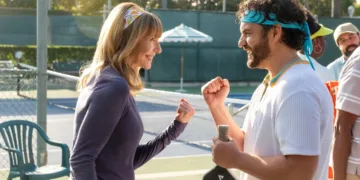
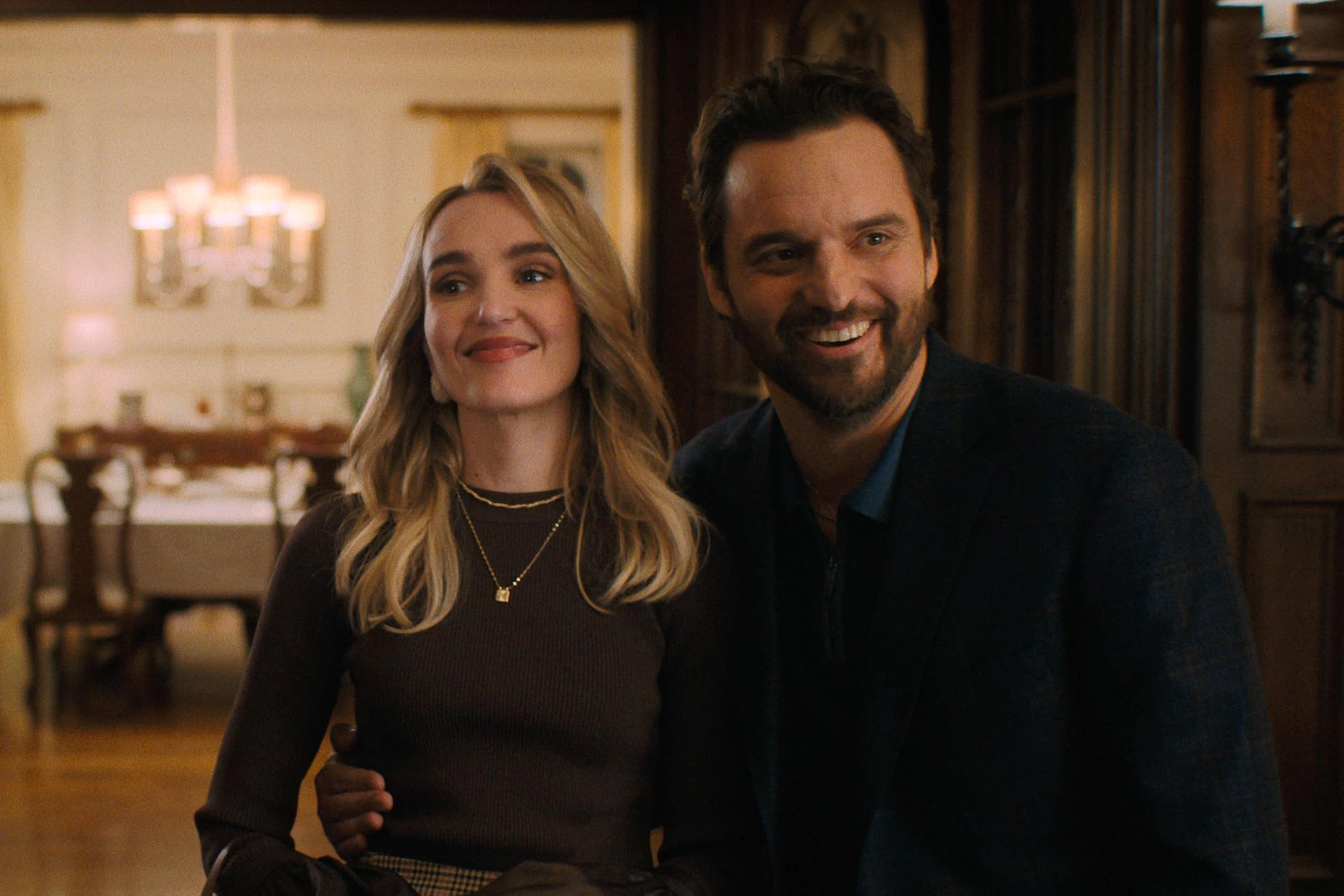
Candace introduces him to that refusal. Mary Steenburgen gives the character a relaxed authority that makes Dusty’s performance of superiority look juvenile. Gail and Judy complete the lesson by beating him with placement, patience, and control.
He cannot overpower opponents who barely move. The humiliation works because the sport’s physical grammar contradicts his identity. A dink, the soft shot dropped near the net, asks for judgment rather than spectacle. “The Hammer” has entered a system in which swinging harder can make the player worse.
This is the film’s richest cultural observation. American sports mythology often treats visible effort as moral proof: speed, pain, muscle, volume. Pickleball scrambles that hierarchy. Older players occupy the court without apology. Small movements defeat grand gestures. Recreation has value without professional ambition. Dusty’s contempt is the anxiety of a man discovering that pleasure can exist outside the ranking system that ruined him.
The film could press harder on that discovery. Chuck’s tennis purism, Skip’s campaign for extra courts, and Dusty’s fear of ageing offer material for sharper satire of class and athletic vanity. Greenbaum prefers genial rituals such as “Fresh pickle!” and jokes about grunters. The result is inviting, but the comedy treats a deep cultural panic as a neighborhood disagreement.
Candace has reasons for playing that Dusty does not initially respect. She is divorced, wary of encountering her ex-husband Mitch, fond of country music, and willing to enter a new social space without pretending it carries historic importance. Steenburgen makes these details feel lived, especially when Candace responds to Dusty’s boasting with calm amusement instead of confrontation.
Their time together shifts the film away from competitive parody. Practice sessions give way to country songs, late-night conversation, and a honky-tonk scene where Dusty poses as Candace’s boyfriend to impress Mitch. The performance becomes emotionally dangerous when Dusty begins to believe it. A viewing of The Graduate prepares the age-gap suggestion, then Dusty makes a romantic gesture that Candace rejects.
The sequence is unusual enough to disturb the film’s safe design. Johnson and Steenburgen have genuine chemistry because both performers understand loneliness as a comic condition. Dusty has spent years waiting for a career to return. Candace has built a life after a marriage ended. Their connection briefly suggests a comedy willing to reconsider which bodies are permitted romance, embarrassment, and desire.
Then the screenplay withdraws. Candace’s rejection protects the film from examining the social discomfort it created. The romance becomes evidence of Dusty’s changing self-image rather than a possibility with consequences for Candace. Her divorce and fear of Mitch remain useful details in his development. Steenburgen gives the character dignity, yet the writing assigns her the familiar labor of teaching a stalled man how to live.
A Deep Bench
The supporting cast keeps finding sharper comedy inside the screenplay’s mild arrangements. Aaron Chen is the clearest example. PJ’s devotion to Dusty never cracks, and that commitment makes each inflated story funnier. He does not function as a conventional truth-teller. He is the one person who has accepted Dusty’s legend exactly as advertised.
Patton Oswalt gives Skip the energy of an activist campaigning for access to a municipal resource. The performance turns court allocation into civic theater. Ed Harris achieves a similar effect from the opposite side, treating pickleball expansion as contamination. Their seriousness creates the satire that the dialogue sometimes avoids.
Other performers receive thinner assignments. Chloe Fineman, Chris Parnell, Fortune Feimster, Cleo King, and Lynne Marie Stewart appear around the edges, often attached to one comic function. The cast suggests a wilder ensemble piece than the finished structure allows. Ben Stiller’s doctor cameo is especially labored, a scene built around sexual fixation that plays like an improvisation waiting for someone to end it.
John McEnroe fares better during the final match. His commentator persona has an obvious comic use, and the film finds a fresh visual escalation by having another tennis legend deliver play-by-play while eating increasingly large pieces of food. The gag succeeds because nobody explains it. The food grows, the match continues, and absurdity is allowed to remain absurd.
Greenbaum’s direction favors bright spaces, clean coverage, and an easy rhythm that lets performers extend reactions. That looseness helps Johnson and Steenburgen during quieter exchanges. It also leaves several jokes on screen after their best beat has passed. At 102 minutes, the film has the duration of a full sports narrative and the dramatic density of a recreational match.
The Soft Shot
The final contest returns the story to its oldest promise: Dusty must face Roddick, protect the club, confront the lie built around his injury, and stop treating Chuck’s approval as the measure of his life. Andy Roddick’s willingness to play a petty version of himself gives the rivalry a playful charge. McEnroe’s commentary and the spectators’ reactions keep the sequence moving once the outcome has become obvious.
Dusty’s change is expressed through technique. The man once defined by a violent serve must trust finesse. His acceptance of the dink turns character development into physical behavior, one of the film’s cleanest choices. He no longer needs every shot to announce him.
The low stakes remain part of the joke. Nobody is saving a town, a family business with deep economic consequence, or a professional career. They are fighting over recreational courts. The seriousness surrounding that dispute reveals how communities turn leisure into identity, then defend identity as property.
The Dink keeps choosing reconciliation where sharper comedy might choose injury. Chuck receives a path back to his son. Candace retains her independence. Tennis and pickleball are permitted to share space. The generosity is pleasant, yet it limits the film’s bite. A story about learning not to swing at full force occasionally needs one joke that lands like a serve.
This sports comedy film premiered on Apple TV on July 24, 2026. The story follows a washed-up tennis pro who breaks a sacred vow to play pickleball in order to save a struggling club and earn his father’s respect.
Where to Watch The Dink Online


Full Credits
Title: The Dink
Distributor: Apple Original Films
Release date: July 24, 2026
Rating: R
Running time: 102 minutes
Director: Josh Greenbaum
Writers: Sean Clements
Producers and Executive Producers: Ben Stiller, John Lesher, Rob Paris, Mike Witherill, Jake Johnson, Rick Steele, Josh Greenbaum, Joe Hardesty, Jonathan McCoy, Daniel Crosser
Cast: Jake Johnson, Mary Steenburgen, Ed Harris, Ben Stiller, Chloe Fineman, Patton Oswalt, Aaron Chen, Martin Kove, Chris Parnell, Christine Taylor, Andy Roddick, John McEnroe
Director of Photography (Cinematographer): Carl Herse
Editors: Greg Hayden
Composer: Dara Taylor
The Review
The Dink
The Dink treats pickleball as a cultural punchline, then discovers greater comic value in the people who take it seriously. Jake Johnson and Mary Steenburgen lend warmth to a formula built from bruised pride, paternal disapproval, and recreational warfare, while Aaron Chen and John McEnroe supply the sharpest laughs. The film’s affection becomes a limitation when its satire calls for teeth, and its romantic detour retreats before testing its own nerve. Still, there is pleasure in watching a comedy admit that softness can be a skill.
PROS
- Johnson and Steenburgen’s chemistry
- Aaron Chen’s committed comic performance
- Ed Harris playing absurdity straight
- Strong final-match gags
- Affectionate pickleball culture
CONS
- Cautious, softened satire
- Familiar underdog structure
- Tentative romantic subplot
- Underused supporting comedians
- Loose pacing