




















Six hundred black-and-white fragments are arranged until the twentieth century begins to look like a machine dreaming of its own destruction. Maciej J. Drygas constructs Trains from material drawn from 46 archives, stripping away narration, interviews, spoken dialogue, and almost every written explanation. History passes through windows, stations, factory floors, military camps, and freight yards. The images are left to accuse one another.
A Franz Kafka quotation appears before the machinery starts moving: “There is plenty of hope, an infinite amount of hope… But not for us.” Drygas then shows workers assembling a steam locomotive piece by piece. Metal plates descend into place. Bolts tighten. Pistons wait for breath. The sequence carries the solemnity of a ritual, as if the workers were building an iron god whose appetite they could not yet understand.
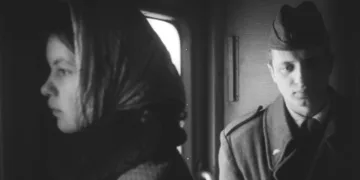
That god offers freedom. Young women gaze through carriage windows. Families gather on platforms. Passengers eat in dining cars while landscapes slide past the glass. Distance becomes manageable, leisure becomes available to ordinary people, and cities begin speaking to one another through timetables. The locomotive compresses space. It also compresses suffering.
Factory of Progress
The First World War section transforms the railway from a promise into an artery. Soldiers leave civilian stations and arrive at training grounds, where they run drills, practise shooting, and learn to breathe through gas masks. Women replace them on factory lines, manufacturing artillery shells that are loaded onto flatcars and carried toward the front.
Drygas builds these passages through repetition. Wheels turn. Weapons move. Bodies return. A railway-mounted gun fires into the distance, and the mechanical rhythm continues as wounded soldiers arrive from the same direction. Men convulse from shell shock. Prosthetic limbs wait beside damaged bodies. The factory has changed its product, though the process remains familiar.
The editing creates a bleak chain of association between locomotives, ammunition, industrial medicine, and the bodies war has broken. Production becomes a moral fog. Each object seems innocent when viewed alone. A wheel is merely a wheel. A carriage is merely a carriage. Placed beside shells, gas masks, and amputees, those objects begin to share a single pulse.
At times, Drygas presses this pattern too firmly. Another departure, another convoy, another line of military cargo. The film’s insistence can dull the shock it seeks to preserve. Repetition is part of the argument, yet repetition can also become shelter. The viewer learns the rhythm and braces before the blow arrives.
Carriages of the Dead
The Second World War footage removes any remaining innocence from the tracks. Hitler salutes crowds from a train, framed by the same machinery that once carried tourists toward holidays. SS officers recline inside polished compartments, laughing and posing for a handheld camera. Their ease is hideous. They look like ordinary passengers because evil often enjoys upholstery.

Charlie Chaplin appears elsewhere, lifted by admirers after stepping from a carriage. Drygas places public adoration beside political worship, allowing cinema, celebrity, and fascist spectacle to occupy the same visual language. A crowd reaches upward. A famous man acknowledges it. The gesture changes meaning, then changes again.
The railway carries every side of the conflict. Tanks travel across conquered land. Civilians flee ruined cities. Soldiers are packed together on their way to battle. Jewish families are forced into freight cars and moved toward concentration camps. After liberation, bodies spill from those same cars while soldiers examine what the system has delivered. The train does not distinguish between passenger and prisoner. It accepts schedules.
Drygas refuses to explain these images with a guiding voice. The silence denies the audience a safe moral distance. Meaning forms through collision: smiling officers followed by deportees, comfortable compartments followed by freight cars, movement followed by death. The camera preserves evidence, yet it also records perpetrators playing for its attention. It witnesses. Sometimes it flatters. Sometimes it arrives too late.
This tension links the railway to cinema itself. Both inventions altered time, distance, and human perception near the beginning of the modern age. The Lumière brothers made a train’s arrival into one of cinema’s foundational images. Drygas watches that promise darken until the camera and locomotive seem like twins, each carrying history forward without choosing its cargo.
Sound After Silence
Saulius Urbanavicius gives the archival footage a voice assembled from absence. Pistons churn. Steel scrapes against steel. Steam whistles cut through stations and battlefields. The reconstructed sounds rarely settle into simple realism. A whistle can resemble an artillery shell, a human cry, or some buried warning trying to escape the image.
Paweł Szymański’s composition, Compartment 2, Car 7, moves beneath the footage with tense, minimal rhythms. The music does the interpretive work narration would usually perform, yet it never tells the audience what to think. It creates pressure. A factory floor becomes ominous before the weapons appear. A crowded platform begins to feel like a threshold long before its destination is known.
The postwar passages breathe differently. Faces linger. Passengers eat, play, wait beneath timetables, and stare through windows. Some notice the camera and smile. Their gestures are brief, almost weightless, yet the preceding images have changed them. Every carriage now contains the memory of another carriage. Every departure carries the shadow of forced transport.
Drygas ends from the front of a moving train as the rails intersect, separate, and curve toward different directions. The image offers no clean hope. It offers choice in its smallest mechanical form: a switch, a turn, one line abandoned for another. The train keeps moving, and history waits beside the lever.
This documentary film premiered in November 2024 at the International Documentary Film Festival Amsterdam. Constructed entirely from archival footage, the film uses trains as a historical conduit to explore humanity’s triumphs and tragedies throughout the twentieth century.
Full Credits
Title: Trains
Distributor: Independent
Release date: November 2024 (IDFA premiere)
Running time: 81 minutes
Director: Maciej J. Drygas
Writers: Maciej J. Drygas
Producers and Executive Producers: Rasa Miškinytė
Editors: Rafał Listopad
The Review
Trains
Trains turns the railway into the pulse of the 20th century, carrying holidaymakers, soldiers, weapons, prisoners, and corpses along the same indifferent tracks. Maciej J. Drygas finds horror in repetition: wheels turn, whistles cry, and history keeps mistaking speed for progress. Saulius Urbanavicius’s sound design gives the silent footage a haunted voice, while the absence of narration leaves each image exposed. Some visual patterns linger too long, yet the final diverging rails preserve a fragile possibility. History does not move forward here. It grinds.
PROS
- Powerful archival montage
- Haunting reconstructed sound
- Precise historical juxtapositions
- Rich meditation on technology
- Striking final image
CONS
- Argument can feel predetermined
- Repetitive visual passages
- Limited historical context