











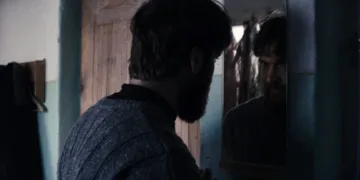












Olli and Matze have arranged adulthood so that almost nothing can separate them. They share an apartment, work across from each other, spend their free time together, and have spent years saving for a year-long trip around the world. Then Matze meets Rebecca while showing her an apartment, falls for her almost immediately, and discovers that his carefully preserved friendship with Olli may finally have to change shape.
Marco Petry’s My Best Friend, His Girlfriend and Me has a useful comic problem hiding inside that setup. Olli, played by Kostja Ullmann, is scared that Rebecca is taking away the future he and Matze have planned since childhood.
Rebecca, played by Janina Uhse, quickly decides that Olli represents everything preventing Matze from growing up. David Kross’s Matze sits between them. That arrangement could sustain a sharp comedy about adult friendship becoming less absolute. Instead, the film keeps converting emotional tension into increasingly petty warfare.
A Rivalry Without Anyone Worth Backing
Olli makes Rebecca’s case for her almost immediately. At a party she hosts in the apartment, he heckles people during their toasts, drags out an embarrassing private joke involving Matze, and turns an occasion Rebecca wants to survive professionally into another performance for himself. Schmitti later gets high and urinates on Rebecca’s boss’s shoes. Olli treats the chaos as another successful night.
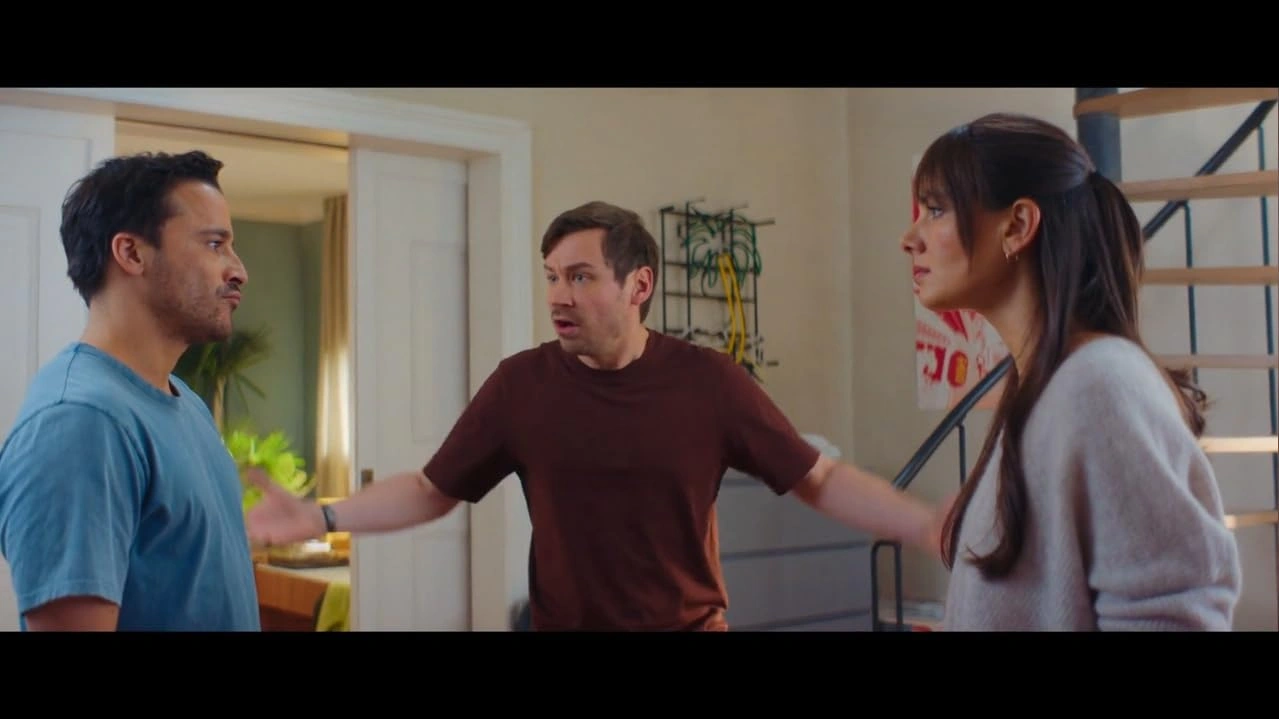
Matze’s response creates the real structural problem. He repeatedly excuses Olli with some variation of “that’s just how he is,” which lets every argument reset without forcing either friend to examine what their relationship has become. Kross plays Matze gently, especially when he stutters under pressure, but the screenplay gives that passivity no productive direction.
Rebecca initially has the clearest grievance. Wanting Olli to avoid humiliating her in front of her boss is hardly authoritarian. Once she moves into the apartment, however, the writing pushes her toward the opposite extreme. She starts treating Olli as a contaminant to be removed from Matze’s life rather than someone whose place in that life might need renegotiating.
The film then makes Olli and Rebecca compete for Matze like parents arguing over custody. The joke depends on Matze having almost no agency, which becomes increasingly strange because every major decision concerns him. His relationship. His friendship. His trip. His future. Yet everybody else gets to decide what those things mean.
The Joke Keeps Escalating, the Comedy Does Not
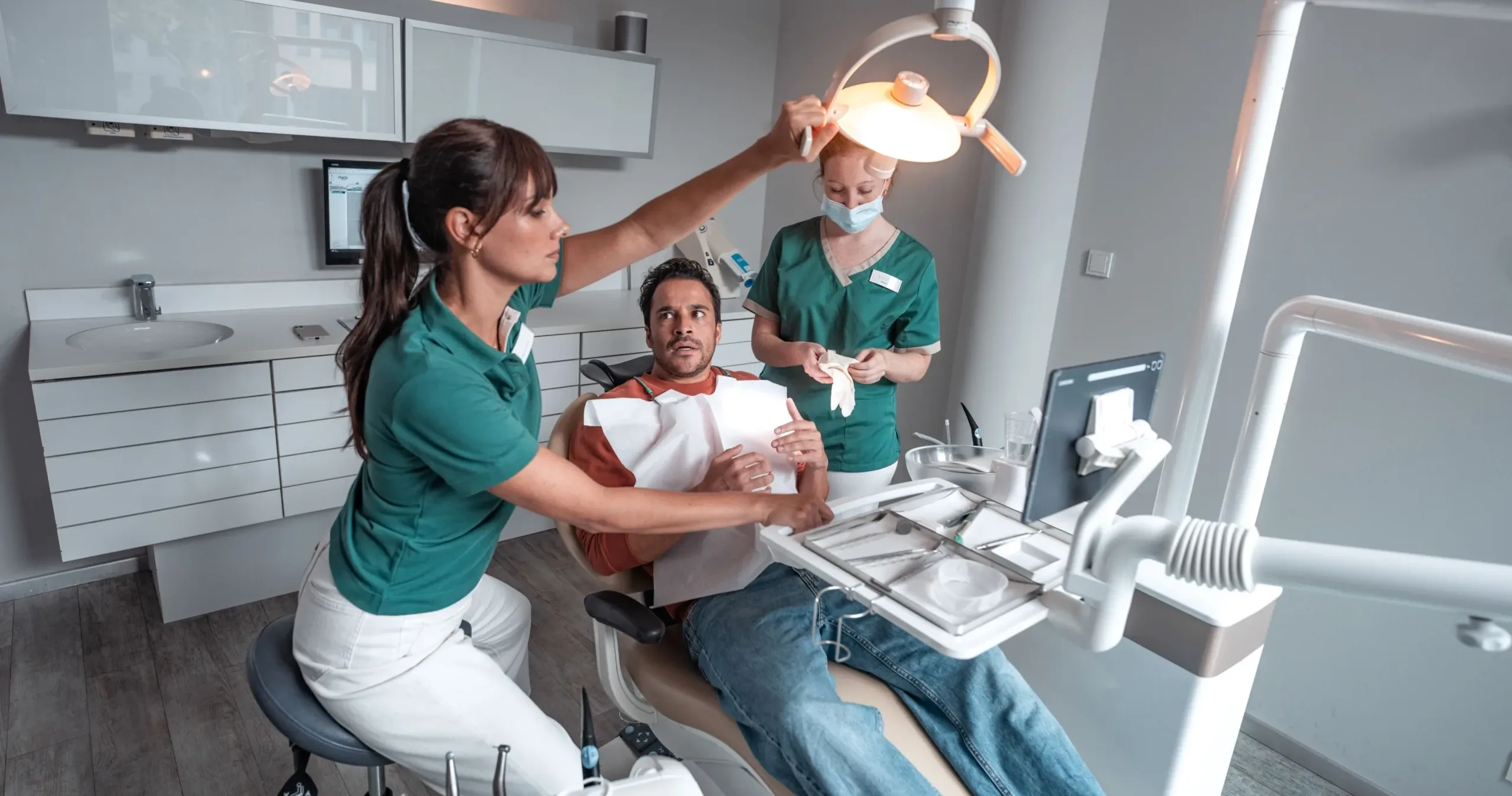
Petry keeps increasing the scale of the sabotage without changing its basic shape. Teeth get dyed. A toaster becomes a fire hazard. Olli tears pages from library books. Paintball turns the rivalry physical. Each incident should make the next confrontation harder to contain. Instead, the film often erases consequences before they can create momentum.
The toaster incident is a good example. Starting a fire inside someone’s home could force the rivalry into genuinely uncomfortable territory, yet the aftermath barely registers. At the library, Olli damages books and receives such mild resistance that the scene loses the friction required for the gag to bite. Even a potential chase is cut away from rather than allowed to develop into a physical comedy sequence.
That clean staging works against the material. Petry wants increasingly unruly behavior, but his direction keeps everything tidy enough to feel insulated from damage. Physical comedy usually needs accumulation: embarrassment creates anger, anger creates retaliation, retaliation changes the room. Here, scenes frequently return everyone to approximately the same emotional position.
The repetition exposes the screenplay’s limited structure. Olli provokes Rebecca. Rebecca retaliates. Matze refuses to choose. Someone behaves worse. Repeat.
At 98 minutes, that loop becomes conspicuous. Ullmann’s restless energy occasionally gives Olli a spark the writing does not earn, and his familiarity with Kross helps sell the history between the two friends. Their performances suggest years of shared routines. The screenplay mostly uses those routines as ammunition.
Growing Up Becomes a False Choice
The world trip is the film’s strongest narrative device because it gives Olli something concrete to lose. Rebecca does not simply represent Matze having less time for him. Her arrival threatens a plan the two men have saved toward for years, something tied to the version of adulthood they imagined together. That gives Olli’s jealousy an understandable source. His response remains selfish, but the emotional logic is there.
The film could have used that trip to ask a harder question: what happens when a friendship built around total availability reaches the age when total availability becomes impossible? Instead, the conflict gradually becomes a choice between male friendship and romantic commitment.
Schmitti and Antje make that simplification especially clear. Antje imposes rules on Schmitti, including a 10 p.m. curfew, and Schmitti explains that her control makes him a better man. The scene treats surrendering personal freedom as evidence of maturity, while Olli’s refusal to change becomes evidence that he has failed to grow.
There is a useful argument buried somewhere between those positions. Olli does need to accept that Matze can love someone without betraying their friendship. Rebecca also needs to understand that partnership does not grant ownership over every existing bond. Matze most urgently needs to decide what kind of life he actually wants.
The screenplay gives Olli the largest obligation to change while letting Rebecca’s controlling behavior recede from scrutiny. Matze remains caught between them, still treated as the prize in an argument he should have been directing himself. A comedy about changing friendships needs movement. This one keeps everyone fighting over the same piece of ground.
My Best Friend, His Girlfriend and Me premiered globally on Netflix on August 14, 2026, where it is currently available for streaming. The German romantic comedy follows Olli, whose lifelong bond and travel plans with his best friend Matze are upended when Matze falls for a new girlfriend named Rebecca.
Where to Watch (2026) Online
Full Credits
Title: My Best Friend, His Girlfriend and Me
Distributor: Netflix
Release date: August 14, 2026
Rating: TV-MA
Running time: 1 hour 38 minutes
Director: Marco Petry
Writers: Marco Petry, Janina Petry
Producers and Executive Producers: Quirin Berg, Max Wiedemann, Marcus Welke, Hannah Leuze, Matheus Gyordano, Bernd Krause, Dagmar Kusche, Marco Petry, Sebastian Zembol, David Vogt
Cast: Kostja Ullmann, Janina Uhse, David Kross, Ferdinand Hofer, Clara Immel, Mira Huber, Larissa Sirah Herden, Anna Herrmann
Director of Photography (Cinematographer): Marc Achenbach
Editors: Knut Hake
Composer: Paul Eisenach, Jonas Hofer
The Review
My Best Friend, His Girlfriend and Me
My Best Friend, His Girlfriend and Me has a workable comic setup, then traps it inside the same argument for 98 minutes. Olli’s fear of losing Matze gives the story an emotional spine, yet the screenplay keeps replacing development with sabotage, from dyed teeth to a flaming toaster. Rebecca gradually becomes as controlling as Olli is possessive, while Matze remains strangely passive in a conflict built around his life. The cast occasionally finds warmth, but the film keeps resetting its characters before they can grow.
PROS
- Strong central premise
- Olli’s insecurity has emotional potential
- Energetic performance from Kostja Ullmann
- Some believable chemistry between Olli and Matze
CONS
- Repetitive rivalry structure
- Frequently irritating characters
- Weak comic escalation
- Matze lacks agency
- Muddy ideas about adulthood and relationships