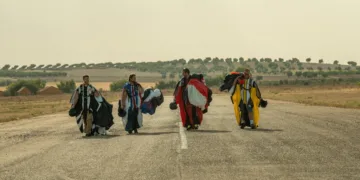















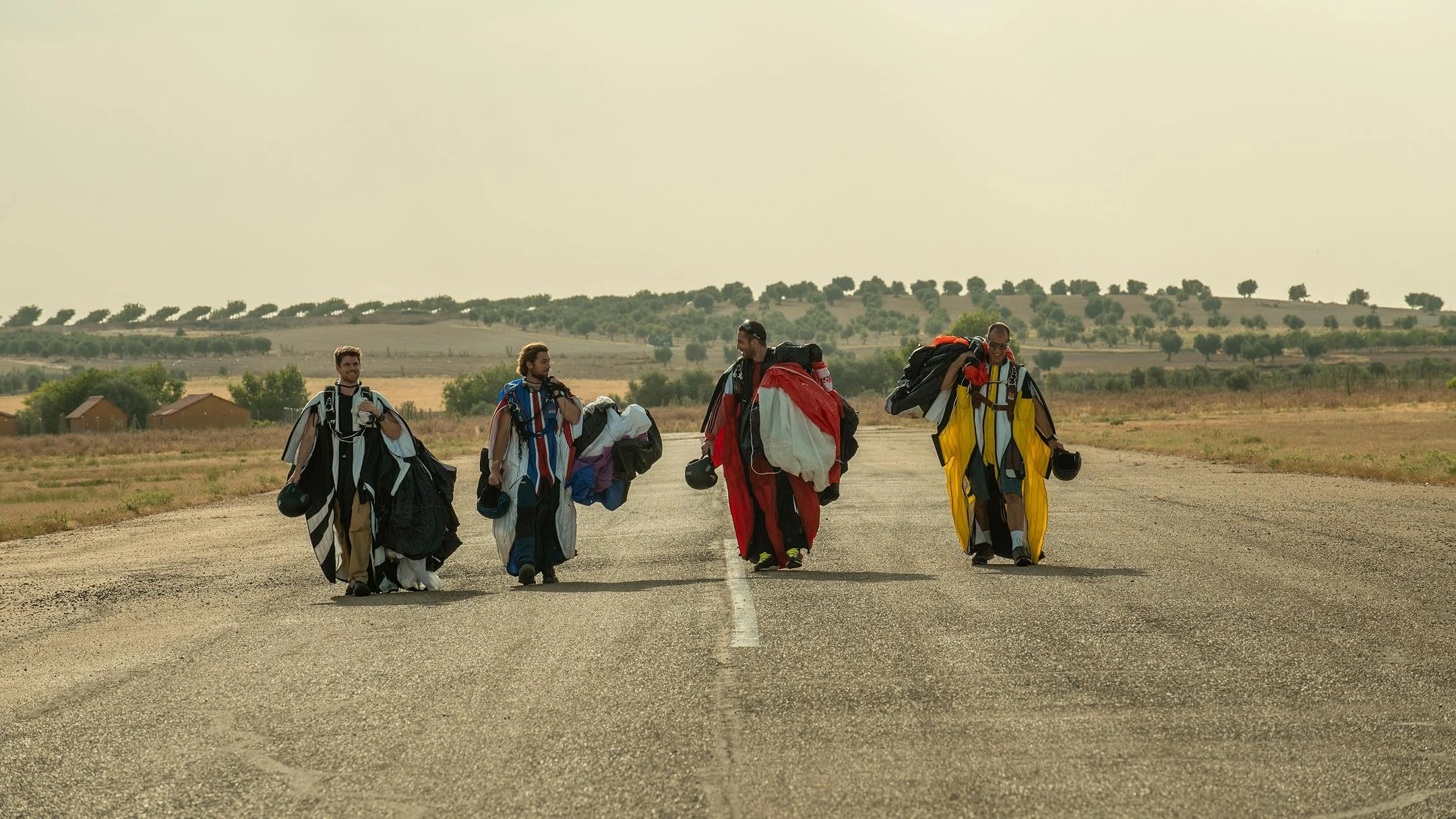

Salvador Calvo’s To The Max treats extreme risk with the solemnity usually reserved for faith. Carlos Suárez, played by Carlos Cuevas, begins as a climber before Armando del Rey, Darío Barrio, Álvaro Bultó, and Manolo Chana pull him toward BASE jumping and wingsuit flying, where mountains cease to be destinations and become departure points.
Alejandro Hernández’s screenplay eventually gives Carlos a grand objective: climb Pakistan’s Nameless Tower and leap from its summit, potentially setting a record. Myriam’s documentary proposal offers the financing needed to turn that ambition into something tangible, and Carlos begins preparing both himself and her for the ascent.
The premise contains an obvious question. Why does someone keep choosing an activity that may kill them? To The Max keeps asking it, then repeatedly backs away before the answer becomes uncomfortable.
Men Defined by the Edge
Carlos, Armando, Darío, Álvaro, and Manolo spend much of the film climbing, training, discussing equipment, and chasing increasingly difficult jumps. Their camaraderie is convincing because Calvo lets physical activity establish intimacy. These men understand one another through shared preparation and the peculiar trust required before someone throws himself from a cliff.
The screenplay gives them little identity beyond that shared hunger. Cuevas makes Carlos quieter than his companions, particularly while he is learning the rhythms of BASE jumping, but the character rarely develops beyond disciplined curiosity and determination. Miguel Ángel Silvestre gives Darío an assertive presence, while Miguel Bernardeau plays Armando with a more introspective temperament. Their differences register as personality sketches rather than fully developed contradictions.
This becomes harder to ignore once death enters the group. Losing friends should fracture the philosophy holding these men together. Instead, grief repeatedly becomes an interval between jumps. They mourn, question themselves briefly, then return to the same pursuit.
There is cultural mythology built around this behavior, the idea that refusing ordinary limits represents some purer form of living. Hernández rarely disturbs that mythology. The men are allowed to call danger freedom without being pressed hard on who bears the emotional cost when freedom ends in a fatal fall.
The women expose that imbalance. Myriam gains proximity to Carlos through the documentary project and training, while other partners largely occupy the role of worried observers. Their fear is present, yet their interior lives remain peripheral. The men get philosophies. The women get consequences.
Admiration Meets Mortality
The deaths create the film’s strongest material because they force its celebratory imagery into conflict with reality. A wingsuit flight across a canyon can look like liberation in one scene and reckless repetition several scenes later. The same act changes meaning once the audience knows what this circle of friends will lose.
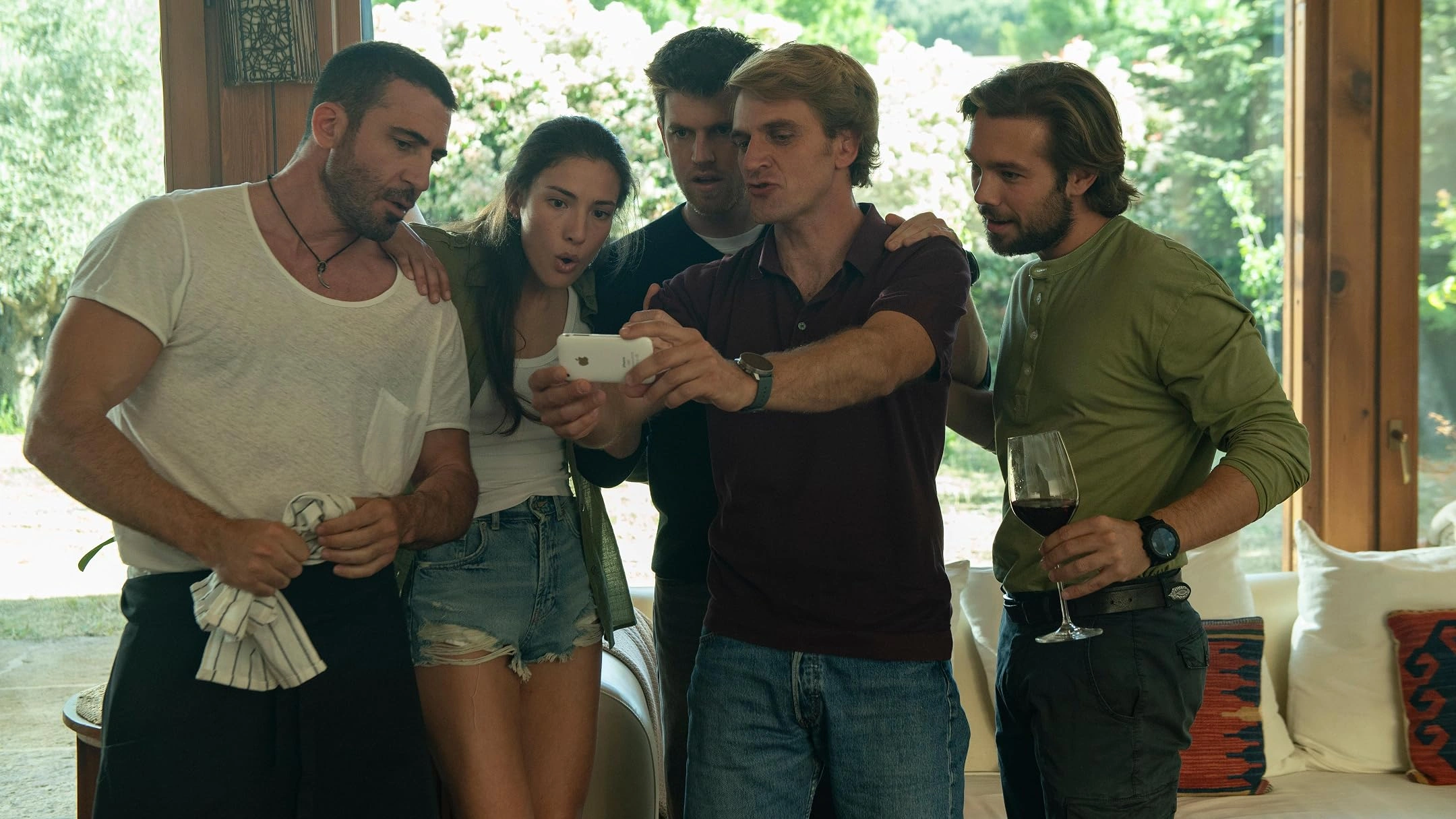
Calvo seems reluctant to let that shift become an accusation. His respect for the real people behind the story is understandable, but reverence becomes a dramatic limitation. Carlos and his friends are framed as men compelled by something outsiders may never understand, which preserves their dignity while reducing the need to examine the damage attached to their choices.
Armando’s reflections come closest to articulating the attraction. The sensation of flight, the intensity, and the escape from routine are presented as experiences powerful enough to reorganize a life. Yet the screenplay never develops a persuasive answer to the harder question: what happens when personal transcendence repeatedly requires loved ones to accept the possibility of sudden death?
By the later tragedies, the cycle becomes almost ritualistic. Loss creates hesitation. Hesitation gives way to memory. Memory becomes renewed commitment. The film appears aware of the disturbing pattern, then frames persistence with such tenderness that its criticism dissolves.
Where Is the Vertigo?
The mountains do much of Calvo’s best directing for him. Wide shots of climbers dwarfed by rock faces, exposed ledges, and wingsuits cutting through open air communicate physical scale immediately. When bodies are small against enormous landscapes, danger needs little embellishment.
Closer shots are less persuasive. Some actor-focused flight footage lacks the violent physical pressure suggested by the speed involved, leaving faces strangely composed while the background insists they are hurtling through space. The illusion weakens precisely when the camera should make the experience intimate.
That artificiality matters because BASE jumping depends on sensation. The viewer needs velocity, wind, proximity to rock, and the sickening understanding that a tiny miscalculation can end everything. The strongest aerial passages briefly provide that charge. Other sequences look constructed rather than lived.
The pacing carries a similar inconsistency. Dialogue-heavy stretches linger without exposing much new psychology, while several emotional developments arrive before the film has fully absorbed the previous loss. Bernardeau is especially affected by this compression, asked to communicate profound grief inside scenes that give him limited space to transform it into something legible.
The sound design supplies rushing air and impact during the flights, yet much of the surrounding drama remains curiously flat. To The Max can place five men above a canyon with death meters away and still struggle to create the unease contained in a partner waiting below, knowing the parachute may never open.
To The Max premiered globally on Netflix on August 15, 2026. The sports drama investigates a series of fatal accidents involving skydivers, following the accounts of the sole survivor as he recounts the tragic events.
Where to Watch To The Max (2026) Online


Full Credits
Title: To The Max (La fiera)
Distributor: Netflix
Release date: August 15, 2026
Rating: TV-MA
Running time: 115 minutes
Director: Salvador Calvo
Cast: Carlos Cuevas, Miguel Bernardeau, Miguel Ángel Silvestre, José Manuel Poga, Carlos Suárez
The Review
To The Max
To The Max has a powerful subject and some arresting mountain photography, yet its reverence for Carlos Suárez and his circle keeps grief from becoming genuine scrutiny. Each death raises questions about obsession, responsibility, and the romantic mythology surrounding extreme risk, only for the film to retreat toward admiration. The women are largely left watching from the ground while the men turn danger into identity. Calvo captures height far better than he captures the psychology required to keep jumping after tragedy.
PROS
- Striking mountain photography
- Effective wide-shot jump footage
- Convincing group camaraderie
- Fascinating real-life subject
CONS
- Thin psychological characterization
- Reverential treatment of risk
- Underwritten female characters
- Uneven dramatic pacing
- Artificial close-up flight sequences