

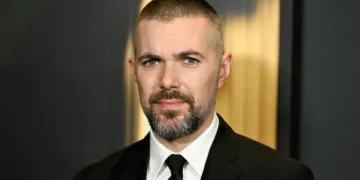

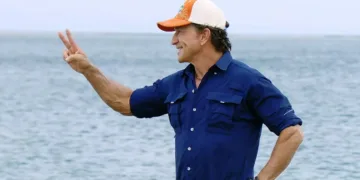
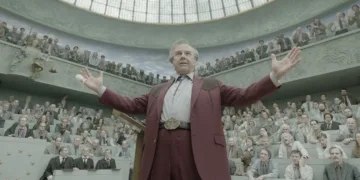




















Kevin Williamson’s return to television feels less like a homecoming and more like an archaeological dig—one where the creator of Dawson’s Creek and the Scream franchise excavates his own family’s buried secrets. The Waterfront, his eight-episode Netflix drama, emerges from the specific crucible of Williamson’s North Carolina childhood, where his fisherman father supplemented dwindling catches with contraband runs during the Reagan-era economic squeeze of the 1980s.
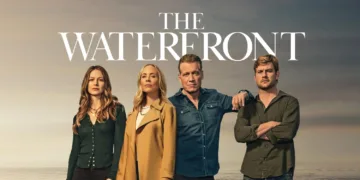
The fictional coastal town of Havenport becomes a pressure cooker of generational trauma, where the Buckley family operates as both regional aristocracy and criminal enterprise. Patriarch Harlan (Holt McCallany), nursing his second heart attack and nth glass of whiskey, presides over a seafood empire that includes the requisite legitimate businesses—fishery, marina, restaurant—and the less advertised drug smuggling operation.
His wife Belle (Maria Bello) manages the visible empire while Harlan courts death through various forms of excess. Their children represent competing responses to inherited toxicity: son Cane (Jake Weary) reluctantly perpetuates the family business, while daughter Bree (Melissa Benoist) battles addiction—both the substance and the family itself.
This is Williamson’s most explicitly autobiographical work, transmuting personal history into the kind of morally ambiguous family saga that has become television’s dominant export. The Buckleys exist in that peculiarly American space where respectability and criminality share the same zip code.
The Velocity of Moral Collapse
Williamson opens with a maritime disaster—a botched drug run that sends the narrative careening toward its inevitable conclusion. This is storytelling as controlled detonation, where each revelation triggers the next in rapid succession. Bodies accumulate with the efficiency of an assembly line (though admittedly a rather small-scale operation by contemporary television standards).
The series operates on what might be called “crisis velocity”—the mounting debts that drive the Buckleys back into criminality create a temporal urgency that mirrors Harlan’s failing health. His old-school criminal ethos (he remembers when drug dealers “dressed well and were polite”) collides with Cane’s reluctant modernization of the family trade. The show threads multiple narrative strands—Bree’s custody battle, Belle’s secret land development schemes, the mysterious bartender Shawn (Rafael L. Silva) whose ignorance of basic mixology raises more red flags than a Soviet parade—into a tapestry of small-town secrets.
The pacing here serves as both strength and weakness. Williamson’s momentum-driven approach papers over occasional narrative thinness, though one suspects this is intentional—the breakneck pace mimics the way criminal enterprises consume their participants. There’s no time for contemplation when survival demands constant motion.
Topher Grace’s mid-season arrival as sociopathic drug kingpin Grady represents the show’s most inspired casting choice. Grace, forever typecast as the affable everyman, transforms his natural likability into something genuinely unsettling. His Grady embodies a particular strain of American psychopathy—the glad-handing businessman whose cheerful demeanor masks profound moral vacancy.
The series builds toward a finale that functions less as resolution than as promise—or threat, depending on one’s perspective. This is television designed for renewal, where narrative satisfaction must be balanced against the commercial imperative of open-ended storytelling.
The Mythology of Almost
The Buckleys exist in a perpetual state of “almost”—almost legitimate, almost successful, almost redeemed. Cane articulates this condition most directly: “I’m really good at almost… Almost good enough. Almost a good guy.” This becomes the show’s central metaphor for American striving, where proximity to success serves as its own form of failure.

McCallany’s Harlan embodies the traditional patriarchal archetype—the father whose love manifests as perpetual disappointment. His relationship with Cane operates on the familiar dynamic of the strong father testing the weak son, though Williamson complicates this through Harlan’s obvious mortality. McCallany, blessed with the kind of weathered gravitas that suggests a lifetime of poor decisions, anchors the family dynamics with appropriate world-weariness.
Bello’s Belle represents the most intriguing character construction—the enabler who becomes the power behind the throne. Her quiet competence contrasts with Harlan’s bombastic failures, suggesting that the real family succession has already occurred. Bello navigates the thankless role of the long-suffering wife while maintaining Belle’s essential intelligence and agency.
Weary faces the more challenging task of making Cane’s reluctant criminality believable. The character represents Williamson’s most direct autobiographical projection—the son caught between family loyalty and personal morality. Weary’s understated performance suggests depths that the writing doesn’t always plumb, though his physical resemblance to McCallany creates an effective visual shorthand for genetic determinism.
Benoist’s Bree provides the series’ moral center, paradoxically through her history of moral failure. Her recovery narrative avoids the typical television treatment of addiction as dramatic device, instead presenting it as the family disease it often becomes. The relationship with her hostile teenage son Diller (Brady Hepner) grounds the series’ more operatic moments in recognizable human pain.
The supporting cast functions as a Greek chorus of small-town complicity. Grace’s Grady stands apart—his performance suggesting that true evil often wears the mask of corporate efficiency. His scenes possess a manic energy that the rest of the series occasionally lacks, transforming familiar criminal archetypes into something genuinely unpredictable.
The family resemblances here extend beyond casting—each character harbors secrets that threaten the collective survival, creating a web of mutual assured destruction that passes for love.
The Aesthetics of Authenticity
Havenport, North Carolina functions as more than setting—it becomes a character study in economic desperation. The coastal environment provides both beauty and menace, where the same waters that support legitimate fishing become highways for contraband. Williamson and his directors, particularly Marcos Siega, create a visual language that captures the precarious balance between respectability and criminality.

The production design achieves something approaching authenticity—the fishery looks like an actual workplace rather than a television set, complete with the grime and functional efficiency that mark real labor. The maritime details ground the criminal activities in recognizable reality, avoiding the common television trap of making illegal enterprises appear impossibly glamorous.
Williamson demonstrates particular creativity in his approach to violence. Torture by fishing net, shark intimidation, body disposal via alligator—these methods reflect both the coastal setting and a certain dark humor about regional resources. The violence feels organic to the environment rather than imported from urban crime dramas.
The show’s visual style reflects Netflix’s house aesthetic—polished to the point of antiseptic cleanliness, though this occasionally works against the supposed grittiness of the subject matter. The cinematography captures the duality of coastal life—the beauty that attracts tourists and the isolation that breeds secrets.
The sound design deserves particular attention, using maritime atmosphere to create tension. The constant presence of water—lapping against docks, churning around boats—becomes a subliminal reminder of the fluidity between legitimate and criminal enterprises. The ocean serves as both highway and graveyard, its indifference to human moral categories reflecting the show’s own moral ambiguity.
The Inheritance of Original Sin
The Waterfront operates within the grand American tradition of family sagas where blood becomes both bond and curse. The show explores the peculiar way that criminal enterprises become family heirlooms, passed down with the same sense of obligation as legitimate businesses. This reflects a broader American anxiety about inherited advantage—the way privilege (even criminal privilege) perpetuates itself across generations.

The series positions addiction as both personal failure and systemic problem, suggesting that the Buckley family disease extends beyond substance abuse to include the compulsive repetition of destructive patterns. Bree’s recovery narrative parallels the family’s attempt to go legitimate—both require acknowledging the damage caused while constructing new patterns of behavior.
The father-son relationship between Harlan and Cane embodies traditional expectations of masculine inheritance, where the son must prove worthy of the father’s criminal legacy. This creates the show’s central irony—Cane’s moral reluctance becomes evidence of weakness rather than strength, forcing him to demonstrate his worthiness through increasing criminality.
Williamson draws from his own family history to create something approaching universality—the way economic pressure forces moral compromise, the thin line between legitimate business and criminal enterprise, the cost of maintaining family identity in a changing world. The show succeeds when it treats these themes as sociological rather than merely dramatic.
The Waterfront represents solid craftsmanship in service of familiar themes. Williamson’s experienced hand guides the material away from the most obvious pitfalls, creating entertainment that acknowledges its commercial imperatives while maintaining character complexity. The series establishes a foundation sturdy enough for extended exploration, though whether that exploration will yield genuine insight or merely sustained melodrama remains an open question.
The show’s cultural impact will likely be measured in Netflix metrics rather than critical discourse, though it succeeds in creating the kind of accessible prestige drama that streaming platforms require. It neither transcends nor embarrasses its genre, achieving that particular form of success that characterizes much contemporary television—professionally competent, occasionally inspired, and designed for algorithmic recommendation.
The Waterfront premiered globally on Netflix on June 19, 2025. This eight‑episode crime‑family drama set in Havenport, North Carolina, follows the Buckley clan as they struggle to save their fishing empire—only to get entangled in drug trafficking and moral compromise. Widely available on all Netflix tiers (4K Dolby Vision/Atmos), the show has quickly become the platform’s number-one series and is being discussed for a potential Season 2 renewal.
Full Credits
Director: Kevin Williamson (“Scream,” “Dawson’s Creek”) served as showrunner and creator; episode directors include Marcos Siega, Liz Friedlander, Erica Dunton, and Jann Turner
Writers: Kevin Williamson (series creator), Michael Narducci, Brenna Kouf Jimenez, Hannah Schneider, Lloyd Gilyard Jr.
Producers and Executive Producers: Kevin Williamson, Ben Fast, Michael Narducci, Marcos Siega (EP); Producers: David Blake Hartley, Barbara D’Alessandro, Ani Arutyunyan
Cast: Holt McCallany, Maria Bello, Jake Weary, Melissa Benoist, Rafael L. Silva, Humberly González, Danielle Campbell, Brady Hepner; Recurring: Gerardo Celasco, Michael Gaston, Topher Grace, Dave Annable, Andrew Call, Joshua Mikel
Director of Photography (Cinematographer): Ramsey Nickell, Itai Ne’eman
Editors: Rosanne Tan, Andrew Groves, Hilary Bolger, Craig Dewey
Composer: John Frizzell
The Review
The Waterfront
The Waterfront delivers competent family crime drama anchored by strong performances, particularly McCallany and Bello's seasoned work. Williamson's autobiographical elements provide authentic texture, while Topher Grace's unhinged kingpin elevates the material beyond genre conventions. The series succeeds through solid craftsmanship rather than innovation—a well-executed entry in an oversaturated field that manages moments of genuine insight amid familiar territory.
PROS
- Strong central performances from experienced cast
- Authentic maritime setting and production design
- Topher Grace's inspired casting against type
- Tight eight-episode structure avoids padding
- Realistic portrayal of addiction and recovery
CONS
- Familiar family crime saga tropes
- Occasionally thin character development
- Overly polished Netflix aesthetic
- Predictable plot mechanics