





























Semi-Soeter returns more than a decade after its predecessor, positioning itself within the familiar yet persistently effective framework of romantic comedy. Directed and co-written by Joshua Rous, the film reunites its central couple—Jaci and JP—as married creatives entrenched in South Africa’s advertising world, this time faced with an absurd but revealing dilemma.
In pursuit of a lucrative campaign for a baby product conglomerate, the pair, childless by choice and circumstance, are thrust into a fabricated role as new parents—complete with a borrowed infant and mounting lies. The setup is familiar, but the execution draws attention to something more culturally ingrained: the persistent narrative that parenthood is the ultimate marker of maturity and societal legitimacy.
Within its bright palette and cheerful pacing, the film presents a kind of satire without fully embracing it—inviting audiences into its wacky plot but slyly reinforcing traditional values beneath the surface chaos. At its center is a professional couple at a crossroads, their upward trajectory threatened not by market pressures or creative burnout, but by the sudden intrusion of biology.
Jaci’s unexpected pregnancy reframes the comedic farce as a story about gendered expectations and the performative layers of modern adulthood. Semi-Soeter wears the face of a light romantic farce, yet beneath its smiles and diaper gags, it reaffirms a longstanding cultural script: success must eventually yield to domesticity, and ambition is best softened by swaddling blankets.
Performing Parenthood
The structure of Semi-Soeter unfolds like a well-rehearsed pitch deck, crisp in its setup and brazen in its escalations, offering a blueprint for how modern life becomes performance when private desire is subsumed by public expectation.
At its outset, Jaci and JP are two figures molded by the logic of the market—successful, polished, devout in their allegiance to the merged altar of Mojo & Amalgamated Media. They are introduced amid the frantic noise of children that do not belong to them, a visual decoy that mirrors the film’s central motif: pretending to be what others expect in order to survive.
Jaci’s unplanned pregnancy serves as the catalytic rupture. It’s a biological wildcard dropped into a perfectly optimized life, and the irony is unmistakable—this couple, previously childless by both design and diagnosis, is now forced into theatrical parenthood to secure a lucrative contract with a baby-brand empire.
The infant they borrow from Hertjie and Karla becomes a prop in a farcical drama, deployed not for emotional connection but strategic advantage. The farce is underlined by Marietjie’s corporate decree: only those who live parenthood can sell it, a mandate that turns human intimacy into a form of branding.
As the narrative tightens, sabotage replaces sincerity. Joubert’s petty vengeance disrupts the couple’s faux-family illusion, sending JP abroad and throwing the entire charade into disarray. But the pitch must go on. The climax—a blend of confession and collapse—exposes not just the falseness of their setup but the exhaustion of the roles they’ve been forced to play.
What follows is a gesture lifted from the rom-com playbook: a transcontinental reconciliation, wrapped in the shock of triplets, punctuated not with certainty but a fragile smile. The plot resists clean resolution, hinting that perhaps in a world where identity is strategy, all relationships must carry a touch of fiction.
Casting Parenthood
The performances in Semi-Soeter operate with the deliberate theatricality of archetypes, but within those boundaries, certain actors manage to evoke moments of uneasy truth. Anel Alexander’s Jaci is a polished construction of professional poise, a woman built for pitch decks and deadlines, whose carefully composed exterior begins to fissure the moment biology interrupts the algorithm.

Alexander plays this unraveling with a tight-lipped urgency, allowing the panic to slip through in fragments—an unsteady breath in the gynecologist’s office, a forced smile tightening as she fumbles through her pitch, a final scene that trades triumph for quiet revelation.
Nico Panagio’s JP is less a character than a posture: the affable alpha, brisk and composed, whose gradual softening is rendered less through dialogue than through tonal shifts in body language. His chemistry with Alexander never feels combustible, but there’s a sense of shared rhythm between them, a professional synergy that makes their romantic strain feel pointed.
Their scenes together hover somewhere between banter and negotiation, each exchange layered with subtext about what it means to want different futures within the same narrative.
Around them, the supporting cast reinforces the thematic scaffolding. Hertjie and Karla, played with cartoonish brightness, represent a domestic ideal so exaggerated it borders on parody. Their brood of five, constantly teetering on the edge of chaos, becomes both an object of slapstick and a critique of sanitized family fantasies.
Joubert and Chadrie, the rival couple, embody a more conventional threat—success packaged in smiling duplicity. Neels van Jaarsveld’s performance has a slick, oily precision that reveals how personal vendettas slip into professional warfare under the guise of good branding.
And then there’s baby Henry, whose presence—silent, squirming, oblivious—is the film’s most consistent source of unease. He is object, symbol, liability. Around his coos and cries, the adult performances coalesce, each actor forced to improvise the meaning of care while selling the illusion of it.
Staging the Sale
Joshua Rous directs Semi-Soeter with a stylistic confidence that rarely interrogates its own reflexes. The film oscillates between broad slapstick and moments of engineered sincerity, yet treats both registers with the same tonal polish, as if the transition between a baby vomiting on a Prada suit and a tearful confession about impending motherhood requires no shift in emotional temperature.

This flattening of affect creates a rhythm that feels mechanical, a comedy of gestures rather than consequences. Timing is measured not in tension or release but in beats—precise, expected, safe.
The cinematography reinforces this polished detachment. Scenes set in the office gleam with aspirational sterility, all glass and chrome, while domestic chaos is rendered with warm tones and cluttered mise-en-scène, though never so messy as to feel lived-in.
The camera lingers longest in close-ups during confessions or panics, framing faces in a kind of emotional shorthand rather than exploring the dynamics beneath. There’s little curiosity in the gaze—images are composed like catalogues, crisp but indifferent.
Editing is brisk, particularly in the pitch sequences, where the tension is drawn less from narrative stakes than from the compression of time. Cross-cutting between the high-gloss professionalism of Mojo’s campaign preparations and the frantic improvisations of fake parenthood serves more as commentary than cohesion. These juxtapositions suggest a thematic critique—capitalism’s demand for authenticity performed on cue—but the film resists exploring it.
Design choices do much of the heavy lifting. The contrast between structured workwear and haphazard parenting attire signals character shifts that the script doesn’t fully articulate. Power suits become armor, and their unraveling, both literal and symbolic, marks the moments when identity must be rewritten. The soundscape mirrors this duality: slick scoring heightens comedic exaggeration, while the muffled cries and domestic clutter of child-rearing anchor the story in an unnerving, sticky realism that lingers just beneath the gloss.
Packaging Parenthood
Beneath its pastel aesthetics and rom-com rhythm, Semi-Soeter smuggles a dense lattice of social codes and contradictions, particularly around work, family, and the commodification of care. The central couple’s dynamic—two professionals merged in ambition and routine—frames a marriage that functions less as intimacy than as corporate synergy.
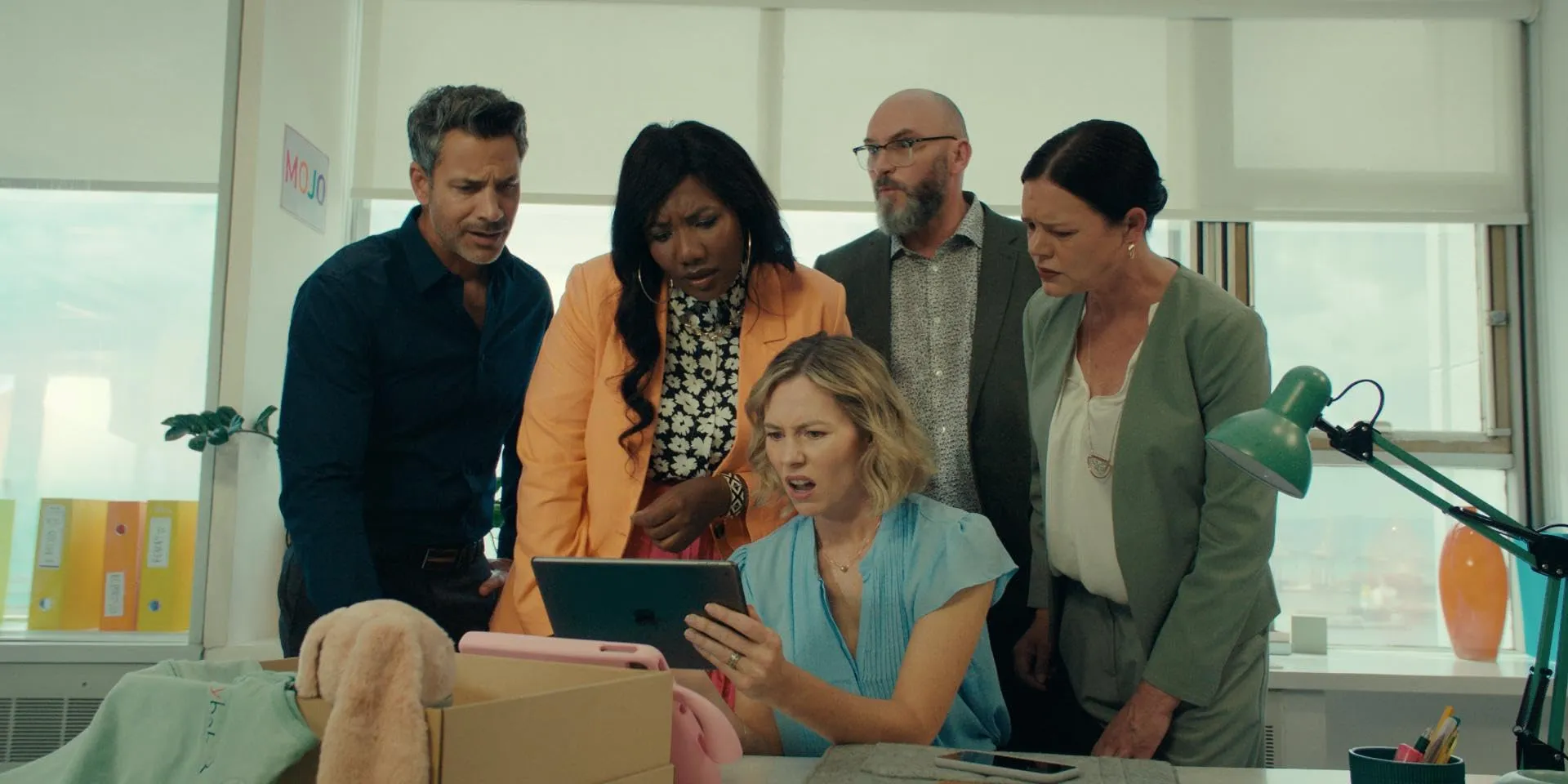
The strain introduced by an unplanned pregnancy isn’t merely biological; it’s ideological, challenging a lifestyle that equates output with identity. What begins as a critique of overwork quietly folds into a rehearsal of traditional fulfillment, as though personal growth can only be accessed through reproductive transformation.
The farce of pretending to be parents in order to win a baby-product contract amplifies the hollowness of contemporary expectations. The couple must simulate caregiving not out of desire, but to meet the demands of a consumer base fetishizing domestic authenticity.
This performance, however absurd, mirrors real-world pressures—where being perceived as a “relatable” professional often requires public displays of personal conformity. Ironically, the roles they fake become the life they embrace, suggesting that identity, under pressure, is elastic and perhaps indistinguishable from performance.
Gender remains central to this transformation. Jaci’s body becomes a site of both concealment and revelation, her choices bracketed by silence, secrecy, and the cinematic inevitability of maternal acceptance. Meanwhile, JP’s trajectory—from workplace pragmatist to soft-spoken aspirant dad—reaffirms the familiar arc of male characters who “come around” without much introspection.
Surrounding it all is the pitch itself, a literalized metaphor for how capitalism repackages the family unit as marketing currency—where babies become brand extensions and caregiving, a sales tactic.
Laugh Tracks and Leverage
The comedy of Semi-Soeter operates with the timing of a metronome, its rhythm designed less to surprise than to reassure. Physical gags abound—spilled formula, misfired diapers, the classic disappearing baby routine—all executed with polished predictability, their messiness carefully contained within glossy cinematography and a buoyant score.
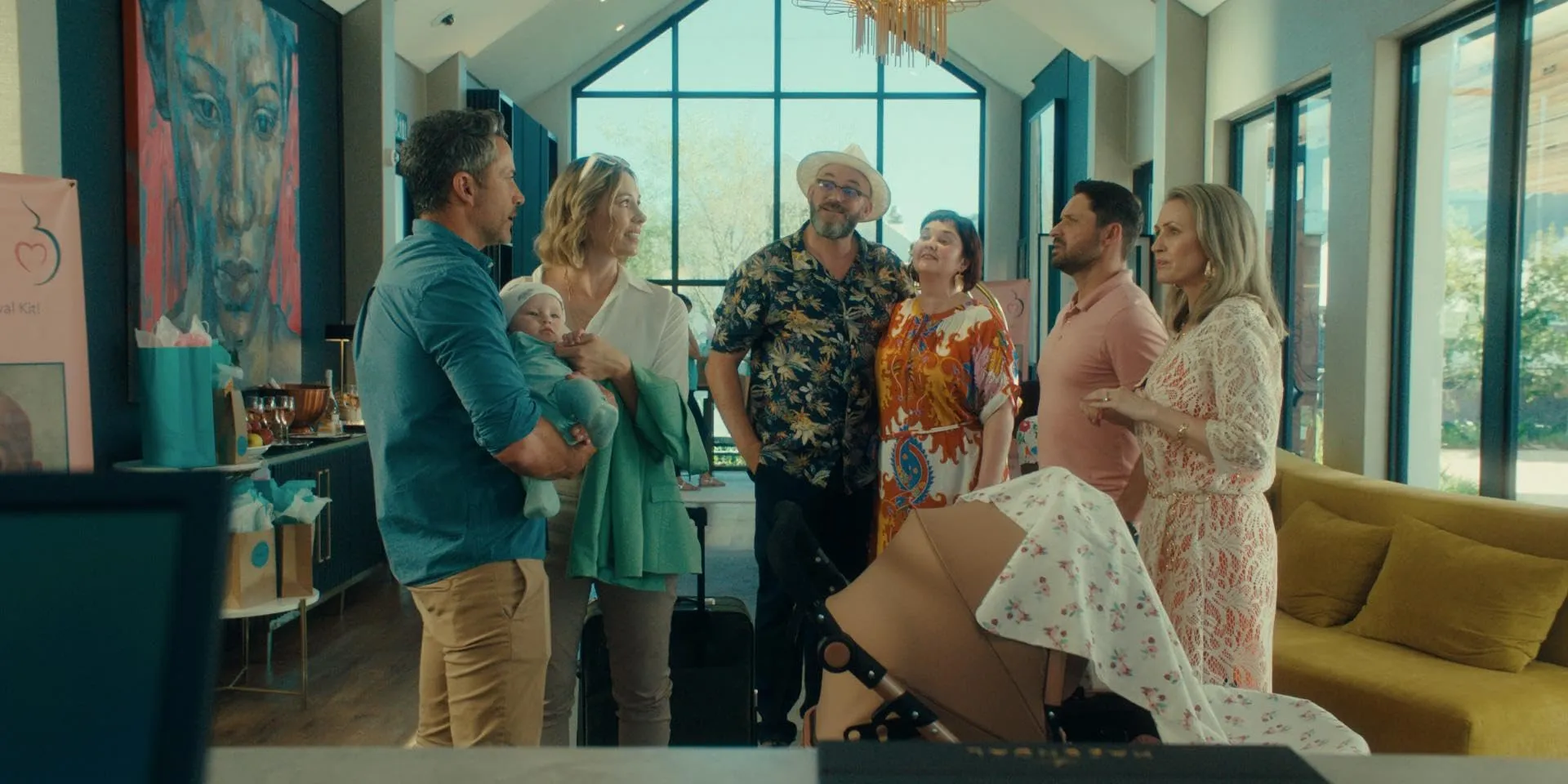
These moments, while competent in their staging, rarely exceed the mechanics of setup and payoff, drawing laughter less from chaos than from choreographed discomfort.
Verbal humor plays a secondary role, often relegated to workplace quips or barbed exchanges between rivals. Jaci and JP’s repartee carries an undercurrent of fatigue rather than electricity, mirroring their characters’ emotional distance.
The film allows for moments of sincere vulnerability, but these are often swept aside by the need to reset the comedic tempo. Sincerity becomes punctuation rather than punctuation mark—a pause before the next pratfall or miscommunication.
The pacing favors momentum over modulation, stringing together gags with minimal space for introspection. The pitch presentation sequence stands out for its constructed crescendo: tension, absurdity, exposure. Yet elsewhere, the insistence on movement dilutes the emotional stakes, reducing potentially resonant moments to transitional beats between comedic interludes.
Audience engagement depends largely on the familiarity of its templates—the overworked couple, the meddling friend, the baby-as-prop routine. These tropes, while universal in their reach, take on a particular gloss within the South African setting, where cultural specificity is hinted at but never quite explored.
The humor lands, often efficiently, but not always deeply. And in its most telling misstep, the film occasionally uses comedy to sidestep discomfort rather than confront it, flattening character complexity beneath a knowing wink.
Echoes in the Pitch Room
Semi-Soeter presents itself as a confection, styled with the familiar glint of studio rom-coms and laced with the cheery chaos of domestic farce. Yet beneath its glossy surfaces lies a narrative that gestures—sometimes consciously, sometimes not—toward deeper anxieties about identity, gender, and the transactional nature of modern relationships.

As a sequel, it mirrors its predecessor’s formula with little desire to subvert it. Instead, it leans into the architecture of expectation: mismatched couple, professional crisis, emotional miscommunication, public unraveling, private reconciliation. It’s a rhythm calibrated for recognition rather than revelation.
The film’s attempt to straddle light-hearted comedy and latent critique yields uneven results. On one level, it succeeds in delivering the mechanics of humor—timed mishaps, caricatured side characters, and the satisfaction of narrative symmetry.
But when it brushes against social commentary—on performative parenting, on female agency, on the commodification of the family unit—it tends to retreat into cliché. There are scenes that almost say something, that flirt with satire, but they are quickly folded back into the safe confines of genre.
Audiences seeking escapism in the shape of familiar conflicts will likely find comfort here. The exaggerated stakes of a pitch, the frantic juggling of roles, the triumphant airport declaration—all are delivered with practiced charm. For viewers more attuned to the tensions behind these tropes, the film offers fragments of insight, scattered between its punchlines and pratfalls.
In isolating moments—Jaci’s tight smile as she pitches a fantasy she’s unsure she wants, or JP’s silence as he watches a baby handed to him like a product sample—the artifice briefly cracks. These instances linger, unspoken yet insistent, like echoes in a boardroom designed for persuasion rather than truth. If Semi-Soeter adds anything new, it’s these subtle ruptures: small, precise reminders that even comedy carries consequences.
The 93‑minute Afrikaans-language film premiered globally on 20 June 2025 on Netflix, where it’s available in over 190 countries with subtitles and dubbed audio.
Full Credits
Director: Joshua Rous
Writers: Sandra Vaughn, Anel Alexander, Zandré Coetzer
Producers and Executive Producers: Anel Alexander, Zandré Coetzer, Ephraim Gordon, Jozua Malherbe, Lucia Meyer‑Marais, Pulane Sekepe, Scharl van der Merwe, Chanél Muller
Cast: Anel Alexander, Nico Panagio, Sandra Vaughn, Louw Venter, Diaan Lawrenson, Neels van Jaarsveld, Hélène Truter
Director of Photography (Cinematographer): Tom Marais
Editors: Regardt Botha
Composer: Loki Rothman
The Review
Semi-Soeter
Semi-Soeter delivers surface-level charm through polished performances and a well-paced comic structure but sidesteps its more provocative themes with a hesitance that undercuts its potential. It mimics the rom-com formula with professional ease while hinting at deeper tensions around identity, parenthood, and performance—without committing to the discomfort those questions invite. The result is watchable and occasionally sharp, but rarely bold.
PROS
- Strong lead performances
- Snappy comedic timing
- Visually polished
- Brief moments of thematic depth
CONS
- Relies too heavily on cliché
- Lacks genuine emotional risk
- Misses opportunities for satire
- Flat character development in key moments