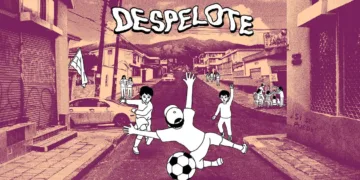


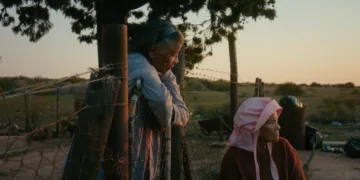


















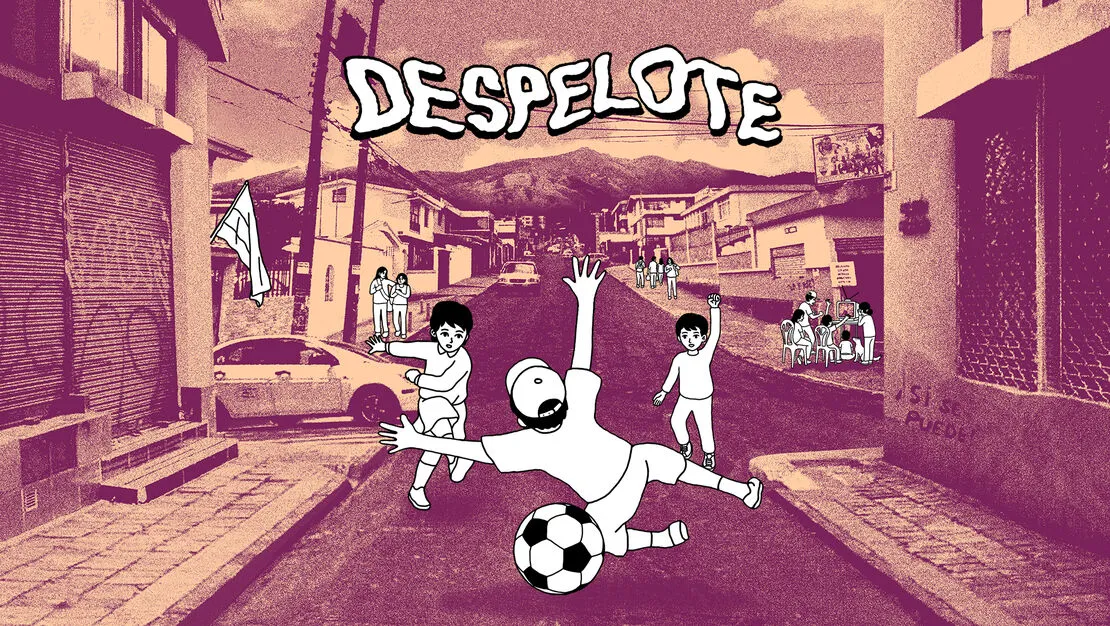

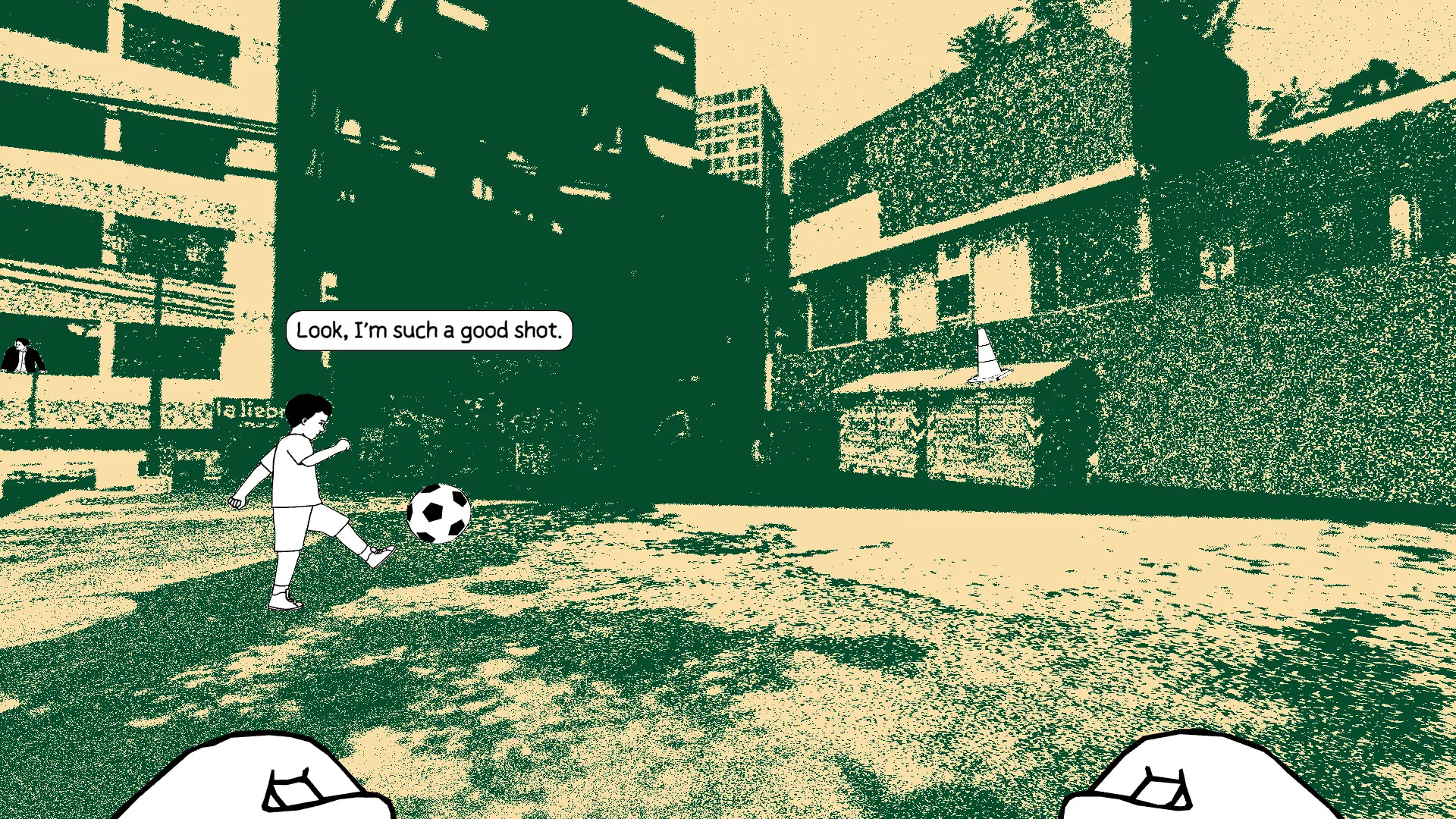
Despelote, created by Julián Cordero and Sebastián Valbuena, unfolds in 2001 Quito as Ecuador vies for its first FIFA World Cup berth. Through five distinct vignettes, it places you in the shoes of eight‑year‑old Julián, whose days revolve around kicking a soccer ball in sunbaked parks, darting between market alleys and stealing glances at live match feeds in shop windows. Its duotone, photograph‑based environments draw from authentic locations, then overlay characters and interactable objects as crisp white line art.
Ball physics lie at the heart of the experience: dribbling momentum, shot alignment and camera control via the right stick nail the awkward charm of childhood play. Interspersed match footage and narrated anecdotes stitch personal memory into each scene, while field recordings of street vendors, children’s laughter and distant crowd roars breathe life into every corner.
Without menus or explicit objectives, Despelote lets you wander at the pace of a youngster lost in exploration, revealing hidden interactions only by chance. The lack of formal guidance echoes a child’s unfocused attention span, rewarding curiosity over completion. In under two hours, it weaves simple delight with deeper themes of nostalgia, community spirit and the emotional weight of a nation chasing its dream.
Roots of Play and Memory: Narrative & Context
Set against the turmoil of Ecuador’s 2001 economic collapse, Despelote weaves public morale into every street corner. With banks shuttered and currency in flux, a single soccer match became a beacon of collective hope. Qualifying for the World Cup carried weight beyond sport—an affirmation of identity for a nation on edge. Archival TV footage and narrated anecdotes anchor each vignette in real events, forging a bridge between lived history and interactive memory. Static-tinged transitions into match clips reinforce the stakes that ripple through Julián’s world.
You inhabit eight-year-old Julián, whose biggest concerns are curfews and perfecting a kick. The first-person view mimics a child’s scattered attention: one moment you chase a ball down a sunbaked lane, the next you’re drawn to an aunt’s hushed conversation. Voice-over reflections are delivered with unfiltered honesty—each line sounds like a memory recalled for the first time. That limited focus shapes your exploration, highlighting how youthful wonder and naiveté color every interaction.
Despelote unfolds across five qualifying rounds, each acting as a temporal waypoint. Between matches you explore a shifting townscape, its cart vendors, elders and street musicians awaiting discovery. Flash-forwards and dream sequences punctuate ordinary play, shrouded in shifting hues and low-fidelity audio stutters. Light levels dim or brighten to signal a narrative leap, while sudden static bursts suggest a fractured recollection. This mosaic approach encourages multiple playthroughs to catch every fleeting detail.
At its heart, Despelote casts play as an act of remembrance. Soccer becomes a metaphor for community bonds—a shared ritual that unites strangers in cafes, park benches and roadside bars. Yet childhood freedom collides with curfew demands, echoing the push-pull between adventure and obligation. Those time limits inject gentle pressure into exploration, reminding you that even youthful joy unfolds within adult-defined boundaries. In that tension, the game captures how memory and identity grow from every kick, every overheard snippet and every hurried goodbye.
Striking Visuals and Immersive Sound
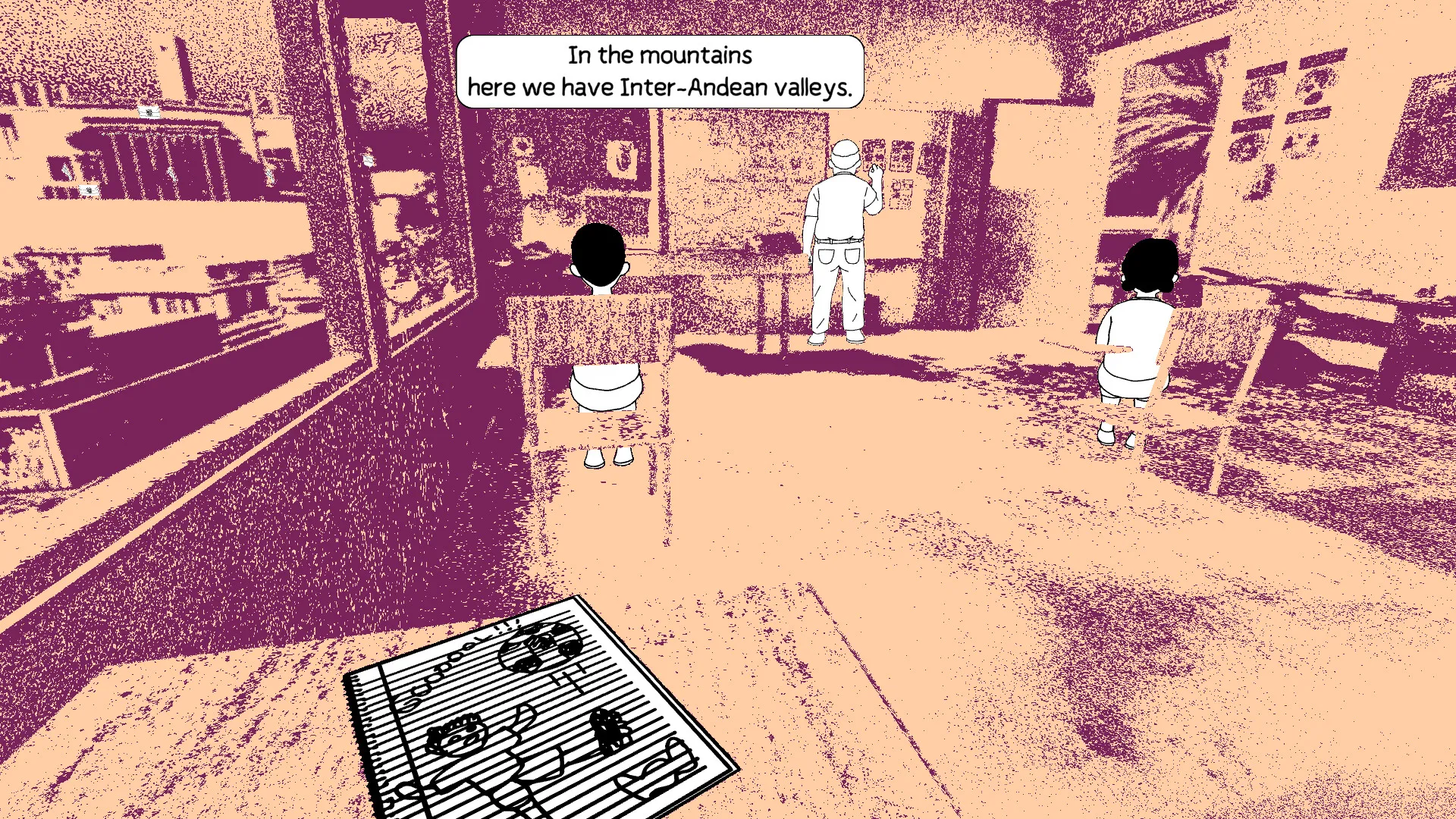
Despelote’s world greets you in washed‑out duotone, where scanned photographs of Quito streets form a soft, hazy backdrop. These real‑life textures blend into a collage of Polaroid fragments, each stitched across 3D space with subtle depth. Against this muted canvas, interactive elements—Julián, his soccer ball, vending carts—appear as crisp white silhouettes. That stark contrast steers your gaze without a single UI marker. The effect mirrors the way Return of the Obra Dinn uses a limited palette to highlight key objects, yet here it feels hand‑crafted, like pages torn from a childhood scrapbook and pressed into the game.
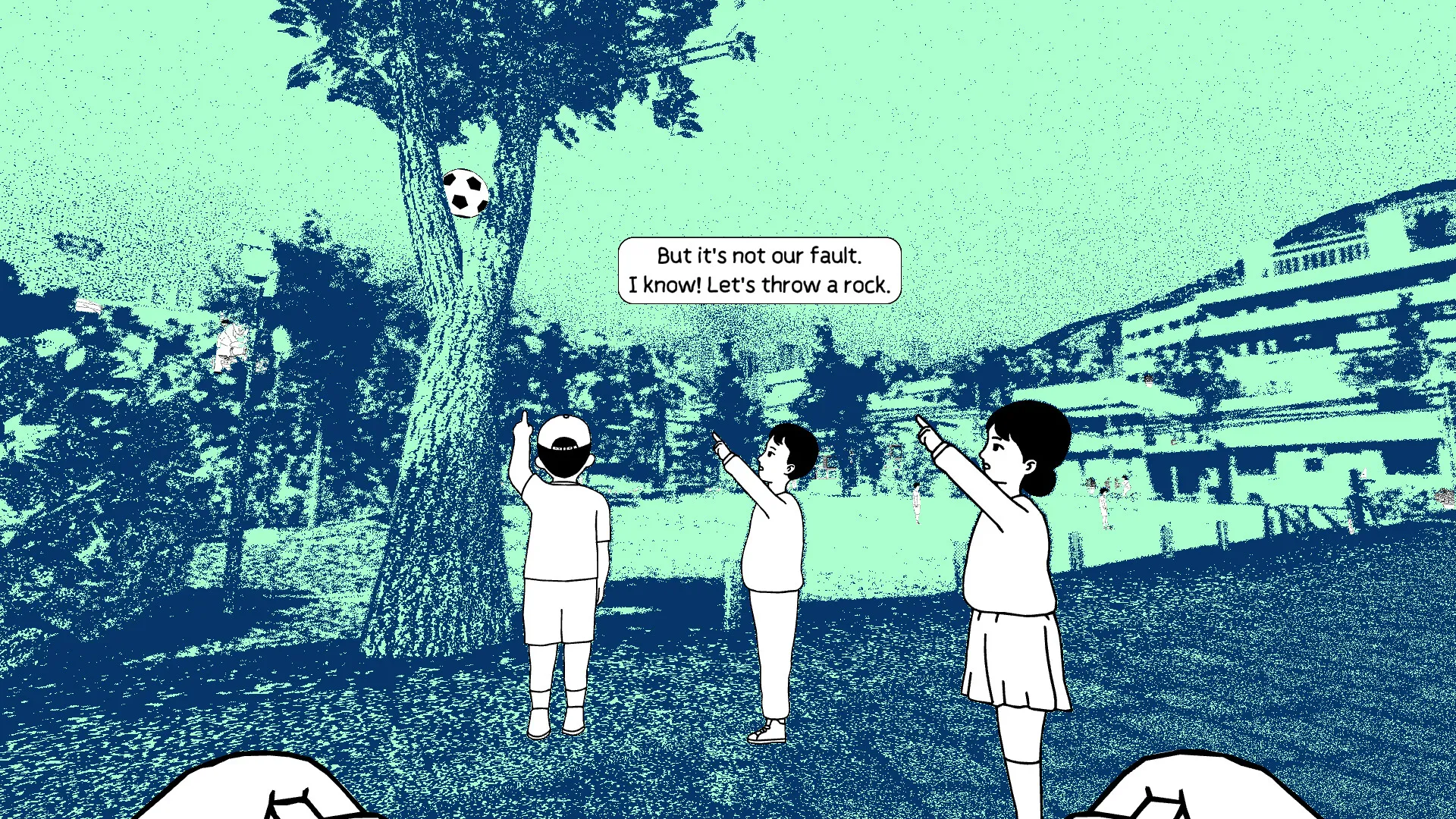
Camera work sets the tone early. A slow pan in the opening moments reveals a park entrance, then lingers on distant mountains before drawing you forward. Dream‑tinted transitions arrive when memory warps reality: color bleeds from sepia to soft green, static edges blur into view and distant sounds crackle like an old TV. Characters animate with simple shifts—a head tilt, an arm raise—that echo paper puppetry. That minimalism recalls the quiet charm of Kentucky Route Zero, where limited motion underscores narrative intent.
Sound designers captured ambient life in Quito’s central plaza: birds trill overhead, vendors bark for customers, cars hum on nearby avenues. During match sequences, layered crowd chants swell organically over background banter, crafting a sense of shared anticipation. In reflective pauses, ambient decay and near‑silence linger just long enough for you to sense the space around you—an approach similar to What Remains of Edith Finch’s use of stillness to emphasize mood.
Dialogue comes alive through genuine Spanish performances drawn from real voices. Pop‑up translations auto‑advance in a rhythm that feels unscripted, sometimes obscuring the screen to mimic a child’s fleeting focus. Overlapping speech simulates the way young ears catch fragments—snatches of argument in a shop, laughter from a corner bench—reminding you that play and memory are rarely neat or fully comprehensible. Together, these visual and audio choices form a sensory harmony, one that matches the clumsy thrill of each kick and captures the restless curiosity of youth.
When Physics Tell a Story
Despelote captures the awkward thrill of a child’s first touches on a ball. Momentum shifts subtly when you switch from walking to sprinting, while misaligned kicks send the ball skittering in unexpected directions. Mapping both camera control and kicking to the right thumbstick creates an initial learning curve, but that friction feels intentional—every missed shot or glancing tap echoes a youngster’s imperfect coordination. Compared to a polished sports title like FIFA, where the ball sticks to your boot, Despelote embraces a bit of mechanical resistance, reminding you that Julián is still mastering basics rather than executing pro‑level maneuvers.
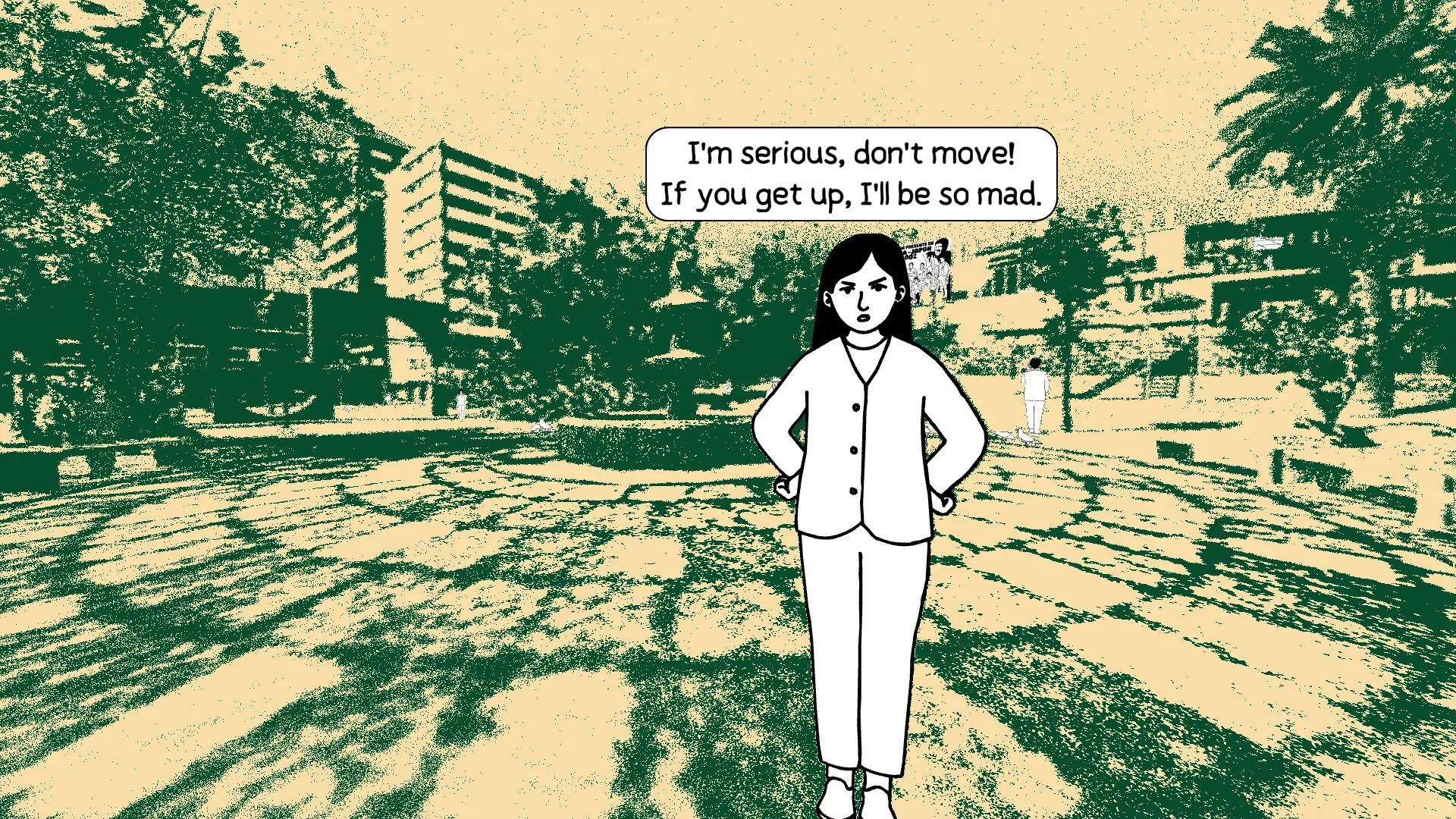
Each vignette plays out as a small sandbox: open plazas scatter bottles, balloons and stray objects ripe for a kick. Without on‑screen markers, you rely on stark white outlines against muted backgrounds to spot interactables—an approach reminiscent of Firewatch’s hidden points of interest.
Stepping into certain zones triggers seamless transitions to the next scene, blending exploration with narrative flow. Though no simple dialogue choices guide you, the sequence in which you engage people and objects subtly shifts what you observe. A chance encounter with a street musician or an overheard family argument adds texture, offering replay value for those who wish to chase every anecdote.
Curfew prompts from Julián’s mother inject a soft timer, pressing you to juggle playtime with story beats. While this echoes the tension of timed quests in RPGs such as Persona, here it never feels punitive—it simply nudges you onward. The absence of a quest log or formal objectives strips away menu clutter, yet some players might long for clearer direction.
That trade‑off between free‑form play and guided pacing suits a narrative focused on childhood spontaneity, though it can leave exploration feeling abbreviated when you race to meet a deadline. By weaving mechanics into memories rather than achievements, Despelote prioritizes atmosphere over completion records.
Playgrounds of Memory
Despelote’s compact town feels richer than its size suggests. You shuffle through a central park ringed by market stalls and winding residential lanes, then duck into playgrounds where rusted swings creak in the breeze. Shop windows double as living rooms for noisy match broadcasts, while food carts line alleyways with steaming arepas. These landmarks guide your wandering without ever spelling out a path. It recalls the focused yet open spaces of indie explorations like Eastshade, where every street corner hides a small surprise.
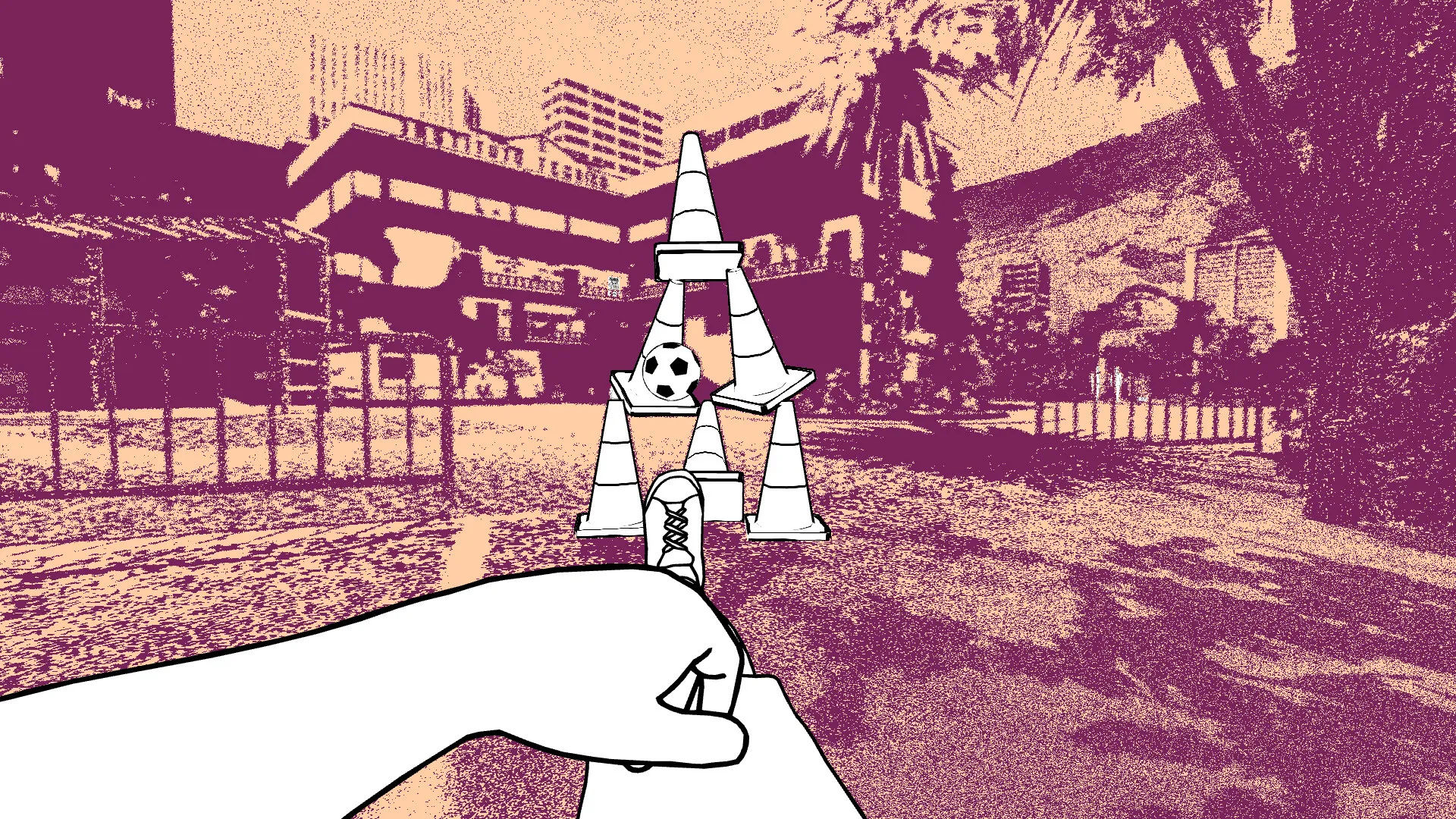
NPCs follow simple routines: an elderly man scatters seed for pigeons, a couple’s hushed dispute drifts across the plaza and a street musician taps out a gentle rhythm on his cajón. Their loops offer familiar backdrops for your own antics—kicking bottles off ledges, nudging balloons into surprised bystanders or launching a stray rock at an unsuspecting tin can.
Those small provocations carry little mechanical weight, yet they shape your emotional map of the town. At the outset, a retro soccer mini‑game flickers on an in‑world TV, hinting at deeper layers beneath these surface moments—much like the playful diversions in Oxenfree that hint at broader mysteries.
Attention in Despelote feels earned. Locking your gaze on a shop‑front screen triggers a smooth zoom‑in, as though Julián’s mind narrows in on the match. Pop‑up translations and ambient chatter overlap when you’re near a busy vendor, forcing you to choose whether to chase every snippet of conversation or let fragments drift by.
And when Mum calls you home, looking down at your watch literally pulls your view away from the world—an immersive reminder that childhood exploration often ends at an adult‑set hour. That tension between curiosity and responsibility injects each stroll with the bittersweet charge of a memory you never quite finish recalling.
Performance and Player Comfort
On the Steam Deck, Despelote generally runs at a steady framerate, keeping the camera pans and ambient details smooth. Occasionally, minor slowdowns crop up during busy crowd chants or when multiple environmental sounds overlap. I encountered a handful of clipping glitches—characters briefly phasing through textures—and rare animation stalls, but none halted progress or distorted key moments.
A robust suite of configuration options lets you tailor audio to narrative beats. Separate sliders for dialogue, ambience, SFX and music ensure conversations remain clear even amid overlapping chatter. Bass reduction, mono mode and a hyperacusis filter help those with hearing sensitivities. Visual toggles include disabling head bob and a simple reticle on/off switch, letting players adjust camera comfort without wading through cryptic menus.
Accessibility extends to translation pacing: pop‑up text boxes auto‑advance at a readable rate, though those with slower reading speeds may wish for manual controls. Control remapping or sensitivity adjustments aren’t deeply exposed, which could challenge players with motor limitations. The absence of a traditional pause menu streamlines immersion—akin to the design ethos of indie narrative titles like What Remains of Edith Finch—but may hinder quick setting changes for some.
At roughly 1.5–2 hours, Despelote stakes its claim as a concise experience. Its timed vignettes and hidden interactions encourage one or two replays to catch every anecdote. Though brief, the combination of performance stability and thoughtful comfort options supports both casual wanderers and detail‑driven players.
Echoes of Play and Memory
Despelote’s imperfect ball physics spark a rush of nostalgia, capturing childhood spontaneity as you chase skittering kicks across sunlit plazas. Spanish dialogue recorded on location, ambient street calls and real Quito landmarks ground the experience in cultural authenticity, pulling you into a world that feels lived‑in.
Mechanic‑driven moments—like fumbling a shot only to watch another child score—mirror the uneven arcs of growth and the way memories skip details. Amid national soccer fever and adult concerns, you sense Julián’s smallness, an eight‑year‑old navigating excitement and curfews.
Hidden NPC interactions and overlapping conversations reward careful wanderers, while revisiting timed segments lets you test different paths through each vignette. That blend of discovery and routine invites a second playthrough, where new anecdotes surface.
By weaving playful physics with genuine moments of wonder, Despelote forges a connection between player and memory. Its warmth lingers in every echo of laughter and every hurried glance at the watch, reminding us how play shapes who we become.
The Review
Despelote
Despelote captures childhood wonder through clumsy soccer physics, photo‑based collage visuals and authentic soundscapes. Its timed scenes deliver pockets of discovery, while curfews can feel abrupt. Cultural details and candid narration create emotional connection, rewarding attentiveness with hidden vignettes. Though brief, this intimate experience leaves a vivid imprint of play and memory.
PROS
- Authentic atmosphere rooted in real Quito streets
- Playful ball physics that mirror childhood imperfection
- Striking duotone collage visuals
- Rich ambient sound captures street life
- Concise length keeps focus on key moments
CONS
- Curfew timers can halt exploration abruptly
- Controls feel finicky during precise kicks
- Repeatable scenes reduce novelty
- Sparse objectives may leave some players adrift
- Minor frame drops and animation hiccups