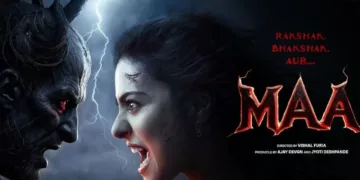






























There are few forces in nature as absolute as a mother’s instinct to protect her child. The Hindi horror film Maa grounds its supernatural tale in this universal truth, pitting one woman’s love against a folkloric evil that has festered for generations.
The film introduces us to Ambika, a modern woman and museum guide in Kolkata, portrayed with fierce conviction by Kajol. Her life with her husband and their 12-year-old daughter, Shweta, is one of contemporary comfort, far removed from the arcane traditions of the past.
This carefully constructed peace is shattered by a sudden family tragedy, compelling a grieving Ambika and a curious Shweta to make a fateful journey to the ancestral village of Chandrapur. The destination is the family’s crumbling manor, or rajbari, a place heavy with the unspoken secrets her husband desperately tried to leave behind.
Upon arrival, they find that the village itself is trapped in time, suffocating under the weight of a horrific curse born from a brutal past. This ancient malevolence has a specific target, and as Ambika confronts the ominous atmosphere of her new surroundings, she realizes a terrifying power is closing in on her daughter.
A Tangled Narrative of Myth and Missteps
The screenplay for Maa attempts to weave a potent Hindu myth into the fabric of a modern horror film, a practice that has yielded powerful results in global cinema from folk horror to mythological fantasy. The film draws upon the epic tale of the goddess Kali and the demon Raktbeej, a formidable entity who could clone himself from every drop of his blood that touched the earth.
Maa translates this into the story of Daitya, a demonic, sentient tree that terrorizes the village of Chandrapur. This foundation is rich with symbolic potential, promising a story where ancient divine battles are mirrored in one family’s personal struggle.
Yet, the film’s narrative execution struggles to live up to its ambitious premise. The story begins with a brutal flashback to a female infant’s sacrifice 40 years prior, an act that births the village’s curse. The plot is set in motion when Ambika’s husband is killed after returning to his ancestral home, prompting Ambika and her daughter Shweta to travel there three months later.
What follows is a first half marked by a sluggish pace. Instead of methodically building dread, the film meanders, filled with scenes that do little to heighten tension or deepen character, a critical flaw that leaves the audience waiting for the story to truly begin.
This slow burn gives way to a plot riddled with jarring inconsistencies that challenge audience investment. Horror as a genre requires a suspension of disbelief, but it must be earned through internal logic. Here, Ambika’s decision to remain in a clearly dangerous environment with her daughter feels less like a character choice and more like a contrivance to keep the plot moving.
The lore itself is contradictory: at times it is stated that kidnapped girls are returned unharmed but unable to menstruate, while at other points it is implied they are turned into demonic entities. This narrative confusion is compounded by a startling lack of external reaction. In a world of constant connection, the idea that numerous girls could disappear from a village without a significant police investigation or media frenzy feels implausible, severing the film’s ties to any recognizable reality.
The Goddess, The Demon, and The Village
At the heart of Maa is a trio of forces, and the film’s success hinges on their interplay. The narrative rests squarely on the shoulders of Bollywood veteran Kajol, who brings a potent, fiery energy to the role of Ambika. Her performance is the film’s anchor, effectively capturing the transformation from a concerned urban mother into a figure of mythic retribution.
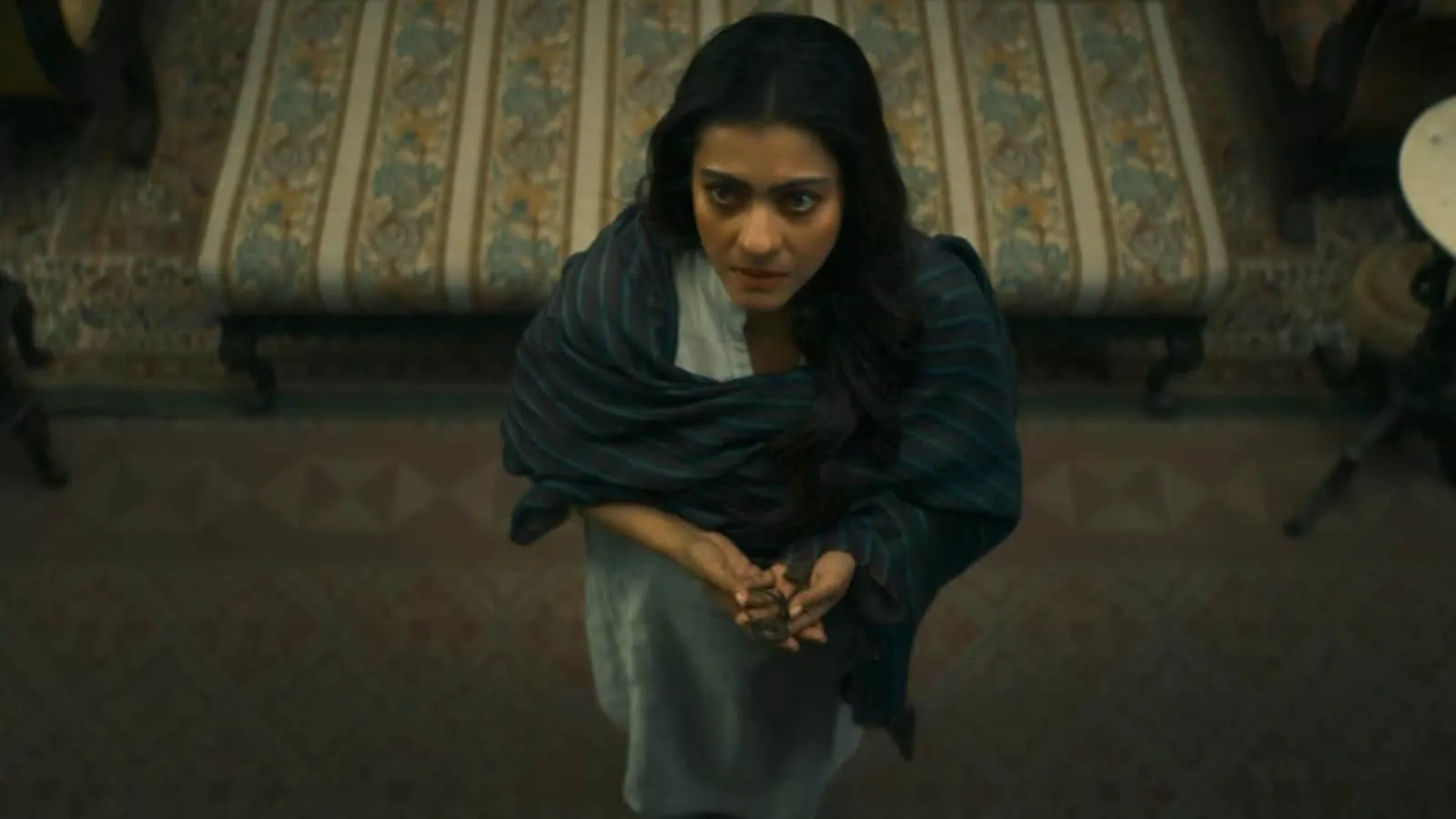
The arc is compelling: a museum guide who intellectually understands the legends of goddesses becomes a woman who must physically embody that divine fury. Yet, the characterization is not without its limitations. At times, Ambika feels less like an organic character and more like a one-dimensional symbol of maternal rage, with her actions driven by the script’s demands rather than a palpable internal psychology.
A compelling hero requires an equally compelling villain, and it is here the film falters significantly. The antagonist, a demonic tree entity named Daitya, is a critical misstep. While the concept of a monster rooted in nature is a staple of folk horror worldwide, the execution is profoundly underwhelming.
The creature’s CGI design lacks weight and menace, resembling something from a mid-budget television series rather than a cinematic threat. With a generic appearance and forgettable dialogue, Daitya fails to project any real sense of personality or terror. This toothless antagonist drastically lowers the stakes, turning what should be a terrifying battle for survival into a curiously unaffecting conflict.
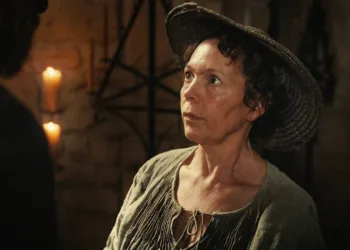
The world is populated by a supporting cast that struggles to leave a lasting impression. Ronit Roy, a consistently strong presence in Indian cinema, is given a meaty role as the village headman, Joydev, and adds a much-needed layer of gravitas to the proceedings. His performance hints at the dark secrets simmering beneath the village’s surface.
However, the other peripheral characters, including the family of the manor’s caretaker and the other villagers, are thinly sketched. The performances from the wider ensemble often feel substandard, which unfortunately detracts from the believability of the cursed village and dilutes the film’s overall atmospheric quality.
An Atmosphere More Artificial Than Eerie
A successful horror film is an exercise in controlled atmosphere, a skill director Vishal Furia has demonstrated in his previous work. With Maa, however, the directorial hand seems uncertain. The film struggles to find a consistent tone, wavering uncomfortably between a grand mythological drama, a pointed feminist fable, and a conventional horror movie.
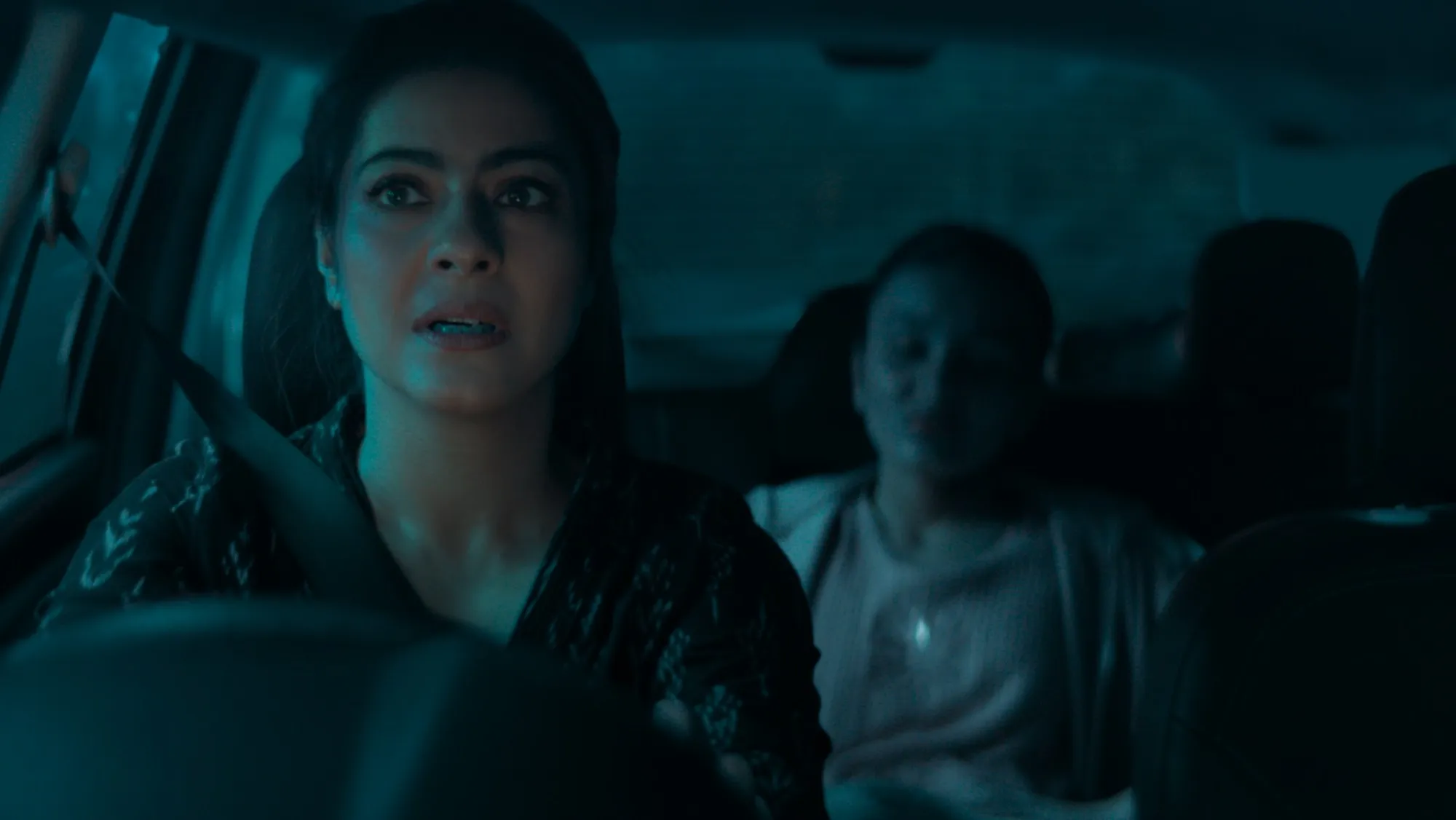
This tonal indecision is its greatest technical failing. Instead of synthesizing these elements into a cohesive whole, the film presents them in sequence, preventing the build-up of sustained dread. A chilling, oppressive atmosphere—the lifeblood of effective horror—never materializes, leaving the audience observant rather than immersed in the terror.
Visually, the film is a study in contrasts. The production design within the ancestral mansion is often striking, using a palette of saturated colors against decaying walls to create a sense of faded grandeur and lurking menace. These tangible sets have a texture and personality that the digital elements sorely lack. The visual effects, particularly the CGI used to render the demon Daitya, are unconvincing and strip the antagonist of any potential fright.
The forest, a critical location for any folk-horror narrative, looks disappointingly artificial, failing to evoke the primeval danger it represents. This disconnect between the practical and the digital creates a jarring visual experience.
The film’s strategy for scares further highlights its atmospheric shortcomings. Rather than cultivating suspense through silence, shadow, and pacing, Maa leans heavily on a series of telegraphed jump scares.
These moments are almost always announced by a surge in the musical score, a well-worn technique that gives the audience ample warning and negates any real shock. While these jolts might startle a viewer for a second, they do nothing to create the lasting sense of unease and psychological fear that separates memorable horror from forgettable thrill rides.
Potent Themes in a Muddled Message
Like many contemporary horror films globally, Maa uses genre conventions to explore potent social issues. Its thematic intentions are clear and commendable, aiming a direct critique at deep-seated patriarchal traditions. The story’s curse is born from the act of female infanticide, a horrifyingly real practice that grounds the supernatural threat in a tangible social evil.
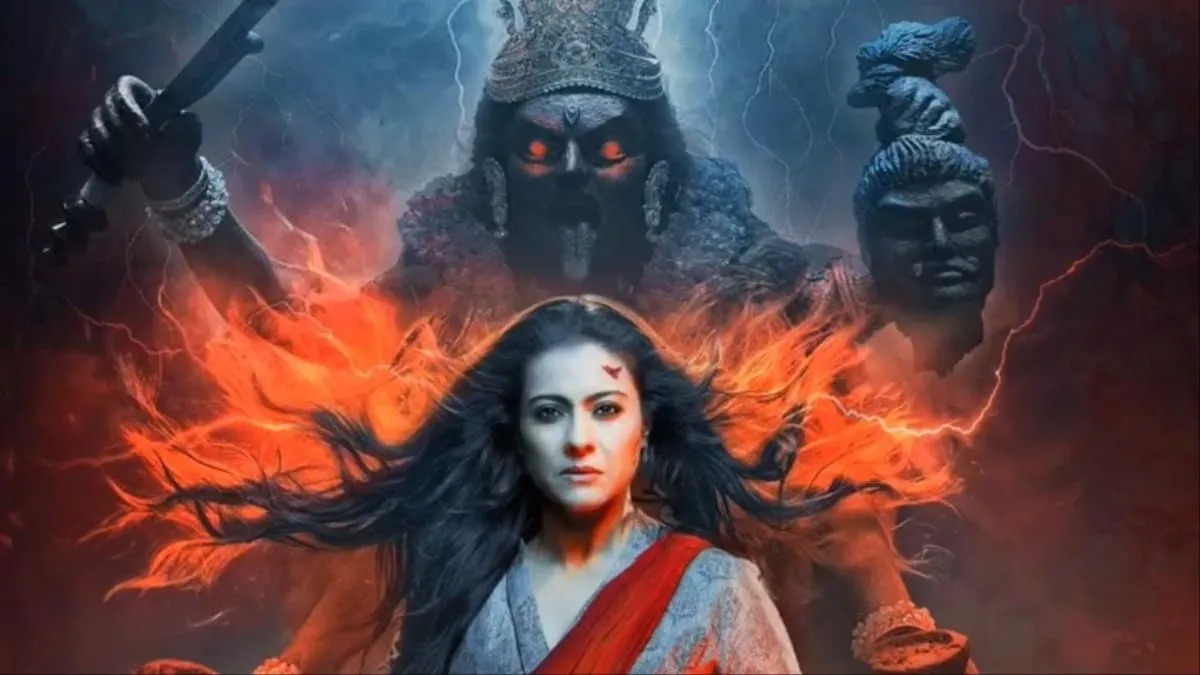
The central conflict is explicitly framed as a battle between the feminine divine, with Ambika becoming a vessel for the goddess Kali, and a feudal, male-dominated power structure that has perpetuated violence against women for generations. This positions the film within a growing subgenre of feminist horror, where monstrous forces are metaphors for systemic oppression.
The film also makes notable strides in its celebration of womanhood. In a particularly progressive move for mainstream Indian cinema, the onset of Shweta’s menstruation is a pivotal plot point. It is handled not with shame or secrecy, but as a natural biological event that, in the twisted logic of the curse, makes her a target. This forthright depiction is a powerful statement. The narrative consistently centers female power, from the ferocity of Ambika’s maternal instinct to the ultimate, awe-inspiring strength of the goddess she channels.
However, a film’s message is only as strong as its delivery, and this is where Maa falters. These ambitious themes are ultimately let down by a clumsy and convoluted narrative. The intended social commentary is buried under a plodding screenplay, weak horror elements, and a general lack of suspense that prevents the audience from becoming emotionally invested.
The message about smashing patriarchy loses its impact when the story itself is not compelling. The climax, where Ambika finally transforms into a divine avenger, is a visually and thematically powerful sequence, but it feels like an isolated moment of clarity in an otherwise muddled and uneven film.
Final Thoughts
Maa is built upon a foundation of immense potential, envisioning a mother’s primal rage as a conduit for divine, mythic power against an ancient patriarchal curse. The film is held aloft almost entirely by the sheer force of Kajol’s committed lead performance.
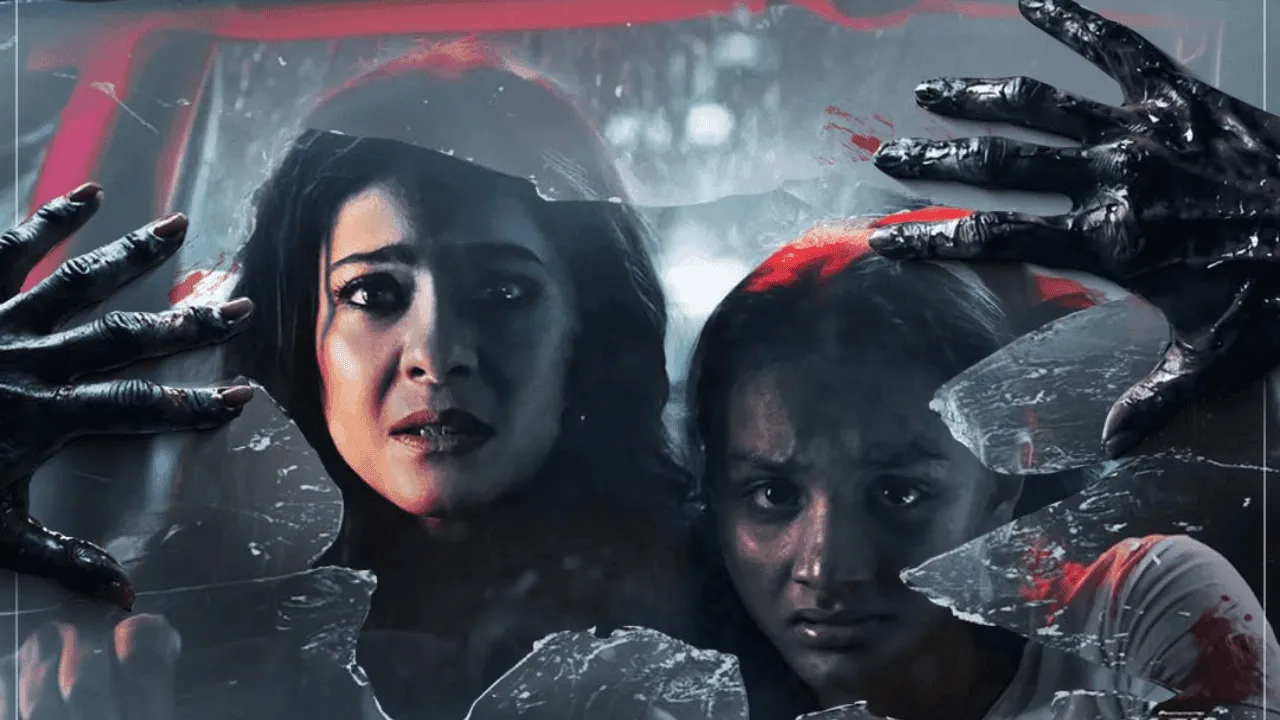
However, this central strength is not enough to salvage the whole. Despite its ambitious themes, the film is critically hobbled by an unthreatening villain, a script tangled in its own logic, and a profound failure to generate genuine scares. The final impression is that of a film with a potent, beating heart tragically buried beneath layers of familiar and poorly executed horror tropes.
Maa is a 133‑minute mythological horror film set in the same universe as Shaitaan and directed by Vishal Furia. It premiered theatrically in India on June 27, 2025.
Full Credits
Director: Vishal Furia
Writer(s): Saiwyn Quadras; dialogues by Aamil Keeyan Khan, Ajit Jagtap
Producers and Executive Producers: Ajay Devgn, Jyoti Deshpande, Kumar Mangat Pathak
Cast: Kajol, Ronit Roy, Indraneil Sengupta, Kherin Sharma, Jitin Gulati, Gopal Singh, Surjyasikha Das, Roopkatha Chakraborty, Aashit Chatterjee, Dibyendu Bhattacharya, Yaaneea Bharadwaj, Vibha Rani
Director of Photography (Cinematographer): Pushkar Singh
Editor: Sandeep Francis
Composer(s): Harsh Upadhyay, Rocky Khanna, Shiv Malhotra
The Review
Maa
Maa is powered by a commendable feminist message and a fierce performance from Kajol, but these strengths cannot save it from a disastrously muddled script. With a non-threatening villain, a story full of logical holes, and a complete absence of genuine suspense, the film fails as both a horror movie and a compelling drama. It is a clear case of noble intentions being thoroughly defeated by poor execution, resulting in a frustrating and ultimately forgettable experience.
PROS
- Kajol delivers a powerful and committed lead performance.
- Ambitious themes that critique patriarchal traditions.
- A progressive and matter-of-fact handling of female biology as a plot point.
CONS
- A weak, unconvincing, and entirely non-threatening antagonist.
- A convoluted plot riddled with major logical inconsistencies.
- A critical lack of genuine suspense, relying on telegraphed jump scares.
- Underwhelming and often artificial visual effects.