



























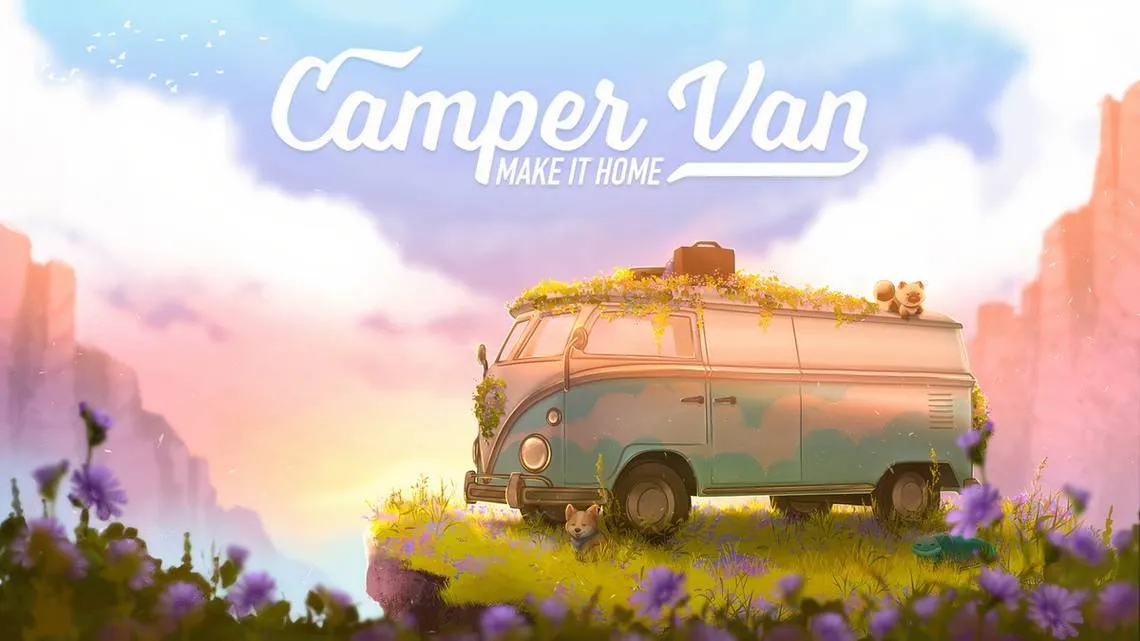

Every act of packing is a quiet act of autobiography; we decide which objects get to tell our story. In Camper Van: Make it Home, Spanish developer Malapata Studio elevates this ritual into the game’s serene heart.
The premise is simple: you are given the shell of a van and the material fragments of a life, tasked not with winning, but with making a home. It is an experience defined by its deliberate lack of pressure. There are no ticking clocks or game-over screens, only the gentle pursuit of a place for everything.
The spatial logic of fitting objects into a grid brings to mind Tetris, yet the cultural gap between them is vast. If the Soviet-era classic was a metaphor for systemic pressure and inevitable collapse, this modern European counterpart is a meditation on personal harmony.
It exchanges the anxiety of failure for the quiet satisfaction of control. In a world of increasing precarity, the game suggests a new ideal: that home is not a place, but a carefully curated and contained mobile existence, defined only by the volume of what we can carry.
The Catharsis of Containment
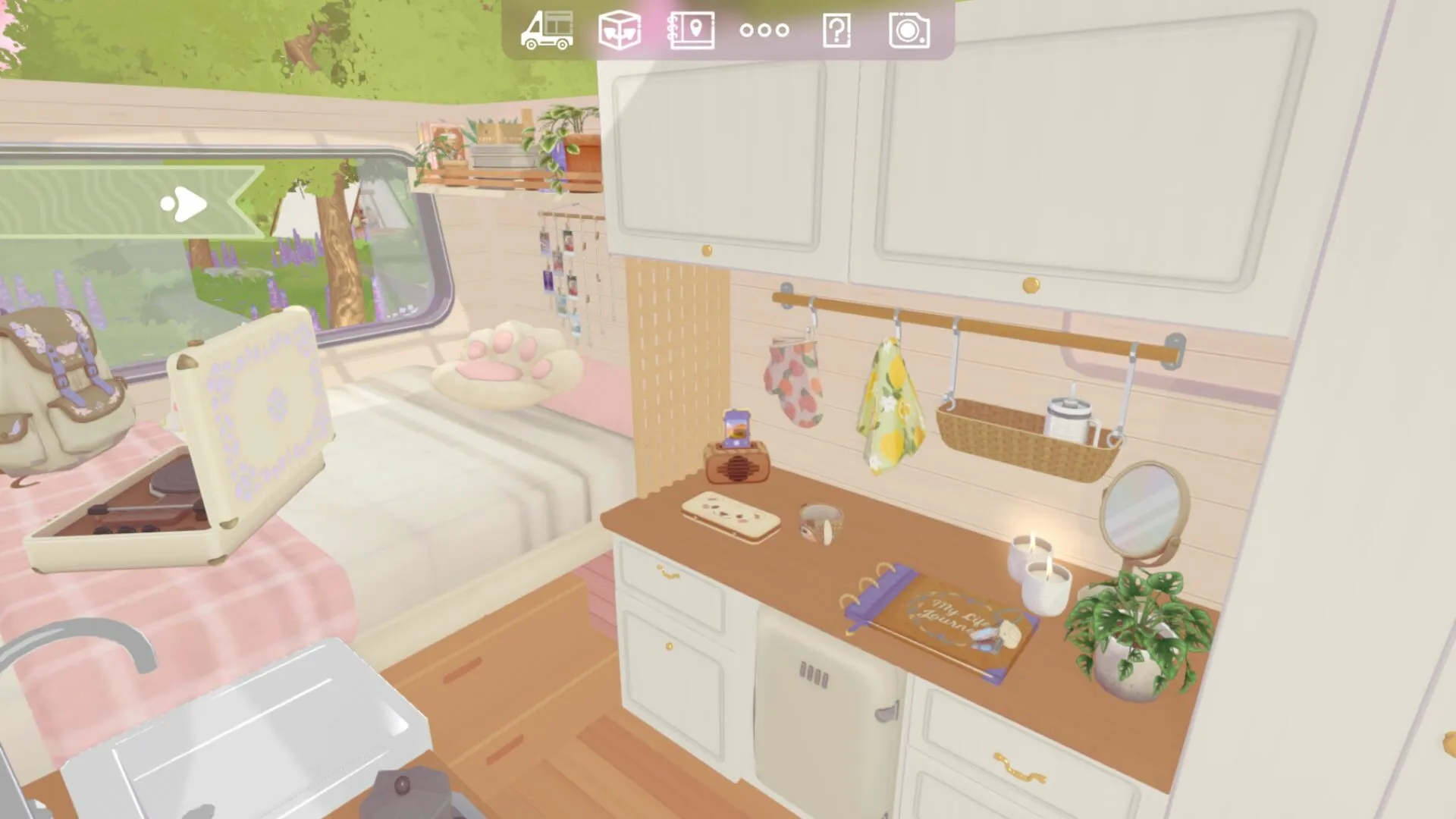
The central mechanic of Camper Van: Make it Home operates less like a traditional game loop and more like a secular ritual. Each level presents the player with a tabula rasa: an empty van. You begin by installing the fundamental structures of a life—the bed, the kitchen, the storage—akin to laying down the grammar for a sentence you have yet to write.
Once the stage is set, a stream of objects appears. These are the vocabulary of a personality: well-worn books, mismatched coffee mugs, clothes for every season, a favorite plant. The player’s task is to pick up each item, consider its form and function, and find it a place within the whole.
What is most striking here, particularly from a design perspective rooted in a global context, is the radical freedom of placement. Unlike the rigid logic of many puzzle games that demand a single, optimal solution, this game from a Spanish studio imposes no such judgment. An item’s correctness is determined by a single factor: does it physically fit? This mechanical choice is a powerful statement.
It suggests there is no objectively right way to arrange one’s life. You are free to be a meticulous minimalist or a chaotic hoarder; the system validates your choices simply by allowing them. This philosophy finds a cinematic parallel in the observational style of filmmakers like Yasujirō Ozu, where the quiet arrangement of a domestic space reveals everything about its inhabitants without a word of explicit judgment.
The challenge is therefore not one of problem-solving, but of self-reconciliation. Finding a home for an awkwardly shaped guitar case feels less like a victory and more like a quiet, satisfying compromise. Even the inclusion of a pet, complete with its own toys and bowls, adds a layer of negotiated space—a life shared.
The entire process becomes a form of therapeutic proceduralism. In a world saturated with noise and demands, the simple, repetitive act of creating order in a small, contained environment offers a profound sense of peace. It makes one wonder what we are truly organizing when we play.
An Itinerary of the Self
Progression in Camper Van: Make it Home takes the form of a linear road trip, a structure with deep roots in global cinema, from American odysseys of self-discovery to the more contemplative journeys of European art-house film.
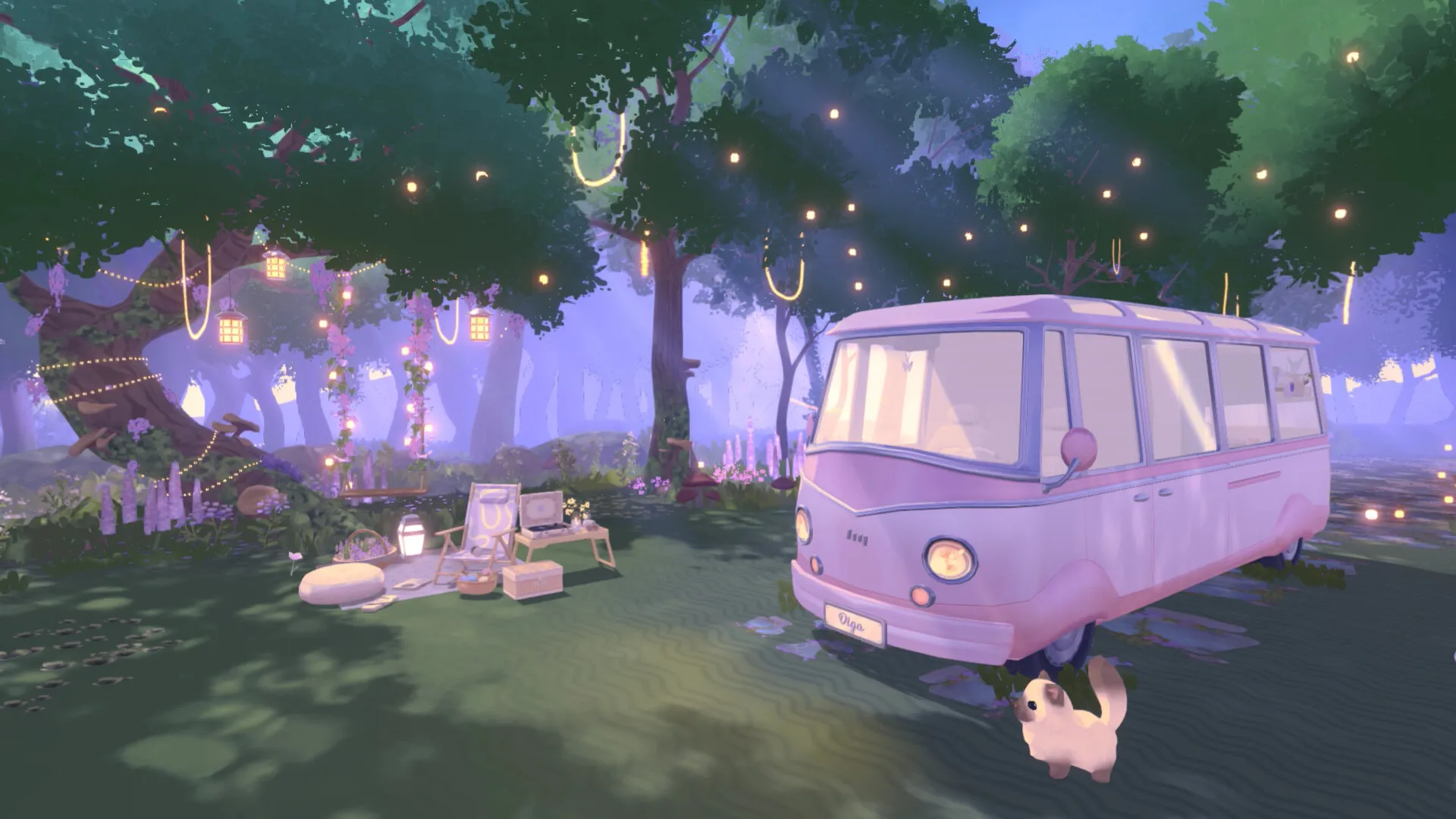
The game unfolds as a series of discrete levels, each a new destination—a sun-drenched beach, a misty forest, a snow-covered cliffside. With each stop, the player’s environment subtly shifts. Sometimes the van itself is new, offering a slightly larger or more complex interior architecture, and with it, a new collection of belongings to integrate.
The game masterfully weaves this forward momentum into its core organizational puzzle. The passing of seasons is not merely decorative; when winter arrives, so do bulky sweaters and thick blankets, creating a tangible new spatial challenge.
The puzzle of fitting your life into a box evolves as that life experiences change. This journey is given a personal, narrative anchor through a scrapbook. Acting as a diegetic diary, it collects mementos from each location, framing the progression not as a simple clearing of levels, but as the accumulation of memories.
Yet, for a game so invested in personal expression, this curated path holds a central contradiction. The player is taught a language of creative freedom but is confined to a strict, unchangeable itinerary. This tension culminates in the game’s most glaring omission: the lack of a creative mode.
After completing the final, prescribed stop, the journey simply ends. There is no opportunity to take the skills of domestic curation learned along the way and apply them to a truly personal project. The game gives you a toolbox but denies you a sandbox, leaving its promise of making a space your own feeling strangely incomplete. It raises the question of whether this was ever truly your journey at all.
Designing Tranquility
In a game with almost no text, the atmosphere is not just background; it is the primary narrative language. Camper Van: Make it Home communicates its story of quiet introspection through a carefully engineered sensory palette. The visual style adopts a globalized aesthetic of comfort, one instantly recognizable from the pages of design magazines and the curated feeds of social media.
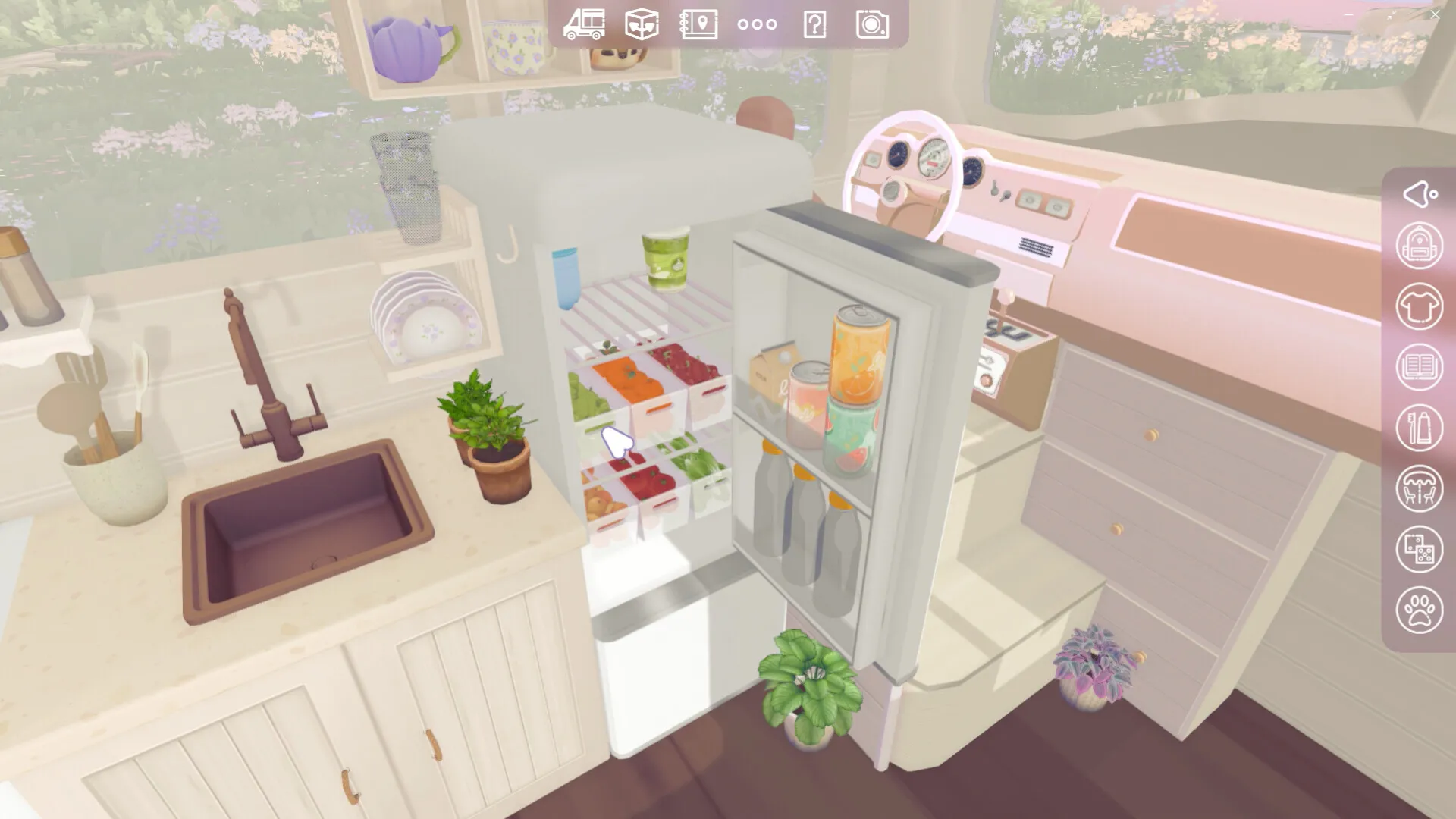
It is a world of soft pastel tones, clean minimalist lines, and smooth, touchable-looking objects. This is not the grit of realism but a romanticized vision of life, where every surface is clean and every color is soothing. The ability to customize the van’s colors and interior fixtures is a key mechanic, inviting the player to become a co-author of this idyllic space, to paint with a palette of pure calm. Despite the softness, the visual design maintains a remarkable clarity, ensuring the organizational tasks are never obscured by the style.
The sound design, however, may be the most critical component of this immersive tranquility. The game’s audio landscape is a direct dialogue with the contemporary digital phenomenon of ASMR. The gentle ambient sounds of wind or distant birds are layered with a soft, unobtrusive guitar soundtrack reminiscent of a ‘lo-fi study beats’ playlist.
But the true focus is on the Foley work. The soft thud of a book placed on a shelf, the delicate click of a ceramic mug set on a counter, the rustle of fabric being folded away—each sound is rendered with a crisp intimacy that provides a direct sensory reward. It is a tangible feedback loop of satisfaction.
Together, these visual and auditory elements create a cohesive and deeply effective atmosphere. The game does not simply depict a peaceful scene; it actively uses its aesthetic tools to induce a state of tranquility in the player. The experience is a testament to the power of a unified sensory design, where every choice serves the singular purpose of building a small, safe, and controllable world. It offers a designed comfort that feels both modern and deeply necessary.
Friction in the Fantasy
For an experience built on seamless immersion and meditative flow, the point of interaction between player and world—the controls—should ideally be invisible. Yet, it is here that Camper Van: Make it Home reveals the seams of its own beautiful construction. Navigating the tight confines of the van can be an exercise in frustration.
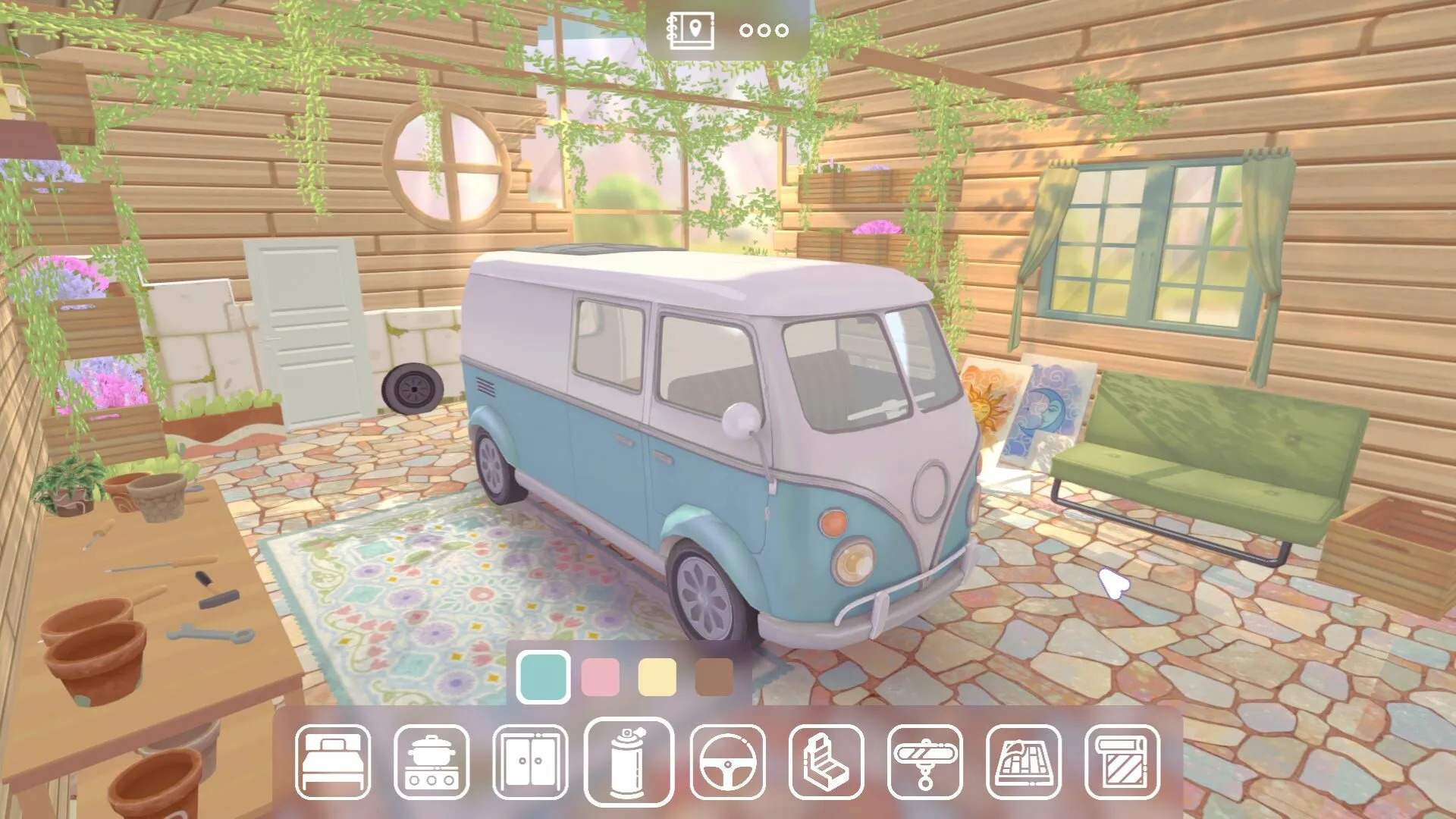
The 3D camera, seemingly at odds with the player’s intent, often struggles to find a useful vantage point, making it difficult to peer into the very nooks and deep drawers the game invites you to fill. Judging depth and rotating objects into a perfect fit can feel clumsy, introducing a layer of mechanical friction that stands in stark contrast to the intended emotional ease. One adapts, of course, but the spell of effortless organization is momentarily broken each time.
This friction is compounded by minor, but noticeable, technical blemishes. In a game so dedicated to visual harmony, moments of digital dissonance are jarring. Objects sometimes clip through one another or become stuck, their physics betraying the solidity they are meant to project. The most symbolic of these flaws involves the scrapbook, the game’s primary narrative object.
Seeing this token of memory pass unnaturally through the solid-state reality of other items is a small but potent tear in the fabric of the simulation. These are not game-breaking issues, but in a minimalist work, every detail matters. They serve as constant reminders of the digital artifice, pulling the player out of a state of being and back into a mode of simply operating a game.
The Archaeology of a Self
In Camper Van: Make it Home, the story is not told; it is excavated. With no dialogue or exposition, the narrative unfolds through the tradition of environmental storytelling, where objects become the primary text. The player acts as a sort of archaeologist of a contemporary life, piecing together a history from the artifacts that emerge from cardboard boxes.
An expanding collection of books, a new set of outdoor gear, a sudden influx of warm clothing—these are the clues that mark the passage of time and shifts in the protagonist’s inner world. The game powerfully literalizes the metaphor of “emotional baggage.” The accumulation of possessions becomes a physical weight, and the challenge of fitting them into the van’s limited space mirrors the very real struggle of carrying one’s past.
The narrative that emerges is intentionally, and perhaps radically, vague. Compared to other games in the genre that provide a more defined character arc, this story remains a faint sketch. We see the what, but are left to infer the why. This ambiguity, however, functions as a distinct narrative strategy.
By refusing to fill in the details, the game creates a space for the player’s own projections. The protagonist’s journey becomes a vessel for our own feelings about memory, possessions, and the difficulty of moving forward. The story is less a plot to be followed and more an emotional state to be inhabited, a quiet reflection on the things we choose to carry with us.
The Digital Zen Garden
Camper Van: Make it Home is best understood not as a game to be conquered, but as a digital space to inhabit. It offers a quiet, meditative retreat focused on the simple pleasure of creating order.
Its appeal is specific, likely to resonate most with players attuned to the frequencies of the “cozy” genre—those who seek aesthetic satisfaction and calm introspection over high scores or narrative complexity. Anyone conditioned by the demand for mechanical depth, a strong plot, or a significant challenge will find the stillness here to be an absence rather than an offering.
The experience is a brief and comforting one. It is a beautifully designed, if slightly flawed, digital object that succeeds entirely on the strength of its tranquil atmosphere. Its satisfaction lies in its deliberate simplicity, offering a temporary escape into a world where the only problem is where to put a book, and the only goal is to make it feel right.
The Review
Camper Van: Make it Home
Camper Van: Make it Home is a beautifully crafted atmospheric experience, a digital zen garden designed for quiet satisfaction. Its core loop of organization is deeply therapeutic, supported by a sublime, minimalist aesthetic and soothing sound design. This meditative quality is frequently interrupted by frustrating controls and, most critically, is undermined by the baffling omission of a creative mode, leaving its promise of ultimate freedom unfulfilled. It's a fleeting, beautiful journey that stops just short of its destination.
PROS
- Wonderfully relaxing and meditative atmosphere.
- Beautiful, clean, and cohesive visual style.
- Immersive and satisfying ASMR-like sound design.
- A simple, therapeutic core gameplay mechanic.
CONS
- Clumsy controls and a fiddly camera break the immersion.
- The absence of a post-game creative mode is a major disappointment.
- Very short with limited replay value.
- Minor bugs and clipping issues detract from the visual perfection.