
























When Chester teaches Liam to speak, he is helping someone who cannot explain who he is or what has happened to him. He also supplies the name Liam, giving his guest an identity before that guest can offer one of his own. Michael Woloson and Scott Tinkham’s Littermates builds its early suspense around this unequal exchange. An unexplained conflict has left a stranger disoriented and dependent; a man with a secluded English country home takes him in. Chester’s assistance is tangible. So is his authority over the person receiving it.
The arrangement becomes easier to understand as Chester establishes its routines. Progress and good behavior earn small tokens called nifties, redeemable for karaoke or time in the hot tub. Leaving the estate is forbidden, and the siren means an immediate trip to the shelter. Yet thirty nifties can purchase a forest outing. The system makes obedience rewarding while turning the world outside into a prize. Liam can learn the rules without understanding the circumstances that produced them. Every privilege still requires Chester to decide that he is ready.
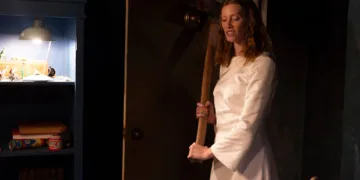
Oliver Woolf makes this position unsettling without reducing Chester to a collection of suspicious mannerisms. His patient instruction gives the household a credible basis in care, and his occasional panic registers the strain beneath its orderly surface. Gunfire and explosions beyond the property give him reasons to be afraid.
The screenplay, written by Tinkham, lets those external threats support his restrictions without settling every question about them. We have enough evidence to understand why Liam accepts protection, while remaining conscious that he cannot independently assess its conditions. Woolf sustains both sides of that relationship through a calm that takes visible work to maintain.
Mel’s arrival changes the story’s machinery. Another confused stranger could have supplied a second round of rehabilitation scenes. Instead, she changes Liam’s place in the house. Joey Bader plays him as someone hungry for reassurance, whose hesitant responses have settled into the confidence of knowing what Chester expects.
Sharing that attention gives him something new to fear. His competitive looks during karaoke make the stakes of an apparently trivial activity clear: Mel can enjoy herself, impress Chester, and disturb Liam’s sense of security in the same evening. The film finds movement inside a routine it has already established.
Kaylee McGregor gives Mel a different relationship to instruction. She questions, tests, and asserts preferences, including a say in the name she will use. Bader’s Liam treats approval as a reason to comply; Mel’s interest in the forest gives her a reason to look past compliance.
Their differences make the sibling behavior convincing. They can become companions while still regarding each other as competitors, and neither response cancels the other. The actors’ adult bodies supply an immediate comic incongruity, but their contrasting wants keep the performances from becoming a prolonged exercise in grown-ups acting small. Liam wants his place secured. Mel wants room to discover what else is possible.

The forest reward connects those wants to the film’s larger structural problem. Chester’s system teaches his dependents to work toward things, then makes access to the outside one of those things. Curiosity has been given an approved route, with a price attached. Mel’s interest therefore grows from the household’s own arrangements, giving her restlessness a firmer basis than a sudden demand for the plot to move. Liam’s attachment to the rules creates friction because the same place offers them different kinds of reassurance. What looks like successful adjustment for one begins to feel restrictive to the other.
Woloson and Tinkham also allow danger to enter spaces the film has taught us to associate with comfort. A hot-tub fight with an intruder, accompanied by Beyoncé’s “Diva,” is the clearest example. The song’s swagger is absurd against the struggle, while the location gives the intrusion a specific consequence: one of Chester’s rewards has become unsafe. The scene’s tonal collision works because the leisure activity already belongs to this household. Elsewhere, karaoke rivalry lets comedy emerge from recognizable jealousy. These sequences keep the humor attached to what the characters want, even when the circumstances become grotesque.
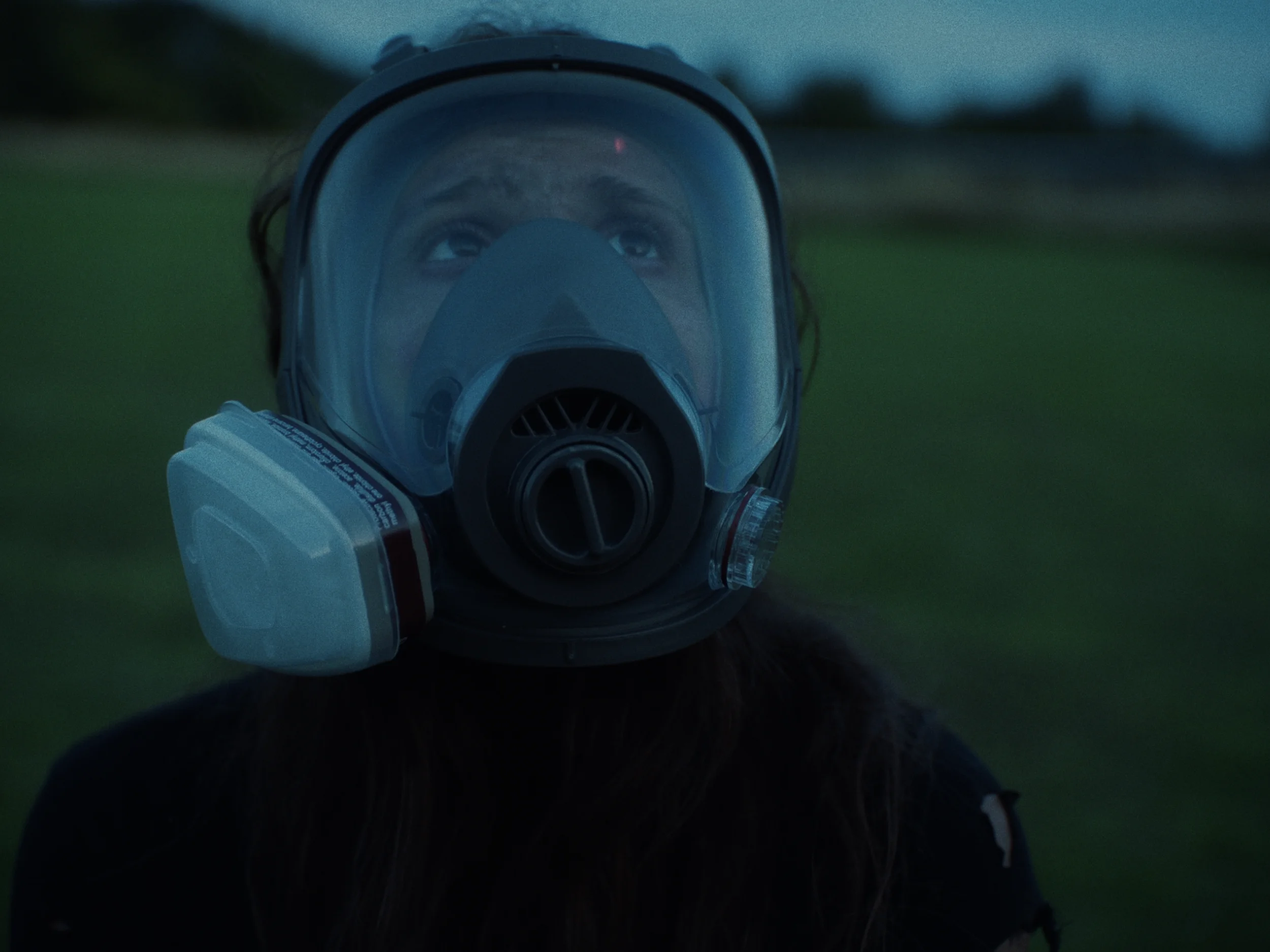
Woloson’s cinematography gives their restricted existence an appealing surface. The countryside looks inviting, and the compact 4:3 frame keeps the film close to its small group. A family photograph, taken with gas masks briefly removed, makes their attempt at ordinary domestic life precarious in a single action. Offscreen gunfire and recurring sirens keep interrupting that appearance of normality. This is an economical way to manage the film’s scale: the war can alter the rhythm of an afternoon without requiring a separate account of military events. The house remains an attractive refuge, and the sounds beyond it prevent refuge from becoming a settled condition.
That concentration also sets the limits of the drama. The conflict remains abstract, and the newcomers’ loss of memory functions chiefly as the condition that makes this household possible. Anyone seeking a developed account of the catastrophe will find little to work with. The more productive questions concern the choices available inside the estate, where the film supplies recognizable motives and practical rules. Its 87-minute running time serves that small scale, though the wider uncertainty can leave the characters’ situation feeling designed for the argument. Their behavior gives substance to a world whose causes remain indistinct.
The later pressure on Chester’s arrangement makes Liam and Mel’s different responses to dependence matter. As they are required to act with greater independence, the story can draw on desires already visible in karaoke competition, rule-following, and curiosity about the forest. Chester’s reassurance becomes harder to sustain once he cannot remain the answer to every difficulty. His care has helped create people capable of wanting lives that do not match the routine he built. For Liam and Mel, learning to make decisions brings a further complication: sharing a home no longer guarantees that they will choose the same way.
Littermates premiered theatrically through Alamo Exclusives on November 6, 2026. Directed by Scott Tinkham and Michael Woloson, the indie science-fiction comedy-drama follows a man who brings a bloodied stranger found in the woods back to a secluded cottage, where their fragile domestic arrangement is tested by isolation and unforeseen secrets.
Where to Watch Littermates (2026) Online
Full Credits
Title: Littermates
Distributor: Alamo Exclusives
Release date: November 6, 2026
Running time: 1 hour 27 minutes (87 minutes)
Director: Scott Tinkham, Michael Woloson
Writers: Scott Tinkham, Michael Woloson
Producers and Executive Producers: Scott Tinkham, Michael Woloson, Oliver Woolf, Kaylee McGregor, Haley Nicole Johnson, Joey Bader, Al Baker, Jake Kuhn, Noah Stratton-Twine
Cast: Joey Bader, Kaylee McGregor, Oliver Woolf, Jack Redmayne
Director of Photography (Cinematographer): Michael Woloson
Editors: Michael Woloson
Composer: Noa Margalit
The Review
Littermates
Littermates builds an effective coming-of-age story from rules, rewards, and competing needs. Chester's lessons establish dependence; Mel's arrival makes that dependence unstable. The three central performances give the household enough credibility to sustain its unsettling mixture of affection, rivalry, and danger. The unexplained conflict and convenient memory-loss premise leave parts of the setup feeling schematic, but the characters' changing desires provide a clear dramatic direction. Its strongest achievement is making the routines that hold a family together become the source of its friction.
PROS
- Sibling rivalry gives the confined story momentum.
- Three precise performances sustain affection and unease.
- Rewards and restrictions prepare the characters' changing needs.
- Domestic comedy and external danger share the same spaces effectively.
CONS
- The conflict beyond the estate remains thinly defined.
- Memory loss can feel like a device arranged for the argument.