






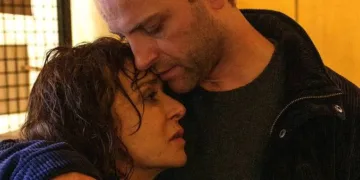

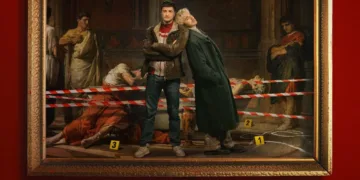
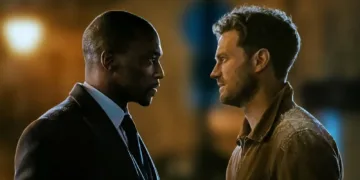














Jimmy Beltrán has school fees to pay, debts to clear, and plans for a better home. Staying away from work sounds sensible to his wife, Pilar, who fears an attack on Bogotá’s Palace of Justice. To Jimmy, the cafeteria there seems a safe place to earn a living. Meanwhile, upstairs, Supreme Court president Alfonso Reyes Echandía is struggling to persuade the authorities that the building needs protection. The premiere of Netflix’s eight-part Under Siege lets those two calculations run alongside each other. Jimmy’s confidence depends on safeguards that Reyes Echandía cannot get anyone to provide.
Elsewhere in the building, Memo takes Mona on a date while scouting the premises for M-19. Reconnaissance is a substantial omission from the invitation. The scene gives their relationship an immediate complication and makes the Palace’s layout part of an unfolding plan. M-19 intends to seize the Court and demand that President Belisario Betancur answer for betraying the peace process. Within the group, disagreements over weapons and an exit strategy expose the distance between political intention and practical preparation. Memo’s assurance that civilians will be unharmed hangs over the ordinary working day we have already seen taking shape.
The attack arrives at the end of the episode. Until then, the cutting between guerrillas, magistrates, military officers, and cafeteria workers steadily removes possible escapes from the approaching disaster. A requested security detail fails to arrive because of a clerical error; warnings meet official disbelief. Foreknowledge supplies tension without requiring the characters to behave like people who have read the history books. Keeping track of the officials is harder. The series sometimes appears to believe that introducing someone’s rank constitutes introducing someone. Its strongest preparation remains Jimmy’s household arithmetic, which makes going to work a decision with recognizable pressures behind it.
Once the siege begins, the reconstructed Palace gives the action a convincing physical foundation. The façade, boxy cars, suits, and decorated uniforms establish an inhabited 1985 rather than a vaguely historical conflict. Smoke and gunfire then transform the workplace into a place its occupants cannot safely leave. Yet the staging often communicates the fact of terror without developing a particular person’s experience of it. Frightened bodies register the danger; the movement among viewpoints keeps asking us to absorb the next piece of the event. The reconstruction supplies continuity of place while attention remains scattered among its occupants.
Some of that distribution is productive. Journalist Olga Behar’s questioning of officials introduces the problem of public knowledge while the operation is still being prepared. Mona’s involvement gives the guerrilla strand a personal relationship through which to test its assurances. These perspectives complicate the chain of events without making every participant’s responsibility interchangeable. They are less successful when their function becomes simply delivering another report. Across the siege and its aftermath, the series repeatedly finds an important action for someone to perform, then moves away before its personal consequences can develop.
Pilar’s search for Jimmy gives that tendency its strongest resistance. After his disappearance, she moves through hospitals, the morgue, and encounters with lawyers, repeatedly trying to convert uncertainty into an answer. The show’s clock changes. The approaching assault had a deadline; her search can be extended by every referral and delay. Moving between the siege and later years allows the same absence to exert different pressures. Slower passages earn their place when they alter Pilar’s trust or expectations. When they merely establish that she is still searching, the eight episodes begin to feel overburdened.
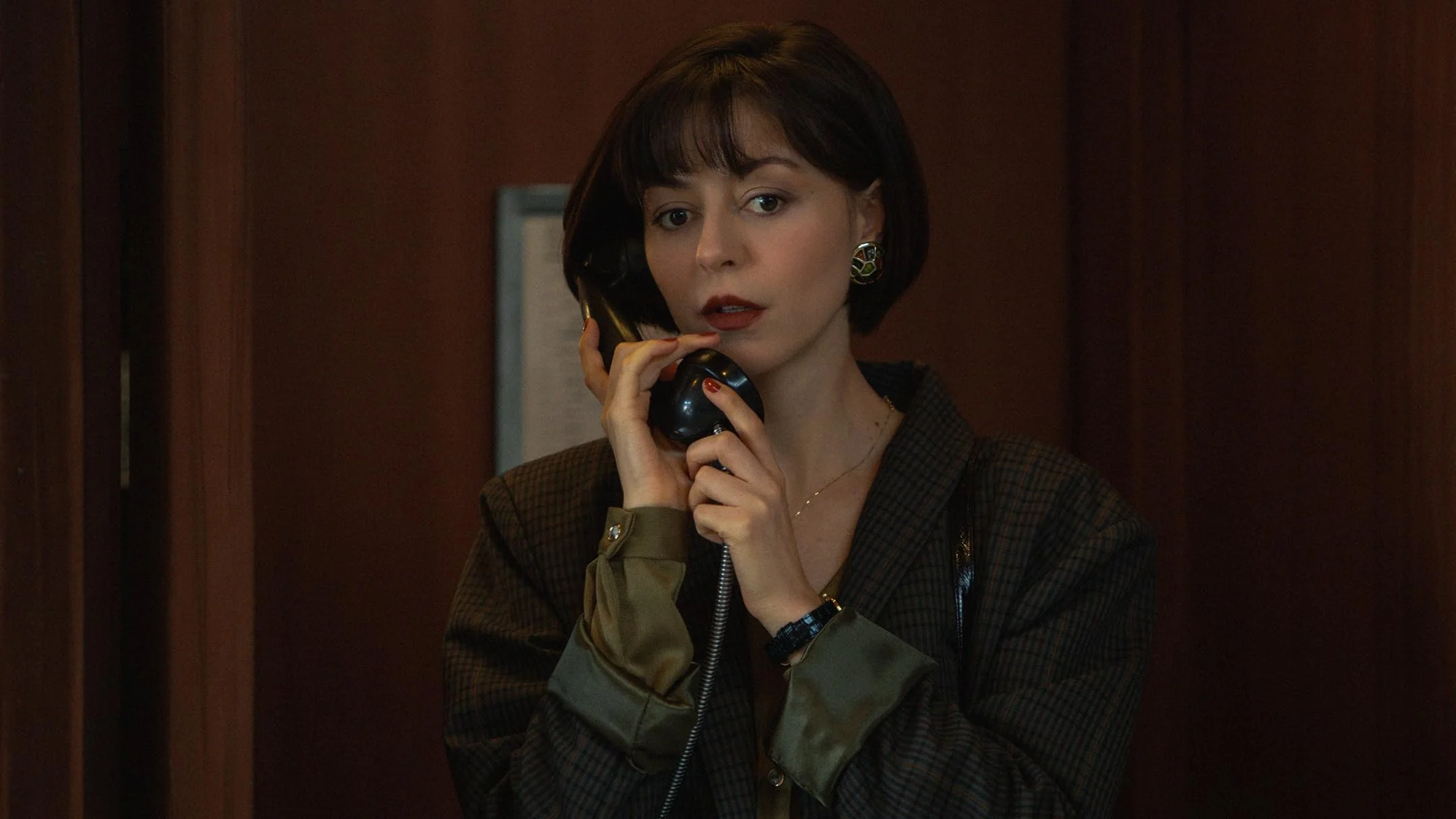
Natalia Reyes makes Pilar’s persistence uneasy enough to sustain those changes. Her admission that abandoning the search would fill her with guilt prevents determination from becoming a permanently admirable pose. Continuing has costs, and stopping would carry another kind of pain. Later frustration with lawyers gives that conflict somewhere to go: the people offering a route toward answers can themselves become difficult to trust. Reyes holds these scenes together through a character whose commitment survives without producing a steady supply of reassurance for herself or anyone else.
The sharpest challenge comes from her daughter, who wants her father back and is tired of hearing that he will return. For a moment, the search becomes a conflict inside the household, with Pilar’s necessary hope failing to meet her child’s immediate need. The series gives too little sustained attention to this pressure. We see the daughters grow older, yet the recurring work of parenting through the uncertainty remains lightly developed. That objection already contains enough drama to support further scenes. Instead, the narrative tends to move toward the next stage of the search while the promise remains unsettled at home.
A cadet who secretly passes information to Pilar receives similarly selective attention. His decision matters enormously to her, while the effect of witnessing military abuse on his continuing life stays largely outside the drama. This is where the series’ breadth becomes restrictive: it needs his testimony and has limited room for the person carrying it. Pilar’s story exposes the cost because her scenes occasionally stay long enough for an action, an assurance, or a refusal to become a problem between people.
The finale finds a stronger use for accumulated information by intercutting the immediate aftermath with proceedings beginning in 2009 against Colonel Alfonso Plazas Vega. Photographs and video of missing cafeteria employees leaving the Palace alive in military custody become evidence, alongside recordings and earlier testimony. The time shifts now have a precise dramatic task. What looked like an exit from danger becomes the starting point for a question the official account cannot comfortably answer. An image acquires force through the argument being made around it.
This late concentration gives the series’ documentary impulses a clearer dramatic purpose, without making every preceding passage necessary. Prosecutor Ángela María Buitrago’s case distinguishes establishing that someone survived the assault from establishing what happened afterward and who was responsible.
The courtroom’s treatment of disappearance as a continuing act also changes the meaning of the intervening years: time passing cannot make the unanswered question obsolete. For Pilar and the other families, proof that a relative left the Palace alive is progress that creates a further demand. They must now get the institutions that received that person to account for where they went.
Under Siege premiered globally on Netflix on November 6, 2026. Created by showrunner Natalia Santa and produced by Dynamo, the intense Colombian historical drama miniseries meticulously reconstructs the tragic 1985 M-19 guerrilla takeover of the Palace of Justice in Bogotá and its harrowing decades-long aftermath for the survivors and victims’ families.
Full Credits
Title: Under Siege
Distributor: Netflix
Release date: November 6, 2026
Rating: TV-MA
Running time: 45–60 minutes per episode
Director: Jayro Bustamante, Edgar Nito, Samir Oliveros
Writers: Natalia Santa, Enrique Videla, Enrique Lozano, Jenny Ceballos, Estefanía Piñeres
Producers and Executive Producers: Mariana Berenguer, Mirlanda Torres, Andrés Calderón
Cast: Natalia Reyes, Luna Baxter, Mariana Gómez, Robinson Díaz, Santiago Alarcón, Carlos Manuel Vesga, Nicole Santamaría, Andrés Castañeda
The Review
Under Siege
Under Siege gives its officials their ranks faster than it gives them personalities. Its tense premiere, convincing Palace reconstruction, and Natalia Reyes’s strained persistence supply firmer dramatic footing. Repeated search beats weigh down the middle, while the ensemble’s private lives receive less attention than their contributions to the record. The courtroom finale makes that accumulated information dramatically useful, turning images of survival into demands for accountability. Getting the evidence before us proves easier than keeping us close to the people carrying it.
PROS
- The premiere builds suspense through ignored warnings and ordinary decisions.
- Natalia Reyes gives Pilar’s determination emotional friction.
- The Palace reconstruction creates a convincing physical setting.
- The finale’s time shifts turn earlier events into consequential evidence.
CONS
- Repeated search beats slow the middle episodes.
- Private consequences receive limited development across the ensemble.
- Siege staging disperses attention without sustaining individual perspectives.