























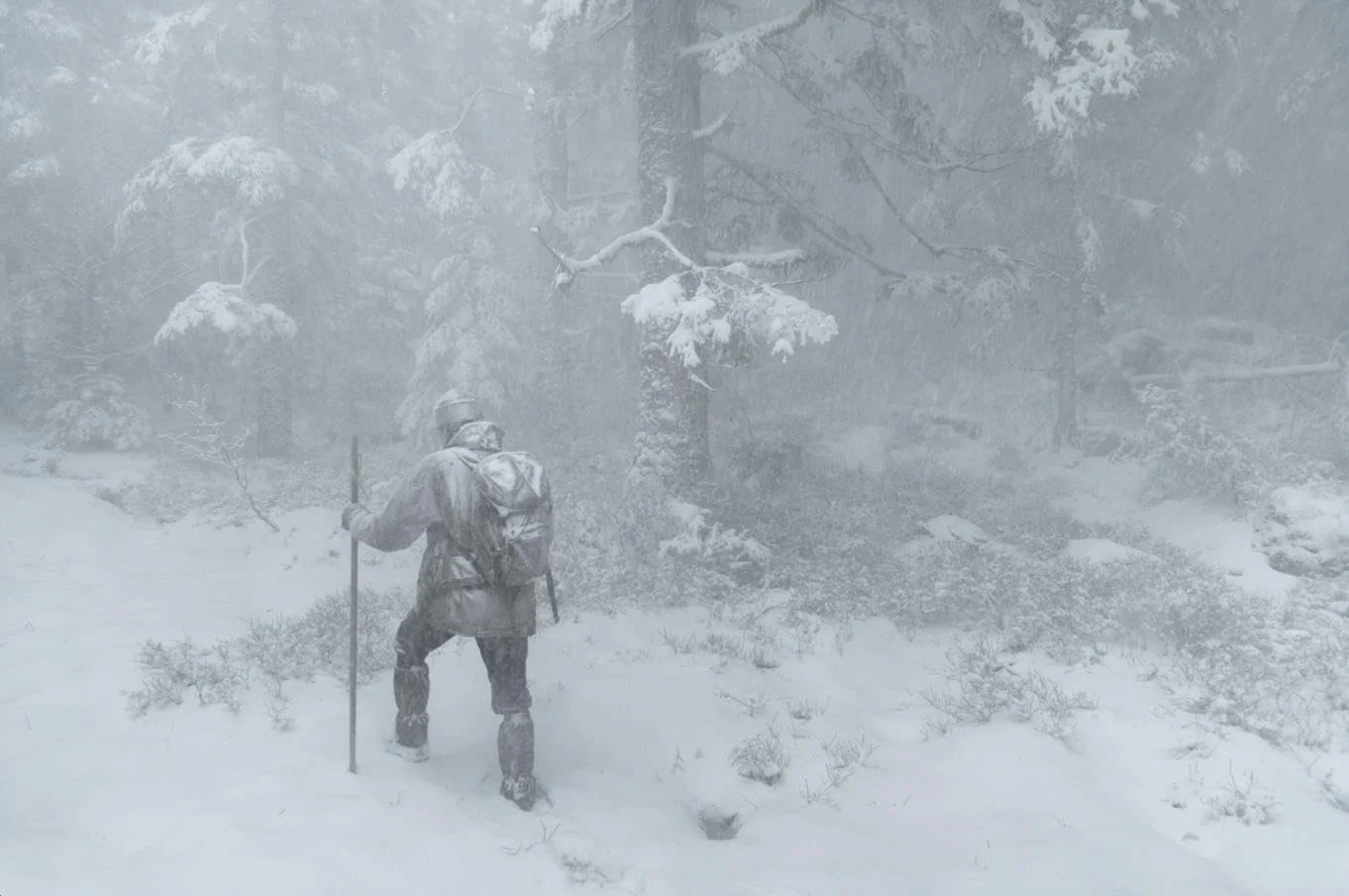

Simon Munier reads One Piece and spends time on his smartphone during a woodland visit with his father and grandfather. Neither activity becomes an indictment of his generation. In Whispers in the Woods, filmmaker and wildlife photographer Vincent Munier returns to the Vosges of eastern France, where he grew up, with his son Simon and his father Michel. Stories told in a candlelit cabin share the film with those glimpses of the boy’s contemporary interests. Nobody needs to confiscate his present to give him access to the family’s past.
Michel teaches through a familiarity that makes the forest intelligible. He recognizes birds by their calls; his accounts of encounters give Simon something to anticipate when they go outside. Knowledge acquires an immediate use in the act of listening. The boy is being offered the pleasure of recognizing another living thing before it becomes visible, and a reason to wait when nothing appears. This gives the film’s ecological education an appealing modesty. Attachment grows through specific discoveries, with an older person making room for a younger one to acquire the skills that made those discoveries possible.
The affection is persuasive, but the family portrait remains slight. In the cabin exchanges, Michel emerges most distinctly as the keeper of knowledge, Simon as its receptive inheritor, and Vincent as the link between them. Their shared purpose receives fuller expression than their individual histories, including the practical history of protecting this landscape. The conversations establish warmth without supplying much sense of how that commitment has been lived beyond these visits. Intimacy can survive such restraint, though the succession of beautiful encounters sometimes gives the family the function of connecting passages whose emotional interest resides chiefly in the animals.
Munier’s images make a stronger case for the duration of those encounters than any conventional family arc could. The opening holds on trees becoming visible through fog, allowing the forest to acquire definition gradually. Elsewhere, needles, branches, and spiderwebs occupy the sharp foreground while a larger creature remains indistinct behind them. The eye has to search within the composition. Visibility becomes something negotiated with foliage and distance, an experience quite different from receiving an animal already isolated for inspection. These shots give perceptual work to the spectator without pretending that a few minutes in a cinema equal the family’s hours of waiting outdoors.
That uncertainty produces suspense without requiring a hunt or a confrontation. Something moves behind the fine detail of a branch, and the image suddenly contains another scale of life. A tree trunk occupied by two birds and a rodent offers a different pleasure: the discovery that a seemingly limited patch of forest can sustain several activities at once. Munier makes room for the viewer to inspect these arrangements. His patience is productive when another shape or inhabitant changes the meaning of what was already visible, giving successive encounters a purpose beyond the accumulation of handsome wildlife portraits.
Sound extends this education beyond the limits of the frame. Stag grunts, crane calls, and the capercaillie’s repeated clicking receive a force that makes each voice difficult to absorb into anonymous woodland ambience. Michel’s ability to distinguish birds by ear becomes something the film asks its audience to begin practicing. The mix selects and magnifies, just as the lens selects a field of vision. Warren Ellis’s strings and vocal textures add an ache to the listening, guiding the encounters toward tenderness and anticipated loss. This forest reaches the audience through emphatic artistic decisions, even when its inhabitants remain elusive.
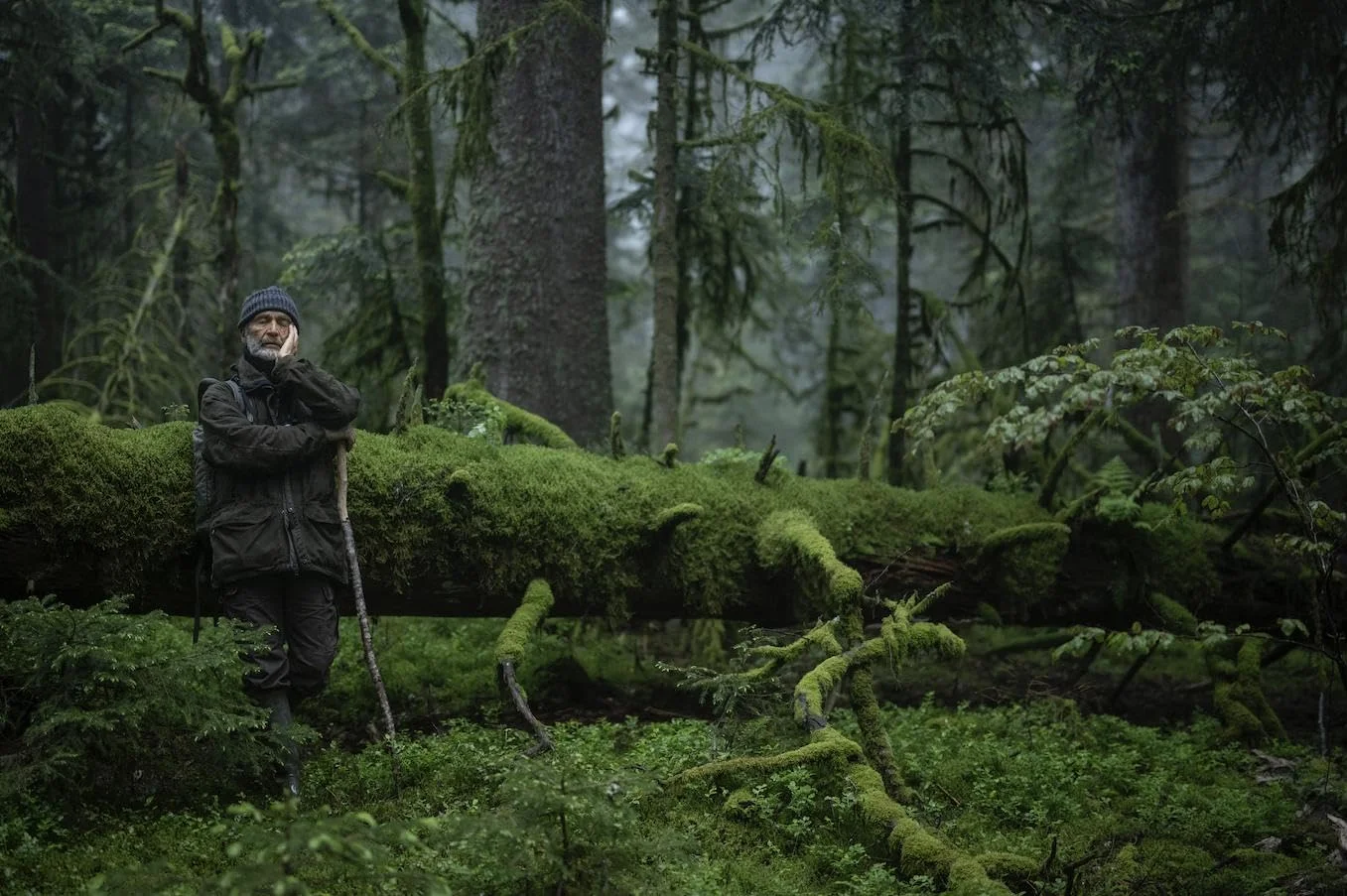
The family’s whispers give this attention a bodily discipline. Watching requires the humans to manage their own presence, keeping their voices low enough to avoid frightening away what they hope to see. Such restraint places a condition on their pleasure: an encounter depends partly on their willingness to leave another creature undisturbed. The filmmaker can enlarge an animal’s call for the audience, while the people in the forest must quiet themselves to remain within listening distance.
The cabin discussion of the capercaillie gives this attentive looking a harsher temporal dimension. Michel grieves for the bird’s disappearance from the Vosges, turning his knowledge into a record of an encounter the place can no longer reliably offer. Family continuity carries an ecological discontinuity within it. Simon can learn what to recognize while losing the chance to recognize it close to home. The candlelight and shared stories acquire a vulnerability that their comfort cannot dispel: a grandfather has memories to hand down, but cannot secure the living conditions that would let his grandson make comparable memories there.
When Simon raises people’s indifference to disappearing species, Michel’s distress locates the problem in a failure of attachment. The film gives that feeling unusual specificity through a bird associated with a particular person and landscape. It offers less purchase on the institutions and land use decisions through which ecological damage occurs or might be resisted. The image of an eagle owl beneath a sky marked by an aircraft brings human activity into the apparent seclusion of the woods, but remains suggestive rather than explanatory. The family’s sorrow has an identifiable object; the forces capable of answering it remain less sharply pictured.
The northern expedition to see a capercaillie places an encounter within Simon’s reach. A bird bound to his grandfather’s stories becomes something he can observe himself, and the transmission of knowledge gains a living subject. Yet the change of location stays significant. The family can travel to find what Michel misses without restoring its place in the Vosges. Simon acquires a sighting of his own under conditions different from those his grandfather remembers, carrying home a memory whose distance from home is already part of its meaning.
Whispers in the Woods was released theatrically in France on December 17, 2025, before expanding to international cinemas and digital platforms through 2026. Directed by acclaimed wildlife photographer and filmmaker Vincent Munier, the breathtaking documentary follows three generations of the Munier family as they explore the tranquil Vosges forests, sharing a profound appreciation for wildlife and passing down a deep understanding of nature from father to son.
Full Credits
Title: Whispers in the Woods (Le Chant des forêts)
Distributor: Paprika Films, Kobalann Productions, Le Bureau Films
Release date: December 17, 2025 (France), 2026 (International)
Rating: G
Running time: 1 hour 33 minutes (93 minutes)
Director: Vincent Munier
Writers: Vincent Munier
Producers and Executive Producers: Pierre-Emmanuel Fleurantin, Vincent Munier, Bertrand Faivre, Laurent Baujard
Cast: Vincent Munier, Michel Munier, Simon Munier
Director of Photography (Cinematographer): Vincent Munier, Antoine Lavorel, Laurent Joffrion
Composer: Warren Ellis, Dom La Nena, Rosemary Standley
The Review
Whispers in the Woods
Whispers in the Woods makes ecological inheritance tangible through the skills a grandfather can teach and the encounters he cannot guarantee. Munier’s patient compositions and expressive sound turn observation into a pleasure worth learning, while Simon’s ordinary interests keep the generational bond free of nostalgia’s scolding. The family remains lightly sketched, and the account of environmental loss is stronger on attachment than its material causes. Yet the capercaillie gives that limitation an affecting specificity: knowledge can survive in a family after its subject disappears from home.
PROS
- Patient compositions reward active observation.
- Distinct animal calls and Ellis’s music deepen the listening.
- Generational teaching avoids moralizing about modern childhood.
- Local wildlife loss gives the family’s attachment emotional weight.
CONS
- Family members receive limited individual development.
- The institutional causes of ecological decline remain underexplored.